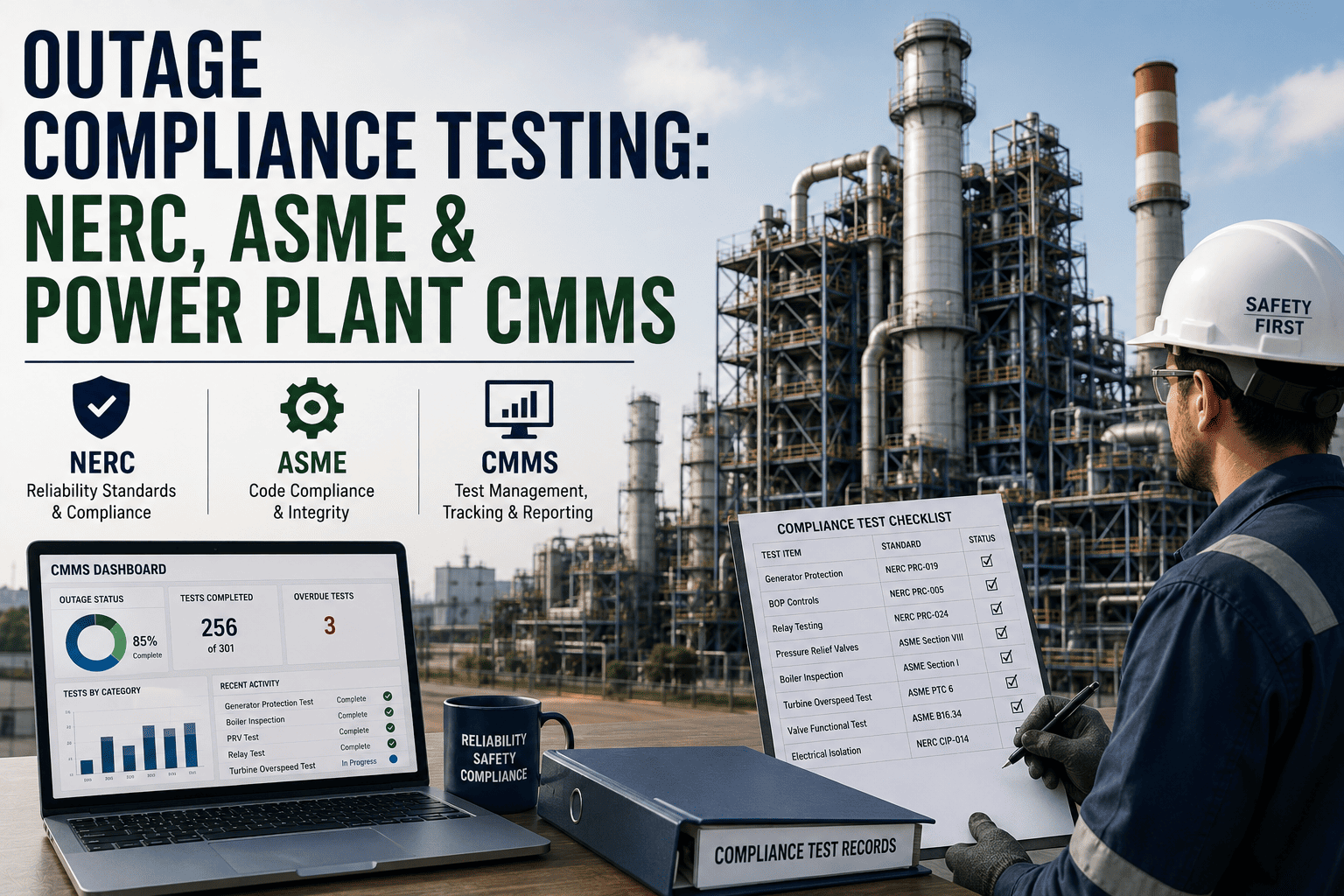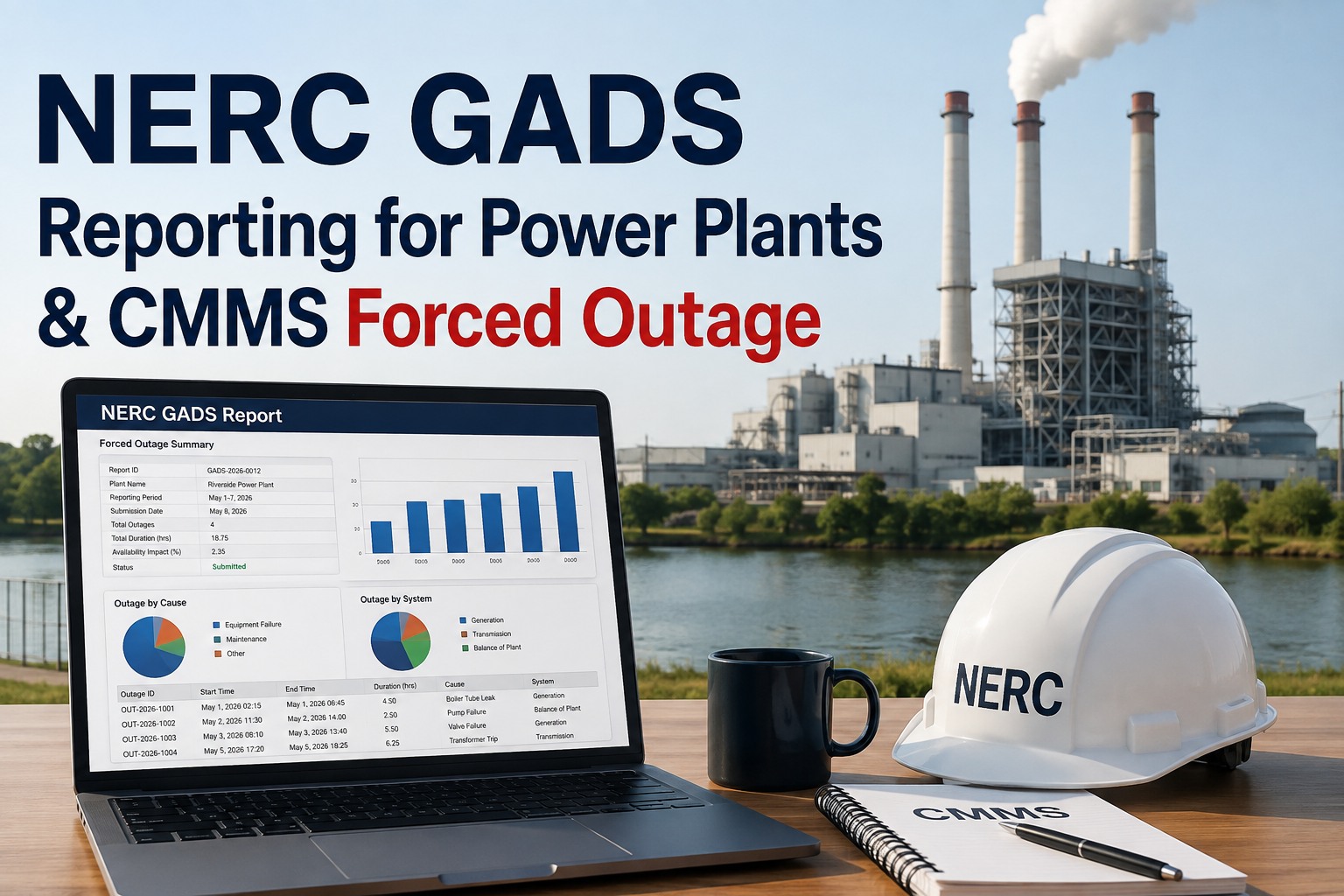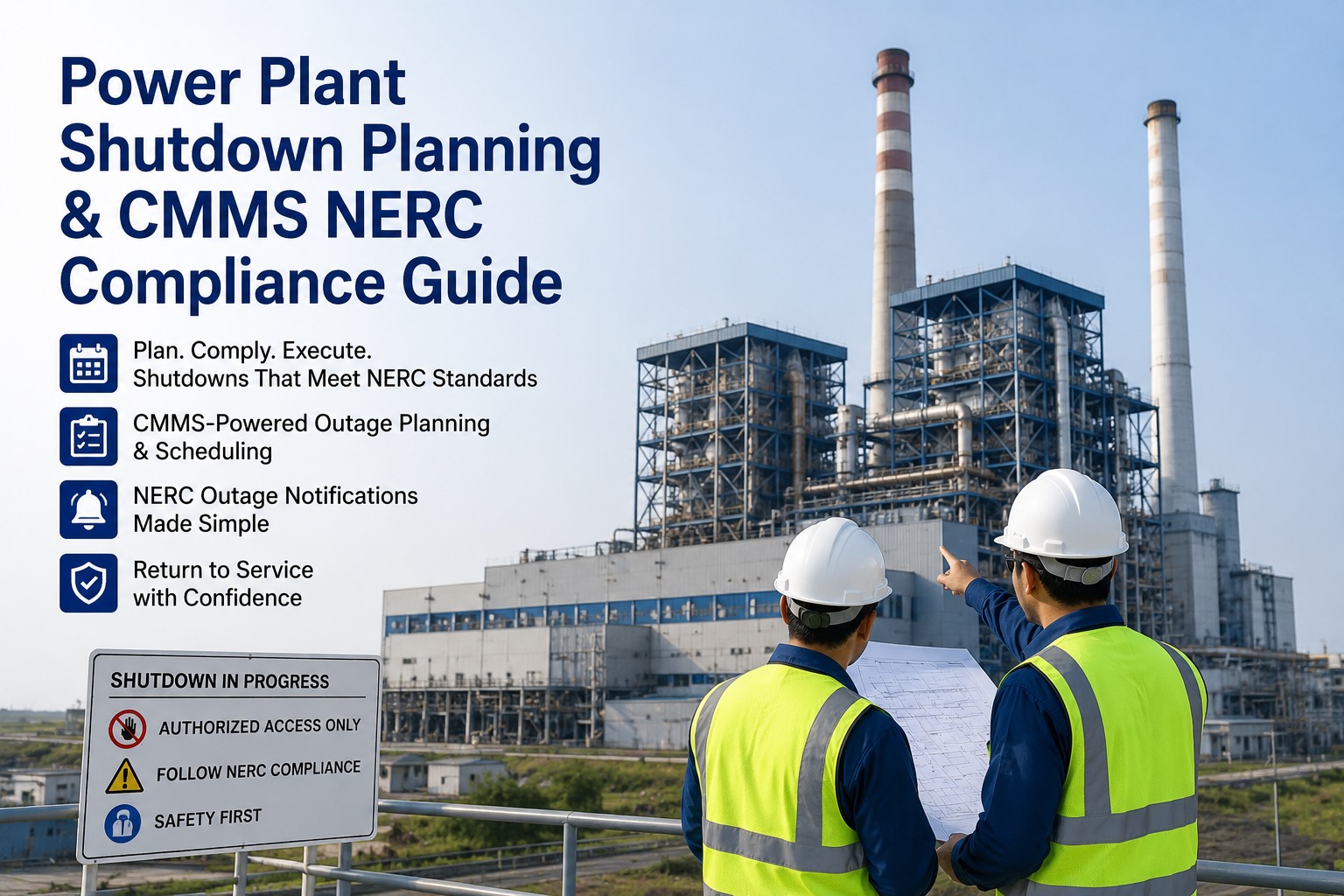
Power plant shutdown planning is where NERC shutdown compliance meets the real-world pressure of wrench-turning, scope creep, and a fixed return-to-service date. Every outage calendar must bake in NERC outage notification lead times, regulatory compliance testing windows, and return-to-service sign-offs — or risk citations and delayed restart. This guide walks maintenance and reliability managers through building a shutdown plan that clears regulatory scrutiny without slipping schedule. Start a free OxMaint trial to see the shutdown module in action, or book a demo with our power-generation team.
Power Plant Shutdown Planning & CMMS NERC Compliance Guide
Build a defensible outage record from notification to return-to-service — scope items, NERC deadlines, compliance testing, and sign-offs synchronized in one auditable shutdown plan.
The Shutdown Planning Timeline
A compliant shutdown works backward from the return-to-service date. Every milestone — NERC notifications, scope freeze, staging, execution, testing — has a fixed lead time. Miss one and the outage slips or the audit fails.
Long-Range Outage Scoping
Pull deferred work orders, last-outage findings, API inspection results, and OEM bulletins. Begin building the outage scope package and preliminary resource plan.
NERC Notification Filed
Submit planned generation outage notification to the Reliability Coordinator per TOP-003-3. Confirm the outage window is accepted before committing to contractor mobilization.
Scope Freeze & Work Order Build
Lock the outage scope. Every scope item becomes a sequenced work order in the CMMS with parts reserved, permits identified, and dependencies mapped.
Pre-Outage Readiness Review
Verify long-lead parts are received, contractor safety reviews are complete, and the critical-path schedule is baselined. Confirm NERC compliance testing requirements are assigned.
Final RC Coordination
Confirm the outage start with the Reliability Coordinator. Verify system separation, tag-out boundaries, and generation reduction plan are communicated to all parties.
Shutdown Execution
Execute the critical-path schedule. Daily outage meetings track progress against baseline. Compliance testing is performed in-sequence as systems are reassembled.
Return-to-Service & Sign-Off
Complete return-to-service checks, document test results, obtain operations sign-off, and synchronize to the grid. Close the NERC outage record with full evidence package.
NERC Notification Requirements & Lead Times
NERC TOP-003-3 and IRO-017-1 require generators to coordinate planned outages with the Reliability Coordinator and Transmission Operator. These notification deadlines are non-negotiable — they must be built into the shutdown calendar from day one.
| Notification Type | NERC Reference | Lead Time | Submitted To | What Must Be Included |
|---|---|---|---|---|
| Planned Generation Outage | TOP-003-3 | ≥ 90 calendar days | Reliability Coordinator | Unit ID, MW impact, start/end dates, reason, expected return |
| Outage Start Confirmation | TOP-003-3 | ≥ 7 days prior | RC & TOP | Confirmed start time, generation reduction plan, system conditions |
| Maintenance Outage (≤ 60 hrs) | TOP-003-3 | ≥ 7 days prior | Reliability Coordinator | Duration, MW reduction, equipment affected, return commitment |
| Forced Outage (unplanned) | TOP-003-3 | As soon as practicable | RC & Balancing Authority | Time of loss, cause (if known), estimated return, MW impact |
| Outage Extension Request | TOP-003-3 | Before original end time | Reliability Coordinator | Revised end time, reason for extension, system impact assessment |
| Return-to-Service Notification | TOP-003-3 | Per RC procedures | RC & TOP | Confirmed return time, ramp rate, synchronization target |
Building the Outage Scope
A defensible outage scope is assembled from four sources. Each scope item must be traceable to its origin — a deferred work order, an inspection finding, an OEM bulletin, or a regulatory mandate — so nothing appears on the outage plan without justification.
Deferred Work Orders
Pull every work order deferred since the last outage. CMMS filters by equipment criticality, deferral reason, and remaining-life estimate. Each deferred WO becomes a candidate scope item with labor and parts estimated.
Inspection Findings
API 510 pressure vessel inspections, API 570 piping evaluations, NDE thickness surveys, and borescope results from the last operating cycle feed condition-based scope items into the plan.
OEM Bulletins & SBs
Manufacturer service bulletins, technical advisories, and mandatory modifications — turbine blade inspections, valve seat replacements, generator rewind notices — are mapped to specific assets and added to scope.
Regulatory Mandates
NERC PRC-005 protection system maintenance, NFPA 25 fire system testing, and EPA continuous-emissions-monitoring calibrations that fall due during the window are locked into the scope with test procedures attached.
Regulatory Compliance Testing During Shutdown
Certain tests must occur when the unit is offline — and the results must be documented before return-to-service. The CMMS assigns each test to the correct outage phase and captures pass/fail evidence against the governing standard.
| Test / Inspection | Governing Standard | Outage Phase | Evidence Required |
|---|---|---|---|
| Protection relay calibration & functional test | NERC PRC-005-6 | During shutdown | Calibration sheet, test set serial, pass/fail, technician sign-off |
| Breaker trip & close timing | NERC PRC-005-6 | During shutdown | Timing trace, comparison to baseline, acceptance criteria met |
| Battery capacity discharge test | NERC PRC-005-6 / IEEE 450 | During shutdown | Discharge curve, capacity %, date, test equipment ID |
| Boiler hydrostatic test | ASME / NBIC | During shutdown | Pressure chart, hold duration, inspector stamp, AI sign-off |
| Steam turbine overspeed trip test | OEM / ASME TDP-1 | Pre-return-to-service | Trip speed reading, mechanical & electronic trip verification |
| Generator stator winding insulation resistance | IEEE 43 | Pre-return-to-service | Megger readings, polarization index, temperature correction |
| CEMS calibration & RATA | 40 CFR 75 | Post-return-to-service | Calibration log, RATA results, QA certification |
| Synchronizer & governor functional check | NERC TOP-001 | Pre-return-to-service | Frequency/voltage response trace, setpoint verification |
Return-to-Service Checks & Sign-Off Chain
Before the unit synchronizes to the grid, a defined sequence of checks must be completed and signed off. Each gate is a go/no-go decision point — the unit does not advance until the prior gate is documented closed.
Tag-Out Clearance Removal
All LOTO clearances removed, tags reconciled, and isolation devices verified in the normal position. Operations confirms the system is electrically and mechanically clear.
System Line-Up & Filling
Valves lined up per P&ID, systems filled and vented, leaks checked. Chemistry confirms water quality meets startup criteria before any heat is applied.
Protection System Verification
Roll & Overspeed Trip
Turbine rolled on turning gear, brought to rated speed, mechanical and electrical overspeed trip tested and recorded. Vibration trends reviewed against baseline.
Excitation & Synchronization
Generator excited, voltage matched, synchronizer verified in auto. Breaker closed to the grid per RC coordination. MW ramp commenced per dispatch instruction.
Full-Load Stability & Closeout
Unit held at full load, all alarms cleared, emissions within permit. Outage record closed in CMMS with all test results, sign-offs, and NERC notifications archived.
How OxMaint CMMS Ties It Together
Spreadsheets and email chains don't survive a NERC audit. OxMaint links every shutdown element — notification deadlines, scope items, compliance tests, and return-to-service sign-offs — into one auditable record that a reliability manager can defend on day one.
Notification Deadline Engine
NERC TOP-003-3 lead times are configured as automated milestones. OxMaint alerts the planner at T−90, T−30, and T−7 days, and logs each notification submission with timestamp and RC acknowledgment attached.
Scope-to-Work-Order Pipeline
Deferred WOs, inspection findings, and OEM bulletins flow directly into the outage scope package. Each item carries its origin, criticality, labor estimate, and parts reservation — no orphan scope items.
Compliance Test Assignment
PRC-005, NFPA 25, and ASME test procedures are pre-built templates assigned to the correct outage phase. Technicians complete them on mobile devices; results auto-attach to the shutdown record.
Return-to-Service Gate Logic
The six RTS gates are configured as sequential go/no-go checkpoints. The CMMS prevents advancing to the next gate until the prior one is signed off — no skipped steps, no verbal approvals.
Audit-Ready Evidence Vault
Every notification, work order, test result, and sign-off is time-stamped and immutable. Export the complete shutdown record as a single NERC audit package in one click.
Critical-Path Scheduling
Scope items are sequenced against the baseline schedule with dependencies mapped. Daily outage meetings update actuals against the plan; slippage on critical path triggers immediate alerts.
Frequently Asked Questions
What NERC standard governs power plant shutdown notifications?
NERC TOP-003-3 (Operational Reliability Data) governs planned outage coordination. Generators must notify the Reliability Coordinator at least 90 calendar days in advance for planned generation outages and confirm the start at least 7 days prior. IRO-017-1 may also apply for outages with inter-area reliability impact.
How far in advance must a planned outage be reported under NERC?
A planned generation outage requires notification to the Reliability Coordinator no less than 90 calendar days before the proposed start date. Maintenance outages of 60 hours or less require at least 7 days' notice. The RC must acknowledge and approve the window before the unit is removed from service.
What return-to-service checks are required before synchronizing to the grid?
At minimum: LOTO clearance removal and verification, system line-up and chemistry confirmation, protection system arming with PRC-005 evidence complete, turbine overspeed trip test, generator insulation resistance test, and synchronizer/governor functional verification. The Reliability Coordinator must be notified of the confirmed return time per their procedures.
How does a CMMS support NERC shutdown compliance?
A CMMS like OxMaint enforces notification deadlines, assigns compliance tests to the correct outage phase, captures test results with timestamps and technician sign-offs, and chains return-to-service gates so no step is skipped. The complete shutdown record — notifications, scope, tests, and sign-offs — is exportable as a single audit package.
What happens if a planned outage extends beyond the approved NERC window?
An extension request must be submitted to the Reliability Coordinator before the original approved end time. The request must include the revised end time, reason for extension, and a system impact assessment. OxMaint flags approaching end times and generates the extension notification automatically so the request is never late.
Plan Your Next Shutdown with NERC-Ready Confidence
OxMaint keeps shutdown scope, NERC notifications, compliance testing, and return-to-service sign-offs in one auditable record — so your next outage clears regulatory scrutiny without slipping schedule.