Your gas turbine has been running hot for the past six days. Not alarmingly hot—just 12°C above baseline exhaust temperature. Your operations team noticed it, logged it, and scheduled an inspection for next month's planned outage. But here's what continuous monitoring would have revealed: combustion liner degradation accelerating toward failure. In 23 days, that turbine will trip during peak demand. The emergency repair will cost $1.2 million. The lost generation revenue during a three-week forced outage? Another $4.5 million. Predictive maintenance exists precisely to intercept this trajectory—transforming subtle thermal anomalies into actionable intelligence weeks before catastrophic failure occurs.
The predictive maintenance market in the energy sector reached $2.25 billion in 2025 and is projected to grow at 25.77% CAGR, reaching $7.08 billion by 2030. This explosive growth reflects a fundamental shift in how power generation facilities approach equipment reliability. Facilities that sign up for intelligent maintenance platforms are capturing these benefits while competitors continue bleeding money through preventable failures.
Why Turbines and Boilers Demand Predictive Intelligence
Power generation held 32.1% of predictive maintenance market revenue in 2024—the largest single customer segment. The reason is straightforward: turbines and boilers represent the highest-value, highest-risk assets in any generating facility. A single gas turbine contains over 300 monitored parameters. Boiler tube failures alone cost the global power industry more than $5 billion annually. When these assets fail unexpectedly, the financial cascade extends far beyond repair costs to include lost generation revenue, grid penalties and emergency procurement premiums.
The traditional approach—scheduled preventive maintenance—costs power plants $17-18 per horsepower annually for corrective work after equipment fails. Predictive and preventive maintenance together reduce this to $7-13 per horsepower. For a facility with hundreds of thousands of horsepower in rotating equipment, the annual savings run into millions. Power plants ready to quantify their potential savings can book a free demo to analyze their specific equipment portfolio.
How Predictive Maintenance Technology Works in Power Generation
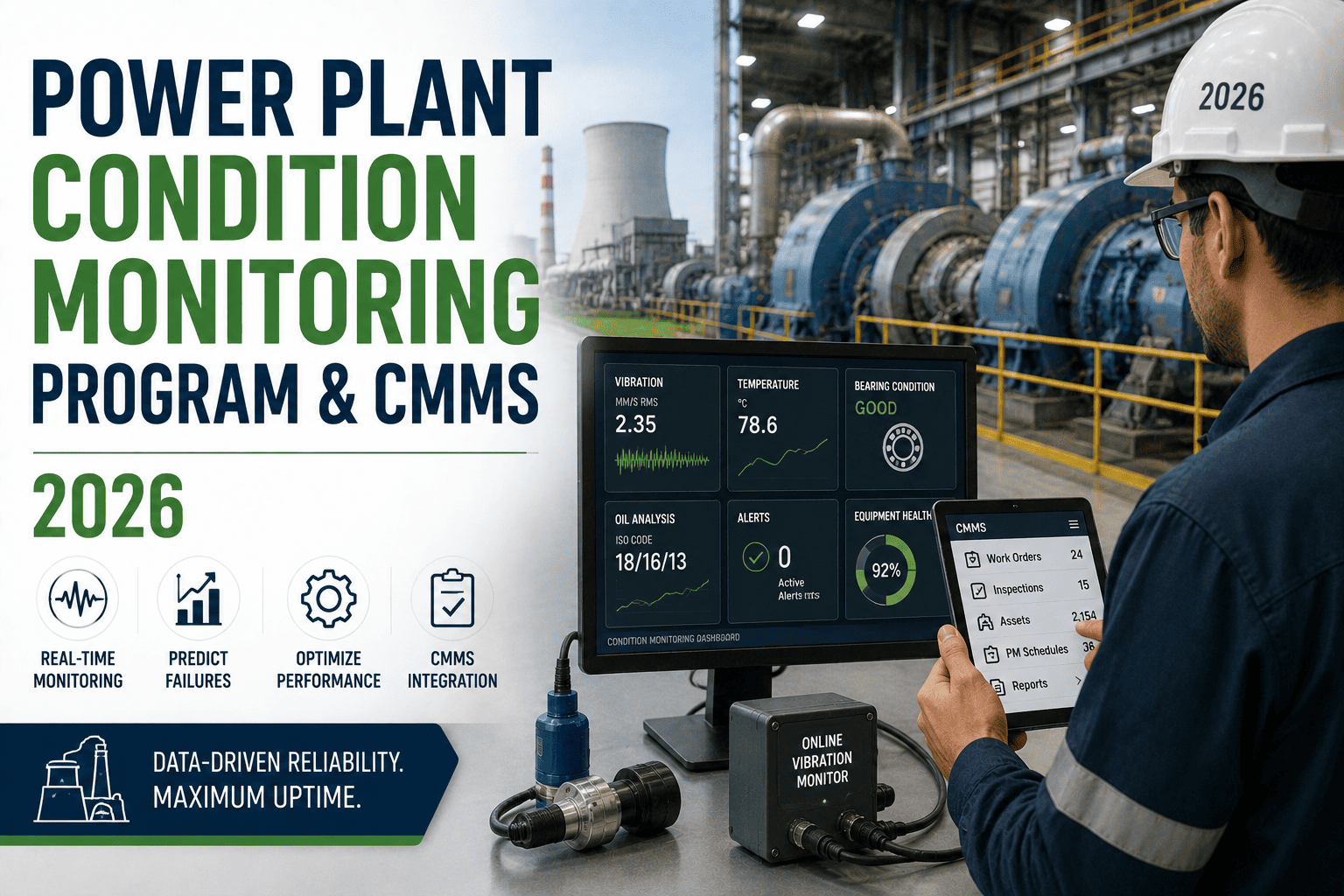
Modern predictive maintenance combines IoT sensors, cloud analytics, and machine learning to transform raw operational data into maintenance decisions. Sensors continuously monitor temperature, vibration, pressure, and oil condition across critical components. This data feeds into AI algorithms trained on thousands of failure patterns, which recognize anomalies and calculate remaining useful life with remarkable precision.
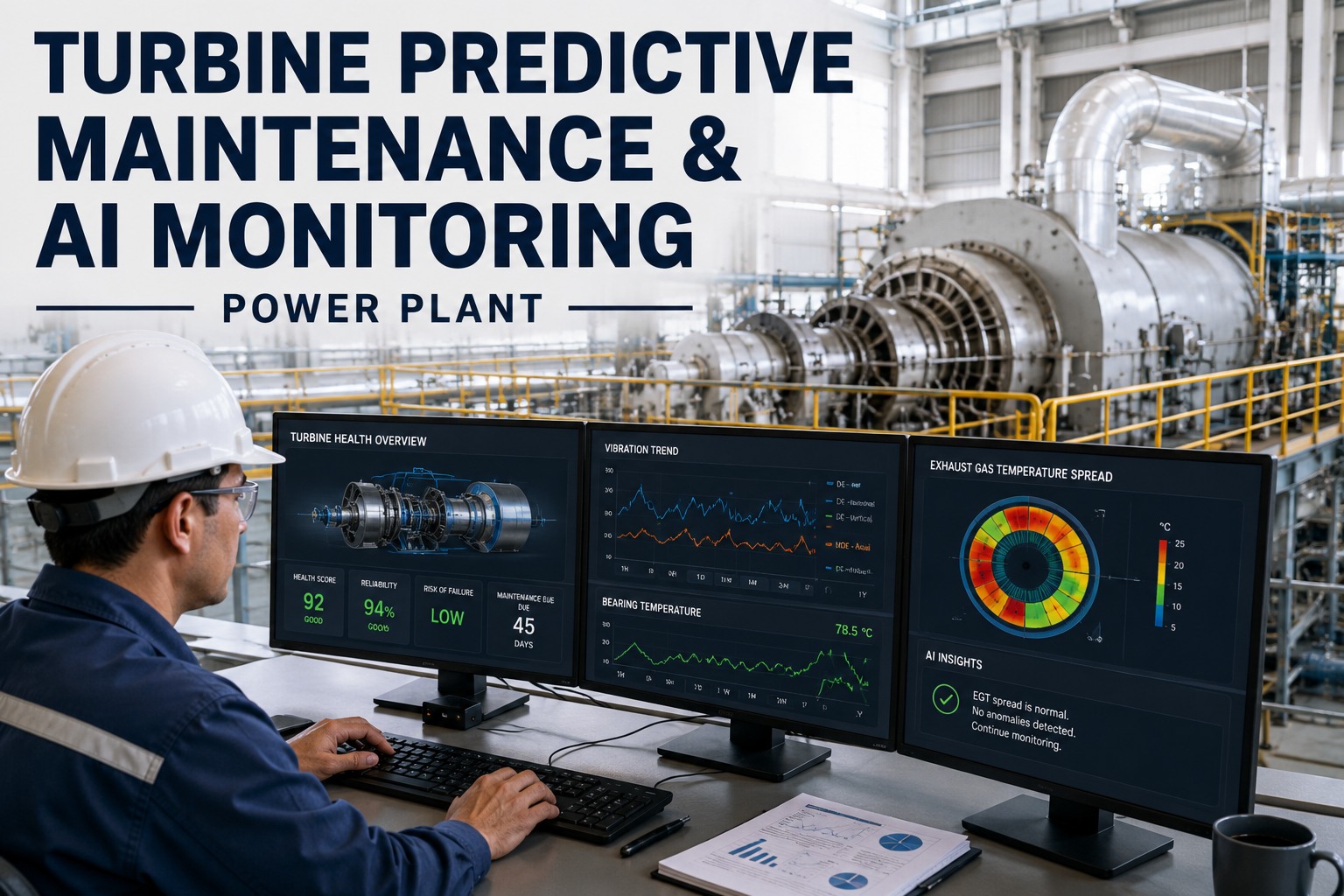
Gas turbines provide particularly fertile ground for AI diagnostics. Temperature anomalies in the exhaust section, monitored through strategically placed thermocouples, reveal combustion problems weeks before they become critical. XGBoost classification models trained on thermal data achieve 97.2% accuracy in distinguishing healthy from faulty operating conditions. This level of precision transforms maintenance from guesswork into engineering certainty. Facilities implementing these capabilities through signing up for integrated CMMS platforms report dramatic improvements in equipment reliability.
The CMMS Integration Advantage
Sensor data without automated response is just interesting noise. The real transformation happens when predictive intelligence feeds directly into your maintenance management system. When a sensor detects bearing degradation trending toward failure, your CMMS automatically generates a work order, assigns it to the right technician with the right skills, orders replacement parts, and schedules the repair during your next planned outage window.
This integration eliminates the gap between detection and action that costs power plants millions annually. No manual interpretation. No forgotten alerts. No emergency scrambles. The system moves from sensor reading to scheduled repair with minimal human intervention required. Power plants seeking this level of automation can schedule a free demo to see the complete workflow in action.
Expert Perspective: The Shift from Reactive to Predictive
Predictive maintenance in power generation isn't optional anymore—it's survival. Gas turbines contain more than 300 monitored parameters, making them fertile ground for AI diagnostics that identify combustion anomalies weeks before failure. The facilities that invest in early detection aren't just avoiding breakdowns; they're fundamentally changing how maintenance operates. By predicting failures before they occur, PdM optimizes maintenance schedules, minimizes downtime, and extends equipment life—ensuring continuous power generation without interruptions.
Measuring ROI: The Numbers That Matter
The business case for predictive maintenance in power generation is compelling and well-documented. Studies show that 95% of predictive maintenance adopters report positive ROI, with 27% achieving full amortization within just one year. Organizations achieve 25-30% maintenance cost reduction and 35-50% downtime reduction. For power plants where a single day of unplanned downtime can cost $50,000-$200,000 in lost generation revenue, these improvements translate to millions in annual savings.
| Performance Metric | Before PdM | After PdM | Impact |
|---|---|---|---|
| Unplanned Downtime | High frequency | Minimal | 35-50% reduction |
| Maintenance Costs | $17-18/HP yearly | $7-13/HP yearly | 25-40% reduction |
| Equipment Lifespan | Standard | Extended | 20-40% longer |
| Failure Prediction | Reactive | 30 days advance | 97%+ accuracy |
| Parts Inventory | Overstocked | Optimized | Reduced carrying costs |
| ROI Timeline | N/A | 18-24 months | 95% positive ROI |
Getting Started: Your Implementation Path
Implementing predictive maintenance doesn't require replacing your entire infrastructure overnight. Modern platforms integrate with existing SCADA systems, leverage wireless sensors that install in minutes, and begin establishing baseline patterns immediately. The key is starting with your most critical equipment—typically your primary turbines and any single-point-of-failure assets where downtime cascades through your entire operation.
For power plants ready to move from reactive firefighting to predictive intelligence, the path forward is clear: identify critical assets, connect monitoring systems to a CMMS platform that automates response workflows, and begin capturing the data that prevents failures before they happen. Sign up for a free trial to see how the integration works in your environment, or speak with our team about which equipment in your facility would benefit most from predictive monitoring.