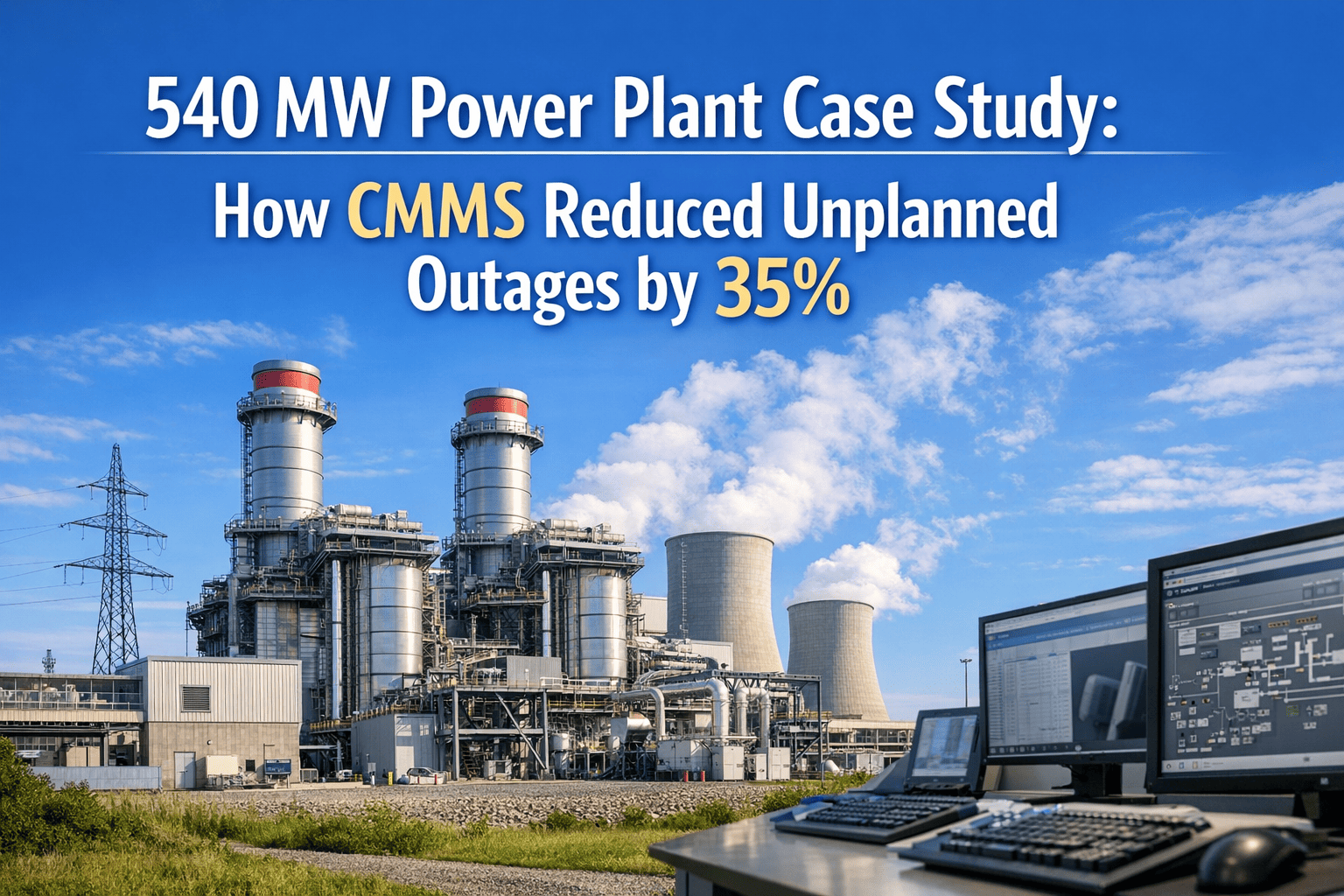
Unplanned power plant downtime is not a maintenance problem — it is a revenue problem. Every forced outage at an electric utility costs over $300,000 per hour in direct losses alone, and the full financial cascade — emergency repair premiums, grid penalties, replacement power procurement, and regulatory fines — routinely pushes the true hourly cost past $500,000. Oxmaint's AI-driven CMMS gives plant operators the real-time visibility to catch equipment degradation weeks before it becomes an unplanned shutdown — or book a free 30-minute demo to see how predictive monitoring works on your assets.
Power Plant Reliability Intelligence
Your Next Forced Outage Is Already Showing Up in the Data
Over 90% of power plant equipment failures show detectable warning signs days to weeks before breakdown. Yet most plants are still reacting rather than predicting. AI-driven maintenance changes that equation — permanently.
$500K+
True hourly cost of a forced outage
52%
Outages from boiler tube failures alone
35–50%
Downtime reduction with predictive maintenance
Why Unplanned Downtime Costs More Than You Think
Most plant managers calculate downtime loss as lost megawatt-hours times current power price. That number is already painful — but it understates the real damage by a factor of three to five. Every forced outage triggers a cascade of costs that compounds with every hour the plant stays offline.
The Four Layers of Downtime Cost
01
Direct Revenue Loss
Lost generation revenue. Electricity cannot be stockpiled — every offline hour is permanent revenue loss that cannot be recovered downstream.
Visible
02
Emergency Repair Premium
Corrective repairs cost 4–5× more than planned maintenance. Expedited parts procurement adds further cost on top of emergency labour rates.
Often Underestimated
03
Grid Penalties & Regulatory Fines
SAIFI-based regulatory fines range from $100,000 to $1,000,000 per incident. Contractual non-delivery penalties add further financial exposure.
Frequently Missed
04
Long-Term Reputation Damage
Capacity auction standings drop. Long-term supply contracts are renegotiated at lower rates. Customer relationships erode over repeated outage events.
Hardest to Quantify
Where Power Plant Failures Actually Come From
NETL data on forced outages at thermal power plants points to a concentrated set of failure sources. The good news: every one of these failure modes produces detectable warning signals weeks before catastrophic breakdown — when the right monitoring is in place.
Root Causes of Forced Outages — Thermal Power Plants
Source: National Energy Technology Laboratory (NETL) — Forced Outage Root Cause Analysis
The Detection Window You Are Currently Missing
The most expensive failure is the one you did not see coming. Equipment degradation in power plants — turbine blade fatigue, boiler tube creep, bearing wear, insulation breakdown — does not happen overnight. Each failure mode has a characteristic signature that appears in vibration, temperature, pressure, and electrical data long before the physical breakdown occurs.
Typical Equipment Degradation Timeline
Weeks 8–12 Before
Micro-vibration anomaly detectable in bearing data. Thermal imaging shows early hot spots. Pressure differential begins drifting outside baseline.
Weeks 3–7 Before
Vibration amplitude rising. Lubrication analysis shows contamination. Electrical parameters showing load imbalance. Maintenance window still available.
Days 1–14 Before
Multiple sensors crossing alert thresholds simultaneously. Process efficiency declining measurably. Last opportunity for controlled shutdown and repair.
Day 0 — Failure
Forced outage. Emergency repair. Full cost cascade begins. Average 5.8-hour event = $1.7M+ in combined losses.
AI monitoring catches the signal at weeks 8–12. Reactive maintenance catches it at Day 0.
Act on the signal before Day Zero
Stop Waiting for Failures. Start Predicting Them.
Oxmaint connects real-time sensor data to your maintenance workflow — so when a turbine bearing shows early degradation at week nine, a work order is generated, parts are ordered, and the repair happens during a planned window. Not during a $1.7M emergency.
Reactive vs. Predictive: The Numbers Side by Side
The business case for predictive maintenance in power generation is no longer theoretical. Industry-wide data and documented plant case studies show consistent outcomes when facilities move from run-to-failure reactive strategies to AI-driven predictive programs.
| Metric |
Reactive Maintenance |
Predictive Maintenance |
| Monthly downtime incidents |
42 incidents (2019 avg) |
25 incidents (2024 avg) |
| Monthly downtime hours |
39 hours/month |
27 hours/month |
| Maintenance cost per HP |
$17–18 / horsepower |
$7–13 / horsepower |
| Repair vs. emergency premium |
4–5× higher on emergency repairs |
Planned repair at standard cost |
| Unplanned outage reduction |
Baseline |
35–50% fewer outages |
| Equipment breakdown elimination |
No predictive capability |
DOE: 70–75% of breakdowns eliminated |
| ROI timeframe |
N/A |
27% of plants: full payback within 12 months |
What Proven Plants Have Achieved
The gap between theoretical and documented results has closed. Plants that have deployed AI-driven predictive maintenance programs are publishing auditable outcomes — numbers that show what shifts when the monitoring layer is in place and connected to maintenance action.
36%
Reduction in unplanned outages achieved by Duke Energy across its fossil-fuel generating fleet after deploying predictive maintenance programs.
$60M
Annual savings at a large U.S. utility that deployed over 400 AI models across 67 generation units, alongside a 1.6 million ton reduction in CO₂ emissions.
85%
Reduction in unplanned downtime incidents reported by plants adopting comprehensive AI-driven maintenance and real-time condition monitoring platforms.
95%
Of organizations implementing predictive maintenance report positive ROI — with the average payback period falling well inside 18 months of deployment.
How Oxmaint Closes the Visibility Gap
Seventy percent of power plants currently have little visibility into when critical equipment is due for maintenance, upgrade, or replacement. Oxmaint is built to close that gap — connecting real-time asset data to work orders, maintenance schedules, and failure history in a single platform purpose-built for heavy industrial operations.
1
Connect Asset Sensors
IoT sensors on turbines, boilers, generators, and balance-of-plant equipment stream vibration, temperature, pressure, and electrical data at continuous sampling rates into the Oxmaint platform via OPC UA or direct API integration.
2
AI Builds the Baseline
The system learns normal operating signatures for each asset — accounting for load variation, ambient conditions, and seasonal cycles. Any drift from the learned baseline triggers a graded alert before it becomes a failure event.
3
Work Orders Generated Automatically
When a monitored asset crosses an alert threshold, Oxmaint generates a prioritized work order, routes it to the right maintenance team, and tracks parts procurement — so nothing falls through the gap between detection and repair.
4
Every Event Adds to the Model
Each maintenance action, near-miss event, and resolved alert enriches the failure model for your specific equipment. Over time, the system predicts with increasing precision — and your EFOR score trends downward, quarter by quarter.
Frequently Asked Questions
How quickly can Oxmaint start detecting issues after deployment?
Useful alerts begin within 2–3 weeks as the AI establishes baseline operating signatures for your equipment. Full predictive accuracy for complex failure modes typically develops over 8–12 weeks of continuous monitoring as the model learns your specific asset behavior patterns.
Does this replace our existing plant control systems or SCADA?
No. Oxmaint reads from your existing data sources — SCADA, DCS, and historian systems — through standard OPC UA connections. It adds the maintenance, reliability, and work order layer that process control systems were never designed to provide.
What types of power plant equipment does Oxmaint monitor?
Oxmaint is asset-agnostic. In power generation contexts it is deployed on steam and gas turbines, boilers and pressure vessels, generators, cooling systems, transformers, and balance-of-plant mechanical equipment. Any asset with sensor data can be monitored. Learn more at
Oxmaint.
How does predictive maintenance affect EFOR scores?
Documented results show plants achieving 35–50% reductions in unplanned outage frequency after full predictive maintenance deployment. This directly improves Equivalent Forced Outage Rate (EFOR), which impacts capacity auction standings and regulatory compliance posture.
What is the typical ROI timeline for a predictive maintenance program?
Industry data shows 95% of implementing organizations report positive ROI, with 27% achieving full payback within the first 12 months. For plants with high forced-outage frequencies, the ROI timeline accelerates significantly.
Book a demo for a plant-specific estimate.
From reactive to predictive — in weeks, not years
Every Hour Your Plant Runs Without Predictive Monitoring Is an Hour of Undetected Risk.
Boiler tube failures. Turbine bearing fatigue. Generator load imbalances. Every one of these failure modes is broadcasting a signal right now. Oxmaint is the platform that listens — and turns that signal into a work order before it becomes a $1.7M outage.