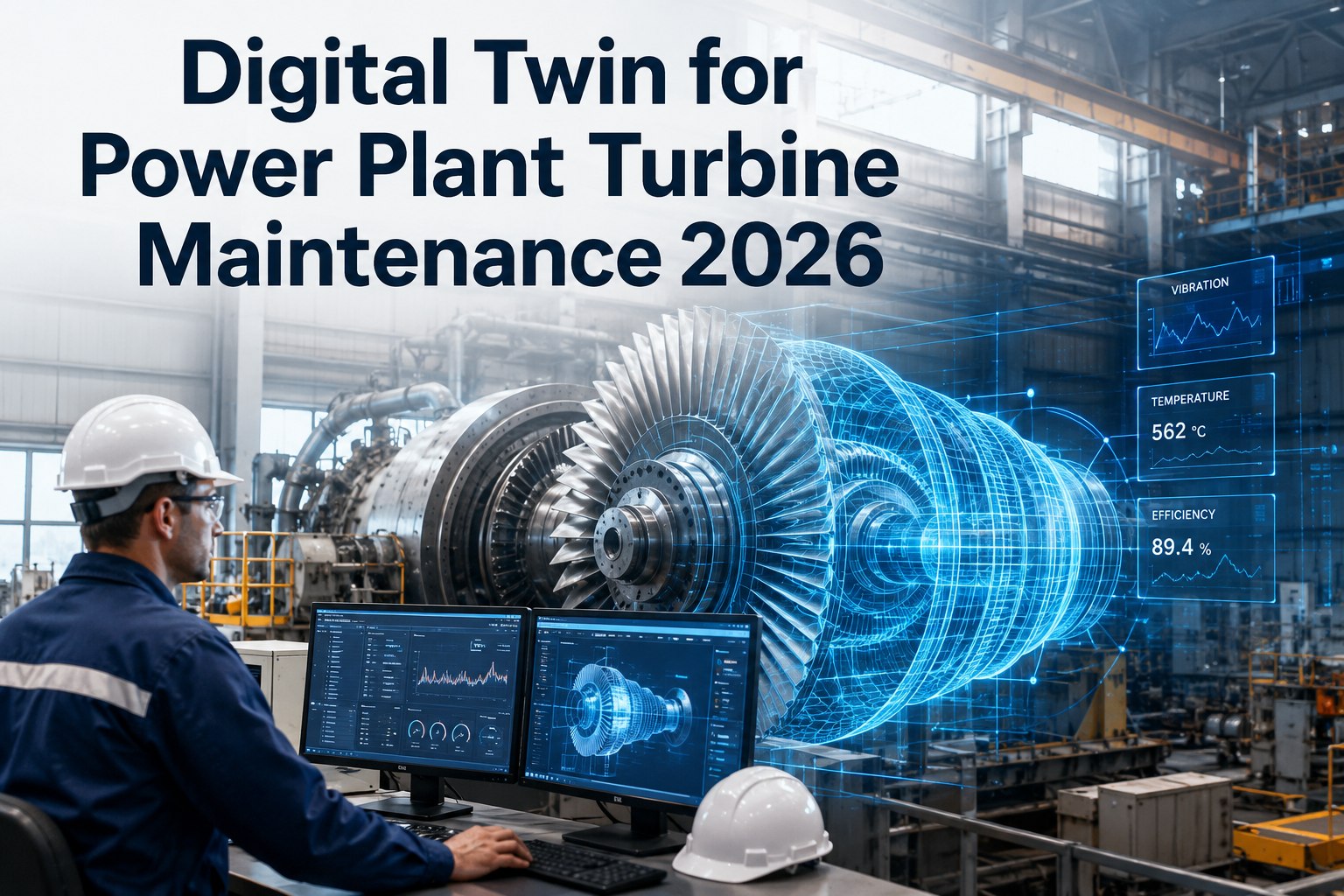
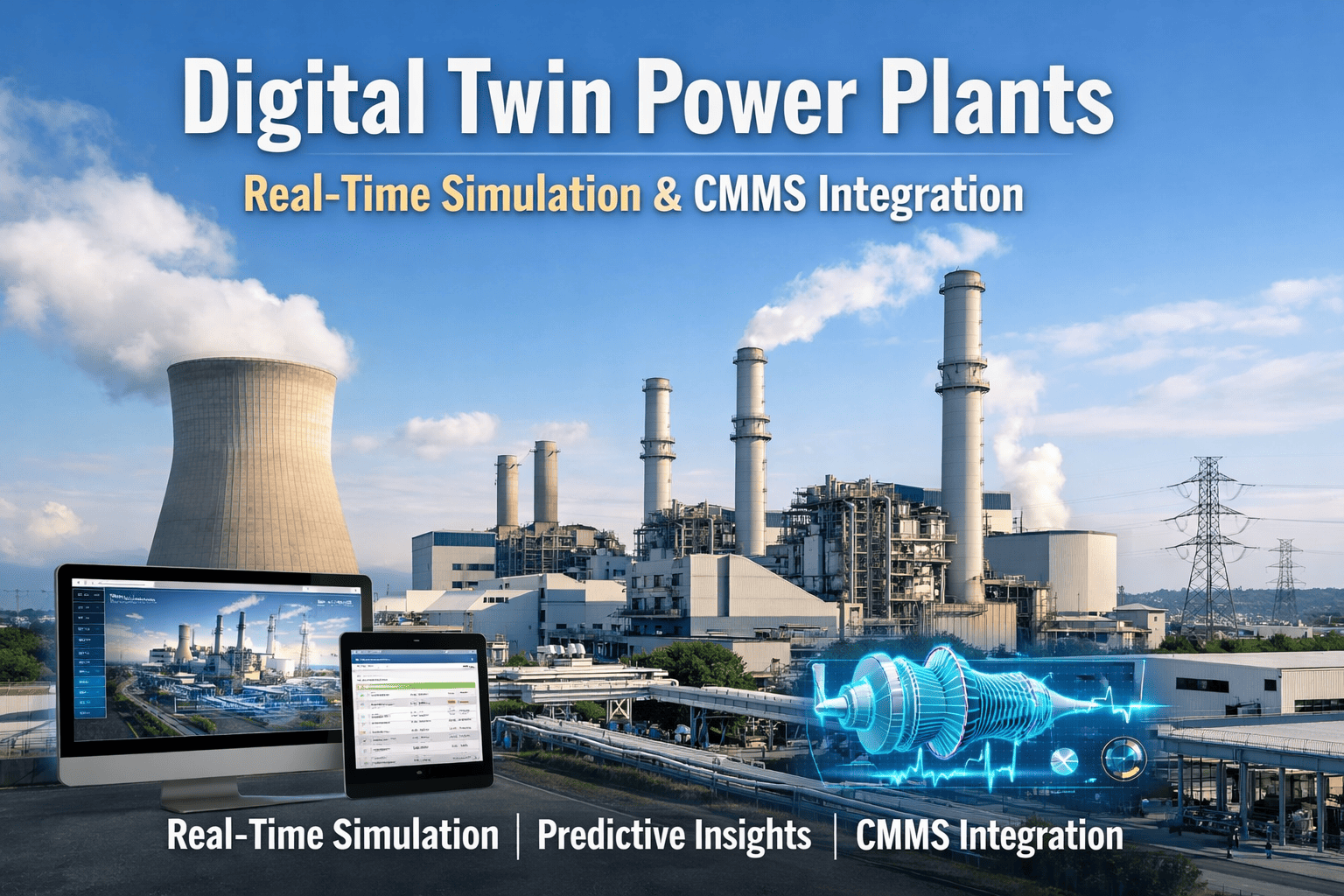
Power plants running on reactive maintenance are living on borrowed time. A single unplanned turbine trip can erase $850,000 or more in one event — replacement power costs, capacity penalties, accelerated wear, and emergency labor stacked on top of each other. Siemens Xcelerator's Executable Digital Twin (xDT) changes the equation by deploying physics-based simulation models directly on edge devices alongside real assets, feeding live operational intelligence straight into your CMMS. Sign in to OXmaint to connect your power plant's digital twin data to automated work orders your team can act on today.
$850K+
average cost per forced outage event in combined-cycle power plants
30–45%
reduction in unplanned outages reported after CMMS-driven digital twin programs
4–8 wks
advance warning xDT oil analysis and vibration trending gives before compressor failure
CES 2026
launch of Siemens Digital Twin Composer connecting xDT to live MES, PLC, and IIoT data
Technology Brief
What Is the Siemens Xcelerator Executable Digital Twin?
The Siemens Executable Digital Twin (xDT) is not a passive 3D model. It is a real-time, physics-based behavior model that runs on a connected edge device or in the cloud, pulling live IoT data from physical assets and responding dynamically. For power generation, this means a turbine's xDT is continuously computing actual thermal degradation, vibration signatures, and efficiency loss — not estimating from a scheduled inspection that may be weeks away.
Launched at CES 2026, Siemens Digital Twin Composer extends this further by connecting xDT models to MES systems, PLC control code, quality management data, and the full Siemens Xcelerator ecosystem including Teamcenter PLM and RapidMiner AI analytics. The result is a closed-loop intelligence layer between your physical power plant and your maintenance operations platform.
01
Physical Asset
Turbine, HRSG, Generator, Cooling System
02
xDT Edge Model
Physics-based simulation running on edge device
03
OXmaint CMMS
Automated work orders, PM triggers, compliance records
Why Power Plants Fail Without Connected Digital Twins
The gap between what Siemens xDT can detect and what most maintenance teams actually act on is not a technology problem — it is a data handoff problem. Digital twin insights trapped in a visualization dashboard nobody checks at 2 AM on a Saturday do not prevent failures.
01
Disconnected Data Silos
DCS historian data, maintenance logs, and xDT model outputs live in separate systems. No single platform correlates a rising approach temperature with a work order backlog on that heat exchanger.
02
Calendar-Only Scheduling
Fixed PM intervals ignore actual asset condition. A turbine running at 95% load in peak summer degrades faster than one at 60% load in spring, but both get inspected on the same 90-day cycle.
03
Lost Compliance Evidence
NERC CIP and EPA documentation requires timestamped, traceable inspection records tied to specific asset events. Handwritten logs and spreadsheets fail audits and void insurance claims.
04
Insight Without Action
The xDT model detects a bearing degradation signature 6 weeks before failure. But without CMMS integration, that insight never becomes a prioritized work order reaching a technician's mobile device.
Turn Siemens xDT Alerts Into Completed Work Orders — Automatically
OXmaint bridges the gap between Siemens Xcelerator's digital twin intelligence and the maintenance actions your team needs to execute on the floor. Connect condition triggers from xDT edge models to asset-specific PM templates, certified technician assignments, and EPA-compliant documentation in one platform.
How Siemens Xcelerator xDT Works With OXmaint CMMS
The integration follows a three-phase operational loop that turns continuous simulation data into documented, closed-loop maintenance workflows across your entire power plant fleet.
Phase 1
Detect
The xDT edge model processes real-time sensor streams — vibration, temperature, pressure, efficiency ratios — against physics-based simulation baselines. It flags deviations weeks before they become failures.
Turbine blade efficiency drop detected at 2.3% degradation
HRSG tube approach temperature rising above baseline threshold
Compressor bearing vibration signature trending toward fault envelope
Phase 2
Trigger
Xcelerator's condition-based event is routed via API to OXmaint, creating a prioritized work order with the asset ID, failure mode context, and recommended action pre-populated from the xDT diagnostic output.
Priority-1 WO generated with xDT diagnostic summary attached
Correct certified technician assigned based on skill matching
Spare parts reservation triggered in inventory module
Phase 3
Close
Technician completes the mobile work order with inspection data, photos, and e-signature. OXmaint feeds completion data back as a reference event into the xDT model, improving its future prediction accuracy.
Timestamped maintenance record satisfies NERC/EPA documentation
Repair outcome logged back to Siemens Teamcenter PLM record
xDT baseline recalibrated post-intervention for improved accuracy
Power Generation Assets Managed by Siemens xDT + OXmaint
Every major rotating and stationary asset in a modern power plant has a distinct xDT model configuration and corresponding CMMS template in OXmaint. This is not a generic workflow — it is asset-specific intelligence at every layer.
Asset
xDT Monitors
CMMS Trigger
Avg Failure Cost (Avoided)
Gas Turbine
Blade efficiency, exhaust temp, vibration spectrum
Hot section inspection WO at 0.5% efficiency drop
$2.4M+
HRSG / Boiler
Tube wall temp, approach delta, stack emissions
Tube inspection WO when approach temp exceeds 3°F baseline
$28M+
Steam Turbine
Shaft vibration, bearing metal temp, LP blade erosion
Bearing inspection WO at vibration envelope threshold
$1.8M+
Generator
Stator winding temp, hydrogen purity, exciter condition
Insulation resistance test WO at temp deviation
$5M+
Cooling Tower
Approach temp, circulating water chemistry, fan amps
Fill replacement WO based on thermal performance loss
$650K+
What Plants Achieve When xDT and CMMS Are Connected
23 days
average forced outage duration avoided per HRSG tube failure prevented through early xDT detection and timely CMMS work order execution
60%
reduction in compliance documentation time when xDT event data auto-populates OXmaint work order fields for NERC and EPA reporting
8–15%
insurance premium reduction for facilities with digitally documented, structured maintenance programs tied to asset condition history
6 weeks
typical advance warning xDT vibration and oil analysis models provide before major rotating equipment failures require emergency repair
We were running a 540 MW combined-cycle plant with Siemens controls and a completely disconnected CMMS. The xDT was telling our engineers everything — but that intelligence never made it to the maintenance team. Once we connected OXmaint to our Xcelerator data layer, the first condition-triggered work order caught a compressor bearing trending toward failure. That single catch saved us an estimated $65,000 in replacement costs and kept us off the grid event reporting list.
— Plant Manager, 540 MW Combined-Cycle Facility, Southeast United States
OXmaint Features Purpose-Built for Siemens xDT Users
Condition-Based PM Triggers
Set work orders to fire on xDT condition thresholds — not calendar dates. A turbine running hard in summer gets inspected when its efficiency curve says so, not when a spreadsheet says it has been 90 days.
xDT IntegrationSmart Scheduling
Asset-Specific Work Order Templates
Gas turbine, HRSG, steam turbine, and generator templates that prompt technicians for exactly the fields that matter — not generic forms that miss critical data like fired hours, approach temperature, and refrigerant charge.
Power Plant TemplatesCustom Fields
NERC / EPA Compliance Documentation
Every xDT-triggered inspection generates a timestamped, signed, digital record meeting NERC GADS, NERC CIP, and EPA Section 608 requirements. No manual log consolidation before an audit.
NERC GADSEPA 608Digital Records
Fired-Hour and Starts Counters
OXmaint tracks OEM-mandated inspection intervals based on fired hours and turbine starts — not just calendar time. Combustion inspections, hot section inspections, and major overhauls trigger at the right operational milestones.
Fired HoursOEM Intervals
Performance Trend Analytics
Chart heat rate, kW output, vibration trend, and approach temperature over time in OXmaint dashboards. Correlate maintenance events with performance improvements to demonstrate the ROI of your Siemens xDT investment.
Heat Rate TrackingKPI Dashboards
Mobile Offline Capture
Technicians complete xDT-triggered inspections on mobile — offline-capable inside turbine halls and substations. Photo attachments, e-signatures, and completed readings sync automatically when connectivity returns.
Mobile-FirstOffline Mode
Your Siemens xDT Is Already Detecting Failures. Is Your CMMS Acting on Them?
The intelligence is already in your Xcelerator platform. OXmaint closes the loop — turning digital twin alerts into prioritized work orders, compliant documentation, and measurable uptime gains. No configuration complexity. Ready in days, not months.
Frequently Asked Questions
What is Siemens Xcelerator and how does it relate to power plant maintenance?
Siemens Xcelerator is an open digital business platform that combines industrial software, hardware, and a partner ecosystem to enable digital transformation at scale. For power plants, it provides the Executable Digital Twin (xDT) and tools like Teamcenter PLM and Digital Twin Composer (launched at CES 2026) that create a continuous, physics-based model of every critical asset. When connected to OXmaint CMMS, Xcelerator's condition data drives maintenance scheduling, work order creation, and compliance documentation automatically.
What is an Executable Digital Twin (xDT) and how is it different from a standard digital twin?
A standard digital twin is often a visualization or static model used in design phases. An Executable Digital Twin (xDT) is a real-time, physics-based behavior model deployed on an edge device or cloud node that continuously processes live IoT data from a physical asset. For a power plant turbine, the xDT is actively computing thermal efficiency, predicting degradation curves, and flagging anomalies — not waiting for a scheduled inspection to detect that something is wrong. The xDT can be deployed on Siemens edge hardware directly in the plant environment without cloud latency.
How does OXmaint integrate with Siemens Xcelerator digital twin outputs?
OXmaint receives condition-based event data from Siemens Xcelerator via API. When the xDT model flags a threshold breach — an approach temperature deviation, a vibration envelope exceedance, or an efficiency drop — OXmaint automatically generates a work order with the asset ID, diagnostic context, and recommended action pre-populated. The technician receives a mobile notification, completes the inspection, and the closed work order feeds back into the xDT model as a calibration event.
Book a demo to see the integration architecture live.
What compliance standards does OXmaint support for power generation facilities?
OXmaint supports NERC GADS (Generating Availability Data System) reporting requirements, NERC CIP cyber-security compliance documentation, EPA Section 608 refrigerant inspection and leak records, and OEM-mandated inspection interval tracking tied to fired hours and turbine starts. Every xDT-triggered inspection generates a digitally signed, timestamped record that satisfies auditor and insurance requirements without manual log consolidation.
Can OXmaint handle both Siemens-controlled and non-Siemens assets in the same plant?
Yes. OXmaint operates as an asset-agnostic CMMS platform. Siemens xDT-connected assets receive condition-based PM triggers automatically. Non-Siemens assets — older balance-of-plant equipment, third-party cooling tower systems, or legacy pumps without digital twin models — are managed on calendar-based or meter-based PM schedules within the same platform. Your entire plant is visible in one place, regardless of the OEM on the nameplate.
Sign up free to set up your first asset hierarchy.
What was announced at CES 2026 regarding Siemens digital twin technology?
Siemens launched the Digital Twin Composer at CES 2026 — a tool that connects the photorealistic, physics-accurate 3D digital twin built within Siemens Xcelerator to real-world physical data sources including MES systems, QMS platforms, PLC code from live assets, and IIoT data streams. Built with NVIDIA Omniverse library integration, Digital Twin Composer creates a visual, physics-accurate replica that operators can interact with in real time. For power generation maintenance teams, this means the gap between what the simulation knows and what the maintenance team sees is effectively eliminated when paired with a connected CMMS like OXmaint.