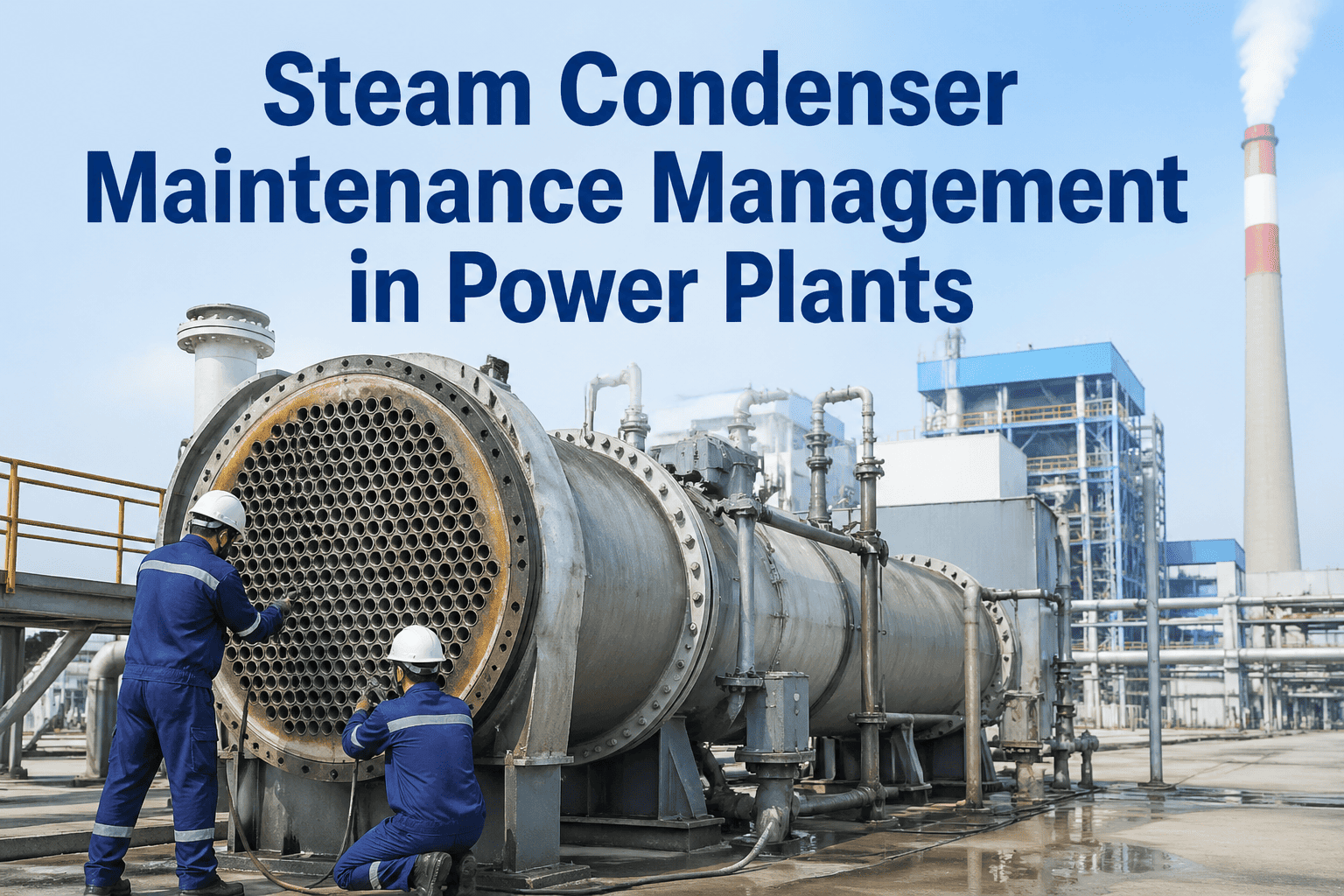
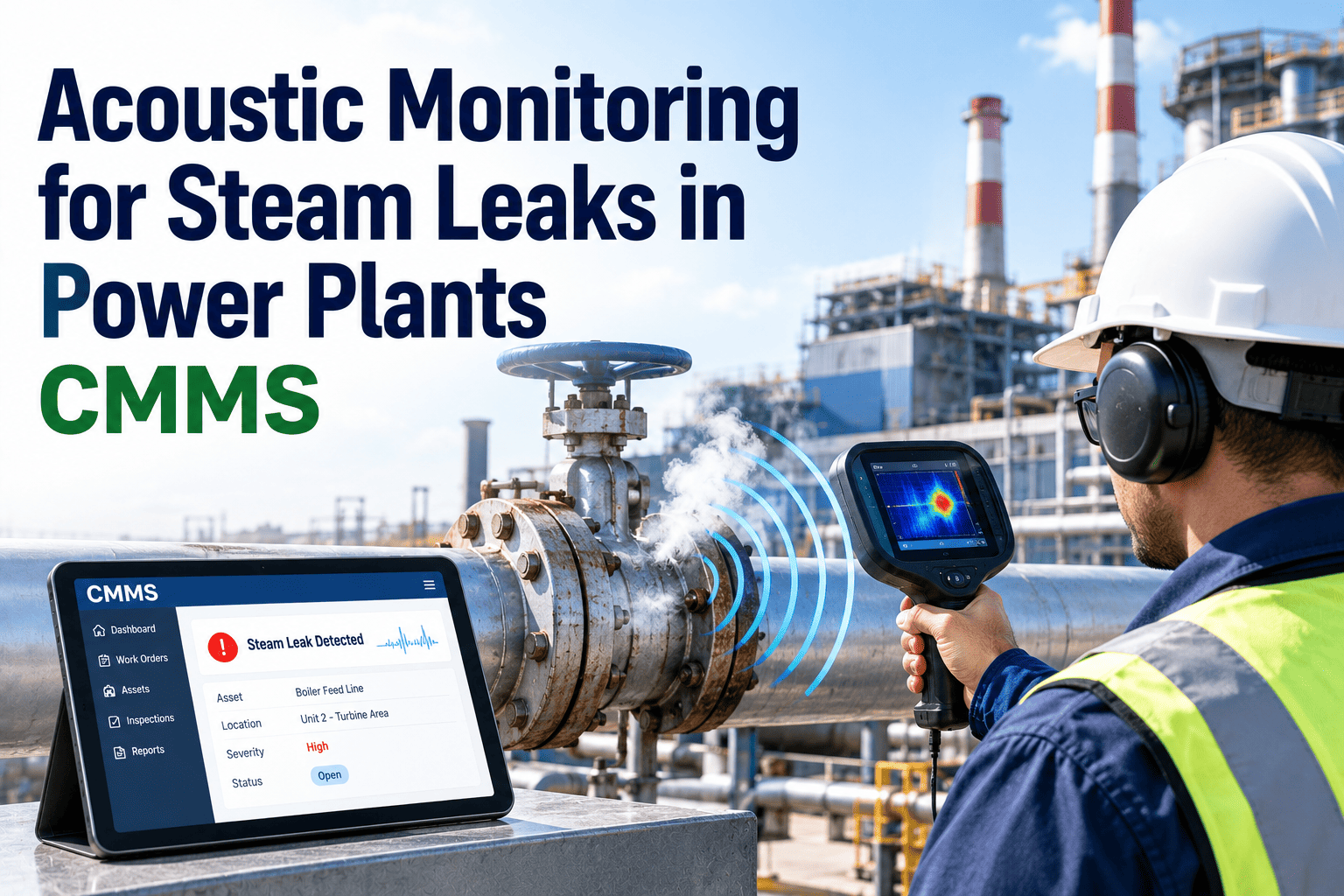
A 1% rise in condenser backpressure costs a thermal power plant roughly 0.5% of total output — silently, continuously, and without triggering a single alarm on most DCS configurations. Fouled tubes, air in-leakage through turbine seals or expansion joints, degraded vacuum pump performance, and hotwell chemistry drift are the four most common and most financially damaging condenser problems — and every one of them is detectable and preventable with a structured, CMMS-driven maintenance program. Plants that rely on periodic manual cleaning accept a sawtooth efficiency curve: performance recovers after a forced outage cleaning, then degrades steadily until the next one. Plants with scheduled, documented condenser maintenance maintain near-design vacuum continuously. This checklist covers every major condenser maintenance task — tube fouling management, air in-leakage testing, hotwell chemistry monitoring, and vacuum system reliability — organized for direct entry into your CMMS as recurring work orders. Set up your condenser PM schedule in Oxmaint or book a 30-minute power plant CMMS walkthrough to see how plants schedule and document every item on this list.
Power Plant Maintenance Checklist
Steam Condenser Maintenance Checklist for Power Plants
Track tube fouling, air in-leakage, hotwell chemistry, and vacuum system health — scheduled and documented inside your CMMS to protect turbine efficiency and megawatt output.
3–3.5%
Thermal efficiency gain from maintaining design condenser vacuum
20–30%
Plant efficiency improvement with proper condenser maintenance
+$150K
NERC fine per documentation failure — not per operational event
How Condenser Degradation Hurts Your Plant — By the Numbers
Every condenser problem compounds. Fouled tubes raise backpressure. Higher backpressure reduces vacuum. Reduced vacuum cuts turbine output. Lower output means more fuel per MWh. Understanding the chain helps maintenance teams prioritize the right tasks at the right intervals.
1
Tube Fouling Builds
Biofouling, silt, scale, and corrosion deposits insulate tube walls. Heat transfer falls. Cooling water struggles to condense exhaust steam at design rate.
→
2
Backpressure Rises
Condenser shell pressure climbs above design. The turbine exhaust must push harder against higher pressure — extracting less work from each kilogram of steam.
→
3
Output Drops or Fuel Rises
Plant is derated to protect equipment. Alternatively, fuel input increases to hold output targets — increasing cost per MWh and CO₂ per unit of generation.
→
4
Tube Leaks Develop
Long-term fouling accelerates corrosion under deposits. Cooling water contamination of feedwater leads to boiler tube corrosion and forced outages with far greater financial impact.
Every week without a documented condenser PM schedule is a week of untracked degradation.
Oxmaint lets you build condenser PM workflows once and schedule them automatically — daily readings, weekly checks, and annual outage inspections all in one place.
Complete Steam Condenser Maintenance Checklist
Organized by frequency and system area for direct input into your CMMS. Each category maps to a separate recurring work order type with its own interval, assignee, and documentation requirements.
Condenser vacuum reading vs. design setpoint
Log absolute pressure (in HgA or mbar). Deviation >0.5 in HgA from design triggers investigation WO.
Hotwell level and temperature
High hotwell temperature indicates inadequate condensing — possible air binding or high cooling water inlet temp.
Cooling water inlet and outlet delta-T
Narrowing delta-T indicates reduced heat transfer — early indicator of tube fouling or reduced cooling water flow.
Air removal system (ejector or vacuum pump) discharge temperature and flow
Rising air removal load indicates in-leakage increase. Document flow vs. baseline for trend analysis.
Condensate dissolved oxygen (DO) sample
Target: <7 ppb. Elevated DO is the primary indicator of air in-leakage before vacuum degradation is visible.
Hotwell chemistry panel — pH, conductivity, hardness, chloride
Chloride above 0.1 ppm indicates cooling water in-leakage and immediate tube leak investigation is required.
Visual inspection of waterbox and expansion joint seals
Weeping seals and wet insulation indicate early-stage leaks. Document with photo and log in CMMS asset record.
Vacuum pump / steam ejector operational parameters check
Compare suction pressure, discharge temperature, and motive steam consumption against established baseline.
Cooling water treatment dosing rates and biocide inventory
Verify chemical feed pump operation and dosing log. Biofouling is the fastest-growing fouling type in open-circuit systems.
Air in-leakage quantification test
Measure non-condensable gas volume in air removal vent stream. EPRI guideline: <1 SCFM per 100 MW capacity. Document result, compare to prior month.
Condenser performance test — TTD (Terminal Temperature Difference) calculation
TTD = hotwell temperature minus cooling water outlet temperature. Rising TTD indicates fouling. Log against design TTD.
Tube cleanliness factor (CF) calculation
CF = actual heat transfer coefficient ÷ clean tube coefficient. CF below 0.85 triggers scheduled tube cleaning WO.
Condensate pump mechanical seal and bearing condition check
Inspect for leakage, vibration, and abnormal temperature. Seal failure introduces air into condensate line.
Full tube bundle inspection — eddy current or ultrasonic testing (UT)
UT wall thickness mapping identifies thinning and pitting. Flag tubes below 80% nominal wall for plugging or replacement.
Mechanical tube cleaning — high-pressure water jetting or brush cleaning
Document cleaning method, contractor, and post-clean cleanliness factor. Photograph representative tube ends before and after.
Air in-leakage survey — helium or SF₆ tracer gas test
Use SF₆ for in-leakage <50 GPD water equivalent; helium for larger leaks or offline conditions. Isolate and plug leaking penetrations.
Tubesheet inspection — visual and dye penetrant for erosion, corrosion, and roll joint integrity
Defective roll joints allow shellside-to-tubeside leakage. Re-roll or epoxy-seal as appropriate and document repair method and tube ID.
Shell and waterbox internal inspection and coating assessment
Check internal coating for disbonding, blistering, or holiday defects. Recoat as required. Document all areas with photos and CMMS attachments.
Vacuum system hydrostatic pressure test post-reassembly
Confirm no new leaks were introduced during maintenance work before return to service. Document test pressure and results.
Hotwell inspection — sediment removal and internal surface condition check
Accumulated sludge and deposits can block strainers and degrade condensate quality. Photograph and document sediment volume removed.
How CMMS Transforms This Checklist into a Living Maintenance Program
A printed checklist gets filed. A CMMS-driven checklist generates work orders, captures technician data at point of completion, tracks trends over time, and triggers follow-on investigation orders automatically when readings exceed limits.
Auto-Scheduled Work Orders
Daily, weekly, monthly, and outage tasks are generated automatically based on calendar or meter triggers. Nothing is missed because no one remembered to create the WO.
Threshold-Based Escalation
When a technician logs a vacuum reading or DO level that exceeds the acceptable range, the CMMS automatically creates a priority investigation work order — no supervisor intervention needed.
Trend Tracking Across Readings
TTD, tube cleanliness factor, and air removal load are trended across months and outage cycles. Performance degradation becomes visible weeks before it affects generation output.
Outage Documentation Package
All tube inspection results, cleaning records, tracer gas test reports, and photos are stored against the condenser asset record — available instantly for insurance audits, regulatory inspections, or OEM warranty claims.
Key Condenser Performance Parameters to Track in Your CMMS
These are the parameters your CMMS should capture as structured data fields — not free-text notes — so they can be trended, compared, and used to trigger maintenance actions automatically.
| Parameter |
Normal Range |
Action Threshold |
CMMS Trigger |
| Condenser backpressure |
Design ± 0.3 in HgA |
> 0.5 in HgA above design |
Priority-2 investigation WO |
| Dissolved oxygen (DO) |
< 7 ppb |
> 10 ppb |
Air in-leakage survey WO |
| Hotwell conductivity |
< 0.1 µS/cm |
> 0.2 µS/cm |
Tube leak investigation WO |
| Terminal Temperature Difference |
Design TTD ± 2°F |
> 5°F above design |
Tube cleaning work order |
| Tube Cleanliness Factor |
> 0.85 |
< 0.80 |
Schedule offline cleaning |
| Air removal load (SCFM) |
< 1 SCFM per 100 MW |
> 2x baseline |
Tracer gas survey WO |
Frequently Asked Questions
How often should condenser tubes be cleaned in a thermal power plant?
Cleaning frequency depends on cooling water quality and fouling type. Most plants using open-circuit cooling from rivers or seawater require mechanical cleaning every planned outage — typically annually. Cleanliness factor trending in your CMMS provides the data to optimize this interval based on actual performance rather than fixed schedules.
What is the most reliable method for detecting condenser air in-leakage?
Elevated dissolved oxygen in the hotwell is the earliest and most sensitive indicator — detectable before vacuum degradation is visible on instrumentation. For locating the leak source, helium or SF₆ tracer gas testing during operation provides precise identification. EPRI recommends keeping in-leakage below 1 SCFM per 100 MW capacity.
Can Oxmaint track condenser performance parameters and automatically generate work orders?
Yes. Oxmaint allows you to define numeric reading fields (backpressure, DO, conductivity, TTD) as part of recurring inspection work orders. When a technician records a value outside the defined acceptable range, the system automatically generates a follow-on investigation or escalation work order — without requiring supervisor intervention.
What documentation should be captured during a condenser outage inspection?
At minimum: eddy current or UT tube inspection results (by tube ID), tube cleaning method and contractor, post-clean cleanliness factor, tracer gas test report, tubesheet condition photos, and a pressure test result after reassembly. All of these should be attached to the condenser asset record in your CMMS for future outage planning and insurance purposes.
How does condenser maintenance affect turbine efficiency and plant output?
Maintaining design condenser vacuum delivers a 3 to 3.5% improvement in thermal efficiency compared to a fouled baseline. For a 500 MW plant, recovering that vacuum is equivalent to adding 15–18 MW of output without capital investment. This is why condenser maintenance delivers some of the highest ROI of any PM activity in a thermal power plant.
Schedule Every Item on This List Inside Your CMMS — Starting Today
Oxmaint has pre-built condenser PM templates for thermal power plants — daily readings, weekly inspections, monthly performance tests, and outage documentation workflows. Load your asset register, set your intervals, and your team has a complete condenser maintenance program running within days.