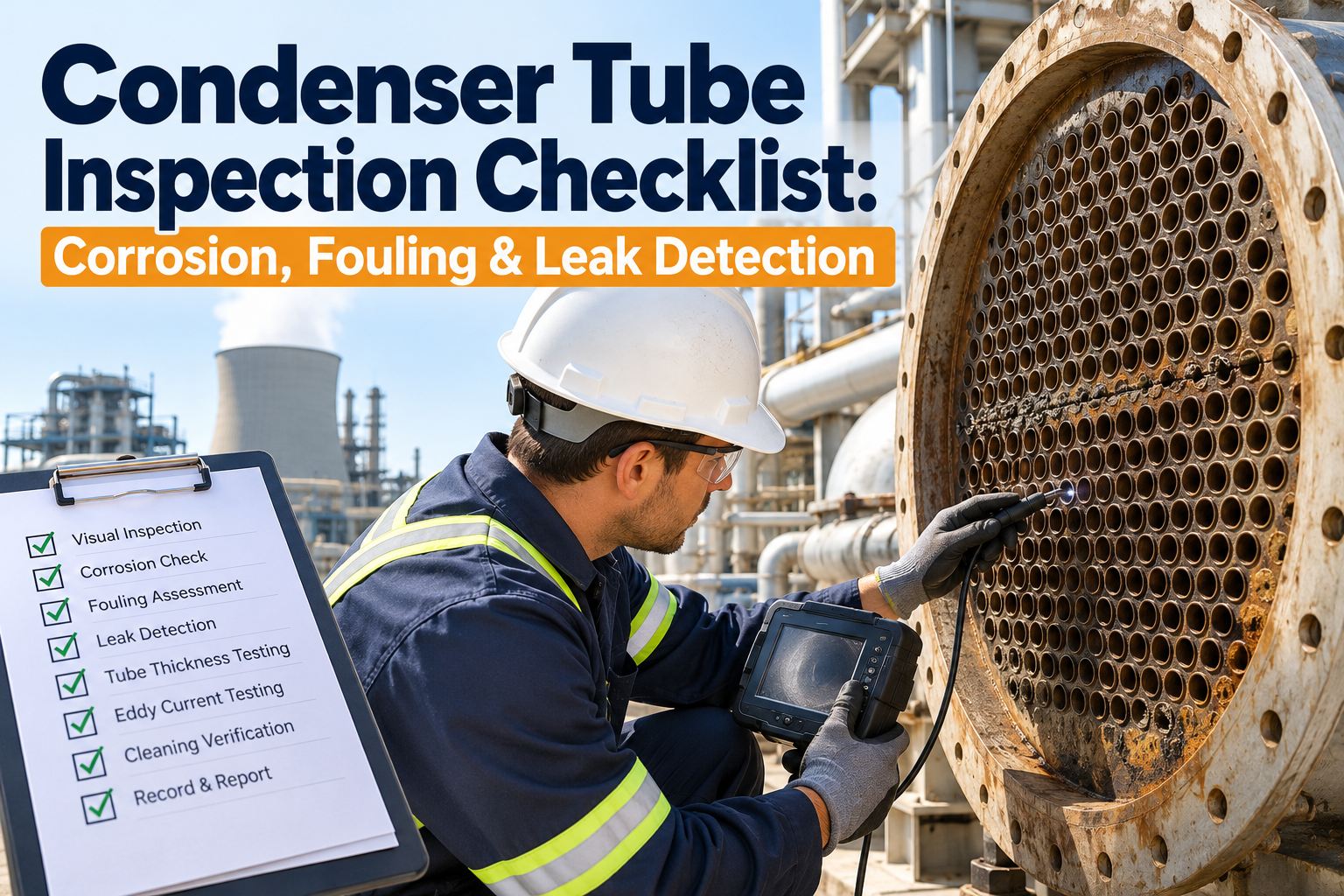
Condenser Tube Inspection Checklist: Corrosion, Fouling & Leak Detection

By Willam Jerry on October 16, 2026

condenser-tube-inspection-checklist-guide

A condenser can lose performance long before it fails outright. Fouled tubes raise backpressure and cost output, corroded tubes thin quietly, and a single leaking tube can push cooling water into the steam cycle. The condenser is also one of the hardest assets to inspect, because you only get a proper look during an outage. This checklist covers what to watch online, what to inspect when the waterbox is open, and what to record afterwards, and shows how OXMAINT AI, the AI-powered CMMS, keeps every tube finding in one history.

Balance of Plant · Condenser Maintenance · Inspection Checklist

Condenser Tube Inspection Checklist: Corrosion, Fouling & Leak Detection

Five stages, twenty-seven checks: from the warning signs you can see while the unit runs, to waterbox entry, cleaning, eddy current testing, leak testing and closeout records. Tick items off as you go, and use OXMAINT AI, the AI-powered CMMS and maintenance management software, to keep tube results, photos and plugging history attached to the condenser asset.

Online warning signs
▲Condenser backpressure
▲Terminal temperature difference
▲Hotwell conductivity
▲Air in-leakage
Any one of these is a reason to plan an inspection
5 Stages
online watch to closeout
27 Checks
tick-box items for each inspection
3 Failure Types
fouling, corrosion and mechanical damage
1 Tube Record
every result logged against the asset

Where Condenser Tubes Fail

Damage is not random. Certain zones of the tube bundle repeat the same problems, which tells you where to look first. The map below shows the four zones inspectors check most closely. Book a demo to see zone-based inspection records in OXMAINT AI.

INLET
WATERBOXcooling water in
1Tube inlet ends
2Support plate contact points
3Steam inlet and outer rows
4Air-cooling zone
TUBE BUNDLE (steam side outside the tubes)
OUTLET
WATERBOXcooling water out
1
Inlet ends
Erosion-corrosion from turbulence, debris and sand; also deposits and blockage.
2
Support plates
Vibration wear and fretting where tubes touch supports.
3
Steam inlet and outer rows
Steam and droplet impingement thins tube walls from outside.
4
Air-cooling zone
Concentrated ammonia and gases can attack susceptible tube materials.

Three Problems You Are Hunting

FOULING
Deposits that block heat transfer
Biofilm, scale, silt, shells and debris reduce heat transfer, raise backpressure and cost output.
CORROSION
Metal loss that leads to leaks
Pitting, erosion-corrosion, stress cracking and microbiologically influenced attack thin tubes over time.
MECHANICAL
Wear from flow, steam and vibration
Fretting, impingement and foreign-object damage cut through tube walls from the outside.

The Condenser Tube Inspection Checklist

Work down the rail, one stage at a time. Findings from each stage feed the next, so record as you go. Tap or click any box to tick it off. Start free and turn this into a reusable inspection template in OXMAINT AI.

A
Pre-Shutdown Review
Before the waterbox opens
B
Isolation & Waterbox Entry
Safe access first
C
Visual Check & Cleaning
Fouling and debris
D
Wall-Thickness & Damage Testing
Corrosion and erosion
E
Leak Test & Closeout
Prove it, then record it

The Tube Map Is Only Useful If You Can Find It Next Outage.

Inspection reports in email folders and spreadsheets get lost between outages. When every result, photo and plugged tube sits on the condenser asset record, the next inspection starts with the history, not a blank page.

Finding Decoder: What You See and What to Do

Use this quick table when a result appears during inspection. Always follow your plant's acceptance criteria and engineering guidance for final decisions.

What you findLikely causeNext step
Deposits or slime inside tubes Biofouling, scaling or poor water treatment Clean, review dosing and cooling water chemistry
Thinning at tube inlet ends Erosion-corrosion from turbulence or debris Measure wall loss, consider inlet protection
Localised pits Pitting, under-deposit or microbial attack Clean fully, test nearby tubes, trend growth
Wear at support plates Vibration and fretting Check bundle support and flow conditions
Thinning on outer rows near steam inlet Steam or droplet impingement Inspect impingement protection, plan repair
Rising conductivity with a clean test result Possible leak elsewhere, tubesheet or joint Run leak test and inspect tube-to-tubesheet joints

Triage: Monitor, Plug or Retube

Once results are in, each tube falls into a simple decision band. Your engineering team sets the thresholds; the aim is a consistent, recorded decision.

MONITOR
Minor indications within criteria. Record, trend and retest at the next inspection.
REPAIR OR PLUG
Leak found or damage beyond criteria. Plug or sleeve, then update the tube map.
PLAN RETUBING
Widespread damage or too many plugged tubes. Build a business case with the trend data.

How OXMAINT AI Supports Condenser Inspections

OXMAINT AI keeps inspections, findings and follow-up work in one place, so condenser health is tracked across outages rather than rebuilt each time. Book a demo to see an inspection workflow in OXMAINT AI.

Inspection templates
Turn this checklist into a reusable template for every outage.
Photos and notes
Attach waterbox and tubesheet photos to the condenser asset.
Findings to work orders
Raise plugging, cleaning or coating jobs straight from a finding.
Condition history
Compare readings and condition scores outage after outage.
Preventive schedules
Plan cleaning and inspection cycles by operating conditions.
Parts and spares
Track plugs, sleeves and gaskets so they are ready for the outage.

Frequently Asked Questions

What should a condenser tube inspection checklist include?
Online performance review, safe isolation and entry, visual and fouling checks, cleaning, wall-thickness testing such as eddy current, leak testing, and complete closeout records. Book a demo to see it as a digital template.
How do I know if a condenser tube is leaking?
Common signs include rising hotwell or condensate conductivity, changes in water chemistry and increased air in-leakage. Leaks are then located with approved methods such as a fill test or helium testing.
What causes condenser tube corrosion and fouling?
Corrosion comes from water chemistry, deposits, erosion, microbial activity and tube material limits. Fouling comes from biological growth, scale, silt and debris carried by cooling water.
How often should condenser tubes be inspected?
It depends on cooling water quality, tube material, operating history and past findings. Many plants combine continuous performance monitoring with detailed inspection at planned outages. Start free with OXMAINT AI.
Can a CMMS track condenser tube plugging?
Yes. A CMMS can store inspection results, plugged tube records, photos and follow-up work orders against the condenser asset, so the history is available at the next outage.

Catch Condenser Damage While It Is Still Cheap to Fix.

Bring your condenser inspections, tube findings and repair history into OXMAINT AI: reusable checklists, photo records, linked work orders and a clear trend of tube condition. Be ready for the next outage with the last outage's data in hand.


Share This Story, Choose Your Platform!