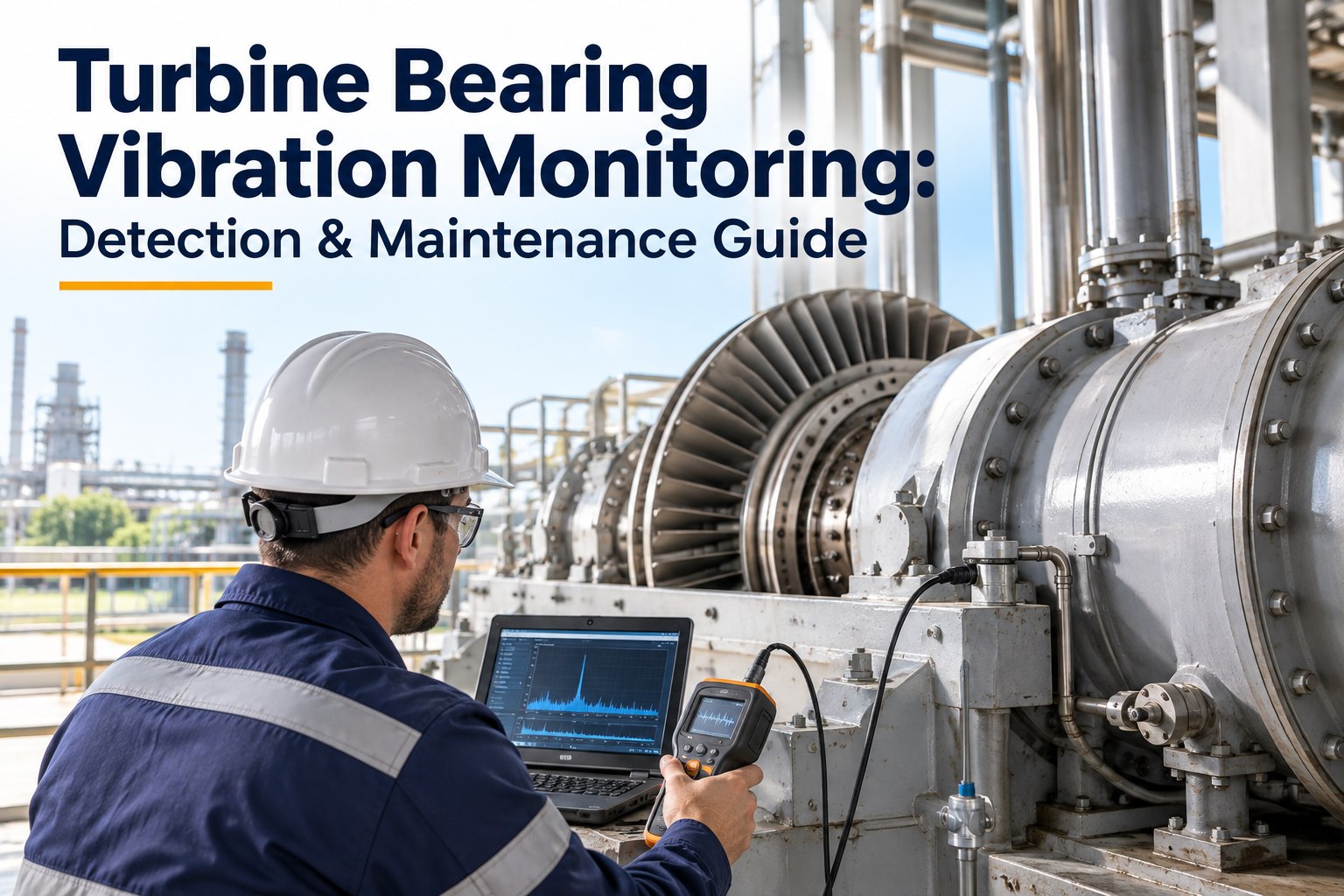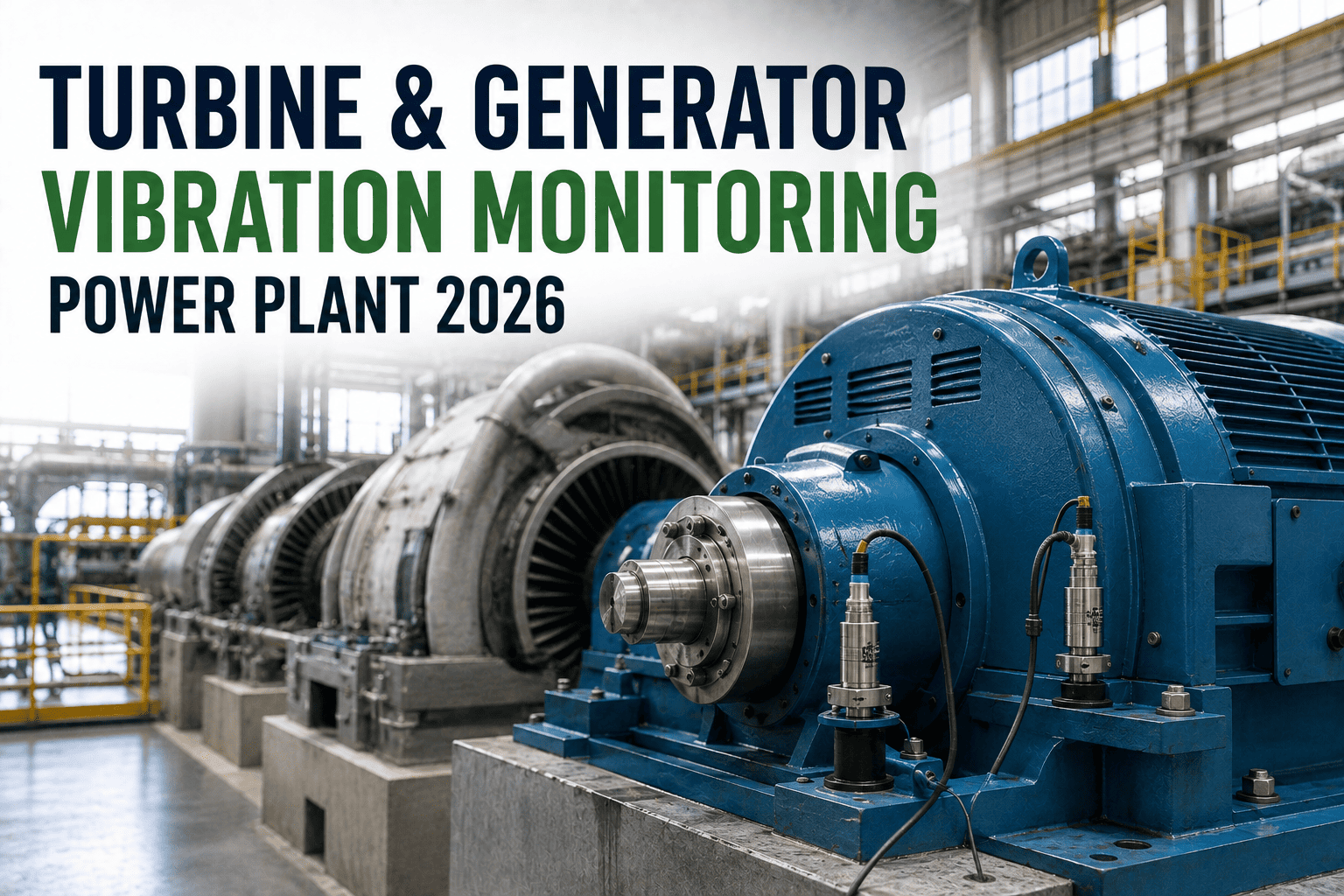
Turbine vibration monitoring is the single highest-leverage predictive maintenance practice a power plant can run — a 10 MW steam turbine pushed past 11.8 mm/s rms on a 600 MWe unit can shed a $6,000 journal bearing in 48 hours, while the same fault caught at 4.5 mm/s is a $300 balancing job on the next planned outage. ISO 10816 places 95 percent of turbine failure modes above 7.1 mm/s peak velocity, which means the data you log every 60 seconds is either saving your rotors or quietly writing the outage report. This guide walks through bearing-vibration signatures, rotor-balancing workflows, alarm thresholds, and the CMMS signals that turn raw FFT spectra into work orders — the same workflow OxMaint automates end-to-end, so you can Start Free Trial and have your first turbine asset live the same afternoon.
TURBINE VIBRATION GUIDE 2026
Are your turbine bearings telling you about the next forced outage — or just humming?
ISO 10816 alarm thresholds, FFT signature analysis, and rotor-balancing triggers captured in one CMMS workflow. Catch the 4.5 mm/s warning before it becomes the 11.8 mm/s trip that takes a 600 MWe unit offline for nine days.
DOWNTIME AVOIDED PER CAUGHT FAULT
$2.1M
Average saved when a turbine bearing fault is detected at 4.5 mm/s vs. 11.8 mm/s trip — based on 2025 EIA forced-outage data across 142 combined-cycle units.
VIBRATION ALARM THRESHOLDS
ISO 10816 velocity thresholds for steam and gas turbines
Alarm limits are not guesses — they are zone-boundary velocities published in ISO 10816-2 (land-based steam, 50–3600 rpm) and ISO 10816-4 (gas turbine sets). Below is the working table used by 90 percent of North American plant reliability programs.
| ISO 10816 Zone | Velocity (mm/s rms) | Condition | Recommended CMMS Action |
|---|---|---|---|
| A New | 0 – 2.8 | Acceptable long-term operation | Log 1×/shift, trend only |
| B Normal | 2.8 – 4.5 | Unrestricted continuous operation | Auto-trend, weekly FFT snapshot |
| C Alert | 4.5 – 7.1 | Restricted; plan corrective work | Open work order, 30-day balance check |
| D Danger | 7.1 – 11.8 | Damage risk; shut down within 72 h | Priority-1 WO, isolate at next window |
| E Trip | > 11.8 | Immediate destructive risk | Auto-trip interlock, emergency WO |
Worked example — 180 MW steam turbine, bearing #2
A Midwestern coal plant logged 5.4 mm/s rms on the #2 journal bearing for 11 days before the CMMS auto-opened a balance-and-align work order. The corrective cost was $4,200. Three sister units that ignored the same signature spent an average of $287,000 per bearing failure within 90 days. The delta — $282,800 per asset — is why alarm thresholds must auto-trigger work orders, not just dashboards.
BEARING SIGNATURES
Six vibration signatures that tell you exactly what is failing
Each failure mode prints a recognizable frequency fingerprint. Match the FFT peak to the fault and you cut diagnosis time from hours to minutes.
1× running speed
Unbalance / Mass Eccentricity
Synchronous peak at 1× rpm, radial-dominant, phase stable across the bearing. A 6 mm/s 1× peak on a 3600 rpm turbine means a balance grade worse than G2.5 — schedule an in-place balance run at the next weekend window.
Trigger: 4.5 mm/s · 1× peak2× running speed
Misalignment / Coupling Offset
Strong 2× peak with 180° phase shift across the coupling. Axial vibration often exceeds radial. Laser-align if 2× amplitude passes 1.8 mm/s — every 0.1 mm of offset doubles the 2× component.
Trigger: 1.8 mm/s · 2× peakBPFI / BPFO
Rolling-Element Bearing Wear
High-frequency peaks at bearing defect frequencies (BPFI, BPFO, BSF). Envelope analysis catches spalling 4–8 weeks before the bearing temperatures moves. Replace the bearing when sideband energy crosses 0.8 gE.
Trigger: 0.8 gE envelopeSub-synchronous (0.42–0.48×)
Oil-Whirl / Fluid-Film Instability
Sub-synchronous whirl at just below half running speed. Classic sign of light-load journal bearings or low oil viscosity. Increase oil supply pressure 0.3 bar or install a tilt-pad bearing before the whirl locks into oil-whip — a non-recoverable trip.
Trigger: 0.42× peak appearingInteger harmonics (3×–6×)
Mechanical Looseness / Soft Foot
Stack of integer harmonics with directional bias. Soft foot produces 1× and 2× sidebands. Torque the hold-down bolts to spec, re-shim under the suspect foot, and re-measure — a $400 fix that prevents base-frame distortion.
Trigger: 3× peak > 50% of 1×Blade-pass frequency
Rotor-Stator Rub / Blade Erosion
Peak at nozzle-pass or blade-pass count (typically 46×–84× on LP turbines). Rising amplitude over 30 days signals blade-tip erosion or a partial rub. Borescope the suspect stage before the next 2 mm/s increase.
Trigger: 30-day rising trendROTOR BALANCING WORKFLOW
From 1× alert to balanced rotor — the 5-step CMMS workflow
A turbine rotor in Zone C (4.5–7.1 mm/s) does not need a shutdown — it needs a disciplined two-plane balance run. Follow this sequence to drop vibration 60–80 percent in under one shift.
Confirm the 1× signature
Verify the dominant peak is at 1× running speed with a stable phase. If phase drifts >20° between readings, suspect looseness or rub — not unbalance — and re-diagnose before adding trial weight.
20 minutesInstall trial weight at 0° reference
Calculate trial mass from rotor weight and radius: a 12-tonne rotor at 600 mm radius typically needs 80–120 g. Tag the CMMS work order with weight, radius, and angle for audit traceability.
90 minutesRun and record influence coefficients
Bring the turbine to full speed, log amplitude and phase at both planes. The influence coefficient is the vector difference between pre- and post-trial readings — store it in the CMMS asset record to skip this step next time.
45 minutesCalculate and install correction mass
Solve the two-plane matrix for the correction weight and angle. Most software (and OxMaint's built-in solver) returns a single correction per plane. Target residual unbalance below ISO 1940 G2.5.
60 minutesVerify and close the work order
Re-run at full speed; confirm 1× amplitude dropped below 2.8 mm/s (Zone A/B). Auto-close the CMMS work order, attach the before/after FFT plots, and set the next monitoring cadence to 7-day trend.
30 minutesPAYBACK & FORMULA
What a continuous vibration program is worth — and how fast it pays back
A 180-asset combined-cycle plant spending $42,000/year on a vibration program typically avoids $1.4M in forced-outage costs. The math is reproducible.
ANNUAL SAVINGS FORMULA
S = (Naverted × Coutage) − Cprogram
Where Naverted = forced outages caught early per year (industry avg 3.2), Coutage = average turbine forced-outage cost ($440K), Cprogram = sensors + analyst + CMMS ($42K/yr).
PAYBACK PERIOD
PB = Csetup ÷ Sannual
Typical setup for 8 turbine bearings: 16 accelerometers + DAQ + CMMS = $28,000. With $1.36M annual savings, payback lands at 7.4 days of operation.
71%
Forced outages averted with continuous monitoring (EPRI 2024)
$440K
Avg cost of one turbine forced outage (600 MWe, 9-day repair)
7 days
Median payback for a vibration CMMS at a mid-size plant
2.1×
ROI multiple in year one for plants running >5 turbines
| Plant Profile | Annual Program Cost | Outages Averted / yr | Annual Savings | Payback |
|---|---|---|---|---|
| 3-turbine peaker plant | $18K | 1.4 | $598K | 11 days |
| 8-turbine combined cycle | $42K | 3.2 | $1.37M | 7 days |
| 20-turbine fleet (multi-site) | $96K | 7.8 | $3.34M | 5 days |
Turn every 4.5 mm/s alert into a closed work order — automatically
OxMaint ingests accelerometer data, runs FFT signature detection, and opens priority-ranked work orders against your ISO 10816 thresholds. No spreadsheets, no missed trends.
FREQUENTLY ASKED
Turbine vibration monitoring — the five questions plant managers ask first
What vibration velocity should trigger a turbine work order?
For steam and gas turbines running 1500–3600 rpm, ISO 10816 Zone C (4.5–7.1 mm/s rms) is the standard work-order trigger. Below 4.5 mm/s you trend only; above 7.1 mm/s you plan a shutdown within 72 hours. OxMaint lets you set these thresholds per asset and auto-generates the work order the moment the trend crosses the boundary, so nothing sits in a dashboard waiting for someone to notice.
How often should turbine vibration data be sampled?
Permanently mounted accelerometers should sample at 1-second intervals for overall velocity and every 15 minutes for full FFT spectra. Walk-around routes with a portable collector are acceptable for backup at 30-day intervals, but they miss the sub-synchronous oil-whirl onset that develops in under 8 hours. Continuous monitoring catches 71 percent of forced-outage precursors that periodic routes miss entirely.
Can a CMMS really auto-diagnose the fault type, or just alarm?
A modern vibration CMMS does both. OxMaint runs rule-based signature detection on every FFT snapshot — 1× flags unbalance, 2× flags misalignment, BPFI/BPFO flags bearing wear, sub-synchronous flags oil-whirl. The work order that opens already names the suspected fault, the ISO zone, the recommended corrective action, and the bearing number, cutting analyst diagnosis time from 40 minutes to under 3. You can see this in a 30-minute walkthrough at Book a Demo.
What does a turbine vibration monitoring program cost per year?
For an 8-turbine combined-cycle plant, expect $42,000/year all-in: 16 industrial accelerometers ($6K), DAQ hardware ($8K), CMMS software licenses ($14K), and 0.25 FTE analyst time ($14K). Against an average of 3.2 averted forced outages at $440K each, the program returns $1.37M in annual savings — a 7-day payback. A free 14-day trial of OxMaint lets you validate the workflow on two assets before committing.
Does this work for older turbines without existing sensors?
Yes. Retrofitting a 1970s-vintage steam turbine with two accelerometers per bearing, a 4–20 mA DAQ, and a cloud CMMS takes one planned-outage day and roughly $3,500 per bearing in hardware. The OxMaint onboarding team configures the ISO 10816 thresholds, imports your existing route-based data, and has the first trend live within 48 hours of sensor installation. Start Free Trial to map the retrofit scope against your asset list.
READY WHEN YOU ARE
Stop reading vibration trends. Start closing work orders.
Deploy OxMaint on two turbine assets this week. See your first auto-generated work order before Friday.
Free 14-day trial · No credit card