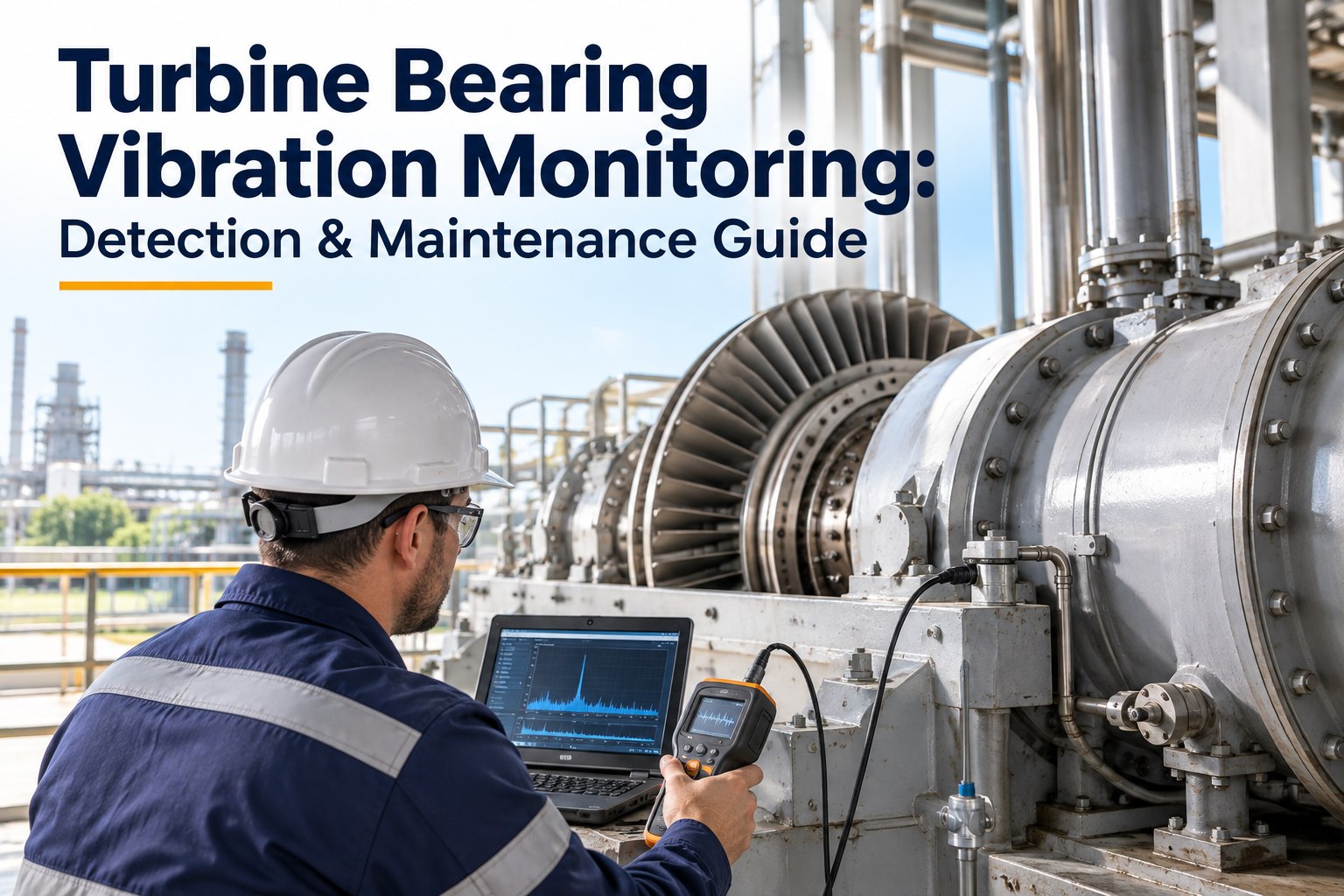
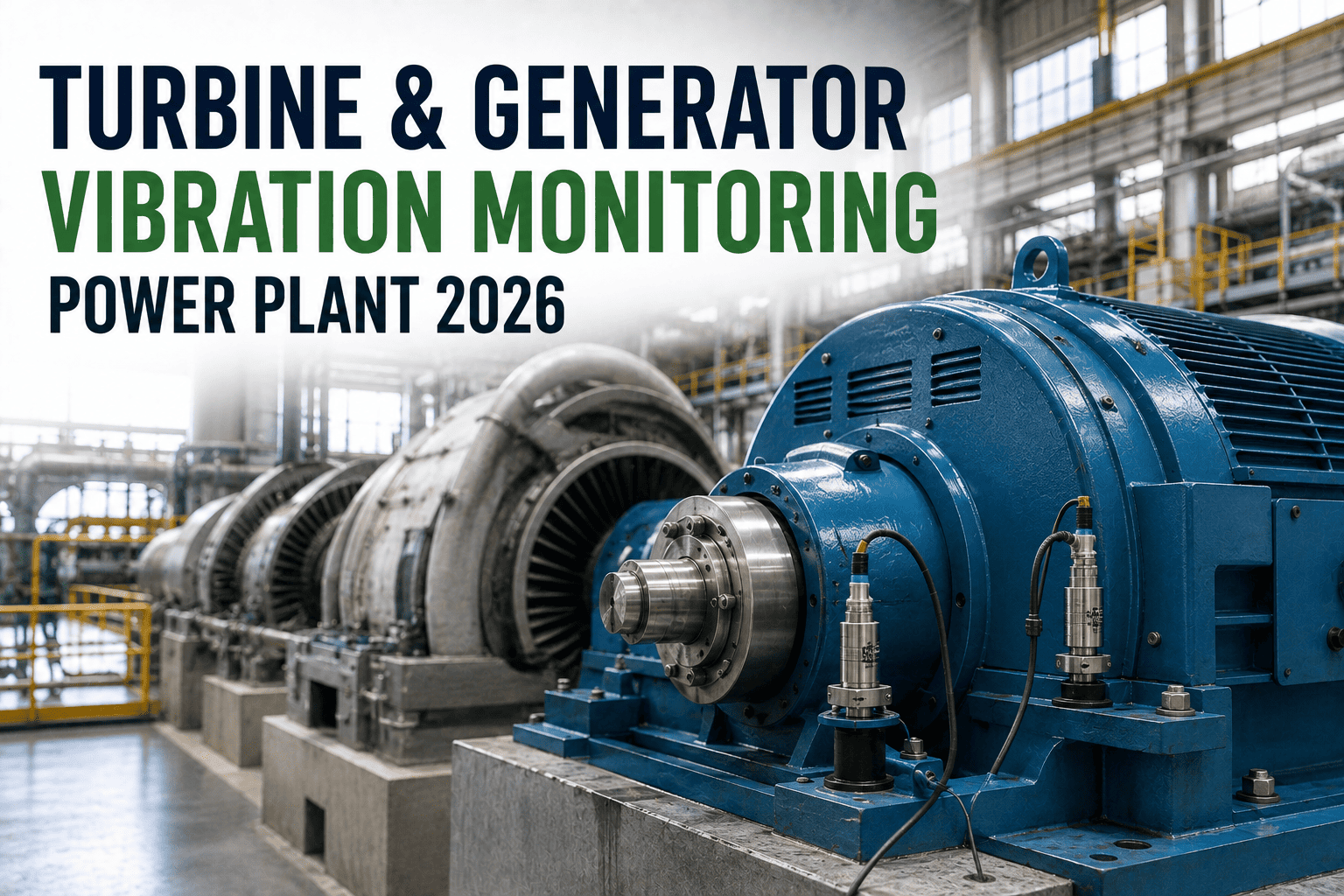
Every fault in a turbine bearing has a signature — a specific place on the frequency spectrum where it shows up first, well before it's audible or visible. Rotor imbalance announces itself at one times running speed. Misalignment shows up at twice running speed. A developing spall on a bearing race generates its own characteristic frequency, calculable from the bearing's own geometry, hours or weeks before the fault would ever trip a temperature alarm. The technology to read these signatures has existed for decades — what separates a working monitoring program from a sensor nobody looks at is knowing which peak means what, and having a place for that reading to turn into an inspection instead of a dashboard nobody checks.
Turbine Bearings · Vibration Monitoring · Rotating Equipment · 2026
Read the Signature Before the Bearing Tells You the Hard Way
A rising 1× peak, growing BPFO signature, or increasing envelope energy can signal an early bearing fault. OXMAINT compares turbine vibration data with its baseline, flags ISO 20816 threshold breaches, and creates an inspection or work order before failure.
1× RPM
the synchronous frequency that flags rotor imbalance
2× & 3× RPM
harmonics that typically flag shaft misalignment
4 frequencies
BPFO, BPFI, BSF & FTF — the bearing-geometry-specific defect signatures
Envelope analysis
the earliest-detecting method, reading sub-surface fatigue before surface damage appears
Match the Peak to the Fault
An FFT spectrum turns raw vibration into a map of exactly what's wrong and where. These are the signatures worth knowing before you're staring at one during an actual alarm. Start free and start trending your own turbines' spectra.
1× Running Speed
Rotor Imbalance
A dominant, stable sinusoidal peak at shaft speed, radial-dominant. Grows in amplitude as imbalance worsens.
2× & 3× Running Speed
Misalignment
Elevated harmonics alongside the 1× peak. Angular misalignment shows strong axial vibration; parallel misalignment is more radial.
BPFO / BPFI
Bearing Race Wear
Impulsive peaks at frequencies calculated from bearing geometry — outer race (BPFO) or inner race (BPFI) defect.
BSF / FTF
Rolling Element / Cage Wear
Ball spin frequency flags rolling-element damage; fundamental train frequency flags cage wear or slip.
Many Sub- & Super-Harmonics
Mechanical Looseness
Erratic amplitude across many harmonics, often with a truncated waveform in the time domain.
High-Frequency Envelope
Early-Stage Bearing Fatigue
Ultrasonic-range energy from micro-stress release in bearing steel — detectable before surface damage forms.
The Four Bearing Defect Frequencies
Every rolling-element bearing has four characteristic fault frequencies, calculated from its own geometry — number of rolling elements, ball diameter, pitch diameter and contact angle. Book a demo to see these calculated for your specific bearing catalog.
⭕
BPFO
Ball Pass Frequency, Outer Race
The most common defect frequency — the outer race is stationary, so contamination and impact damage tend to hit it first.
🔘
BPFI
Ball Pass Frequency, Inner Race
Often linked to shaft fit problems or contamination reaching the rotating inner race.
⚙️
BSF
Ball Spin Frequency
Flags damage to the rolling elements themselves — the balls or rollers, rather than a race.
🔗
FTF
Fundamental Train (Cage) Frequency
Flags cage wear or slip — the component holding the rolling elements in position.
Every Reading Trended. Every Threshold Named to a Fault.
OXMAINT keeps each turbine's vibration baseline, ISO 20816 zone status, and fault-frequency trend on one asset record — so a rising BPFO signature or a growing 1× peak opens an inspection naming the suspected fault, not a generic alarm.
Catching It Early vs. Catching It Late
Not every detection method sees a bearing fault at the same stage. Using only broad RMS trending means missing the earliest warning entirely.
RMS Velocity Trending Alone
Catches general deterioration, imbalance, misalignment
Misses sub-surface bearing fatigue in its earliest stage
Rising trend often only visible once damage is already progressing
FFT + Envelope Analysis
Pinpoints the specific fault frequency and likely cause
High-frequency envelope catches sub-surface fatigue earliest
Diagnosis, not just detection — names the fault, not just "something's off"
From Reading to Scheduled Work — The 4-Step Loop
01
Capture the Spectrum
Vibration reading logged against the specific bearing's baseline and calculated fault frequencies.
02
Match the Signature
Peak location — 1×, 2×, BPFO/BPFI, envelope energy — matched against known fault signatures.
03
Check the Zone
Overall severity checked against ISO 20816 zones to gauge urgency alongside the specific fault.
04
Open the Work Order
Inspection or repair scheduled, with the suspected fault and bearing reference attached.
Setting Up a Program That Actually Gets Used
✓
Establish a real baseline per bearing before setting alert thresholds — not a generic default.
✓
Calculate bearing-specific fault frequencies from actual bearing geometry, not a rough estimate.
✓
Use envelope analysis alongside standard FFT to catch sub-surface fatigue at its earliest stage.
✓
Tie alerts to ISO 20816 zones, not a single arbitrary number, so severity guides urgency.
✓
Name the suspected fault on the resulting work order — a diagnosis, not just an alarm, saves the technician's first hour.
✓
Review the trend, not just the latest reading — a slow climb toward a fault frequency is as important as crossing it.
Frequently Asked Questions
What's the difference between 1× and 2× vibration readings?
A dominant peak at 1× running speed (once per shaft revolution) typically indicates rotor imbalance. A peak at 2× (twice running speed), especially alongside the 1× peak, typically indicates misalignment — angular misalignment tends to show more strongly in the axial direction, parallel misalignment more in the radial direction.
What are BPFO and BPFI, and why do they matter?
Ball Pass Frequency Outer race (BPFO) and Inner race (BPFI) are characteristic frequencies calculated from a specific bearing's geometry. A rising peak at one of these frequencies indicates a developing defect on that specific race — outer or inner — well before it would show up as a temperature change or audible noise.
What is envelope analysis, and how is it different from standard FFT?
Standard FFT analyzes vibration energy across a frequency range to find dominant peaks. High-frequency envelope analysis specifically targets the ultrasonic-range signals produced by micro-stress release in bearing steel — a signal that appears before surface-level bearing damage develops, making it useful for the earliest possible detection.
Can vibration monitoring tell you which specific bearing component is failing?
Yes, in most cases — the four bearing defect frequencies (BPFO, BPFI, BSF, FTF) each correspond to a different bearing component, so a peak at one of these frequencies (rather than another) points to whether it's the outer race, inner race, rolling elements, or cage that's developing a fault.
How does OXMAINT use ISO 20816 in vibration alerts?
ISO 20816 defines vibration severity zones (A through D) used across rotating machinery to classify overall vibration severity. OXMAINT checks incoming readings against a bearing's own baseline and these zone boundaries to help prioritize which threshold breaches need immediate attention versus scheduled follow-up.
Know Which Fault It Is Before the Bearing Fails.
Trend every turbine bearing's vibration signature against its own baseline — and let a rising 1× peak, a BPFO signature, or growing envelope energy open a work order that already names the suspected fault.