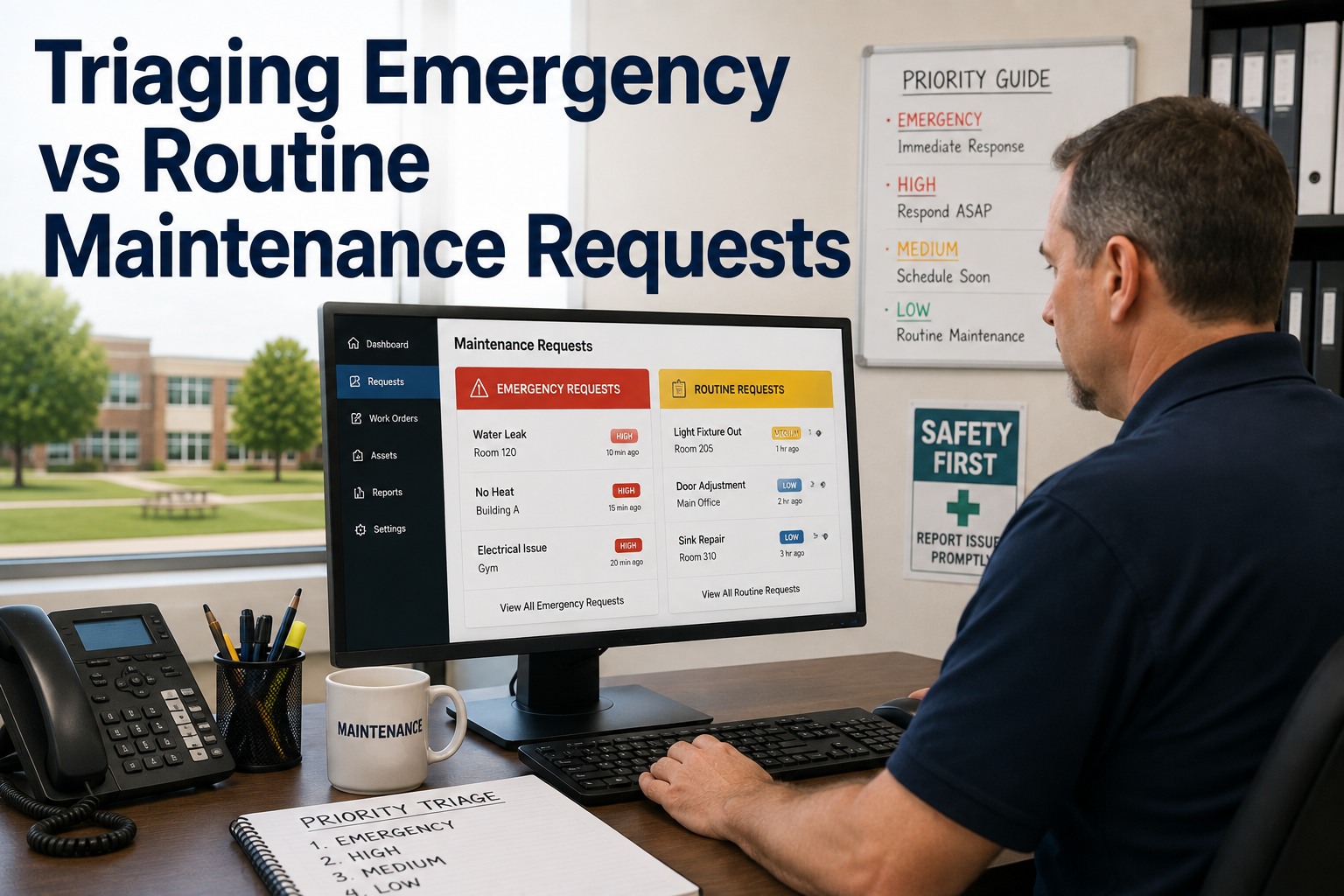
Emergency vs routine maintenance triage is the single biggest lever property teams have for controlling costs, protecting tenants and extending asset life — yet most teams still treat every ticket as urgent, burning through labor budgets and delaying the work that actually matters. A structured maintenance request triage system classifies each incoming request by severity, safety risk and operational impact, then routes it to the right technician with a clear response-time SLA. Property maintenance prioritization is what separates teams running at 90%+ first-time-fix rates from those drowning in reactive work orders. This guide breaks down the definitions, intake workflow and communication scripts you need to triage maintenance requests with confidence — and shows how OxMaint automates the entire prioritization process so nothing slips. Ready to stop firefighting? Start Free Trial and see the difference today.
Is every maintenance request treated as an emergency in your operation?
When 100% of tickets are flagged urgent, 0% actually are — and your fastest technicians spend their day on leaky faucets while a life-safety issue waits in the queue. Triage fixes that.
Emergency vs routine maintenance: legal & operational definitions
Most jurisdictions and lease agreements define emergency maintenance property as any condition that poses an immediate threat to occupant health, safety, property or habitability — think gas leaks, sewage backups, no-heat in winter, electrical sparking or structural failure. Everything else — a dripping faucet, a noisy HVAC fan, a cracked outlet cover — falls under routine maintenance property, which can be scheduled within 24–72 hours without legal exposure.
Immediate response required
- Gas leak, carbon monoxide or fire risk
- No heat in winter / no AC in extreme heat
- Sewage backup or flooding from burst pipe
- Electrical sparking, exposed live wiring
- Broken lock on ground-floor entry
- Elevator entrapment or stuck occupants
Planned & scheduled
- Slow drain, minor drip, running toilet
- HVAC making noise but still heating/cooling
- Cracked outlet cover or switch plate
- Appliance operating but not optimally
- Cosmetic drywall or paint damage
- Pest control (non-infestation)
How to triage maintenance requests in 5 steps
A repeatable maintenance request triage workflow removes guesswork from intake. Here is the 5-stage process high-performing property teams use to prioritize maintenance requests from first call to closed ticket.
Intake with structured fields
Every request is captured through a portal or phone script that asks: What is the issue? Is there water, gas, heat or electrical involved? Are vulnerable occupants (elderly, infant, medical-needs) affected? This data feeds the triage engine automatically.
Auto-classify by severity matrix
Requests are scored against a severity matrix — safety risk, asset criticality, legal/habitability exposure and occupancy impact. A gas leak scores P1 (emergency); a slow drain scores P3 (routine). No human judgment needed at this stage.
Route to the right technician
P1 emergencies page the on-call tech or 24/7 vendor immediately with all job details pushed to mobile. P2–P3 jobs enter the planning queue for the next available slot, matched by skill, certification and proximity.
Communicate SLA expectations
The tenant receives an automated message stating the priority level assigned, the expected response window and next steps. Setting the expectation up front cuts follow-up calls by up to 40%.
Close the loop & log data
On completion, the tenant gets a resolution notification and a quick satisfaction rating. The work order — labor hours, parts used, root cause — feeds your analytics dashboard for continuous SLA improvement.
Property repair triage matrix: priority levels & response SLAs
Use this matrix as your baseline for maintenance priority property decisions. Adjust response windows to match your lease terms and local habitability codes — but keep the four-tier structure consistent across every property.
| Priority | Definition | Response Time | Resolution Target | Example |
|---|---|---|---|---|
| P1 — Emergency | Immediate threat to life, safety, health or property | 1–2 hours | Within 24 hours | Gas leak, no heat in freezing weather |
| P2 — Urgent | Significant impact but no immediate safety danger | 4–8 hours | Within 48 hours | Partial power outage, one of two AC units down |
| P3 — Routine | Functional inconvenience; habitability not affected | 24–72 hours | Within 5–7 days | Slow drain, noisy fan, minor drip |
| P4 — Planned | Cosmetic or preventive; can wait for next cycle | 7–14 days | Within 30 days | Paint touch-up, filter swap, caulk renewal |
Automate maintenance request triage with OxMaint
Manual triage on spreadsheets or email inboxes is where SLAs collapse. OxMaint's AI-powered CMMS classifies, routes and tracks every work order automatically — so true emergencies get speed and routine work gets planned. Here is what teams gain when they switch.
AI severity scoring at intake
OxMaint reads each incoming request, scores it against your severity matrix and assigns P1–P4 priority in under 2 seconds — no dispatcher judgment required. Cuts misclassified emergencies by up to 70%.
Auto-routing & SLA tracking
P1 emergencies page the on-call technician instantly with full job context on mobile. SLA countdowns and escalation alerts ensure no emergency maintenance property ticket breaches its response window.
Tenant communication on autopilot
Automated SMS and email updates keep tenants informed at intake, dispatch and resolution — reducing inbound follow-up calls by 35–45% and keeping satisfaction scores above 4.5/5.
Analytics that prove compliance
Every triage decision, response time and resolution is logged with timestamps. Export a full audit trail in one click for lease compliance, habitability disputes or insurance claims — zero manual record-keeping.
See OxMaint triage your maintenance requests live
Book a 30-minute demo and watch real work orders get classified, routed and resolved — on your assets, with your team's SLAs.
What changes when triage works: a worked example
A 320-unit multifamily portfolio spending $48K/yr on emergency callouts
Before OxMaint
- 63% of tickets flagged urgent — technicians ran reactively all day
- Average emergency response: 4.5 hours (SLA breach on 1 in 4)
- After-hours vendor callouts: $48,200/year
- Tenant satisfaction: 3.6 / 5
After OxMaint (6 months)
- True emergencies correctly identified 98% of the time at intake
- Average emergency response: 1.3 hours — zero SLA breaches in Q2
- After-hours callouts down to $19,600/year (59% reduction)
- Tenant satisfaction: 4.7 / 5
Emergency vs routine maintenance triage: frequently asked questions
What counts as emergency maintenance on a property?
Emergency maintenance is any issue posing an immediate threat to occupant health, safety, habitability or structural integrity — gas leaks, sewage backups, no-heat in freezing weather, electrical sparking, flooding or a broken ground-floor entry lock. These require a response within 1–2 hours under most lease terms and local habitability codes. Everything else is routine maintenance and can be scheduled within 24–72 hours. Start Free Trial to automate this classification instantly.
How fast should a landlord respond to a maintenance request?
P1 emergencies should receive a response within 1–2 hours and resolution within 24 hours. P2 urgent issues within 4–8 hours. P3 routine requests within 24–72 hours. P4 planned items can be addressed within 7–14 days. These windows align with industry-standard SLAs and most state habitability guidelines.
How do you prioritize maintenance requests when everything feels urgent?
Use a severity matrix scoring each request on safety risk, legal/habitability exposure, asset criticality and occupancy impact. Requests involving life-safety hazards score P1; functional inconveniences with no safety risk score P3. OxMaint's AI engine applies this matrix automatically at intake so triage is consistent and auditable — Book a Demo to see it classify your real tickets.
Can a tenant sue for delayed emergency maintenance?
Yes. If a genuine emergency — such as no heat in winter or a sewage backup — goes unaddressed beyond the legally required response window, tenants may file habitability complaints, withhold rent, or pursue damages in many jurisdictions. Documenting your triage decision, response timestamp and resolution is your best legal defense — which is why automated logging in a CMMS like OxMaint is essential.
What is the difference between maintenance triage and preventive maintenance?
Maintenance triage is the process of classifying and prioritizing incoming reactive requests — deciding which need immediate action and which can wait. Preventive maintenance is scheduled, proactive work performed on a calendar or usage-based cycle (filter changes, inspections, lubrication) to prevent failures before they happen. OxMaint handles both: triaging reactive tickets while running your PM schedule in parallel to reduce future emergencies.
Stop treating every ticket like an emergency
OxMaint's AI-powered CMMS classifies, routes and tracks every maintenance request — so true emergencies get speed, routine work gets planned, and your team stops firefighting. Free 14-day trial · No credit card required.
Free 14-day trial · No credit card
.png)