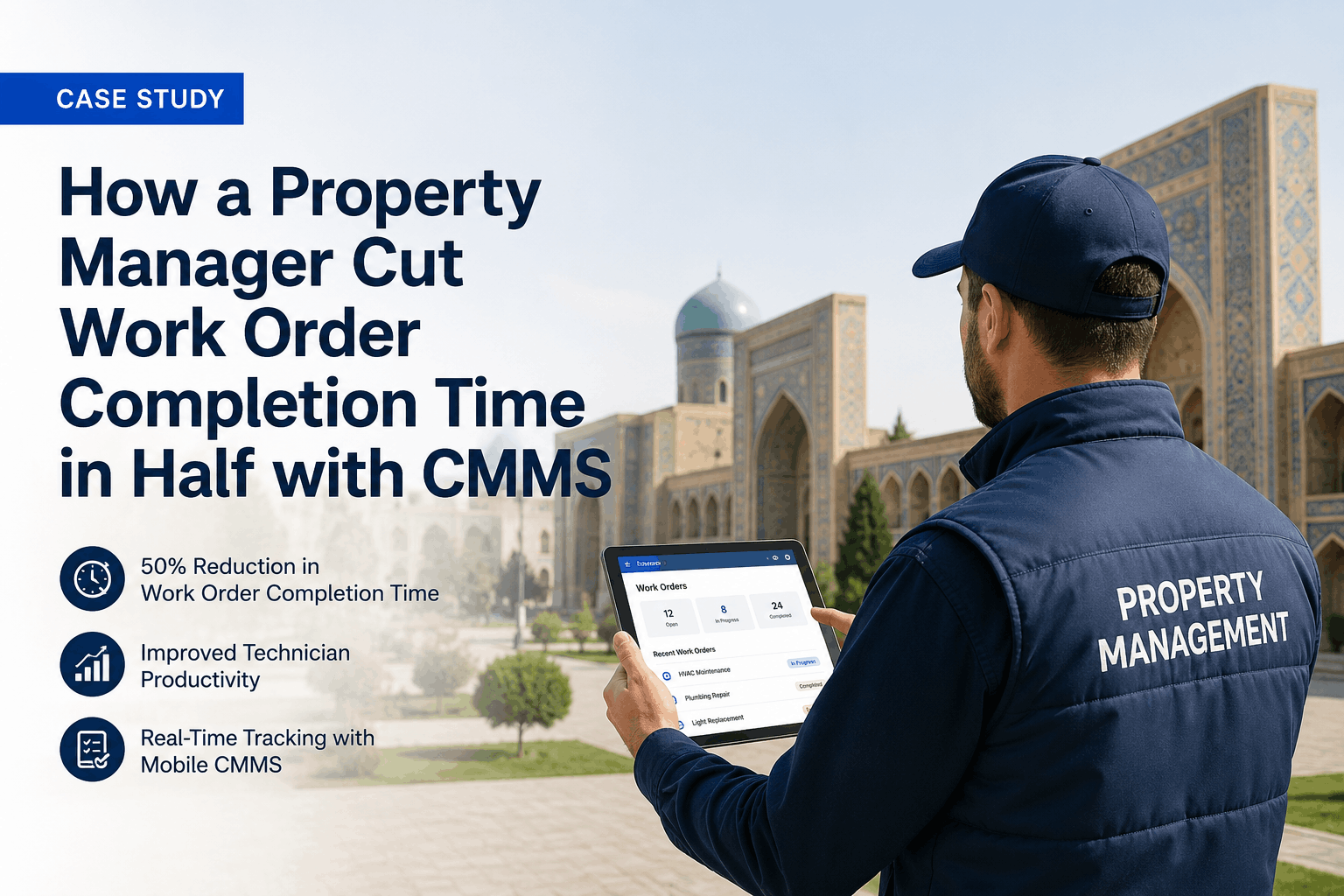
A 350-unit luxury residential tower — home to over 900 residents across 42 floors — was drowning in paper. Maintenance requests arrived on handwritten slips. Work orders were printed, signed, filed, and lost. Technicians carried clipboards. Supervisors re-entered data into spreadsheets every evening. The operations team spent more time managing paper than managing the property. Twelve months after deploying OxMaint's Mobile App & Field Access platform, the tower achieved fully paperless maintenance operations, cut administrative overhead by 65%, reduced work order completion time by 48%, and logged a 91% technician adoption rate within the first 30 days. Book a demo to see how OxMaint transforms residential maintenance operations.
Ready to Go Paperless?
See how OxMaint's Mobile App & Field Access platform eliminates administrative overhead in luxury residential properties.
350 units. 65% admin reduction. 91% technician adoption. Fully paperless in 21 days.
01 / The Property
350 Units. 42 Floors. One Operations Team Running on Paper.
Property Type
Class A luxury high-rise residential tower. Mixed-tenure: long-term rentals, short-stay serviced apartments, and owner-occupied units across four residential wings.
Scale
350 residential units across 42 floors. Approximately 920 residents. Amenity levels include rooftop terrace, fitness center, concierge suite, and two parking structures.
Maintenance Team
11-person in-house operations team. Three supervisors, six field technicians, two administrative coordinators. Multi-trade: HVAC, plumbing, electrical, and general maintenance.
Request Volume
Averaging 340 maintenance requests monthly. Peak months reaching 480+. 100% processed via paper-based work order forms prior to deployment.
Prior System
Paper work order binders. Resident requests via front desk or telephone. Manual spreadsheet logging by coordinators. Zero digital field access or mobile capability.
Resident Profile
High-expectation resident base. Premium lease rates averaging $4,200/month. Maintenance responsiveness cited in 78% of lease renewal surveys as a satisfaction factor.
02 / The Challenge
The Hidden Cost of Paper-Based Operations
The inefficiency was not confined to administrative inconvenience. Paper-based operations were creating systemic delays, data blind spots, and resident friction that were eroding the property's premium positioning. With no digital record layer, supervisors had no real-time visibility into work order status, technician location, or task backlog. Every escalation started with a phone call. Book a demo to see how OxMaint eliminates these exact operational gaps.
65%
Admin time lost to manual data entry
Two coordinators spent an estimated 22 combined hours weekly re-keying handwritten work orders into spreadsheets, compiling status updates, and generating monthly maintenance summaries manually.
3.4 days
Average work order completion time
From resident request to completion sign-off, the paper cycle averaged 3.4 days — not because the work took that long, but because paperwork routing, technician assignment, and status updates were all manual and asynchronous.
34%
Work orders with incomplete records
Audit of prior-year maintenance files found 34% of closed work orders were missing at least one required field — parts used, labor time, or completion signature — creating liability exposure and preventing warranty claims.
0%
Real-time supervisor visibility
Supervisors had no mechanism to view active work order status without physically locating a technician or calling the front desk. Escalations from residents could not be answered in real time — only after manual status checks.
Paper wasn't just slow — it was invisible. There was no way to know where a job stood, which technician had it, or whether it had been started at all, without physically tracking someone down.
03 / The Solution
OxMaint Mobile App & Field Access: Full Digital Transition
After reviewing three digital maintenance platforms, the property management team selected OxMaint for its combination of mobile-first field access, offline capability for basement and lower-floor coverage gaps, and a deployment model that did not require a third-party implementation consultant. The existing 11-person team handled the transition independently. Sign up free and explore the platform your team can deploy on their own.
The solution centered on replacing every paper touchpoint with a mobile-native equivalent — from resident request intake through field execution to supervisor sign-off. OxMaint's Field Access module gave technicians complete work order visibility on their devices, with real-time status updates that eliminated the need for any back-and-forth coordination through the front desk or administrative coordinators.
APP
Mobile work order management replaced paper binders entirely. Technicians received, accepted, updated, and closed work orders from their mobile devices — with full asset history, photo documentation, and parts logging available at the point of work.
FLOW
Digital request-to-close workflow automated routing from resident submission through assignment to completion. Supervisors gained real-time dashboards showing active jobs, technician status, and open backlog without any manual check-ins.
DATA
Structured data capture enforced mandatory completion fields — labor time, parts consumed, resolution notes, and photo evidence — making incomplete records structurally impossible, not a policy issue.
OPS
Resident communication integration sent automatic status notifications at key workflow milestones — request received, technician dispatched, work complete — eliminating inbound status calls to the front desk.
04 / Implementation
Fully Operational in 21 Days. Last Paper Work Order: Day 22.
Days 1–4
Asset Registry & Workflow Mapping
All 350 units, common areas, and building systems mapped into OxMaint's asset registry. Existing work order categories migrated from paper templates to digital form structures. Request routing rules configured per trade type and floor zone.
Days 5–10
Mobile Device Configuration & Offline Setup
OxMaint app deployed across 11 team devices. Offline mode configured and tested for basement mechanical rooms and parking structures with limited connectivity. QR code asset tags printed and installed across 218 maintenance-tracked assets.
Days 11–17
Parallel Run & Field Training
Seven-day parallel operation period: paper and digital simultaneously. All 11 team members completed role-specific training — technicians in 1.5 hours, supervisors in 2.5 hours, coordinators in 3 hours. 91% of technicians self-rated confident with the platform by end of day 17. Book a demo to see how fast your team can get up to speed.
Days 18–21
Digital Cutover & Paper Elimination
Full digital cutover completed. Paper work order binders archived. Resident request intake shifted to digital portal and front desk tablet. Automated status notifications activated. Supervisor real-time dashboard went live across three supervisor devices.
05 / Results
12 Months of Measurable Digital Transformation
The transition was not incremental. Eliminating paper from every maintenance workflow delivered compounding improvements across administrative efficiency, field productivity, data quality, and resident experience — measurable within the first 60 days of full deployment. Book a demo to see these results mapped to your residential property.
| Metric |
Before OxMaint |
After OxMaint |
Change |
| Administrative overhead (weekly hours) |
22 hrs / week |
7.7 hrs / week |
−65% admin time |
| Average work order completion time |
3.4 days |
1.76 days |
−48% cycle time |
| Work orders with incomplete records |
34% |
0% |
100% record completeness |
| Technician platform adoption (Day 30) |
N/A |
91% |
Fully adopted |
| Resident status inquiry calls (monthly) |
~210 calls / month |
~34 calls / month |
−84% inbound calls |
| Maintenance satisfaction score (resident) |
6.1 / 10 |
8.7 / 10 |
+43% satisfaction |
| Monthly reporting preparation time |
9 hrs manual |
Under 45 mins |
−92% reporting time |
| Paper work orders processed |
340+ / month |
0 / month |
Fully paperless |
65%
Admin overhead reduced
0
Paper work orders remaining
91%
Technician adoption Day 30
The last paper work order was processed on day 22. Within 60 days, the coordinators had reclaimed 14 hours per week — time that shifted entirely into resident communication quality and proactive maintenance coordination.
06 / Key Analysis
Why the Numbers Moved So Sharply
01
Structured digital capture eliminated rework at the source. The prior paper system created a secondary workload: coordinators not only logged initial requests but frequently had to chase technicians for missing information — parts lists, completion signatures, labor hours — before records could be considered closed. OxMaint's mandatory field enforcement made incomplete closures impossible, removing the entire rework loop from the administrative process.
02
Automated resident notifications collapsed inbound call volume. Before deployment, the front desk fielded an estimated 210 maintenance status calls monthly — roughly seven per day — because residents had no visibility into their open requests. OxMaint's automated milestone notifications (request received, technician en route, work complete) reduced these calls to 34 per month within the first 90 days, freeing front desk staff from a significant reactive burden.
03
Real-time supervisor visibility accelerated triage and prioritization. The single largest driver of extended work order completion times was not labor capacity — it was decision latency. Supervisors could not prioritize or reassign jobs without manually checking with field technicians. The real-time dashboard eliminated this coordination lag, enabling dynamic job reassignment that reduced average completion time from 3.4 to 1.76 days. Sign up free and see the supervisor dashboard live.
04
High technician adoption was driven by simplicity, not training hours. The 91% Day 30 adoption rate was not a product of extended onboarding — technicians completed role-specific training in 1.5 hours. Adoption was driven by the platform's mobile-native design, which reduced the cognitive load of field documentation rather than adding to it. Technicians reported that closing a work order on OxMaint took less time than filling out a paper form.
07 / Business Impact
Beyond Efficiency: What the Digital Shift Protected
Resident Retention
Maintenance responsiveness satisfaction rose from 6.1 to 8.7 out of 10. In the deployment year, the property recorded its highest annual lease renewal rate — 89% — in five years of operation. Management attributed the improvement in part to measurably better maintenance communication quality.
Liability & Compliance
Achieving 100% work order record completeness — up from 66% — resolved a standing compliance gap flagged in the prior year's insurance audit. Full digital records with timestamped photo documentation now provide defensible evidence for warranty claims and incident reports.
Coordinator Capacity
Reclaiming 14+ administrative hours weekly per coordinator enabled a reallocation of both roles. One coordinator absorbed additional vendor management responsibilities; the other took on proactive resident lifecycle communications — tasks previously deferred due to workload.
Sustainability & Brand
Eliminating approximately 4,100 paper work orders annually supported the property's documented ESG initiative, contributing to a measurable reduction in operational paper consumption cited in its annual sustainability report submitted to the parent property group.
22 hrs
Weekly admin before
7.7 hrs
Weekly admin after
−84%
Resident status calls
21 days
To fully paperless
08 / Conclusion
Paperless Is Not a Destination — It's a Foundation
This tower's paper-based operations were not a legacy of negligence — they were a rational system for a period when digital alternatives were either too expensive or too disruptive to deploy. That calculus has shifted permanently. OxMaint's Mobile App & Field Access platform made the transition achievable in 21 days, at a cost recoverable in the first quarter through administrative savings alone. Book a demo to see your property's transition roadmap.
More significantly, the digital layer created a foundation that paper never could: a complete, timestamped, searchable record of every maintenance event in the building's history — available in real time to supervisors, queryable for trend analysis, and presentable to residents, insurers, and regulators as structured evidence. The 65% reduction in administrative overhead is the visible result. The institutional knowledge now preserved in structured digital form is the compounding asset. Request a demo to see how OxMaint maps to your residential property's operations.
65% Admin Reduction. 91% Adoption. Fully Paperless in 21 Days.
350 units. Zero paper. Real-time field visibility from day one. See what it looks like for your property.
09 / FAQ
Frequently Asked Questions
What does a paperless maintenance operation mean for a residential tower?
A paperless maintenance operation means every step of the maintenance workflow — resident request intake, work order creation, technician assignment, field execution, parts logging, and completion sign-off — is handled digitally, with no paper forms, binders, or manual data re-entry at any stage. The result is a complete digital record of all maintenance activity, real-time supervisor visibility, and automated resident communications, all managed through a mobile platform accessible to every member of the operations team.
How does OxMaint's mobile field access work for maintenance technicians?
OxMaint's mobile app gives technicians a complete view of their assigned work orders — including asset history, previous maintenance notes, required parts, and any resident-supplied details — directly on their mobile device. Technicians can accept jobs, log labor time, photograph completed work, record parts used, and close work orders from the field without returning to a central desk or completing paper forms. The app functions offline in low-connectivity areas such as basement mechanical rooms, syncing data when connectivity is restored.
How long does it take to transition a residential property to paperless maintenance with OxMaint?
Transition timelines depend on team size and asset count, but this 350-unit, 11-person team was fully operational and paper-free within 21 days — including asset registry setup, device configuration, parallel run, team training, and full cutover. Smaller residential properties typically complete the transition in 10–14 days. OxMaint is designed for existing operations teams to implement independently, without external consultants or dedicated IT staff.
What administrative efficiency gains can residential properties expect from digital maintenance?
Properties transitioning from manual paper-based systems typically see 50–70% reductions in administrative overhead within the first 90 days. The primary savings come from eliminating manual data re-entry, removing status-check workflows, automating report generation, and enforcing structured data capture that prevents record rework. This tower achieved a 65% reduction, recovering 14+ administrative hours per week across its two-coordinator team.
How does digital maintenance management improve resident satisfaction in luxury residential buildings?
Digital maintenance management improves resident satisfaction through two primary mechanisms: faster completion times and proactive communication. Automated status notifications eliminate the need for residents to call and check on their requests, while real-time supervisor dashboards enable faster triage and technician dispatch. This property reduced work order completion time by 48% and cut resident status inquiry calls by 84%, contributing to a maintenance satisfaction score improvement from 6.1 to 8.7 out of 10.
Does OxMaint support compliance and liability documentation for residential properties?
Yes. OxMaint's structured digital records provide timestamped, photo-documented evidence of every maintenance event — including the technician who performed the work, materials used, labor time, and completion verification. This record completeness supports insurance audits, warranty claim submissions, regulatory inspections, and incident documentation. This tower resolved a standing insurance audit finding by achieving 100% work order record completeness — up from 66% under the prior paper system.
What is the typical technician adoption rate for OxMaint in residential properties?
Technician adoption is consistently high because OxMaint's mobile interface is designed to reduce the effort of field documentation rather than add to it. Role-specific training for field technicians averages 1.5 hours. This property recorded a 91% confident-adoption rate among technicians within the first 30 days of deployment — a result driven by platform simplicity and the fact that closing a digital work order required less time than completing a paper form.