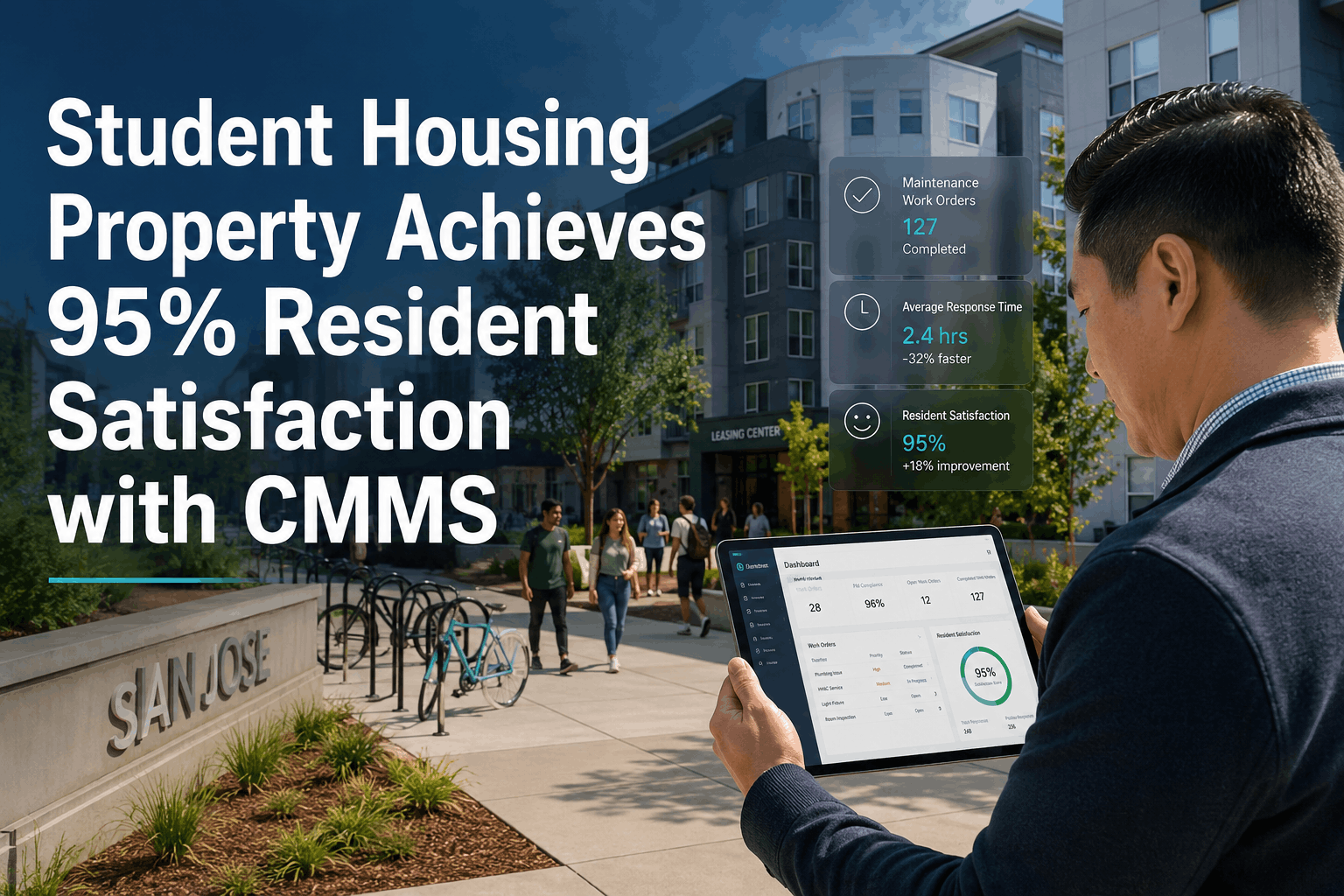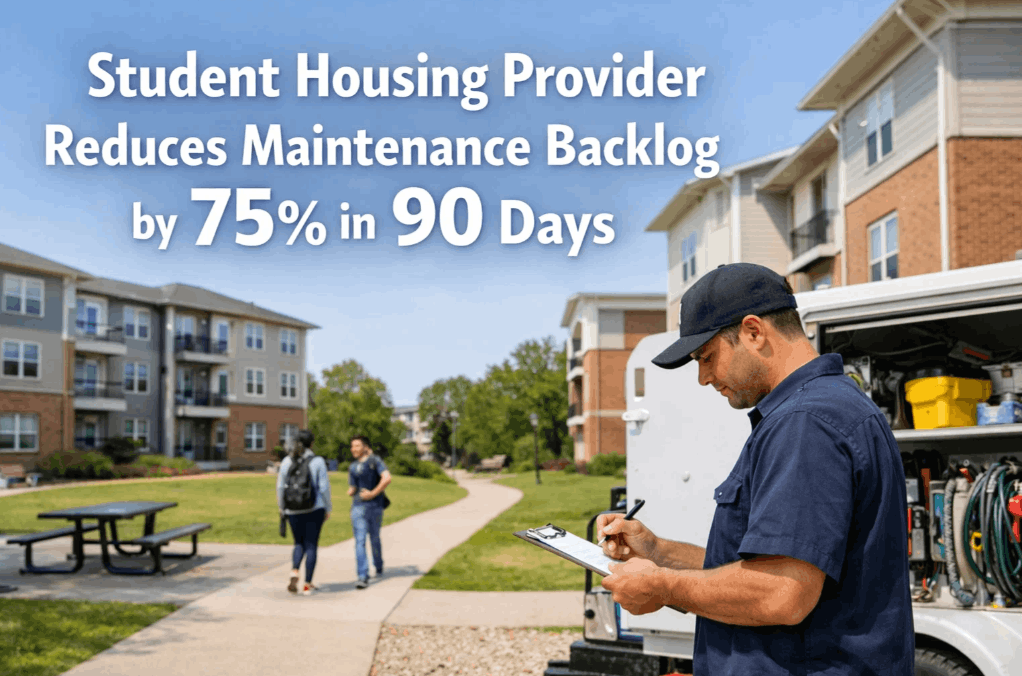
Student housing operations run on volume. Thousands of residents, thousands of requests, and a maintenance team that was never built to absorb the surge. For one 3,000-bed provider managing six properties across two campuses, the backlog wasn't a symptom of poor staffing — it was the direct result of a work order system that couldn't keep up. Within 90 days of deploying OxMaint's automated work order management platform, they eliminated 75% of their backlog and fundamentally changed how their operations team worked. Book a demo to see how OxMaint handles high-volume student housing operations.
The Property
The Challenge
Student housing maintenance is unlike commercial or residential property management. The academic calendar creates hard operational deadlines — move-in weekends demand fully functional units, and mid-semester failures affect residents with no flexibility to relocate. The provider was managing 3,000 beds with a manual intake system that treated a dripping tap and a broken heating unit with equal priority: first in, first out.
The consequences were measurable. Resident satisfaction scores had dropped to 3.1 out of 5 across all six properties. The operations manager was spending 40% of their working week chasing status updates instead of managing outcomes. And with move-in season 90 days away, the backlog was on track to exceed 500 open items.
The Solution
The provider evaluated three platforms before selecting OxMaint. The deciding factors were deployment speed, the ability to configure priority logic specific to student housing workflows, and mobile-first technician access that required no laptops or desk check-ins. OxMaint's work order management module was configured and live within the first week.
Key capabilities deployed for this use case included automated intake from a resident-facing portal, triage rules that assigned urgency scores based on issue category and location, technician dispatch via mobile app with pre-loaded task details, and a supervisor dashboard providing live backlog visibility across all six buildings. Sign up free to explore how these features work in your property.
Implementation Approach
Resident-facing work order portal configured and branded. Priority matrix built across 8 issue categories — plumbing, HVAC, electrical, appliances, access control, pest, structural, and general. All 11 technicians onboarded to the mobile app in a single 90-minute session.
Existing 340+ open work orders imported and scored by the priority matrix. Critical items surfaced within hours. A two-week sprint addressed all P1 and P2 items with dedicated daily assignments. First visible reduction in 6 months.
All new requests flowing through the resident portal. Auto-assignment routing technicians by building zone and current workload. Supervisor dashboard replacing all manual status calls. Response time dropped from 4.1 days to under 6 hours.
Preventive maintenance schedules activated ahead of move-in season. Unit inspection checklists digitized. Backlog cleared to 84 items — a 75% reduction from peak. All six buildings certified operationally ready 11 days before the academic intake window.
Results After 90 Days
Same team. Same properties. Same resident volume. One system change. Book a demo to see what these results could look like for your portfolio.
| Metric | Before OxMaint | After 90 Days | Change |
|---|---|---|---|
| Open work order backlog | 340+ items | 84 items | 75% reduction |
| Avg. request-to-assignment time | 4.1 days | 5.8 hours | 94% faster |
| Digital intake rate | 38% | 100% | Full digitization |
| Work order closure rate (monthly) | 61% | 89% | +28 percentage points |
| Resident satisfaction score | 3.1 / 5 | 4.3 / 5 | +39% improvement |
| Supervisor time on status calls | 40% of work week | 9% of work week | 78% reduction |
| Repeat complaints (same issue) | 28% of tickets | 7% of tickets | 75% reduction |
Key Benefits and Business Impact
Move-in readiness achieved without overtime. For the first time in three years, the properties entered move-in season with a cleared backlog and no outstanding P1 items. No emergency staffing was required. The operations manager described it as the most controlled intake period in the organization's history.
Resident trust measurably recovered. Satisfaction climbed from 3.1 to 4.3 within 90 days — driven primarily by faster response visibility and consistent communication. Residents could track their request status, eliminating the follow-up calls that had consumed front desk resources daily.
Supervisor capacity unlocked. With manual status chasing eliminated, the operations manager reclaimed 31% of their weekly hours. That capacity shifted to proactive planning, contract reviews, and building-level performance analysis — work that had been deferred for over two years.
Repeat failures cut dramatically. Automated work order documentation created an issue history per unit. When a plumbing fault was logged twice in the same room within 60 days, the system flagged it for root cause investigation rather than treating it as two separate tickets. Repeat complaints dropped from 28% to 7% of all tickets.
Compliance simplified before renewal season. Elevator certifications, fire safety inspections, and electrical checks were all mapped into OxMaint's compliance calendar. Regulators and institutional landlords received documentation packages in under 24 hours — previously a two-week manual process. Book a session to see how OxMaint supports compliance across student housing portfolios.
Conclusion
This case demonstrates that high-volume student housing maintenance problems are fundamentally systems problems, not staffing problems. Eleven technicians managing 3,000 beds is operationally viable — but only inside a system that can receive, triage, assign, track, and close requests without manual intervention at every stage.
OxMaint's work order management platform provided exactly that foundation. Within 90 days, the backlog dropped by 75%, resident satisfaction recovered to its highest point in two years, and the operations team entered move-in season prepared rather than reactive. The investment in structured workflow returned measurable results before the academic year even began. Start your free trial and see the difference in week one.