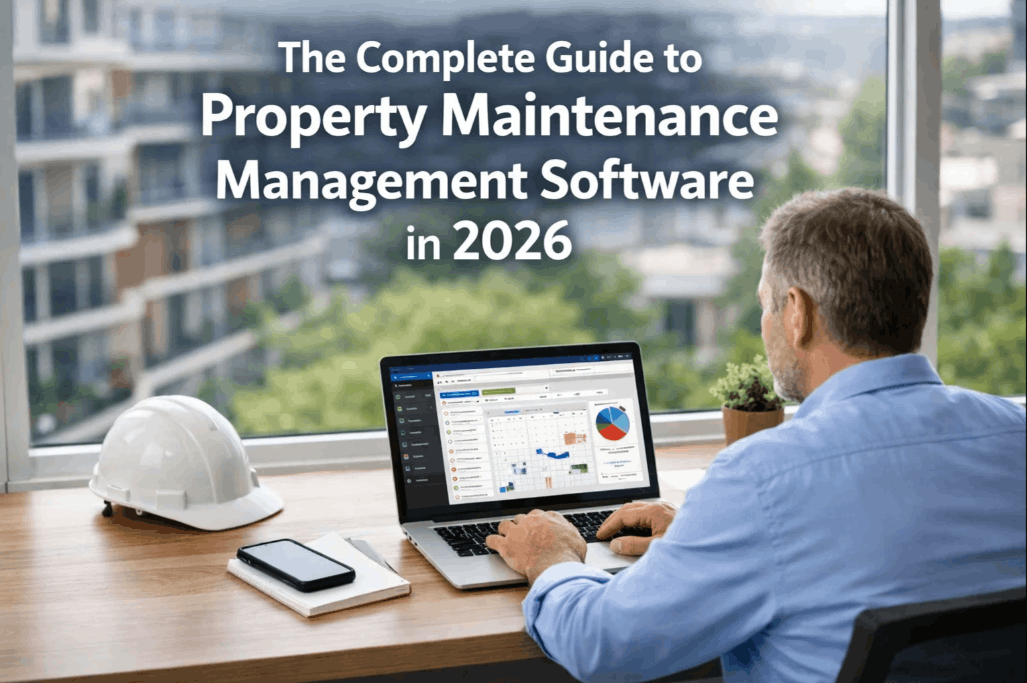
Property management has entered a new era. Across residential complexes, commercial office parks, retail chains, and industrial campuses, facility operators are retiring fragmented spreadsheets and reactive repair cultures in favour of intelligent, cloud-native property maintenance management software — platforms that unify work order automation, asset tracking, vendor coordination, compliance documentation, and predictive analytics into a single operational system. As the global CMMS market crosses $1.8 billion in 2026, the strategic question for property operators is no longer whether to digitise maintenance management, but which platform architecture delivers the highest return on operational investment across their specific portfolio type and scale.
Average 3-year ROI from mature CMMS deployments across property portfolios
Join the PlatformSee OxMaint in action with a property specialist — automated PM, real-time visibility, audit-ready docs
Step Into the DemoWhat Is Property Maintenance Management Software?
Property maintenance management software — classified in the industry as a Computerised Maintenance Management System (CMMS) — is a purpose-built digital platform that centralises, automates, and tracks every maintenance activity across a property portfolio. At its operational core, a modern CMMS replaces disconnected email chains, paper work orders, and asset inventory spreadsheets with a unified system of record: a single environment where every maintenance request, inspection schedule, vendor contract, equipment service history, and compliance document is stored, tracked, and reportable on demand.
Unlike generic project management tools, property-focused CMMS platforms are engineered around the specific operational rhythms of real estate: recurring preventive maintenance schedules tied to lease obligations and manufacturer intervals, vendor management workflows for third-party contractor coordination, tenant-facing fault reporting channels, asset lifecycle tracking that informs capital expenditure forecasting, and compliance documentation frameworks aligned with local building codes and safety regulations. In 2026, the leading platforms extend this foundation with AI-driven anomaly detection, IoT sensor integrations, mobile-first field interfaces, and portfolio-wide analytics dashboards that give operations leadership real-time visibility across every property in their estate. Sign up for OxMaint to explore a purpose-built property CMMS designed around these exact requirements.
Why Generic Tools Fail Property Maintenance Operations at Scale
The majority of property operators begin their maintenance management journey with tools that were never designed for the purpose: shared email inboxes, spreadsheet-based PM trackers, or horizontal project management applications. These approaches function adequately at low portfolio complexity — a handful of assets, a small team, predictable maintenance rhythms. But as portfolios expand and asset diversity increases, the fundamental mismatch between generic tooling and property maintenance requirements becomes operationally costly in ways that accumulate invisibly until a compliance audit, tenant dispute, or major equipment failure makes them suddenly visible.
Generic tools lack the domain logic that makes property maintenance function correctly at scale. They have no concept of asset hierarchies that mirror physical building structures, no PM scheduling engines that account for seasonal servicing requirements, no vendor credentialing workflows that protect against liability exposure from uninsured contractors, and no compliance documentation architecture aligned with building code inspection cycles. As portfolios grow, teams compensate by adding administrative overhead — more manual coordination, more reconciliation work, more time assembling documentation before audits. Purpose-built property maintenance management software eliminates this overhead by embedding the right operational logic directly into automated workflows from the ground up. Explore OxMaint to see how purpose-built logic changes the game.
Core Capabilities of a Modern Property CMMS Platform
Centralised database of every building asset — HVAC units, elevators, fire systems, roofing, plumbing — with service history, warranty data, and replacement cost records
Automated PM calendars driven by manufacturer intervals, seasonal requirements, and lease obligations — eliminating missed maintenance that escalates into costly reactive repairs
End-to-end work order lifecycle from tenant fault report through technician assignment, field completion, and sign-off documentation with full photo and parts records
Centralised vendor portal with credential tracking, insurance certificate verification, purchase order management, and SLA performance monitoring
Real-time KPI dashboards tracking maintenance spend, asset reliability scores, PM completion rates, and operational health across every property in the portfolio
Key Functional Domains in Property Maintenance Management
Effective property maintenance management spans several interconnected operational areas, each with distinct workflows, stakeholder requirements, and documentation obligations. A mature CMMS platform addresses all of these domains with purpose-built logic — not generic workarounds. Understanding the full functional scope of a true property CMMS helps operators identify the gaps in their current toolset and evaluate vendor platforms against actual operational requirements rather than marketing feature lists.
Structured PM programs for HVAC, plumbing, electrical distribution, elevators, and fire suppression with automated scheduling and compliance documentation trails
Self-service tenant portals for fault reporting with transparent work order status tracking and SLA-driven resolution timelines that protect long-term lease relationships
Scheduled inspection workflows for building code compliance, fire safety certifications, and regulatory audit documentation across all property types and tenures
Asset age and condition data aggregated into capital replacement forecasts that support annual budget planning and long-term reserve fund management
Utility consumption tracking integrated with maintenance records to identify energy waste from deteriorating building systems and flag assets requiring servicing
Native mobile apps for on-site technicians enabling work order acceptance, photo documentation, parts logging, and completion sign-off from any location
CMMS Software Comparison: Feature Benchmarking for 2026
The property maintenance software landscape in 2026 spans a wide capability spectrum — from lightweight SaaS tools designed for small residential portfolios to enterprise-grade platforms built for global commercial real estate operators managing thousands of assets across multiple geographies. Navigating this spectrum effectively requires moving beyond vendor demonstrations to benchmark platforms against the specific operational requirements of your portfolio. The table below maps critical feature categories across the three primary market tiers.
Property CMMS Platform Feature Comparison by Market Tier
| Feature Category | Entry-Level Tools | Mid-Market CMMS | Enterprise / AI-Native |
|---|---|---|---|
| Work Order Management | Manual creation, email notifications only | Automated routing with mobile app support | AI-prioritised queues with predictive assignment |
| Preventive Maintenance | Basic calendar-based scheduling | Interval-based PM with procedure templates | Condition-based and predictive PM trigger logic |
| Asset Management | Simple inventory list, no hierarchy | Asset hierarchy with full service history | Complete lifecycle management with IoT sensor feeds |
| Vendor Management | Contact directory only | PO management and credential tracking | SLA enforcement with contractor performance analytics |
| Compliance Tracking | Manual tracking, no automation | Inspection checklists with due-date alerts | Regulatory mapping with auto-generated audit trails |
| Reporting & Analytics | Basic spreadsheet export | Pre-built dashboards and standard reports | Custom BI with real-time portfolio-wide analytics |
| Integrations | None or limited API access | ERP and accounting system connectors | Open API ecosystem — IoT, BMS, ERP, and PMS |
| Mobile Capability | Mobile browser only, no offline mode | Native app with offline sync | Full offline support, barcode scanning, AR-assisted workflows |
The Financial Case for Preventive Maintenance Software
The most consequential operational decision in property maintenance management is the balance between preventive and reactive maintenance — and the most quantifiable financial argument for investing in dedicated CMMS software is the cost differential between these two approaches. Reactive maintenance consistently costs three to five times more per repair incident than equivalent planned preventive maintenance. Emergency contractor call-outs, expedited parts procurement, after-hours labour premiums, and tenant disruption penalties compound direct repair costs into total incident costs that routinely exceed significant sums for major building system failures.
A single avoided emergency chiller replacement, unplanned lift outage, or fire suppression system failure can generate enough cost savings to recover the full annual cost of a mid-market CMMS subscription. When this preventive dividend is multiplied across a portfolio of multiple properties over a three-year deployment window, the financial return on investment consistently ranges from 300% to 500% in well-documented industry case studies. Beyond direct repair cost avoidance, CMMS-driven maintenance programs extend average asset useful lifespans by 20 to 30%, deferring capital replacement expenditures that represent the single largest line item in most property operating budgets. Calculate your savings with OxMaint and see what structured PM is worth to your portfolio.
Systematic PM execution reduces unplanned equipment failures by 35 to 50%, cutting emergency repair spend that runs 3 to 5 times the cost of equivalent planned maintenance
Properties with mature CMMS programs report 20 to 30% longer average asset lifespans, deferring capital replacement costs and improving long-term financial performance
Mobile work order management eliminates paper-based administrative overhead, increasing technician productive wrench time by an average of 25% within the first deployment year
Automated compliance tracking and audit documentation eliminate regulatory gaps that generate building code violations, insurance penalties, and lease dispute liabilities
Expert Reviews: What Facility Directors Say in 2026
We spoke with senior facilities and property operations leaders across commercial, residential, and mixed-use portfolios to understand what they actually evaluate when selecting and using property maintenance management software. Here is what they reported from the field.
"The platforms winning in 2026 are not the ones with the longest feature list — they are the ones that make the 80% of daily maintenance work invisible. Auto-scheduled PMs that fire without anyone touching a calendar. Mobile work orders completed in under two minutes. One-click compliance reports that used to take a week to assemble. If your team is still building inspection logs in a spreadsheet before an audit, your CMMS is not doing its job."
"Before deploying a structured CMMS, our capital planning was essentially guesswork — we replaced equipment reactively, not strategically. Now every replacement decision is backed by actual condition data and service history. We deferred two major HVAC replacements last year because the data showed they had life left. That alone paid for three years of platform costs."
"Vendor performance analytics changed how we manage contractor relationships entirely. We identified two contractors generating 60% of our repeat callback work within the first quarter of using the platform. We renegotiated one contract and terminated the other. Our average work order resolution time dropped by 31% in six months — not because we hired more people, but because we finally had the data to hold suppliers accountable."
"My biggest evaluation criterion was offline mobile capability — we have basement plant rooms and underground car parks where connectivity drops to zero. Platforms that only worked with live internet connection were immediately disqualified. The right CMMS needs to work everywhere your technicians work, not just in the office. Once we found a platform with true offline sync, our field team adoption went from grudging compliance to genuine enthusiasm."
How to Select a Property Maintenance Management Platform
Selecting a property CMMS is a long-term operational commitment. The switching costs — data migration, workflow reconfiguration, staff retraining, integration rebuilds — are substantial enough that most organisations maintain their CMMS selection for five or more years. Getting the evaluation right requires moving beyond feature demonstrations and pricing comparisons to assess regulatory alignment, integration architecture, implementation quality, and genuine vendor expertise in the property management domain. Sign up for OxMaint to see how a purpose-built property maintenance platform performs against your actual operational requirements.
Document your asset count, property types, team structure, and existing technology stack before approaching any vendor — requirement clarity produces better platform fit and more accurate total cost proposals
Map every system your CMMS must connect to — property management software, accounting platforms, building management systems, and tenant portals — and validate each vendor's API capability against your specific integration stack
Require a 30 to 60 day pilot with real assets and real work orders before committing — polished demonstrations cannot expose the usability gaps and workflow mismatches that only emerge in live operational conditions
Assess the vendor's data migration process, property-specific configuration expertise, and post-launch support model — implementation quality is the single biggest determinant of whether a capable platform delivers measurable value
Calculate full TCO including subscription fees, implementation costs, integration development, training, and support — then model against the quantified financial impact of your current reactive maintenance spend
Confirm the platform architecture scales with your portfolio growth and that the vendor's roadmap aligns with your IoT, AI, and analytics ambitions over the next three to five years
Implementation Strategy: From Legacy Systems to Digital Operations
The most common failure mode in property CMMS implementations is over-scoping the initial deployment phase. Organisations that attempt to migrate all assets, configure all workflows, and activate all integrations simultaneously encounter data quality failures, change management resistance, and timeline overruns that delay value realisation and damage internal confidence in the platform. The most successful implementations follow a structured phased approach: prioritise the highest-risk asset categories and most operationally painful workflow gaps in phase one, generate measurable results within the first 90 days, and expand to full platform capability as team proficiency and data quality mature.
Asset data quality is the single most important determinant of implementation success. Equipment records that are incomplete, inconsistently formatted, or historically inaccurate corrupt the automated workflows the platform is designed to execute. Investing in asset data cleansing before migration — verifying nameplate data, consolidating service history records, establishing consistent naming conventions — delivers compounding operational returns throughout the platform lifecycle. Change management at the frontline technician level is equally critical: staff who understand how the new system improves their daily work adopt it faster and with fewer workarounds than those who experience it purely as administrative imposition. Schedule a demo to walk through OxMaint's phased implementation approach with a specialist.
AI, IoT, and the Future of Property Maintenance Management
The most significant capability evolution in property maintenance management software between 2023 and 2026 has been the maturation of AI-powered predictive maintenance — the shift from time-based scheduling to condition-based maintenance driven by real-time equipment telemetry. Where earlier CMMS generations automated scheduling and documentation, next-generation platforms use machine learning models trained on equipment sensor data, historical failure records, and environmental inputs to predict asset failures before they occur and generate dynamic maintenance recommendations that optimise cost, operational risk, and tenant disruption simultaneously.
For property operators, the practical benefit of predictive maintenance is a fundamental transformation in how maintenance resources are allocated. Instead of servicing a rooftop HVAC unit every six months regardless of its current condition, a predictive CMMS monitors vibration signatures, refrigerant pressure, and energy consumption patterns in real time — flagging anomalies that indicate emerging failure and scheduling intervention precisely when it is most cost-effective. Commercial real estate operators piloting these systems report 25 to 40% reductions in total maintenance spend as unnecessary scheduled interventions are replaced by data-driven, just-in-time maintenance, while emergency failure rates decline simultaneously. Facilities investing in scalable, API-connected platforms today are positioning themselves to leverage these capabilities as they become standard across the industry. Book a walkthrough to see OxMaint's AI-ready maintenance architecture in action.
See OxMaint transform your property operations — mobile work orders, PM scheduling, real-time analytics
Step Into the DemoFrequently Asked Questions
What is property maintenance management software used for?
Property maintenance management software centralises all maintenance operations across a real estate portfolio — including work order management, preventive maintenance scheduling, asset lifecycle tracking, vendor coordination, compliance documentation, and capital planning. It replaces manual and fragmented processes with automated workflows that reduce costs, improve asset reliability, and provide complete operational visibility across every property in the estate.
How does a property CMMS differ from generic project management tools?
Property CMMS platforms are purpose-built for maintenance operations with domain-specific logic: asset hierarchies that mirror building structures, PM scheduling engines tied to manufacturer and regulatory intervals, vendor credentialing workflows, and compliance documentation frameworks. Generic project management tools lack this domain logic entirely and cannot scale to the complexity of multi-site property maintenance without generating significant administrative overhead.
What ROI can property managers expect from CMMS software?
Property operators consistently report three-year ROI of 300% to 500% from mature CMMS implementations, driven by reactive maintenance cost reduction of 35 to 50%, extended asset lifespans of 20 to 30%, and technician productivity gains averaging 25%. A single avoided major emergency system failure is typically sufficient to recover the full annual cost of a platform subscription.
How long does property CMMS implementation take?
A core implementation including asset data migration, PM schedule configuration, and work order management typically completes in 60 to 90 days for a focused deployment. Full platform activation with integrations, advanced analytics, and mobile rollout takes 4 to 6 months. Phased implementations that prioritise highest-risk asset categories consistently accelerate early value delivery and improve long-term adoption rates.
What features should I prioritise when selecting a property maintenance platform in 2026?
In 2026, the highest-priority evaluation criteria are mobile-first work order management with genuine offline capability, automated PM scheduling with compliance interval mapping, open API integration with existing property management and accounting systems, and AI-powered anomaly detection for condition-based maintenance. Vendor implementation quality and post-launch support expertise are equally important as platform capabilities — the best software delivers no operational value if it is incorrectly configured or poorly adopted by frontline teams.