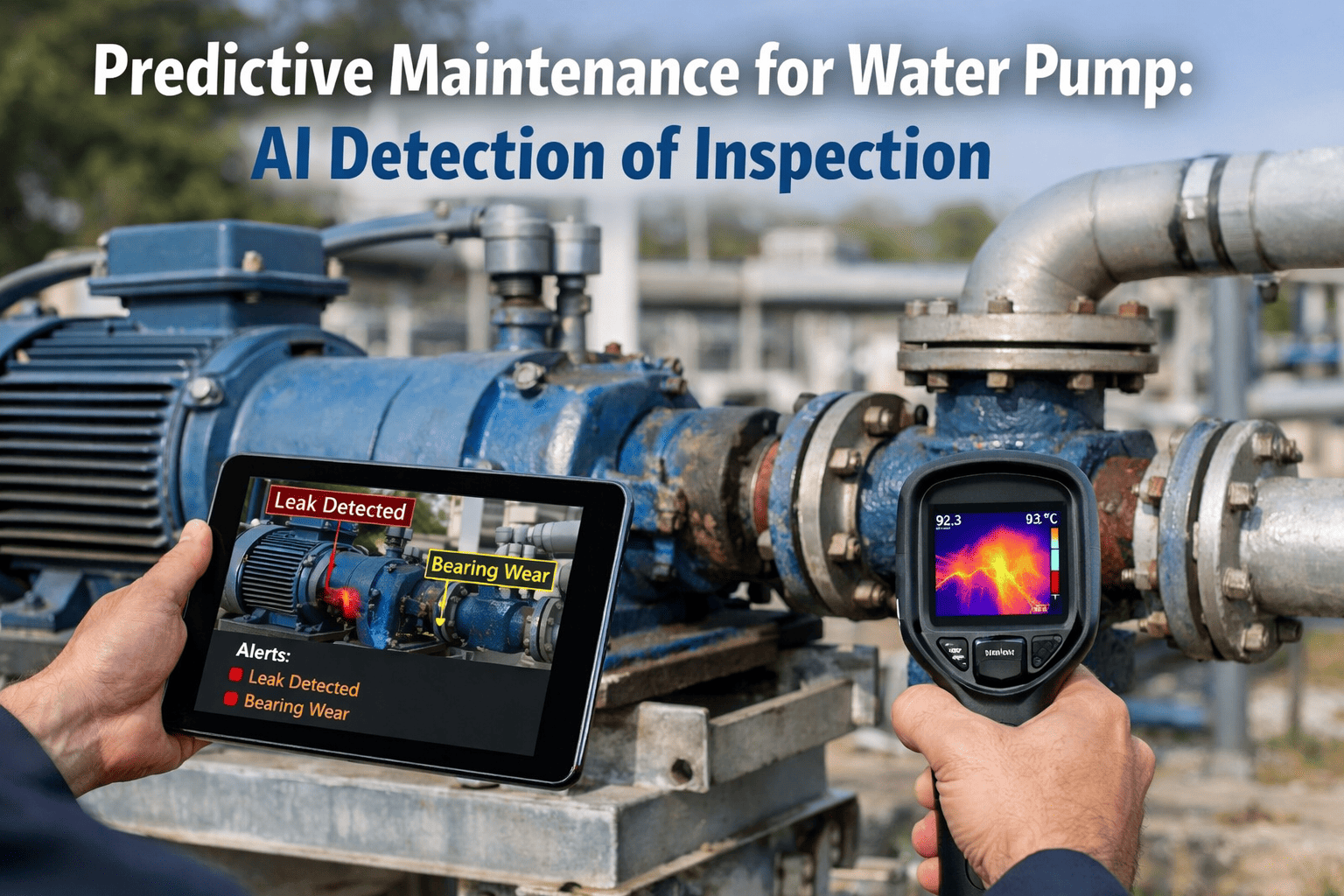
Predictive Maintenance for Rooftop Water Tanks Using AI & IoT
By oxmaint on January 22, 2026
Traditional water storage is a "black box" infrastructure: invisible degradation leads to reactive, costly failures. By integrating IoT telemetry and Machine Learning (ML) at the edge, facility managers can transition from scheduled manual checks to real-time predictive maintenance. Smart sensors stream continuous time-series data—pH, turbidity, and vibration—into cloud dashboards, where anomaly detection algorithms predict structural fatigue and contamination risks before they breach safety thresholds. Engineering teams who start a free trial replace guesswork with data-driven precision.
IoT & AI System Performance
24/7
Real-time Telemetry Stream
98.5%
ML Prediction Accuracy
<50ms
Actuator Response Latency
ZERO
Unplanned Downtime Events
Our stack monitors critical variables—ultrasonic water levels, TDS sensor readings, and solenoid valve logic states—ensuring compliance via automated logging. Facility managers ready to book a demo can see how digital twins and predictive models prevent hardware degradation.
IoT Sensor Network & Logic Audit
Standardized auditing tracks the health of the physical layer and the integrity of the data pipeline. This checklist ensures the IoT ecosystem is functioning correctly.
While software handles the logic, the physical IoT layer requires maintenance. Follow this cadence for optimal system uptime.
Continuous
AI Monitoring
Algorithms analyze flow rates and chemical composition every second.
Monthly
Sensor Calibration
Verify pH and Turbidity readings against a handheld control unit.
Quarterly
Physical Cleaning
Remove biofilm from probes and check actuator mechanical movement.
Annually
Firmware & Hardware Audit
Replace aging batteries, OTA update check, and inspect waterproofing.
Expert Insights on Smart Water Tech
"You cannot manage what you do not measure. We replaced a building's manual checks with IoT turbidity sensors and found that contamination spikes happened at 3 AM due to backflow—something a human inspector never would have caught. The AI now auto-locks the inlet valve the moment parameters deviate."
1
Data Integrity
Clean data inputs are crucial for valid AI predictions.
2
Edge Processing
Process critical alerts locally to avoid cloud latency.
3
Loop Closure
Ensure sensors can trigger actuators without human input.
We support LoRaWAN for long-range, low-power setups, as well as NB-IoT and standard Wi-Fi (2.4GHz) for buildings with existing infrastructure.
How does the AI predict leaks?
The model uses historical flow data to establish a baseline. Deviation algorithms flag usage patterns that don't match known consumption, identifying micro-leaks early.
Do sensors require external power?
Most endpoint sensors are battery-operated with a 3-5 year lifespan, utilizing sleep cycles to conserve energy. Gateways typically require mains power.
Is the data encrypted?
Yes, all transmission is secured via AES-128 encryption from the node to the gateway, and TLS 1.3 for cloud communication, ensuring data integrity.
What happens if the internet goes down?
The local gateway has edge processing capabilities to handle critical shut-off logic (e.g., stopping a pump during overflow) even without cloud connectivity.