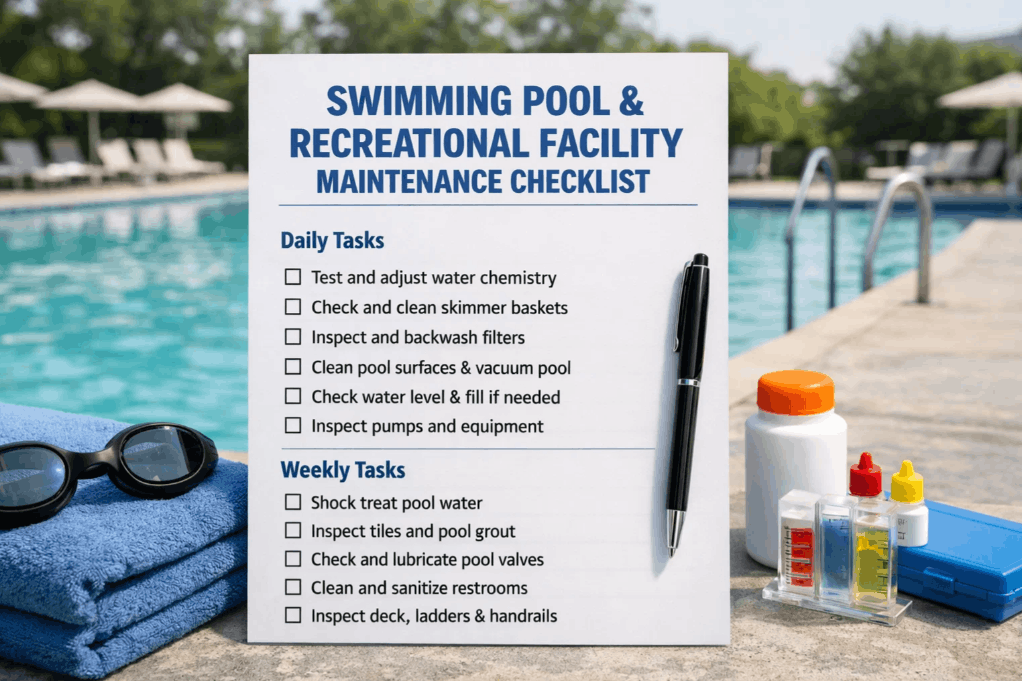
Swimming pools and recreational facilities demand year-round vigilance — from water chemistry to equipment integrity, safety compliance to seasonal preparation. A single oversight can lead to health hazards, equipment failures, or regulatory violations that shut down your amenities entirely. A structured swimming pool and recreational facility maintenance checklist gives property managers and facility teams a reliable system to keep water safe, equipment operational, and guests protected every day of the season. Book a Demo to see how OxMaint streamlines pool and amenity maintenance from a single platform.
OxMaint: Preventive Maintenance Scheduling for Recreational Facilities
Automate pool inspection schedules, assign chemical treatment tasks to certified staff, and generate audit-ready maintenance logs — all from one mobile-friendly platform built for amenity operations.
Why Pool and Recreational Facility Maintenance Is Non-Negotiable
Recreational facilities serve dozens to hundreds of users daily, making consistent maintenance a public health obligation, not just a property management best practice. Poorly maintained pool water spreads waterborne illnesses, while neglected equipment creates drowning risks and mechanical failures that lead to costly closures. Municipalities and insurance carriers require documented proof of routine inspections — facilities that cannot produce maintenance records face fines, liability exposure, and loss of operating permits.
Daily Pool and Facility Checks
Daily inspections are the foundation of safe pool operations. These tasks must be performed before opening each day and documented with time-stamped records to satisfy health department requirements. Book a Demo to digitize and auto-schedule daily inspection rounds.
Weekly Maintenance Checklist
Weekly tasks address system-level performance and prevent the gradual buildup of conditions that degrade water quality and equipment lifespan. These inspections require a trained facility technician with access to all mechanical systems. Book a Demo to access pre-built weekly pool maintenance templates.
Monthly Pool Maintenance Checklist
Monthly inspections cover mechanical systems, safety infrastructure, and compliance-critical components that require closer examination than weekly checks provide. These tasks should be performed by a qualified pool technician and documented for regulatory records. Sign Up Free to start tracking monthly pool inspections with automated reminders and digital work orders.
Quarterly Inspection Checklist
Quarterly inspections target deeper system performance, regulatory compliance documentation, and infrastructure components that require licensed technicians and coordination with local health authorities. Book a Demo to see how OxMaint helps you schedule and document quarterly compliance inspections effortlessly.
Seasonal Opening and Closing Checklist
Seasonal transitions represent the highest-risk periods for pool and recreational facility operations. Opening a pool without a structured startup checklist risks health department closure orders, while improper winterization leads to freeze damage costing tens of thousands in repairs. Sign Up Free to access ready-made seasonal pool opening and closing checklists built for property teams.
- Remove, clean, and store winter cover; inspect for tears or damage before storage
- Inspect pool shell for winter frost cracks, surface delamination, or tile displacement
- Reinstall and prime all circulation pumps, valves, and return jet fittings
- Inspect and lubricate all O-rings and valve gaskets before pressurizing the system
- Fill pool to operating level and run full chemical startup protocol to balance water
- Shock treat pool water and run filtration continuously for 72 hours before opening to users
- Test and certify all safety equipment, lighting, and anti-entrapment drain covers
- Complete health department pre-season inspection and obtain operating permit
- Perform a final super-chlorination shock treatment before closing to prevent algae over-winter
- Blow out and plug all return lines, skimmer lines, and main drain plumbing to prevent freeze damage
- Drain water below skimmer throat and add winterizing algaecide per water volume
- Remove, clean, and store all removable equipment: ladders, diving boards, and slides
- Drain and winterize the pool heater, pump, and filter per manufacturer cold-weather procedures
- Install winter safety cover and secure all anchor points and cover weights
- Disconnect and store chemical dosing equipment in a temperature-controlled space
- Complete all maintenance records and schedule spring inspection before closure
Critical Control Points: High-Risk Pool Failure Areas
Certain pool components carry disproportionate risk due to their safety-critical function, shared load across many users, or hidden failure modes. Every inspection cycle must prioritize these components above all others.
| System Component | Failure Risk | Inspection Frequency | Key Inspection Focus |
|---|---|---|---|
| Main Drain Covers | Critical — entrapment drowning risk | Monthly visual; replace every 5 years | VGB compliance, secure fastening, no cracks |
| Chemical Dosing Systems | High — health code violation risk | Daily calibration check | Output accuracy, feed line integrity, probe condition |
| Pool Barrier and Gates | High — drowning prevention code | Monthly structural check | Self-latching function, gap compliance, climb resistance |
| GFCI and Electrical | Critical — electrocution risk | Monthly GFCI test | GFCI trip function, bonding continuity, conduit seals |
| AED and Rescue Equipment | Critical — emergency response | Daily pre-opening check | Battery status, pad expiration, equipment accessibility |
| Circulation Pump | High — water safety and filtration | Daily pressure and flow check | Motor temperature, seal drips, flow rate adequacy |
Common Pool and Facility Failure Patterns
Documentation Requirements for Pool and Facility Compliance
Pool operators face overlapping documentation requirements from local health departments, insurance carriers, and municipal licensing bodies. Facilities that cannot produce complete maintenance records during inspections face permit suspension, financial penalties, and in serious cases, permanent closure orders.
Implementing a Digital Pool Maintenance Program
Paper chemical logs and clipboard inspection sheets consistently fail in high-traffic recreational facility environments — records get wet, tasks get skipped during busy periods, and compliance gaps emerge only when a health inspector arrives. A digital maintenance management platform built for amenity operations eliminates these risks by automating recurring inspection scheduling, capturing chemical readings from mobile devices in real time, and producing complete compliance histories on demand. Sign up free on OxMaint to start scheduling, assigning, and documenting your entire pool maintenance program from one platform your team can access anywhere on the property.
When evaluating a maintenance platform for pool and recreational facility operations, prioritize real-time chemical log entry from poolside mobile devices, automated work order generation when chemical readings fall outside acceptable ranges, photo documentation capability for equipment defects and pool surface conditions, staff certification tracking with expiration alerts, and compliance-ready report exports for health department and insurance audits.
OxMaint: The Pool Maintenance Platform for Amenity Teams
Schedule recurring pool inspections, track chemical treatment tasks, and generate compliance-ready logs — all from one platform your team can use on any device, poolside or in the equipment room.