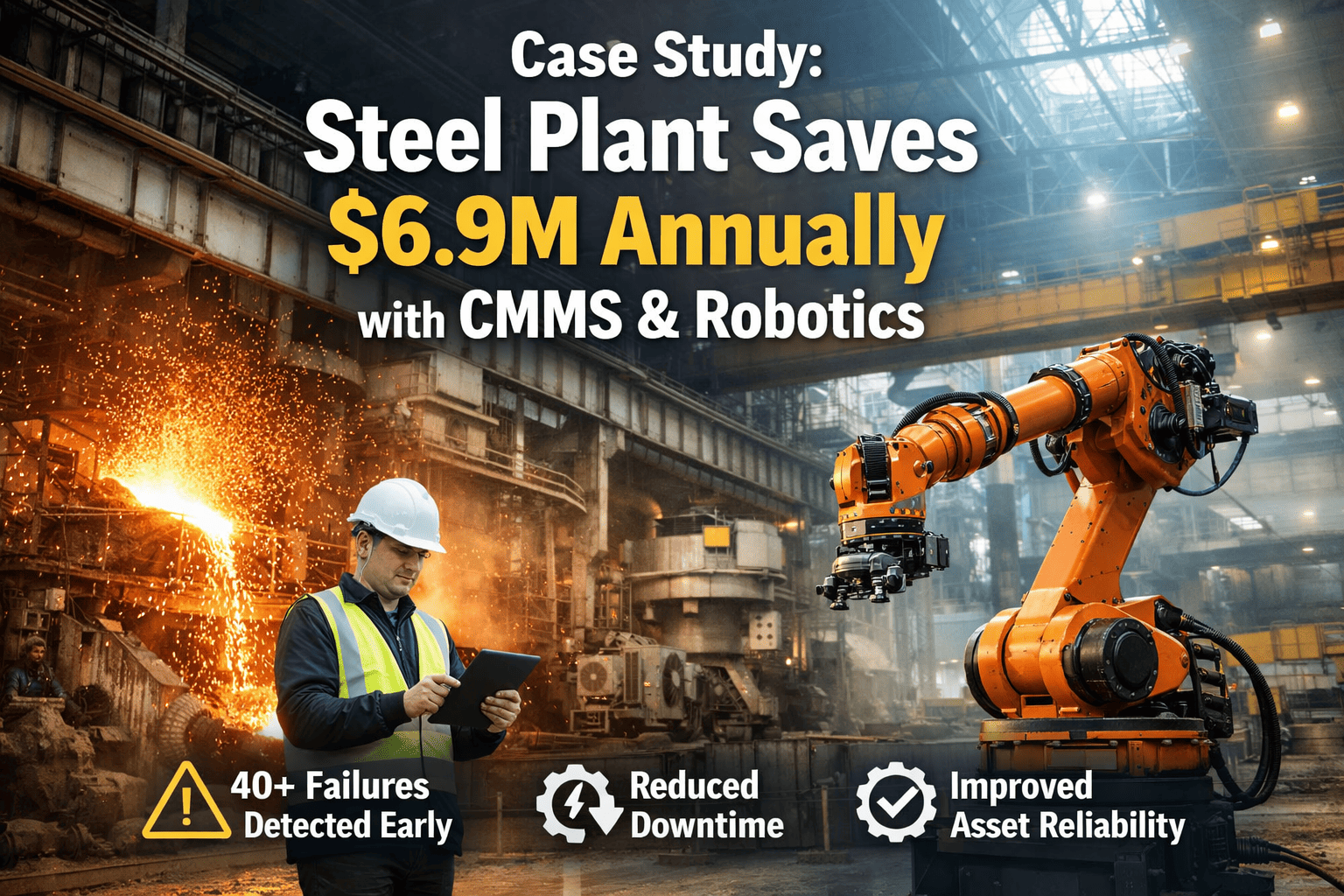
A 2.4 million tonne-per-year integrated steel mill was losing $8.6 million annually to unplanned equipment failures — averaging 22 major breakdowns per month across the blast furnace, steelmaking shop, caster, and hot rolling mill. Within 12 months of implementing OxMaint as their plant-wide CMMS, unplanned downtime dropped 47%, emergency maintenance costs fell 52%, and the operation recovered 4,100+ production hours that had previously been lost to breakdowns. Here's exactly what changed, measured month by month.
Plant Profile
Integrated steel mill · 2.4M tonnes/year · 4 major production units
Challenge
22 major unplanned breakdowns/month · $8.6M annual loss · reactive maintenance culture
Implementation
OxMaint CMMS deployed plant-wide across all 4 production units in phased 4-month rollout
Timeline to Results
Measurable improvement within 90 days · Full 47% reduction achieved by Month 12
The Numbers at a Glance
Before
→
After 12 mo
Major Breakdowns / Month
↓ 47% reduction
Before
→
After 12 mo
Emergency Maintenance Cost
↓ 52% reduction
Before
→
After 12 mo
Overall Plant Availability
↑ 9 percentage points
Before
→
After 12 mo
Planned vs Reactive Ratio
↑ from 31% to 78% planned work
"
We went from firefighting every shift to actually planning our maintenance week. The breakdowns didn't just decrease — the ones that still happen are smaller, shorter, and cheaper because we catch things earlier.
— Plant Maintenance Director
Month-by-Month: Watching the Curve Bend
Unplanned Downtime Hours Per Month — 12-Month Trajectory
400h300h200h100h0
Month 1–2: Asset registry built, PM schedules loaded, baseline measured
Month 3–5: PM compliance reaches 80%+, first repeat failures eliminated
Month 6–8: Predictive monitoring active on critical equipment
Month 9–12: Full maturity — 47% reduction sustained
Where the Gains Came From
Hot Rolling Mill
↓ 58% — Cobbles eliminated through AGC servo valve monitoring. Bearing failures predicted 4–6 weeks ahead.
Continuous Caster
↓ 47% — Segment roll bearing replacements scheduled proactively. Mold oscillation PMs eliminated breakout scares.
Blast Furnace
↓ 50% — Cooling system monitoring prevented stave failures. Gas cleaning fan vibration caught 5 weeks early.
Steelmaking (BOF)
↓ 47% — Lance system PMs became consistent. Hydraulic tilting system failures predicted from pressure trending.
This Mill's Results Can Be Your Results. The Data Proves It.
OxMaint delivered 47% downtime reduction in 12 months at a 2.4M tonne integrated mill. The same CMMS, the same methodology, the same results framework — available to your operation today.
Implementation Timeline: What Happened When
Month 1
Foundation
2,847 equipment assets registered
PM schedules for top 200 critical assets loaded
Maintenance team trained (4 sessions, 120 personnel)
Baseline established: 386 unplanned downtime hours in Month 1
Month 2–4
PM Engine Running
PM compliance: 0% → 82% in 90 days
1,240 deferred maintenance items identified and prioritized
Spare parts linked to equipment — 340 stock-out risks flagged
Month 4 downtime: 262 hrs (–32% from baseline already)
Month 5–8
Predictive Layer Added
Vibration monitoring on 48 critical rotating assets
Oil analysis program launched — monthly sampling on 32 gearboxes
First 6 failures predicted and prevented before breakdown
Month 8 downtime: 194 hrs (–50% from baseline)
Month 9–12
Full Maturity
RCA program launched — top 15 repeat failures investigated and corrected
Shutdown planning module deployed for annual turnaround
Mobile work orders live — 94% field adoption rate
Month 12 downtime: 204 hrs (–47% sustained, seasonal variation)
"
The biggest surprise wasn't the downtime reduction — it was how fast the culture shifted. By Month 4, mechanics were requesting work orders instead of avoiding them. By Month 8, they were competing to have the best PM compliance scores. OxMaint didn't just give us software — it gave us a system the team wanted to use.
— Reliability Engineering Manager
The Wins They Didn't Expect
$1.4M
recovered from dead stock cleanup — CMMS linked parts to equipment and flagged 2,100 SKUs for decommissioned assets
Zero
environmental violations in Year 1 — ESP and gas cleaning PMs maintained 100% compliance vs. 6 notices the prior year
34%
reduction in maintenance overtime — planned work during day shifts replaced emergency call-ins at night
2.8×
improvement in first-time fix rate — technicians arrive with diagnosis and parts instead of troubleshooting blind
4,100+
production hours recovered annually — equivalent to 17 extra days of full-capacity operation per year
ROI Payback: Investment vs. Return
Year 1 Investment
OxMaint platform + licensing$68,000
Implementation + configuration$42,000
Training (120 personnel)$18,000
Predictive monitoring hardware$92,000
Total Investment: $220,000
Year 1 Returns
Reduced downtime (4,100 hrs × $2,100 avg/hr)$4.5M
Emergency maintenance cost reduction$4.5M
Spare parts inventory optimization$1.4M
Overtime reduction$380K
Total Return: $10.78M
Payback period: 8 days. The $220,000 investment was recovered in production value within the first 8 days of measurable downtime reduction. Every day after that is pure return — 49× ROI in Year 1.
47% Less Downtime. 52% Lower Emergency Costs. 49× ROI. Your Turn.
This isn't a projection — it's a measured result from a real integrated steel mill using OxMaint. The same platform, the same implementation methodology, and the same results framework are available for your operation.
Frequently Asked Questions
How quickly did results appear after OxMaint implementation?
Measurable improvement within 90 days. By Month 4, unplanned downtime had already dropped 32% from baseline — driven by PM compliance reaching 82% and the first batch of deferred maintenance items being addressed.
What was the biggest single contributor to the 47% reduction?
The hot rolling mill delivered the largest absolute improvement — 58% reduction in unplanned downtime, primarily from preventing cobbles through AGC servo valve monitoring and predicting bearing failures 4–6 weeks before seizure.
How many people needed to be trained?
120 maintenance personnel across 4 production units were trained in 4 sessions during Month 1. Field adoption reached 94% by Month 9 through mobile work order access. No specialized IT staff were required.
Is this result typical for steel plants implementing OxMaint?
Steel plants implementing structured CMMS with predictive maintenance capabilities typically achieve 35–55% reduction in unplanned downtime within 12 months. The 47% result falls in the middle of this range. Plants with higher starting downtime rates tend to see larger percentage improvements.
What was the total cost of implementation?
$220,000 all-in: platform licensing ($68K), implementation and configuration ($42K), training ($18K), and predictive monitoring sensors ($92K). Payback was achieved in 8 days of operation. Year 1 ROI was 49×.
.png)