The Complete Guide to AI in Steel Manufacturing (2026)
By Alex Jordan on June 4, 2026
A steel plant manager in Pittsburgh, Pennsylvania stood on the rolling mill floor in June 2025 with a production target of 540 tonnes per shift and no visibility into whether her blast furnace hearth would survive the next 30 days. The refractory lining had shown no external signs of degradation — but two months of missed inspection data and deferred thermal imaging analysis meant nobody really knew. When the hearth failed unexpectedly at 2 AM on a Saturday morning, the emergency repair took 18 days. The plant lost 9,720 tonnes of production capacity, incurred $2.4 million in contractor emergency fees, watched 47 supply chain partners scramble to reschedule deliveries, and filed a formal notice with their primary customer that shipments would miss contract dates. Every one of those costs would have been zero if someone had installed vibration sensors, thermal cameras, and an AI predictive maintenance platform eight months earlier — the same platform that now runs on blast furnace, caster, and rolling mill assets at ArcelorMittal, POSCO, and Tata Steel. OxMaint brings AI predictive maintenance, IIoT sensor integration, and condition-based work order automation to steel plants of every size — from regional integrated mills to mini-mills running EAF furnaces — so your critical assets send failure signals 3-6 weeks early, not at catastrophic rupture.
AI Catches Failures Before Production Stops
Machine learning algorithms process real-time vibration, temperature, and pressure data across blast furnaces, rolling mills, casters, and EAF transformers — predicting failures 3-6 weeks in advance with 90%+ accuracy
Cost of one unplanned blast furnace failure in Pittsburgh — emergency repairs plus lost production and supply chain penalties
90%+
Prediction accuracy — AI detects multi-parameter failure signatures invisible to human inspection rounds
$4.1M
Average annual maintenance cost reduction across US integrated steel mill — 42-furnace facility deploying predictive AI
Why AI Predictive Maintenance Is Now Standard at Every Competitive Steel Mill
Steel mills in 2026 operate in a permanent state of competing deadlines — 24/7 production windows, zero inventory supply chains, and customer penalty clauses that turn a single unplanned 12-hour outage into lost revenue that takes weeks to recover. The three-tier maintenance pyramid below shows the financial and operational consequence of staying reactive. At the top, mills running AI predictive maintenance catch developing problems during planned maintenance windows — replacing a worn refractory plate for $18,000 instead of emergency-replacing a shattered hearth for $620,000. In the middle, calendar-based preventive maintenance still misses 55-70% of actual component failures because it ignores the wear data hiding inside your equipment. At the bottom, reactive maintenance — still the standard at roughly 35% of US steel mills — converts routine maintenance into emergency mobilization, with repair costs that run 5-7x higher than planned intervention and supply chain chaos that extends beyond the immediate repair window.
Blast Furnace Refractory Monitoring
Highest value prevention target
Temperature gradient mapping, thermal image analysis, stave cooler pressure trending, gas composition monitoring. AI predicts tap-hole erosion 6-8 weeks early — saving unplanned $500K+ repairs. OxMaint connects to existing thermocouples, gas analyzers, and infrared cameras to build digital twin of refractory health in real time.
Continuous Caster Breakout Prevention
Catastrophic failure — molten steel release
Mold oscillation frequency, tundish temperature stability, casting powder absorption rate, strand surface temperature. Breakouts cost $180K-$350K per incident plus safety liability. AI flags thermal instabilities 4-6 hours before breakout threshold — enabling mold powder adjustment or casting parameter modification to avoid shutdown entirely.
Rolling Mill Motor and Gearbox Health
Vibration analysis detects bearing wear
Motor current signature analysis, gearbox vibration envelope, bearing temperature, lubrication contamination. Production rolling mills run 16-24 hour campaigns; bearing failure mid-campaign stops entire mill. OxMaint wireless triaxial accelerometers detect misalignment and wear progression weeks before failure threshold — enabling bearing replacement during scheduled campaign breaks.
EAF Transformer and Electrode Monitoring
Critical for mini-mill and EAF operations
Transformer oil temperature, dissolved gas analysis, primary voltage harmonics, electrode force feedback. Transformer failure stops the entire EAF and delays scrap melting schedules. AI detects winding degradation and cooling system failure 2-4 weeks in advance — enabling planned transformer service or spare unit activation without production loss.
Hydraulic System Predictive Monitoring
Common failure source across equipment
Hydraulic pump vibration, pressure ripple analysis, fluid particle count and viscosity, filter differential pressure. Hydraulic failures cascade — pump damage contaminates the entire system. OxMaint fluid condition sensors and acoustic analysis predict pump wear 4-8 weeks early, enabling fluid flush and seal replacement before catastrophic failure.
Automation and Robotic Systems
Joint reducer wear and servo degradation
Joint current draw trending, positional accuracy drift, axis vibration envelope, cable tension analysis. Welding and handling robots in modern mills run 20+ hours per day. OxMaint detects joint reducer wear, servo motor degradation, and cable harness fatigue — predicting bearing replacement windows without disrupting continuous production flow.
AI Predictive Maintenance for Steel
Stop Guessing. Start Predicting. Every Critical Asset. Every Failure. Every Week Early.
OxMaint integrates with your existing SCADA, PLC, DCS, and IIoT sensor networks to deliver AI-powered failure forecasting, condition-based work order automation, and maintenance compliance documentation — all on one platform built specifically for steel plant operations across blast furnaces, EAF, rolling mills, and casters.
AI-Powered Failure Detection Across Steel Mill Equipment Classes
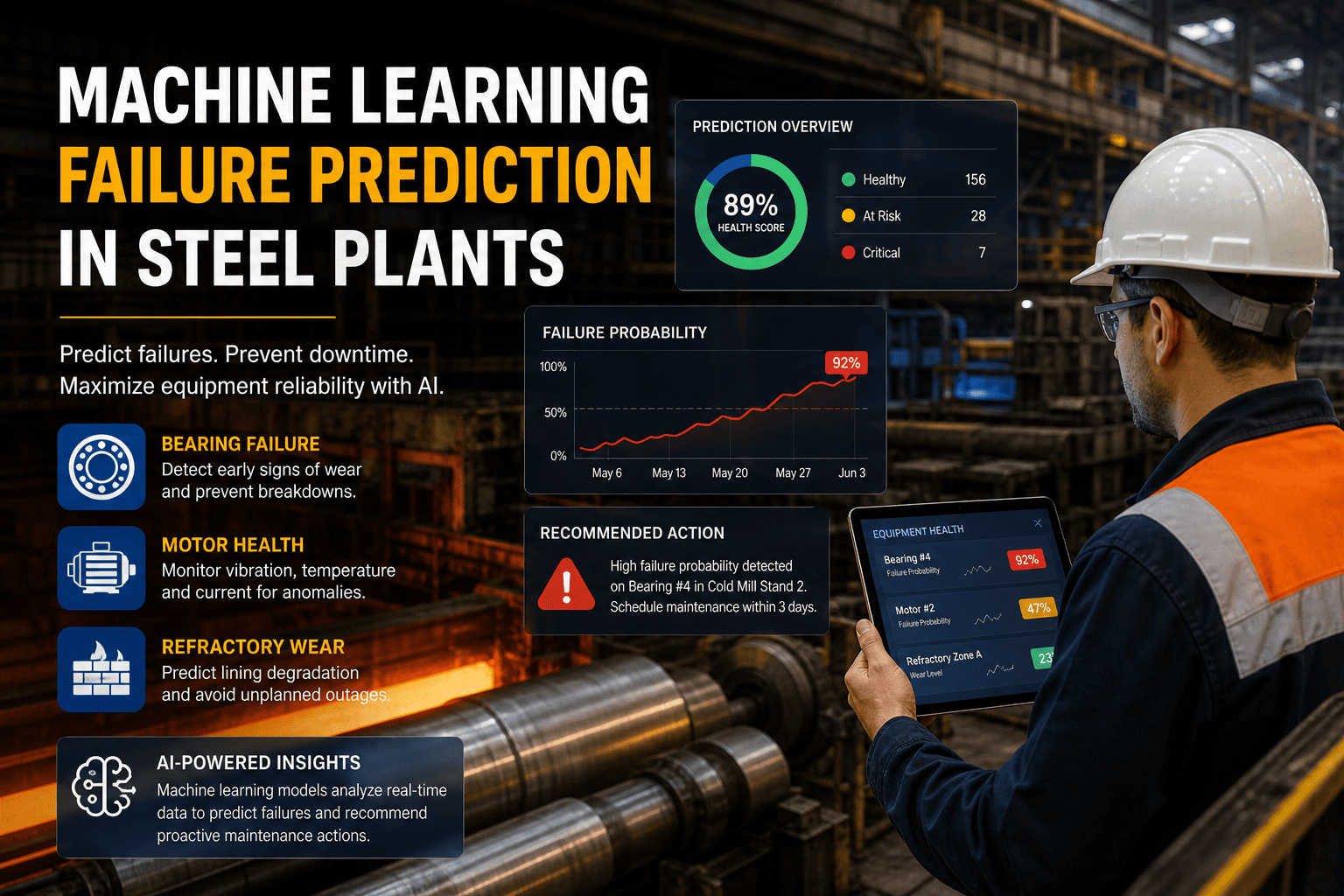
The machine learning models that power predictive maintenance in steel plants process five categories of real-time data — vibration (from accelerometers and proximity probes), thermal (from infrared cameras and thermocouples), electrical (from motor current signature analysis and electrical signature analysis), hydraulic (from pressure transducers and fluid condition sensors), and process (from SCADA feeds, gas composition, and metal temperature). Each data stream reveals different aspects of equipment degradation. A rolling mill bearing does not fail all at once — it spends 4-6 weeks generating a rising vibration signature before mechanical contact occurs. A blast furnace stave cooler begins leaking slowly, showing rising pressure differential before catastrophic water loss. A caster mold develops micro-fractures that change its natural resonance frequency weeks before the fracture propagates. OxMaint algorithms correlate across all five data categories simultaneously, detecting failure signatures that single-parameter monitoring misses entirely.
Multi-Parameter Sensor Integration
Wireless triaxial accelerometers, infrared thermal cameras, temperature transmitters, pressure transducers, electrical signature analyzers, and ultrasonic sensors deploy across blast furnaces, rolling mills, casters, and EAF systems. OxMaint ingests data from 50+ concurrent sensor streams per major asset class — each providing continuous condition visibility without single point of dependency.
Machine Learning Failure Prediction
Deep learning models trained on 10+ years of historical failure data from integrated and EAF steel operations across North America and Europe. Models detect bearing wear, refractory degradation, mold fatigue, hydraulic system contamination, and electrical degradation 3-6 weeks before component failure — enabling planned maintenance scheduling instead of emergency mobilization during peak production periods.
Real-Time Condition Monitoring Dashboard
Web and mobile dashboard displays asset health status, trending degradation curves, remaining useful life projections, and scheduled maintenance windows. Maintenance teams see equipment condition 24/7 — enabling shift handoffs to flag emerging issues and enabling maintenance planners to optimize spare part procurement and crew scheduling around predicted failure windows.
Automated Work Order and Parts Management
When predictive algorithms detect developing failures, OxMaint automatically generates maintenance work orders with equipment diagrams, required part lists, estimated labor hours, and safe work procedures. Integration with ERP and CMMS systems ensures required parts are ordered 6-8 weeks before predicted failure date — eliminating the supplier emergency premium that adds 40-60% to emergency repair costs.
Compliance Documentation and Audit Trail
OxMaint maintains complete maintenance audit trail — condition measurements, failure predictions, maintenance actions taken, parts used, technician sign-off. Automatically generates compliance packages for annual insurance inspections, regulatory audits, and customer contract reviews. No manual compilation required — documentation is built during operational workflow.
The Steel Industry's Current Maintenance Breakdown — Three Tiers with Starkly Different Economics
The financial exposure at each maintenance maturity level in US steel operations tells a clear story about competitive advantage. The bottom tier — reactive maintenance — still represents approximately 30-35% of US integrated mill capacity and 25-30% of mini-mill EAF capacity. These operations run calendar-based PM on routine systems, but complex assets like blast furnace refractory, continuous caster molds, and rolling mill bearings fail unpredictably, triggering emergency repair costs that run $180K-$620K per incident depending on asset class and production stage when failure occurs. The middle tier — calendar-based preventive maintenance — covers roughly 50% of US capacity. These mills schedule PM on 90-day or annual intervals regardless of actual equipment condition. The result: over-maintenance on robust components that could run longer, and missed failures on high-wear assets that degrade faster than average because they run harder or older equipment is less forgiving.
"We had six unplanned mill stops in 2024 — three were rolling mill bearing failures, two were blast furnace refractory issues, one was a caster mold fracture. Total cost: $1.8 million in emergency repairs, replacement production, and supply chain penalties. We deployed OxMaint in September 2025. Since then, zero unplanned failures. We caught two bearing issues 5 weeks early, one caster mold degradation at 6 weeks, and one refractory thermal anomaly at 8 weeks. Every one of those we fixed during planned maintenance windows. The system paid for itself in the first replacement bearing alone — and we've avoided $950,000 in emergency costs so far."
— Director of Maintenance, Integrated Steel Mill · 850K tonnes annual capacity · Ohio, USA
How AI Detects Failures — The Technical Foundation
Predictive maintenance in steel operations is built on decades of equipment failure data that reveals patterns invisible to traditional inspection. A rolling mill bearing does not generate alarm conditions while degrading — it generates a slowly rising vibration signature as the raceway develops micro-spalls. A blast furnace stave cooler does not leak catastrophically on first failure — it shows a rising pressure differential trend as internal corrosion creates micro-leaks. A continuous caster mold does not crack suddenly — it develops micro-fatigue over weeks, changing its resonance frequency slightly and increasing damping on each thermal cycle. OxMaint machine learning algorithms process these subtle degradation signals continuously — detecting patterns that human operators reviewing daily shift reports would never notice.
Frequently Asked Questions — AI Predictive Maintenance for Steel Mills
Q1Can OxMaint work with older blast furnaces and rolling mills that lack modern sensors?▼
Yes — wireless triaxial accelerometers, infrared thermal cameras, and ultrasonic sensors retrofit onto legacy equipment without modifications. Edge computing gateways translate old PLC and SCADA signals into modern digital formats (OPC-UA, MQTT) that OxMaint ingests directly.
Q2How long does it take to deploy OxMaint across a multi-furnace integrated mill?▼
Initial deployment of critical assets (blast furnace, primary caster, main rolling mill) takes 4-6 weeks. Full plant rollout with complete sensor network and algorithm calibration completes in 12-16 weeks. First AI-generated failure prediction alert typically appears within 3-4 weeks of go-live.
Q3What happens if OxMaint predicts a failure but the equipment doesn't actually fail on schedule?▼
This is normal and expected — predictive algorithms estimate failure probability based on current wear trajectory. If operating conditions change or component wear slows, the failure timeline extends. OxMaint continuously recalibrates and will either cancel the prediction or extend the timeline as new data arrives.
Q4Can OxMaint integrate with our existing SCADA, DCS, and ERP systems?▼
Yes — OxMaint connects via OPC-UA, Modbus TCP, PROFIBUS, and REST APIs. Integration with CMMS platforms (SAP, IBM Maximo, Infor EAM) for automatic work order creation is native. Custom connector development for proprietary systems takes 2-4 weeks.
Q5How does OxMaint handle the cold sensor environments near blast furnaces and EAF melting zones?▼
High-temperature wireless accelerometers and transmitters rated to 150–180°C mount at controlled distances from direct heat. Optical temperature sensors measure refractory surface temperature without electronics exposure. Sensor placement is critical — OxMaint deployment team handles site assessment and optimal positioning.
Q6What training does our maintenance team need to operate OxMaint?▼
Maintenance planners and reliability engineers need 8-12 hours of platform training. Technicians performing sensor maintenance and equipment repairs need 4-6 hours on sensor calibration and trending interpretation. OxMaint provides live training, recorded modules, and ongoing support.
Q7How does OxMaint protect our operational data and comply with cybersecurity standards?▼
OxMaint meets ISO 27001, SOC 2 Type II, and NIST Cybersecurity Framework standards. Data encryption in transit and at rest, multi-factor authentication, role-based access control, and continuous security monitoring are standard. Option for on-premise deployment available for mills with strict data residency requirements.
Q8What is the ROI timeline for deploying OxMaint at a US integrated steel mill?▼
Average ROI payback is 18-24 months. First-year savings average $650K-$1.2M per major asset (blast furnace or rolling mill) from prevented emergency repairs and extended asset life. Year two savings typically increase as the AI model matures with more plant-specific operational data.
AI Predictive Maintenance for Steel Mills
Stop Reacting to Failures. Start Predicting Them. On Every Critical Asset. Three to Six Weeks Early.

.png)