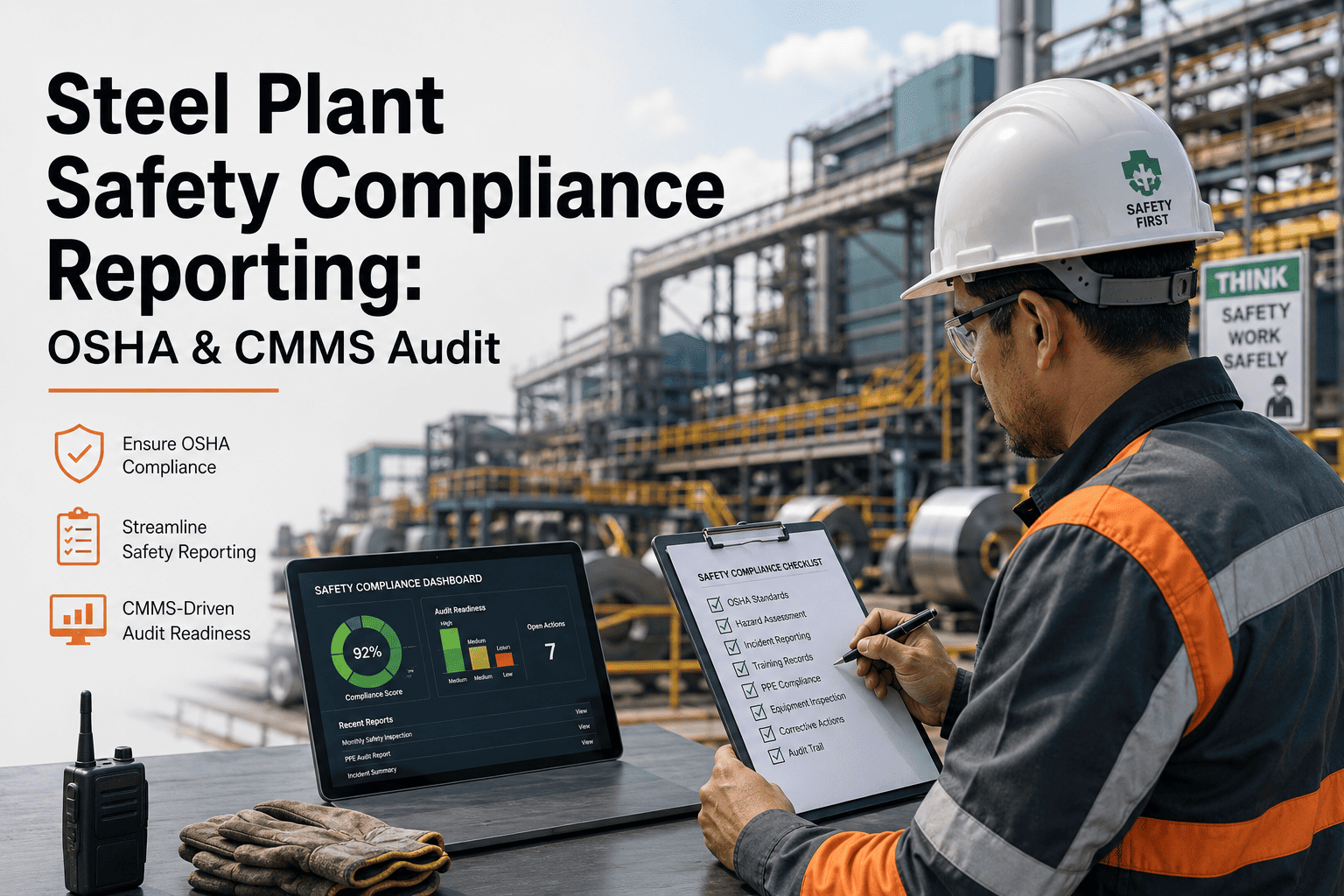
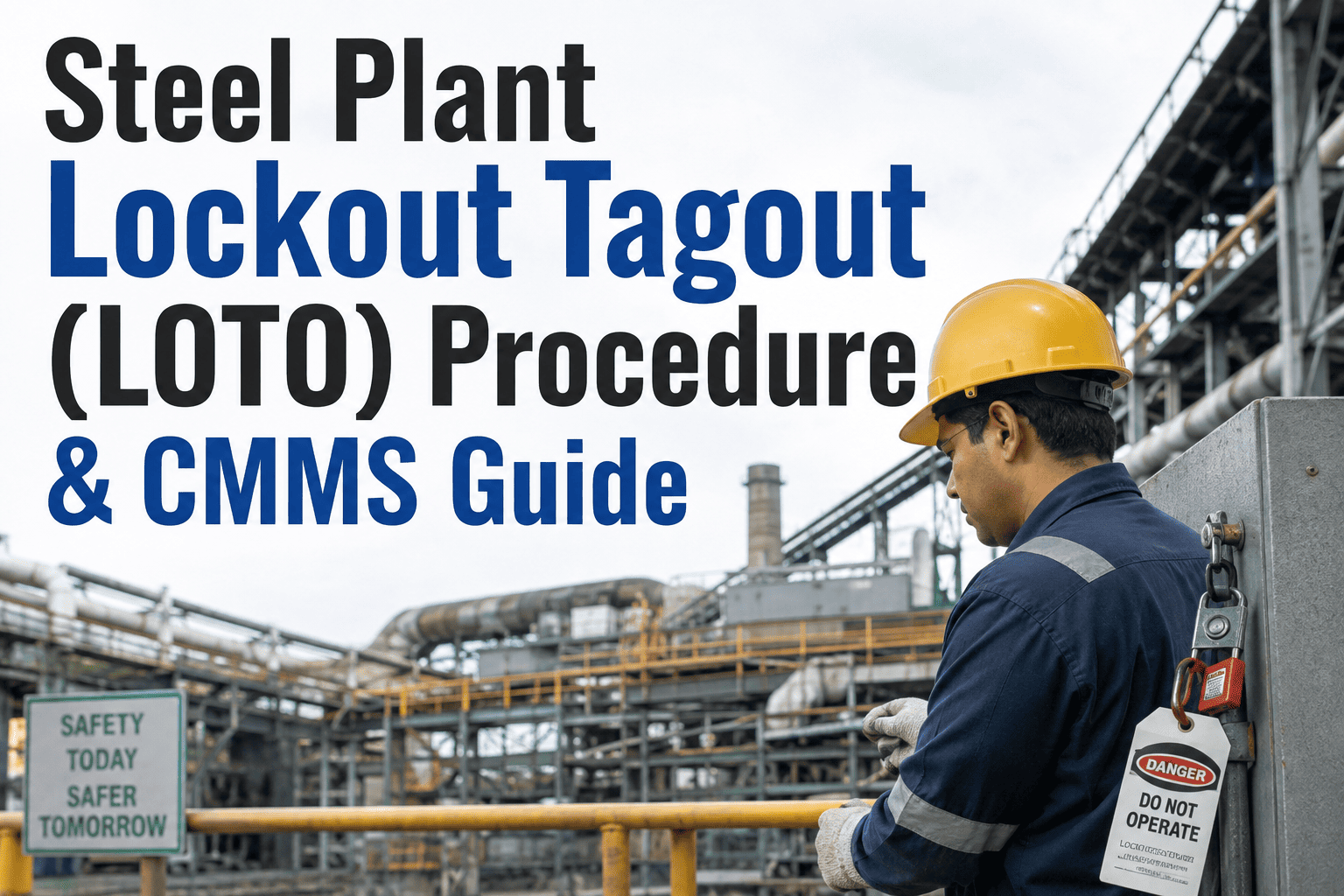
Lockout/Tagout violations remain among the most cited and most fatal OSHA findings in integrated steel operations. OSHA 29 CFR 1910.147 — the Control of Hazardous Energy standard — was cited 2,554 times in FY2024, accounting for over $22 million in penalties across US industrial facilities alone. In a steel plant, the hazardous energy profile is uniquely complex: blast furnace hydraulic systems operating above 3,000 PSI, BOF converter electrical systems at 11kV, rolling mill drives storing residual kinetic energy, and coke oven gas networks that remain pressurised long after isolation valves are closed. An incomplete LOTO is not a paperwork failure — it is a fatality waiting for a shift change. OxMaint's Compliance Tracking module digitises every LOTO procedure into mobile-accessible permit workflows with mandatory verification gates, contractor controls, and audit-ready records that survive an OSHA inspection. Book a demo to see steel plant LOTO workflows live in OxMaint.
Checklist · Steel Plant Safety · OSHA 29 CFR 1910.147 · Compliance Tracking
LOTO Procedure Checklist for Steel Plant Maintenance
Energy isolation verification, multi-lock contractor control, authorised person sign-off, and audit-ready documentation — the complete LOTO compliance framework for blast furnace, BOF converter, rolling mill, and coke oven maintenance in integrated steel facilities.
#5
OSHA most-cited standard — LOTO (1910.147) — 2,554 citations and $22M+ in penalties in FY2024 alone
120
Fatalities per year attributed to inadequate hazardous energy control in US industrial facilities (OSHA data)
50,000
Injuries annually from inadequate LOTO across US manufacturing and heavy industry — steel plants among highest-risk
6 types
Hazardous energy present in steel plants: electrical, hydraulic, pneumatic, thermal, chemical, and gravitational
Phase 1 — Preparation
Phase 2 — Isolation
Phase 3 — Verification
Phase 4 — Contractor Control
Phase 5 — Restoration
Phase 6 — Audit Records
CRITICAL
Blast Furnace Hydraulics
Hydraulic & Pneumatic
3,000–5,000 PSI stored pressure
Full bleed-down + pressure gauge verification to zero before entry
CRITICAL
BOF Converter Drive
Electrical — HV
11kV supply + VFD capacitor residual
HV isolation, earthing, capacitor discharge verification — minimum 5-min wait
HIGH
Rolling Mill Drive Train
Electrical + Kinetic
3.3kV + flywheel stored energy
Power isolation + full mechanical stop verification + brake engagement confirmed
HIGH
Coke Oven Gas Network
Chemical + Pressure
COG at 300–800 Pa, CO content 5–7%
Double-block-and-bleed valve isolation + gas test <10% LEL before entry
MEDIUM
Blast Furnace Skip Hoist
Gravitational + Electrical
Skip mass up to 30 tonnes at height
Power isolation + physical block/chock installed under skip + visual confirmation
MEDIUM
Ladle Transfer Car
Electrical + Thermal
415V drive + residual ladle heat to 800°C
Power isolation + thermal cool-down period per WIMS thermal schedule
Phase 01
Preparation — Before Any Energy Isolation Begins
OSHA 1910.147(c)(4) requires that before any maintenance on equipment where unexpected energisation could occur, the authorised employee must have knowledge of the type and magnitude of energy, the hazards it presents, and the method of control. In a steel plant, this means the maintenance supervisor and the authorised person must jointly review the equipment-specific LOTO procedure before the first isolation point is touched — not during the isolation sequence. An equipment-specific written LOTO procedure is mandatory for every machine or system where multiple energy sources exist or where the isolation sequence is not self-evident.
Preparation Checklist
OSHA 1910.147(c)(4) — Before Isolation
Equipment-specific LOTO procedure retrieved from OxMaint asset record — procedure confirmed current revision; any revision dated more than 12 months ago triggers mandatory review by safety officer before proceeding; procedure includes isolation point map with energy type, magnitude, and sequence order
Record: LOTO procedure version on work order · Role: Authorised Person + Supervisor
All affected employees notified — production supervisor, crane operators, adjacent area workers, and shift manager informed that the named equipment is being taken out of service for LOTO; notification documented on permit; no verbal-only notifications accepted
Record: Affected employee notification list on PTW · Role: Supervisor
All required LOTO hardware staged — hasp for multi-lock grouping, individual padlocks for each authorised person (personal lock, personal key), danger tags with authorised person name and date, equipment-specific blinds/spades for coke oven gas and process fluid isolation confirmed available and in serviceable condition
Record: Hardware checklist on PTW · Role: Authorised Person
Contractor LOTO requirements confirmed if third-party workers will be involved — contractor supervisor briefed on steel plant LOTO procedures; contractor personnel issued facility LOTO hardware; contractor lock verified on hasp before any equipment isolation is treated as complete
Record: Contractor LOTO briefing sign-off · Role: Safety Officer + Contractor Supervisor
Phase 02
Energy Isolation — Sequence and Physical Control
OSHA 1910.147(d) requires that equipment be isolated from all energy sources using an established sequence, that energy isolating devices be locked in the safe position, and that stored or residual energy be relieved or restrained before the authorised employee proceeds. In steel plants, the most critical failure mode is incomplete identification of all energy sources — a blast furnace hydraulic system may have four independent isolation points, and isolation of three still leaves sufficient stored pressure to cause a fatal crush injury. The sequence must follow the written procedure exactly, with each isolation step confirmed before the next begins.
Energy Isolation Checklist
OSHA 1910.147(d) — Sequential Isolation Required
Electrical isolation completed in sequence per procedure — main circuit breaker opened and locked; upstream feeder confirmed de-energised with approved voltage tester (non-contact tester plus contact tester per steel plant standard); lock applied to breaker and tagged with authorised person's name, date, and work order number
Record: Voltage test readings (expected zero) on PTW · Role: Authorised Person (electrical)
Hydraulic system bleed-down completed — isolation valve closed and locked; system pressure bled to zero via approved bleed point; pressure gauge at isolation point confirmed reading zero; gravity-fed hydraulic accumulators identified and discharged per procedure; minimum 3-minute hold at zero before proceeding
Record: Pressure gauge readings (before bleed / after bleed) on PTW · Role: Authorised Person (mechanical)
Process gas isolation with double-block-and-bleed — for coke oven gas, blast furnace gas, and oxygen pipework: two isolation valves closed and locked in sequence; bleed valve between them opened to vent entrapped gas to safe location; gas test performed at work area confirmed below 10% LEL before entry; spade/blind installed downstream of outer block valve where procedure requires
Record: Gas test readings, spade installation confirmation on PTW · Role: Authorised Person + Gas Monitor
Gravitational energy restrained — elevated components (skip hoist, crane hooks, converter vessel, any suspended load) physically blocked or chocked in position; blocks/chocks confirmed installed and load weight verified as supported independently of any hydraulic or electrical hold system; visual confirmation by second authorised person before proceeding
Record: Physical blocking confirmation with second-person verification on PTW · Role: Two Authorised Persons
All isolation points physically locked — each energy isolating device has a personal padlock from each authorised person whose safety depends on it; multi-person hasp used where more than two persons require simultaneous lock-out; lock count verified against authorised person count before proceeding to verification phase
Record: Lock count vs authorised person count on PTW · Role: Supervisor
OxMaint's LOTO permit workflow enforces every isolation step as a mandatory gate — technicians cannot sign off Phase 3 without completing all Phase 2 items. Every lock, every gas reading, and every pressure verification is recorded automatically against the work order for instant audit retrieval.
Phase 03
Verification — Confirming Zero Energy State Before Entry
OSHA 1910.147(d)(6) requires that before any work begins, the authorised employee must verify that isolation and de-energisation of the equipment have been accomplished. Verification is not the same as isolation — it is a separate, independent confirmation step that must be completed after isolation hardware is applied. In steel plants, verification is particularly critical for VFD drives that retain stored capacitor energy after electrical isolation and for hydraulic systems where accumulator discharge may be incomplete due to check valve positioning.
Verification Checklist
OSHA 1910.147(d)(6) — Mandatory Before Any Work Begins
Electrical zero-energy verification — attempt to energise equipment using normal start controls (push button, HMI start command, or remote start) with all persons clear of equipment; zero response confirms electrical isolation is complete; any unexpected movement, contactor closing, or control panel response indicates incomplete isolation — do not proceed
Record: Test start attempt result (no response = PASS) on PTW · Role: Authorised Person
VFD/drive capacitor discharge verification — for variable frequency drives: minimum discharge time per manufacturer specification observed (typically 5–15 minutes after electrical isolation); DC bus voltage measured with approved meter; DC bus below 50V required before mechanical contact with drive components; reading documented with instrument ID and reading value
Record: DC bus voltage reading, instrument ID, time of measurement on PTW · Role: Authorised Electrician
Process gas re-test at work location — final gas test performed at actual work area (not only at isolation point) with calibrated multi-gas detector reading O2, CO, H2S, and LEL; gas readings recorded; work may only proceed if: O2 19.5–23.5%, CO <25 ppm, H2S <1 ppm, LEL <10%; re-test required every 60 minutes during work or if work area ventilation changes
Record: Gas readings (all parameters) with instrument serial and calibration date on PTW · Role: Gas Monitor / Safety Officer
Supervisor sign-off on zero-energy state confirmed — maintenance supervisor or safety officer reviews all Phase 2 and Phase 3 records, physically inspects isolation hardware (locks, tags, blocks), and signs work permit to authorise work commencement; permit number linked to OxMaint work order before any person enters the work area
Record: Supervisor sign-off with name, time, and permit number on PTW · Role: Maintenance Supervisor / Safety Officer
Phase 04
Contractor LOTO Control — Multi-Employer Coordination
OSHA 1910.147(f)(2) requires that when outside contractors perform servicing or maintenance on equipment that is, or may be, covered by LOTO, the host employer must inform the contractor of the LOTO procedures and ensure the contractor understands them. In a steel plant where maintenance shutdowns routinely involve 20–50 contractor personnel from multiple companies working simultaneously on interconnected systems, this is not a training formality — it is an operational control requirement. Group LOTO with a single hasp and mandatory individual contractor locks on that hasp is the only OSHA-compliant approach for multi-employer steel plant maintenance events.
Contractor LOTO Control Checklist
OSHA 1910.147(f)(2) — Multi-Employer Coordination
Contractor LOTO briefing completed before work begins — contractor supervisor and all contractor personnel briefed on the specific equipment LOTO procedure, the isolation points in use, the group hasp location, and the requirement for each individual to apply their own personal lock; briefing conducted in language understood by all personnel; sign-off sheet completed and retained in OxMaint
Record: Contractor briefing sign-off sheet attached to work order · Role: Host Safety Officer
Individual contractor padlocks applied to group hasp — every contractor employee working on the isolated equipment applies their own personal lock to the group hasp; lock count confirmed against contractor personnel headcount by contractor supervisor and host safety officer jointly; no work may commence until lock count matches personnel count
Record: Contractor lock count vs contractor personnel count on PTW · Role: Contractor Supervisor + Host Safety Officer
Contractor shift change LOTO continuity protocol — at every contractor shift change, outgoing contractor employees must not remove their lock until incoming replacement has applied their lock to the hasp; no gap in multi-lock coverage permitted; shift handover documented on permit with incoming and outgoing personnel names and times
Record: Shift handover LOTO continuity log on PTW · Role: Contractor Supervisor
Emergency removal procedure confirmed — in the event a contractor employee leaves site without removing their personal lock, the emergency removal procedure requires: written authorisation from facility safety manager, positive confirmation that the individual is not in the hazard area (sign-in/sign-out verification), and documentation of removal reason, time, and authorising person in OxMaint
Record: Emergency lock removal documented in OxMaint with full chain of authorisation · Role: Facility Safety Manager
Before vs After — LOTO Compliance Programme Outcomes
A 1.8 MTPA integrated steel plant in India operating blast furnace, BOF steelmaking, and hot rolling mill implemented OxMaint's digital LOTO permit system across 340+ isolation points. Results tracked over 18 months versus the prior paper-based LOTO programme baseline.
LOTO Procedure Compliance Rate (%)
Incomplete LOTO Incidents / Quarter
OxMaint Digital
2 incidents
LOTO Audit Prep Time (hours)
Paper-Based
72 hrs manual
OxMaint Digital
Under 4 hrs
Contractor LOTO Non-Conformances / Month
OxMaint Digital
1–2 per month
Phase 05
Restoration — Safe Return to Service After Work Completion
OSHA 1910.147(e) defines the restoration sequence: remove all tools and materials, ensure all employees are safely positioned or removed from the work area, remove LOTO devices in the reverse order of isolation, and notify affected employees that work is complete. In steel plants, restoration is a critical safety event in its own right — the most common restoration-related incidents occur when energy is restored before a worker in an adjacent section has cleared the area, or when a hydraulic system is re-pressurised before a test fitting has been reinstalled.
Restoration Checklist
OSHA 1910.147(e) — Reverse Sequence Required
Work area clearance verified — all tools, test equipment, temporary scaffolding, and consumable materials removed from equipment and work area; all guards and safety devices reinstalled and confirmed functional; test fittings, blanking plates, and temporary seals replaced with permanent components; visual walk-through completed by authorised person
Record: Work area clearance sign-off on PTW · Role: Authorised Person + Supervisor
All personnel accounted for and clear of equipment — headcount of all authorised persons and contractor employees confirmed against permit; sign-out documented for each individual; positive confirmation that no person is in an adjacent area that could be affected by re-energisation; specific attention to elevated areas (gantries, platforms) above the equipment being restored
Record: Personnel clearance headcount on PTW · Role: Supervisor
All personal locks removed from hasp — each authorised person removes only their own lock; lock count confirmed at zero before hasp is removed from group isolation device; each person's lock removal documented with time; if any person is unavailable to remove their lock, the emergency removal procedure (Phase 4) must be followed before hasp removal
Record: Lock removal log with individual names and times on PTW · Role: Supervisor
Energy restoration in reverse sequence — isolation devices removed and energy restored in the reverse order of isolation, per the written procedure; each restoration step confirmed before the next proceeds; affected employees and production supervisor notified that equipment is being returned to service and standby period required before production restart
Record: Restoration sequence completion on PTW — permit closed in OxMaint · Role: Authorised Person
Phase 06 — LOTO Documentation and Audit Records
OSHA 1910.147(c)(4)(ii) requires that LOTO procedures be documented in writing and made available to employees. An annual review of procedures is required. For steel plants seeking ISO 45001 certification or subject to statutory safety inspections, the documentation trail covers not just whether procedures exist but whether they were followed — for every permit, every shift, every contractor. OxMaint generates this evidence trail automatically as the byproduct of the digital permit workflow.
| Record Type |
Required Content |
Retention Period |
Standard Reference |
OxMaint Module |
| LOTO permit record |
Equipment ID, isolation points, energy types/values, authorised persons, sign-off times |
5 years |
OSHA 1910.147 / ISO 45001 Cl.8.1.3 |
Digital permit attached to work order |
| Verification test records |
Voltage readings, pressure readings, gas test values, instrument IDs, test times |
5 years |
OSHA 1910.147(d)(6) |
Permit form fields — mandatory gate |
| Contractor briefing records |
Contractor company, personnel names, briefing content, sign-off signatures, date |
3 years |
OSHA 1910.147(f)(2) |
Contractor management module |
| Annual procedure review |
Equipment ID, procedure revision date, reviewer name and qualification, changes made |
Duration of procedure use + 3 years |
OSHA 1910.147(c)(4)(ii) |
Procedure asset record — annual review WO |
| Emergency lock removal |
Lock owner, reason, authorising manager, confirmation person not in hazard area, date/time |
5 years |
OSHA 1910.147(e)(3) |
Special authorisation record in OxMaint |
| LOTO programme audit |
Audit date, auditor, findings, corrective actions with target dates, close-out evidence |
3 years |
OSHA 1910.147(c)(6) / ISO 45001 Cl.9.2 |
Compliance audit module — exportable |
Expert Review
VK
Vijay Krishnaswamy
Head of Safety & Risk, Integrated Steelmaking · 26 years · NEBOSH Diploma · NIT Rourkela, Metallurgical Engineering · ISO 45001 Lead Auditor
The gap between a documented LOTO programme and an effective one is almost always the same thing in steel plants: verification. Facilities have written procedures, hasp boxes, and padlock kits. What they do not have is a reliable mechanism to confirm that every isolation step was actually completed in sequence before the first technician entered the hazard zone. Paper permits are completed retrospectively after the job in 40% of cases I have audited — the isolation has been done, but the documentation records a sequence that may or may not reflect what actually occurred and when. Digital permit systems like OxMaint solve this by making the checklist the workflow itself — you cannot sign off Phase 3 verification until Phase 2 isolation records are complete with actual instrument readings. That is not a bureaucratic improvement; it is the difference between a fatality and a near miss being caught by the system rather than by luck.
Frequently Asked Questions
Does every piece of equipment in a steel plant require a written LOTO procedure?
OSHA 1910.147(c)(4)(i) requires documented procedures for all equipment unless the employer can demonstrate all six specific exemption conditions apply — which essentially means simple, single-energy-source equipment with visible isolation. In a steel plant, virtually no asset qualifies for the exemption: blast furnaces, rolling mills, BOF converters, coke oven batteries, and all associated process systems have multiple energy sources requiring documented procedures. The practical answer is that every major steel plant asset requires a written, equipment-specific LOTO procedure with an isolation point diagram.
OxMaint's asset registry stores the LOTO procedure against each asset record and automatically flags procedures overdue for annual review.
What is the correct LOTO approach for a steel plant maintenance shutdown involving multiple contractors?
For multi-contractor shutdowns, OSHA 1910.147(f) requires the host employer to coordinate LOTO with all contractors and ensure each individual who is authorised to perform work applies their own personal lock. The correct mechanism is group LOTO with a single hasp at each isolation point — the host authorised person applies the first lock, each contractor individual adds their personal lock, and the energy can only be restored when every lock has been removed. OxMaint's contractor management module tracks contractor briefings, individual lock assignments, and shift handover continuity to ensure no gap in protection during personnel changes.
Book a demo to see the multi-contractor LOTO workflow.
How does OxMaint support LOTO compliance for OSHA inspections and ISO 45001 audits?
OxMaint stores every completed LOTO permit — including all verification readings, authorised person sign-offs, contractor briefing records, and permit closure timestamps — in a searchable, immutable audit trail attached to the relevant asset and work order. When an OSHA inspector or ISO 45001 auditor requests evidence of LOTO programme compliance, OxMaint generates a complete permit history report for any asset, date range, or equipment type in under 10 minutes. The same report shows procedure review dates, calibration records for test instruments, and corrective actions from any previous non-conformances.
Start a free trial to explore the compliance reporting module.
What are the OSHA penalties for LOTO violations in a steel plant?
Under OSHA's penalty structure, a serious LOTO violation carries a penalty of up to $16,550 per violation as of 2024. A willful or repeated LOTO violation — which applies when a facility has been previously cited for the same type of deficiency — carries penalties up to $165,514 per violation. In a steel plant with multiple simultaneous maintenance events, a single OSHA inspection identifying systemic LOTO programme deficiencies across multiple assets can generate multi-million-dollar penalty exposure. The compliance and training investment in a digital LOTO system is typically recovered by preventing a single citation. Review
OxMaint's compliance tracking features to understand how digital permit records reduce citation risk.
OXMAINT COMPLIANCE TRACKING · STEEL PLANT LOTO
Every Isolation Point. Every Lock. Every Verification Reading. One Audit Trail.
OxMaint digitises your entire steel plant LOTO programme — equipment-specific procedures stored against each asset, mandatory sequential permit workflows, contractor lock tracking, and instant export of OSHA and ISO 45001 audit evidence. From blast furnace hydraulics to rolling mill drives, every hazardous energy source is managed in one platform.