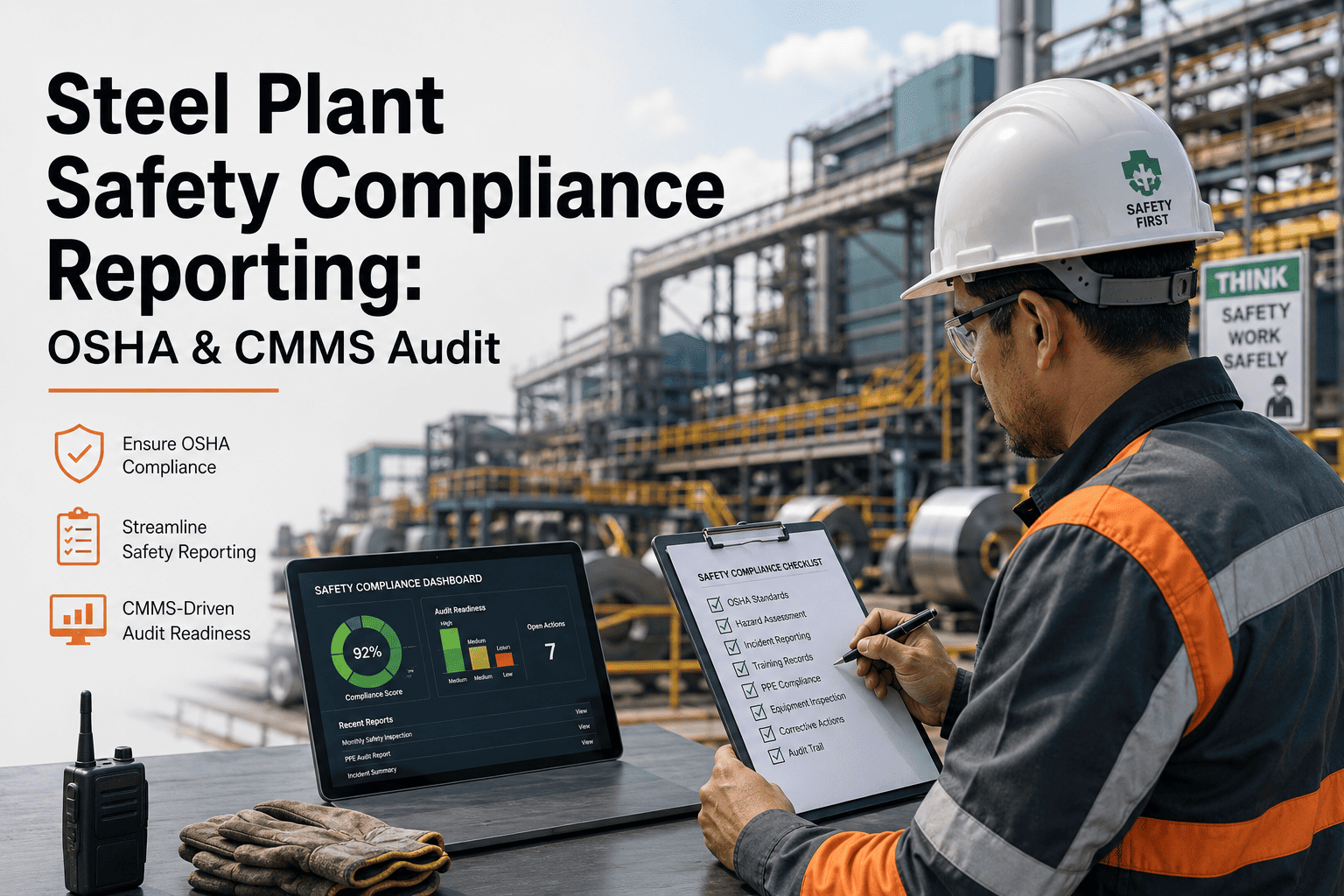
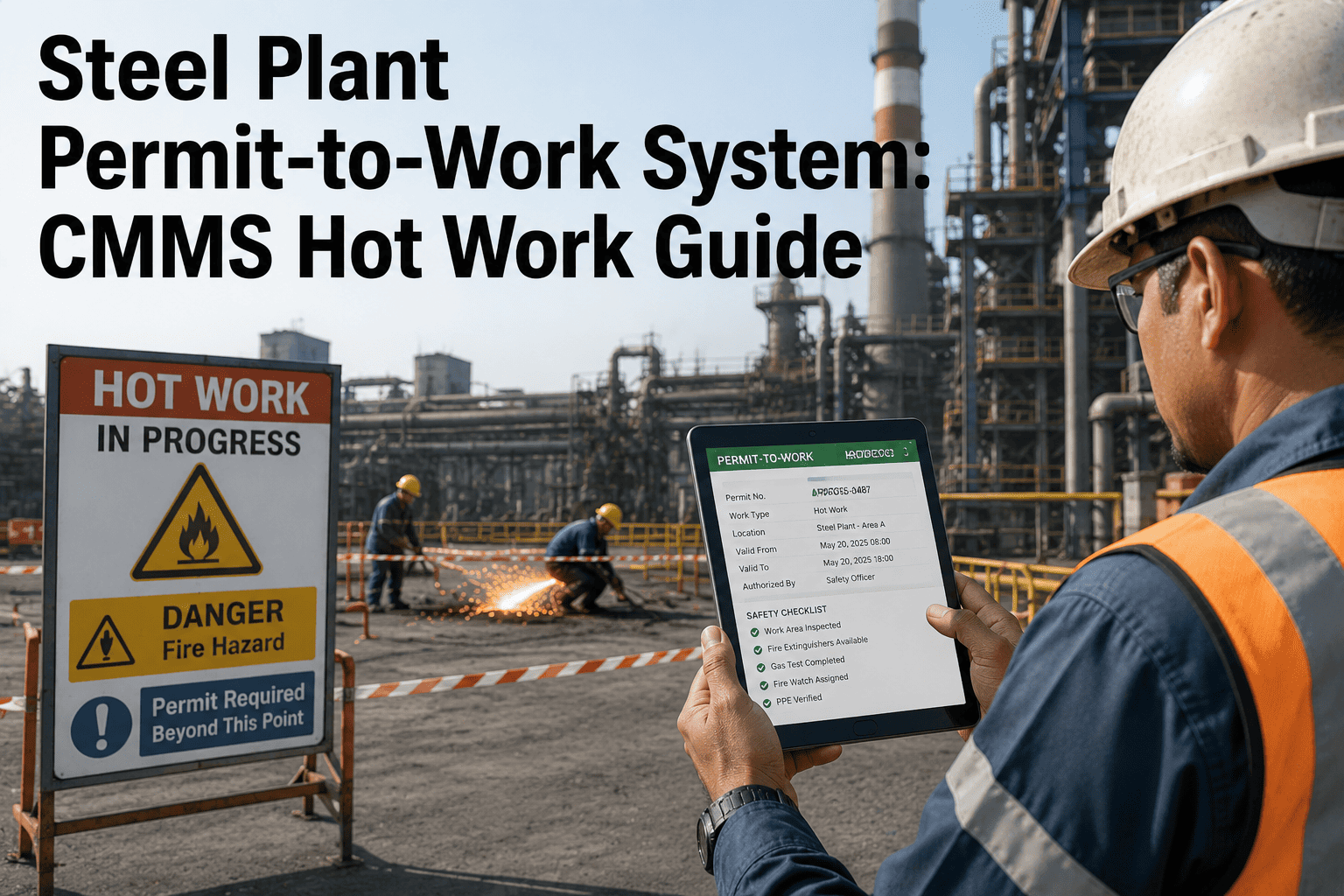
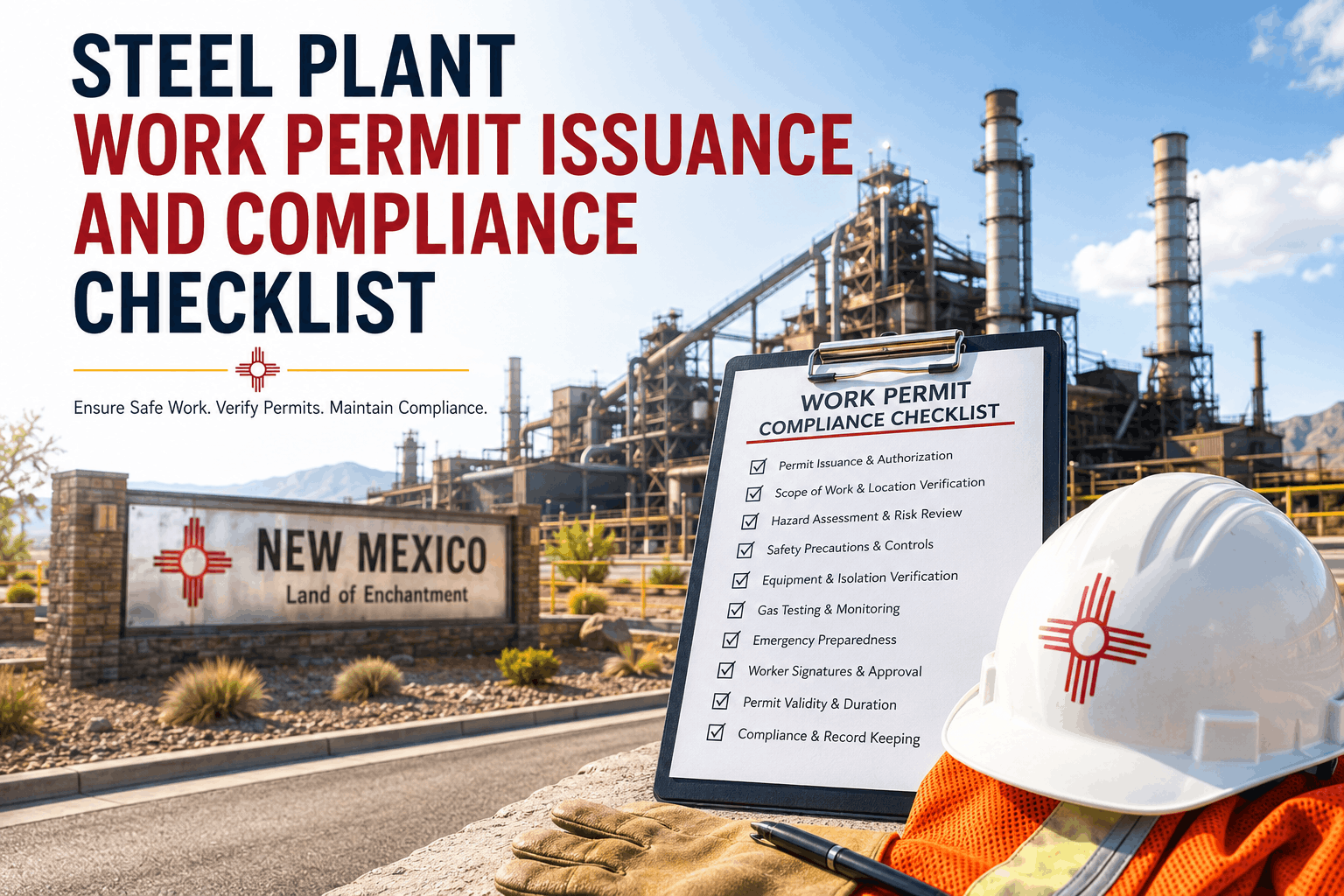
A steel plant shutdown with 800 contractors on site is statistically one of the most hazardous work environments in heavy industry. The fatality and serious injury rate for contractor workers in industrial turnarounds is three to five times higher than for permanent employees doing equivalent work — not because contractors are less skilled, but because they are working in an unfamiliar site, with unfamiliar hazards, under time pressure, often without the institutional knowledge that permanent staff carry. The site owner's responsibility for contractor safety does not end at the gate induction. It extends to every permit issued, every confined space entry authorised, every isolation verified, and every near miss reported and acted on. Managing 800 people's safety compliance manually — with paper induction registers, spreadsheet permit logs, and physical posting of work authority documents — is how incidents happen. Sign up for Oxmaint to digitise your contractor safety management before your next shutdown mobilisation.
Managing Contractor Safety Across the Full Shutdown Lifecycle
Contractor safety management is not a gate check at site entry — it is a continuous process that starts with prequalification months before mobilisation and ends with post-shutdown performance review. Each phase creates obligations for the site owner, and each phase generates records that must be retained for regulatory, insurance, and legal purposes. Sign up for Oxmaint to build your contractor management lifecycle in CMMS today.
Before any contractor receives a purchase order for shutdown work, their safety management system, incident history, competency certifications, and insurance coverage must be assessed against the site's contractor qualification standard. Oxmaint registers each qualified vendor with their competency categories, approved work types, and qualification expiry dates — generating alerts when any qualification approaches expiry before the planned shutdown date.
Each contractor worker requires a valid site-specific safety induction before accessing the plant. Processing 800 inductions in the 48 hours before blowdown creates access bottlenecks that delay early work starts. Oxmaint's induction scheduling module allows contractor supervisors to pre-register their workforce and schedule induction sessions in advance — spreading the volume across 2–3 weeks and ensuring everyone is inducted before mobilisation day rather than on it.
Each contractor work order in Oxmaint carries the required permit types as predecessor gates — confined space entry, hot work, working at height, electrical isolation, and radiation as applicable. No work order reaches "execute" status unless the relevant permit has been issued for that work face and that shift window. Permit status is visible to the shutdown manager in real time — enabling proactive permit preparation rather than reactive permit chasing when contractors arrive at a work face ready to start. Book a demo to see permit gating configured.
Near misses, first aid events, and recordable incidents involving contractors must be reported immediately, investigated, and linked to the specific work order and location where they occurred. Paper-based incident reports that are transcribed into a separate system hours or days after the event create accuracy problems and regulatory compliance risk. Oxmaint incident records link directly to the relevant work order — preserving the work context, the permit status at the time, and the contractor's induction and competency records.
Oxmaint generates a contractor performance scorecard after each shutdown: work order completion rates, planned vs. actual hours, safety incident counts and types, permit violations, and quality defects requiring rework. This data updates the contractor's prequalification record — directly influencing future contract award decisions and establishing the institutional knowledge base for vendor selection at the next major outage. Sign up to start building your vendor performance database.
Five Contractor Compliance Areas Every Steel Plant Must Track in CMMS
Each compliance area below represents a documented obligation under ISO 45001, OSHA General Industry Standards, or common-law duty of care for site owners who engage contractors. Each area requires CMMS records to demonstrate compliance during regulatory inspections or post-incident investigations. Click any area to expand the specific requirements and Oxmaint tracking method.
ISO 45001 Clause 8.1.4 requires organisations to ensure contractors have received appropriate safety information before commencing work. Each steel plant shutdown must document that every contractor worker has received and understood the site-specific induction — hazardous areas, emergency evacuation routes, gas detection alarm signals, and hot metal traffic rules — before accessing the plant.
A permit-to-work system is a formal written system that controls high-risk work activities by requiring authorised sign-off before work begins. The permit must specify the exact work scope, location, hazards, controls, and time validity — and must be closed and signed when work ceases. Open permits with no active work associated are a regulatory finding in any ISO 45001 audit.
For regulated work activities — electrical, pressure vessel, crane operation, scaffolding, confined space rescue, and asbestos removal — individual worker competency certificates must be current and verified before the worker performs that work. Paper competency registers maintained by contractors are difficult to audit in real time. Oxmaint stores individual worker competency records with expiry dates — checked automatically before permit issuance. Book a demo to see competency verification in action.
Near miss underreporting is the leading indicator of serious injury potential. Steel plant shutdowns with 800+ contractors typically see 3–8 reportable near misses per day of active work — most of which go unreported on paper-based systems because reporting feels bureaucratic, contractors fear consequences, or the forms are not accessible at the work site. Digitising incident reporting via mobile-accessible Oxmaint forms increases near miss reporting rates by 60–80% in the first shutdown — providing the leading indicator data that prevents escalation to serious events. Sign up for Oxmaint to enable mobile incident reporting.
Post-shutdown contractor performance data is the most underutilised asset in industrial turnaround management. Most companies evaluate contractors informally — based on the relationship quality and the senior project manager's recollection. A systematic performance scorecard built from CMMS data provides objective evidence for future contract award decisions and creates competitive pressure on contractors to improve safety performance between events.
How Oxmaint's Permit-to-Work System Works in a Steel Plant Shutdown
The permit-to-work system is the primary safety control for contractor activities in high-hazard zones during shutdown. Oxmaint's digital permit workflow enforces every mandatory step — from hazard assessment through to permit closure — without paperwork gaps or manual tracking.
When a shutdown work order is created in Oxmaint, the maintenance planner selects the applicable permit types required for that job — confined space, hot work, working at height, LOTO, or radiation. The permit types become mandatory predecessor items that must be issued before the work order can proceed to execution status.
Oxmaint generates a permit preparation notification to the safety team 24–48 hours before the planned work order start time. The safety officer reviews the work scope, arranges the required gas tests or isolation confirmations, and pre-populates the permit fields in Oxmaint. This advance notification eliminates morning-shift permit queues that delay contractor starts by 1–3 hours.
The authorised permit issuer and the contractor supervisor attend the work location together. Gas test results, isolation confirmation, and PPE verification are recorded in the Oxmaint permit record. Both parties sign digitally. The work order moves from "permit pending" to "execute" status — and the contractor can begin work within minutes rather than hours. Induction currency and competency certificates are verified automatically during this step.
The shutdown safety dashboard shows all active permits by zone, type, and time remaining. Permits approaching expiry generate automatic reminders to the permit holder and issuer. At shift change, permits requiring handover to the incoming shift supervisor are flagged — preventing the common scenario where a night shift team begins work on a permit that was valid for day shift conditions only.
When work is complete, the contractor supervisor closes the permit in Oxmaint — confirming the work area is clear, all isolation returns are complete, and no hazards have been created. The permit closure links to the work order completion, generating the completion record required for recommissioning documentation. Unclosed permits at end of shift generate an escalation alert to the shutdown safety officer. Sign up to configure your permit closure workflow.
Contractor Safety Compliance Requirements by Work Type — CMMS Evidence Reference
Use this table as a pre-shutdown audit tool to verify that Oxmaint is configured to capture the required compliance evidence for each high-risk work category present in your shutdown scope.
| Work Type | Regulatory Basis | Required CMMS Records | Permit Type | Risk Level |
|---|---|---|---|---|
| Confined space entry | OSHA 1910.146 / ISO 45001 Cl.8 | Gas-free cert, entry register, rescue plan, atmosphere monitoring log | Confined Space Permit | Critical |
| Hot work (welding/cutting/grinding) | NFPA 51B / Local fire code | Gas test result, fire watch log, 30-min post-work check, extinguisher placement | Hot Work Permit | Critical |
| Electrical isolation & LOTO | OSHA 1910.147 / IEC 60364 | Isolation point register, lock-out tag-out log, test before touch confirmation, reinstatement sign-off | LOTO Certificate | Critical |
| Working at height (>1.8m) | OSHA 1926.502 / ISO 45001 | Harness inspection date, anchor point verification, exclusion zone setup confirmation | WAH Permit | High |
| Crane lift operations | ASME B30 / National crane code | Lift plan approval, rigger and operator certification, crane inspection currency, exclusion zone log | Lift Permit | High |
| Pressure vessel repair | ASME Sec.IX / National Board | Coded welder certificate, weld procedure specification, post-weld NDT result, inspector approval | Pressure Equipment WO Gate | High |
| Refractory demolition / dust | OSHA 1910.1000 / Silica standard | Silica/ceramic fibre exposure monitoring log, respiratory protection programme record, air sampling results | Dust/Hazmat Permit | High |
| General contractor access | ISO 45001 Clause 8.1.4 | Site induction record, induction date, assessor name, PPE issue confirmation, emergency contacts | Site Access Register | Medium |
Swipe to view full compliance reference table
800 Contractors, Zero Paper Permit Logs — That Is What Digital Contractor Safety Management Looks Like
Every induction, every permit, every competency certificate, and every near miss report from your next shutdown should live in Oxmaint — searchable, auditable, and available to a regulator within minutes rather than days. The time to configure this is before mobilisation, not after the first incident.
What Robust Contractor Safety Management Prevents
We had a serious incident on our last EAF shutdown — a contractor working in an electrical room that was believed to be isolated, but one circuit had been missed in the isolation register. Paper-based LOTO records with 40 isolation points on a handwritten list were the root cause. The post-incident investigation took 3 weeks to reconstruct because half the paper permits had been filed in the contractor's site office and not our system. The regulatory fine and legal costs came to more than the entire CMMS platform would have cost us over five years. Every shutdown since has used Oxmaint for all isolation certificates and permit records — and our regulator visits now take half a day instead of three weeks.
Contractor Safety Management — Common Questions
Oxmaint's permit-to-work system checks the worker's induction status against their profile record before issuing any permit. If the induction is expired or the worker has not completed the required site-specific induction, the permit issuance is blocked — the safety officer cannot proceed with permit sign-off until the induction record is current. This check happens automatically at every permit request, not just at initial site entry. Workers who completed an induction at a previous event on the same site but whose induction has since expired are treated the same as workers with no induction on record. Sign up for Oxmaint to configure your induction validity rules.
Oxmaint supports multi-language induction records and permits. The induction delivery language and any interpreter involvement are recorded in the worker's induction record — providing evidence that the safety content was delivered in a language the worker comprehends. This is increasingly important for ISO 45001 compliance as regulators scrutinise language barrier incidents. Work order and permit fields can be configured to display in the primary language of the work site. Book a demo to see multi-language configuration options.
The reporting worker or supervisor submits the near miss via the Oxmaint mobile form — which captures time, location, work order reference, hazard type, and a photo upload. The system immediately notifies the shutdown safety officer and creates a mandatory investigation work order if the near miss meets the defined severity criteria. The investigation work order has a 24-hour completion requirement. If the work order is not completed within 24 hours, it escalates to the safety manager. All near miss records are linked to the relevant contractor company — contributing to their post-shutdown safety performance scorecard.
After each shutdown, Oxmaint generates a performance scorecard per contractor company: LTIFR, near miss reporting rate, permit violations, work order completion rate vs. planned, and rework percentage. These scores are stored in the contractor's prequalification record. When the procurement team evaluates contractors for the next major shutdown, Oxmaint surfaces the historical performance scores alongside the current prequalification status — allowing selection decisions to be based on objective historical data rather than relationship quality and verbal recollection. Contractors with consistent high safety and execution performance receive preferred vendor status, reducing the prequalification burden for future events. Sign up to start building your vendor performance database.
The contractor management module — induction record templates, permit type configurations, competency certificate fields, and vendor registration — can be configured in 1–2 weeks for a typical steel plant shutdown scope. Pre-registering contractor workforces and uploading existing competency records requires 2–3 additional weeks depending on the number of contractors and workers involved. Planning to complete configuration 8–10 weeks before mobilisation provides enough time for contractor supervisors to pre-register their teams, schedule induction sessions, and resolve any competency gaps before the shutdown start date.
Contractor Safety in a Steel Plant Shutdown Is Non-Negotiable. Your Records Should Prove It.
The regulatory burden on site owners for contractor safety is increasing — ISO 45001, OSHA General Industry Standards, and national safety legislation all place explicit obligations on the party that controls the work site. Oxmaint gives you the induction records, permit audit trail, competency verification, and incident documentation that demonstrates those obligations are being met — in a format that a regulator can review in minutes, not weeks.