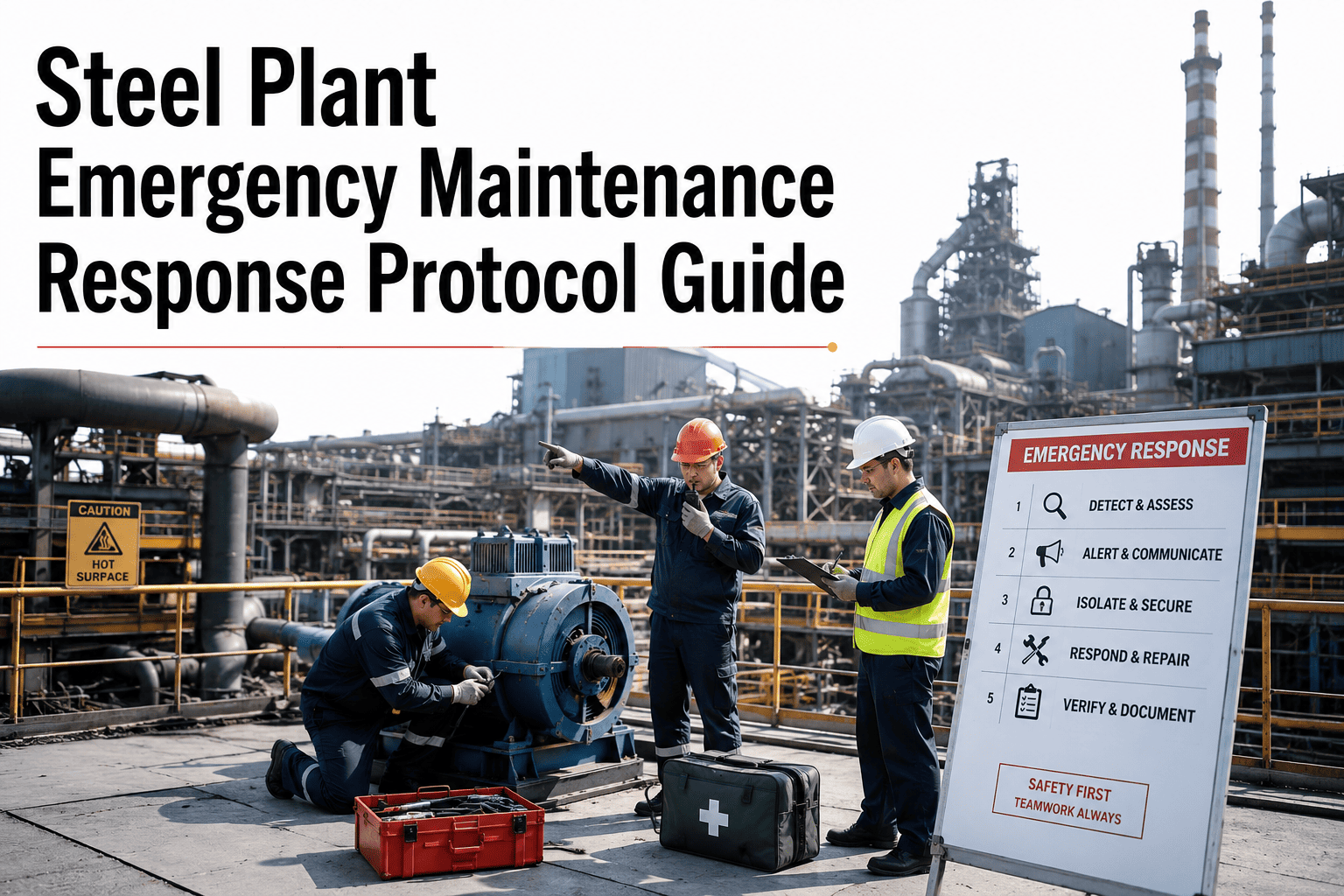
Emergency response drills separate steel plants that can execute critical evacuations in 180 seconds from facilities where confusion reigns for 15+ minutes. OSHA 1910.38 mandates documented fire and evacuation drills at least annually, yet 68% of steel plants lack quantified drill performance metrics. Steel mills conducting quarterly emergency response drills with timed evacuation measurements, documented observer feedback, and post-drill corrective action tracking reduce incident severity by 45% when actual emergencies occur. A single unplanned evacuation where assembly point accountability fails, communication systems freeze, or fire suppression response is delayed costs $2.3M+ in regulatory penalties, workers compensation claims, and equipment loss. Oxmaint's digital drill evaluation module timestamps every step from alarm activation through all-clear, generates real-time KPIs, and tracks corrective actions from drill to completion—transforming paper-based after-action reports into actionable safety improvements.
Master Emergency Response with Quantified Drill DataReal-time evacuation timing, observer assignments, assembly point verification, and post-drill action tracking—OSHA-audit-ready drill documentation.
Emergency drills must simulate realistic hazard scenarios that test the actual response systems and decision pathways your facility would execute during a genuine crisis. Generic "evacuate now" drills teach nothing about coordinated response to specific hazards—molten metal spills, gas releases, crane collapses, or confined space rescues each trigger distinct response protocols, equipment deployments, and role assignments. OSHA expects to see evidence that your facility has identified all credible hazard scenarios, written response procedures for each, and conducted drills that exercise those specific procedures. A steel mill that has never drilled a molten metal spill containment response, only generic evacuation, fails the compliance test the moment an actual spill occurs.
A drill without timed measurements is merely a fire safety theater—no data on whether response was actually effective. Steel plants measuring drill performance track evacuation time from alarm activation to all-clear at muster stations, first-response team deployment times (fire team in position in under 5 minutes, spill containment crew deployed in under 8 minutes), communication delay (time from alarm detection to message reaching the last sector), and assembly point accountability (all personnel accounted for within 10 minutes). These metrics reveal systemic weaknesses: an evacuation time exceeding 300 seconds indicates congestion at egress points, a 12-minute accountability delay reveals that headcount procedures are manual and error-prone, a 7-minute fire team deployment shows insufficient positioning or unclear authority to abandon tasks immediately. Oxmaint's real-time drill timer, mobile check-in capability, and observer checklists transform drills into measurable capability assessments.
3. Communication Systems & Emergency Notification Testing
A plant evacuation fails within 90 seconds if the communication system fails. Steel mills relying on overhead paging as the sole emergency notification method discover during drills that furnace noise masks announcements in certain zones, or that language barriers prevent non-native speakers from understanding terse alarm messages. Dual-mode communication (overhead paging + text alerts + visible strobes + horn patterns) ensures no zone is missed. Testing communication during drills—not just testing the paging system once per year—ensures all channels activate, all zones receive the message, and personnel understand what the alarm means and where to assemble.
The value of a drill is in the corrective actions that follow. A drill that reveals a bottleneck at the main stairwell is a success if the plant then engineers a secondary egress route; a drill that reveals that the spill containment kit is missing is a success if the plant immediately replaces it. A drill that is completed, filed away, and forgotten is just a compliance checkbox with zero impact on safety. Post-drill evaluation sessions must convene all participants (zone supervisors, first responders, observers, safety staff, plant management) within 48 hours while observations are fresh, discuss what worked and what failed, assign corrective actions with owners and due dates, and track those actions to completion. Oxmaint's post-drill action tracking module converts verbal observations into tracked work orders with assignment, due date, and closure verification.
Transform Drills into Measurable Safety CapabilityTimed evacuations, observer assignments, real-time accountability, and automated corrective action tracking—drill data that proves readiness to OSHA.
1. How often are steel plants required to conduct emergency drills?
OSHA 1910.38 requires at least one emergency action plan drill per year, but best practice is quarterly drills (4 per year). USA steel mills operating at benchmark-competitive safety levels conduct 6-8 drills annually (mixing announced and unannounced).
2. What is the difference between announced and unannounced drills?
Announced drills (personnel know date and time in advance) train procedures under ideal conditions. Unannounced drills (surprise exercises) measure real-world response and reveal gaps like absenteeism, unclear communication, or blocked egress routes.
3. What evacuation time should a steel plant target?
Complete evacuation from most zones should be achieved in under 180 seconds (3 minutes). High-hazard zones (near furnaces or molten metal) may require up to 240 seconds. Any zone exceeding 300 seconds indicates a congestion or communication problem requiring corrective action.
4. Who should conduct post-drill after-action reviews?
An independent facilitator (Safety Director or external consultant) should lead the review within 48 hours of the drill, with all zone supervisors, first responders, observers, and safety staff present. The session must focus on facts (what happened) not personalities.
5. How should corrective actions from drills be tracked?
Each finding must become a formal work order with assigned owner, description, due date, and resource requirements. Verify closure before the next drill and document the verification (photo evidence, training records) for audit files.
6. What role do independent observers play in drills?
Observers from safety staff or external sources (not zone supervisors) document execution against procedure. They record timings, identify gaps, and provide objective feedback. Observations must be specific ("Zone 2 stairwell congestion lasted 45 seconds") not vague ("evacuation was slow").
7. What is the purpose of drilling multiple scenarios annually?
Rotating scenarios (evacuation, confined space rescue, fire suppression, spill containment) tests all response systems systematically. A plant drilling only generic evacuation never validates whether specialized response teams are actually prepared.
8. How does Oxmaint help with drill documentation for OSHA audits?
Oxmaint timestamps all drill activities, logs observer notes and measurements, generates formal drill reports with findings and corrective actions, and tracks action completion. When OSHA arrives, you export a single report proving systematic drill execution and continuous improvement.
Build Emergency Readiness Through Quantified DrillsEvery alarm tested, every evacuation timed, every action tracked—drill program that ensures readiness when it matters most.