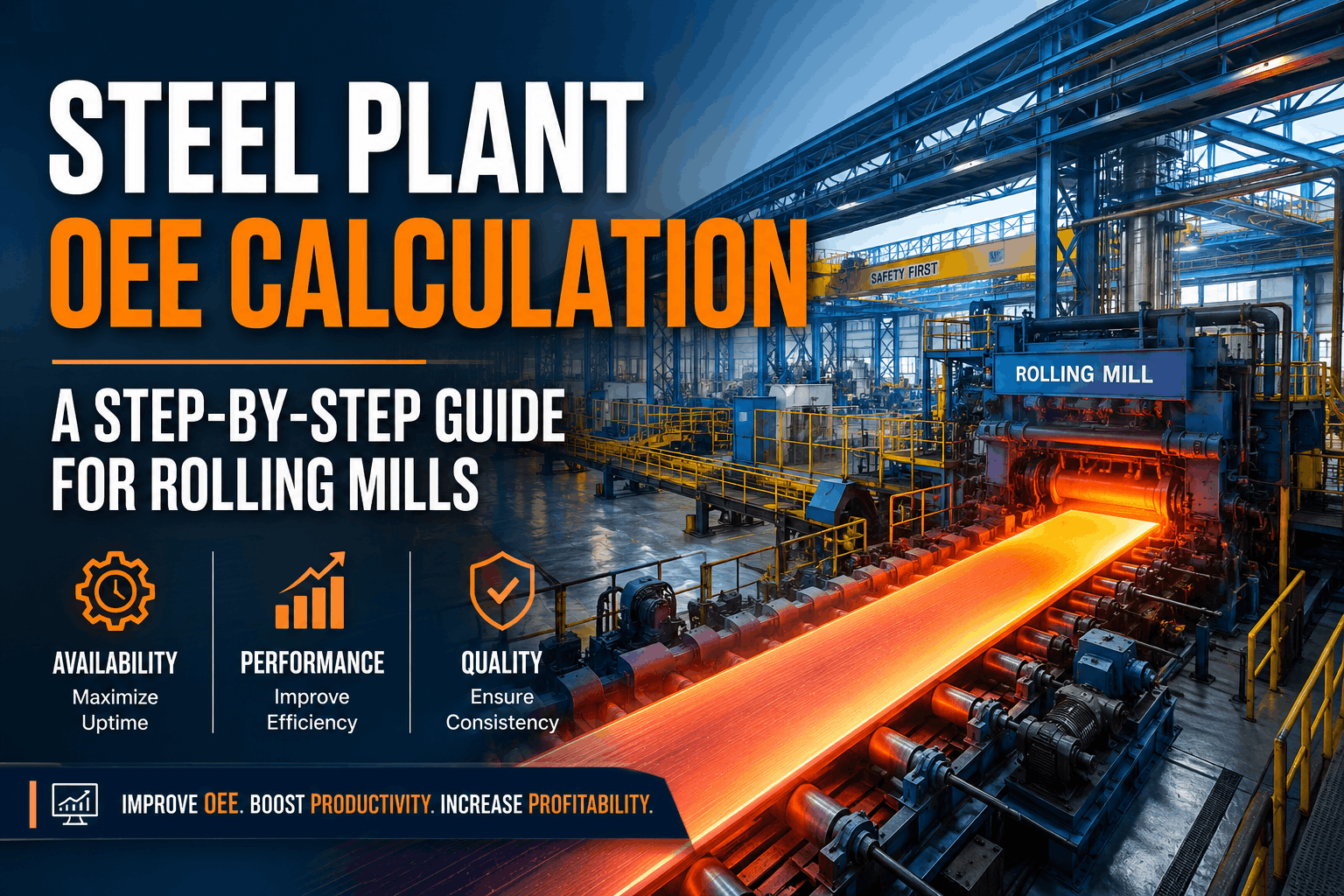
A steel plant reporting 72% OEE on manual shift logs is often operating at closer to 58% in reality — the gap is entirely minor stoppages, unreported speed losses, and quality defects coded as planned events because nobody had a system fast enough to catch them as unplanned ones. The journey from measured 72% to world-class 85% is not a technology problem; it is a measurement discipline problem compounded by a maintenance response speed problem. World-class 85% OEE decomposes into three simultaneous targets: 90% Availability, 95% Performance, and 99.9% Quality — and weakness in any single factor pulls the combined score below the benchmark regardless of how well the other two perform. Book a 30-minute demo to see how Oxmaint's Analytics & Reporting platform calculates live OEE per line, identifies the dominant loss category, and routes the right maintenance work order to close it — or start a free trial on your most critical production line.
Steel Plant OEE Improvement Roadmap: 72% to 85%
The six big losses mapped to steel plant equipment, the four-phase roadmap from reactive to predictive, and the KPIs that measure progress. Powered by Oxmaint Analytics & Reporting.
What OEE Actually Measures — And Why 72% Probably Isn't Your Real Number
OEE = Availability × Performance × Quality. The formula is simple; the honest measurement is not. Manual downtime logs understate actual loss by 30–60% because operators rarely log stoppages under five minutes, speed reductions go unrecorded until shift end, and quality losses are often coded as planned scrap rather than unplanned defects. Before building a roadmap from 72% to 85%, the first task is validating whether 72% is real. Plants switching from manual entry to PLC-based automatic capture consistently find their actual OEE is 10–15 points lower than reported. The strategic decisions that flow from 72% and from 58% are completely different — and the roadmap below is calibrated for the realistic, honest number, not the reported one.
Unplanned breakdowns, planned maintenance in production windows, changeover time, and material/tooling delays. The most visible loss in steel plants — a blast furnace tap hole failure or a roll change overrun shows up immediately in the shift report.
Speed losses, micro-stoppages under 5 minutes, and reduced-rate running. The most underreported loss in steel plants — a hot strip mill running at 85% of nominal speed for an entire shift loses 300 tonnes of production that never appears in any breakdown log.
Defective output, prime-to-secondary downgrades, rework, and startup scrap. In flat-rolled steel, a $200–400/tonne prime-to-secondary differential makes the Quality factor financially equivalent to a line stoppage — but it is rarely treated with the same urgency.
The Six Loss Categories Mapped to Steel Plant Equipment
Every point of OEE loss traces to one of six categories defined by Nakajima's TPM framework. In steel manufacturing, each category has a dominant equipment source and a specific measurement method. Oxmaint's Analytics platform tags every loss event to its category automatically from SCADA and production data — so the Pareto is generated in real time, not reconstructed from memory at month end.
| Loss Category | OEE Factor | Steel Plant Source | Typical Impact | Primary Fix |
|---|---|---|---|---|
| Unplanned Breakdowns | Availability | Blast furnace refractory, rolling mill drives, hydraulics, crane failures | High — 5–15 pts | Predictive maintenance |
| Setup & Changeovers | Availability | Roll changes, gauge changeovers, product grade transitions | Medium — 2–8 pts | SMED methodology |
| Minor Stoppages | Performance | Cobble detection trips, cooling system interruptions, sensor faults | High — often hidden | Root cause elimination |
| Reduced Speed | Performance | Strip tension instability, thermal limit throttling, operator caution | Medium — 3–6 pts | Process stabilisation |
| Process Defects | Quality | Surface defects, dimensional drift, scrap at grade boundaries | Medium — 2–5 pts | SPC + AI vision |
| Startup Losses | Quality | First-coil transitions, heat-up losses, cold-start scrap | Low-medium — 1–3 pts | Standard startup procedures |
The Four-Phase Journey from 72% to 85% OEE
The roadmap below is not a technology deployment plan — it is a capability-building sequence. Phase 1 establishes honest measurement. Phase 2 stabilises Availability. Phase 3 recovers Performance. Phase 4 locks in Quality. Each phase has a realistic OEE gain range and a primary Oxmaint capability that supports it. Attempting to run all four phases simultaneously produces none of the gains; completing them in sequence produces all of them.
Honest Measurement
Connect production assets to automated data capture. Replace manual shift logs with PLC/SCADA-based OEE calculation. Establish the real baseline — accept that the number will be lower than reported.
Availability Recovery
Deploy condition monitoring on high-impact assets. Convert top-three breakdown sources from reactive to predictive maintenance. Target unplanned breakdown time at the largest contributors from Phase 1 Pareto.
Performance Recovery
Pareto micro-stoppages from the now-accurate measurement system. Eliminate the top five recurring trip sources. Address speed throttling through process stabilisation and parametric optimisation on high-variance operations.
Quality Lock-In
Integrate AI vision quality inspection and SPC on dimensional quality. Close the defect-to-maintenance loop so every quality escape triggers an upstream equipment work order. Target first-pass yield above 99.5%.
See your plant's live OEE calculated per line, per shift, with the Six Big Loss Pareto — no spreadsheets, no manual entry.
The Metrics That Track Progress at Every Phase
| KPI | Formula | Baseline (Avg) | Phase 2 Target | World-Class |
|---|---|---|---|---|
| Overall OEE | Availability × Performance × Quality | 60–72% | 75–78% | ≥ 85% |
| Availability | Run time / Planned production time | 78–83% | 85–88% | ≥ 90% |
| Performance Rate | (Ideal cycle time × Output) / Run time | 82–88% | 90–93% | ≥ 95% |
| First Pass Yield | Good units / Total units | 96–98% | 98.5–99% | ≥ 99.9% |
| Unplanned Downtime % | Unplanned stops / Total planned time | 12–18% | 7–10% | < 5% |
| MTBF | Run time / Number of failures | Baseline+ | +30% vs baseline | Rising trend |
| MTTR | Total repair time / Repairs | 3–6 hrs | < 2.5 hrs | < 1.5 hrs |
What 20 Years of Steel Plant OEE Improvement Teaches You
Frequently Asked Questions
Start Measuring Real OEE Before You Try to Improve It
Oxmaint calculates live OEE per line from your SCADA and production data, generates the Six Big Loss Pareto in real time, and routes the right maintenance work order to the right technician. The roadmap from 72% to 85% starts with knowing your honest number.