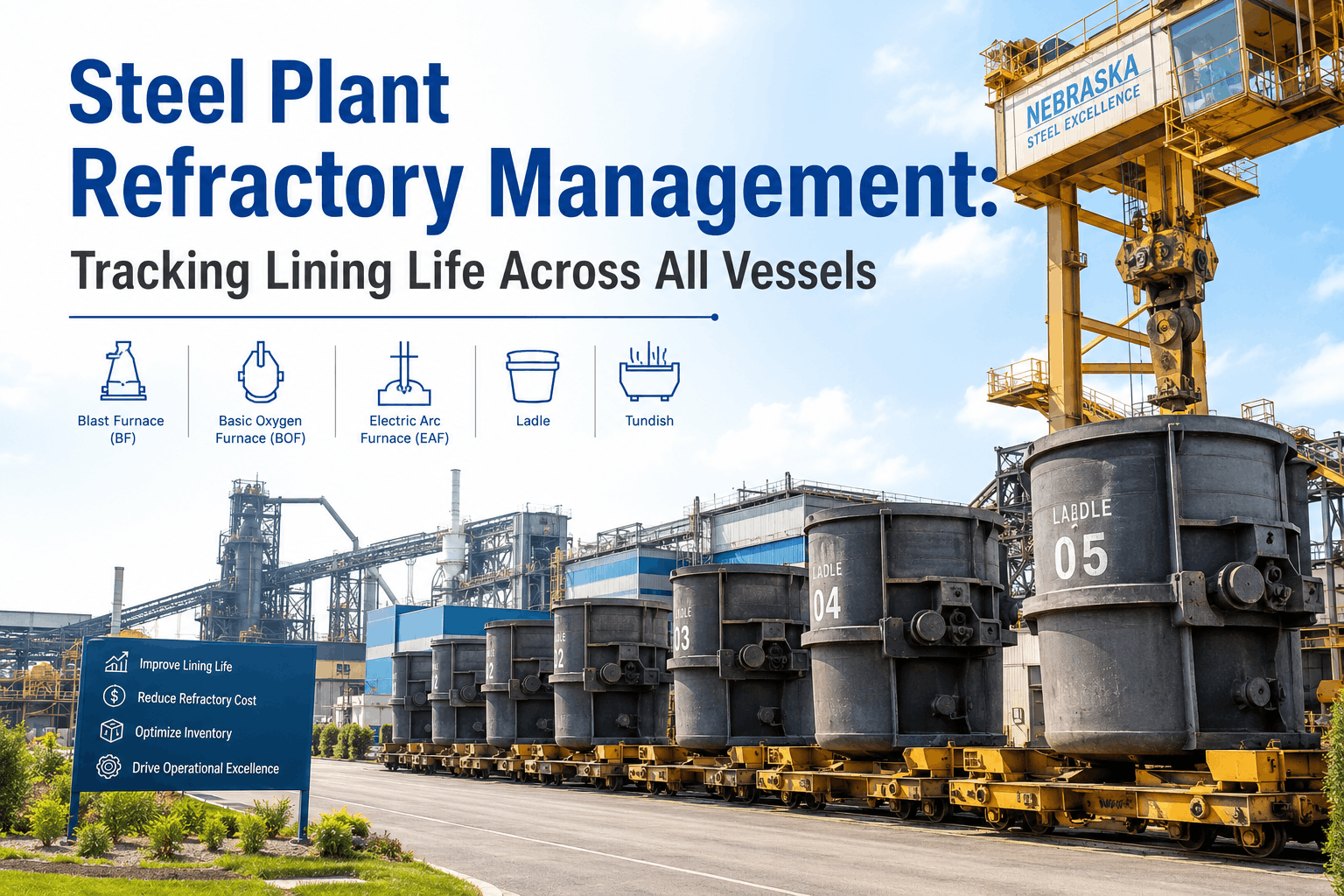
Refractory materials are the only barrier between 1,600°C molten steel and the steel shell of every vessel in the plant. When refractory fails, the consequences range from an unplanned reline costing $2-15 million to a molten metal breakout that threatens lives. Yet refractory management at most steel plants remains surprisingly primitive — wear data lives in spreadsheets nobody updates, gunning decisions are made by feel, and campaign end dates are guessed rather than calculated. World-class plants treat refractory as a precision-managed consumable. They track wear rates by zone, correlate degradation with process variables, and predict remaining life accurately enough to plan relines months in advance. Sign up for OxMaint to bring this discipline to every lined vessel in your plant.
Steel Plant Refractory Management: Selection, Installation & Life Tracking Across All Vessels
Material selection, installation QC, wear tracking, reline scheduling, and cost-per-heat optimization — managed from a single CMMS platform.
Every Vessel. Every Zone. Every Heat.
Every vessel in a steel plant is lined with refractory, but each has radically different materials, wear mechanisms, campaign lengths, and economic impact. Effective management requires vessel-specific tracking — not a one-size-fits-all PM schedule. Book a demo to see how OxMaint maps every vessel in your plant.
is the single most important refractory metric. It divides total campaign cost (initial lining + installation labour + mid-campaign repairs + production losses during reline) by total heats produced. Plants that track this metric campaign-over-campaign consistently outperform those that manage refractory on calendar schedules alone.
Five Disciplines of World-Class Refractory Management
Steel plants that achieve top-quartile refractory performance — longest campaigns, lowest cost per tonne, fewest unplanned relines — consistently execute these five disciplines. OxMaint tracks each one automatically. Sign up free to build your refractory tracking foundation.
Systematic Wear Tracking
Measure remaining lining thickness by zone using laser scanning, ultrasonic gauges, or thermal modelling at defined intervals. OxMaint tracks remaining thickness per zone, wear rate trending (mm/heat), minimum thickness alerts, and predicted remaining life with confidence intervals.
Process Correlation
Refractory does not wear at a constant rate — it is driven by slag chemistry, temperature, gas stirring intensity, and tapping conditions. OxMaint correlates wear rate with slag basicity, FeO content, tap temperature, and slag splashing effectiveness to identify controllable degradation factors.
Repair Optimization
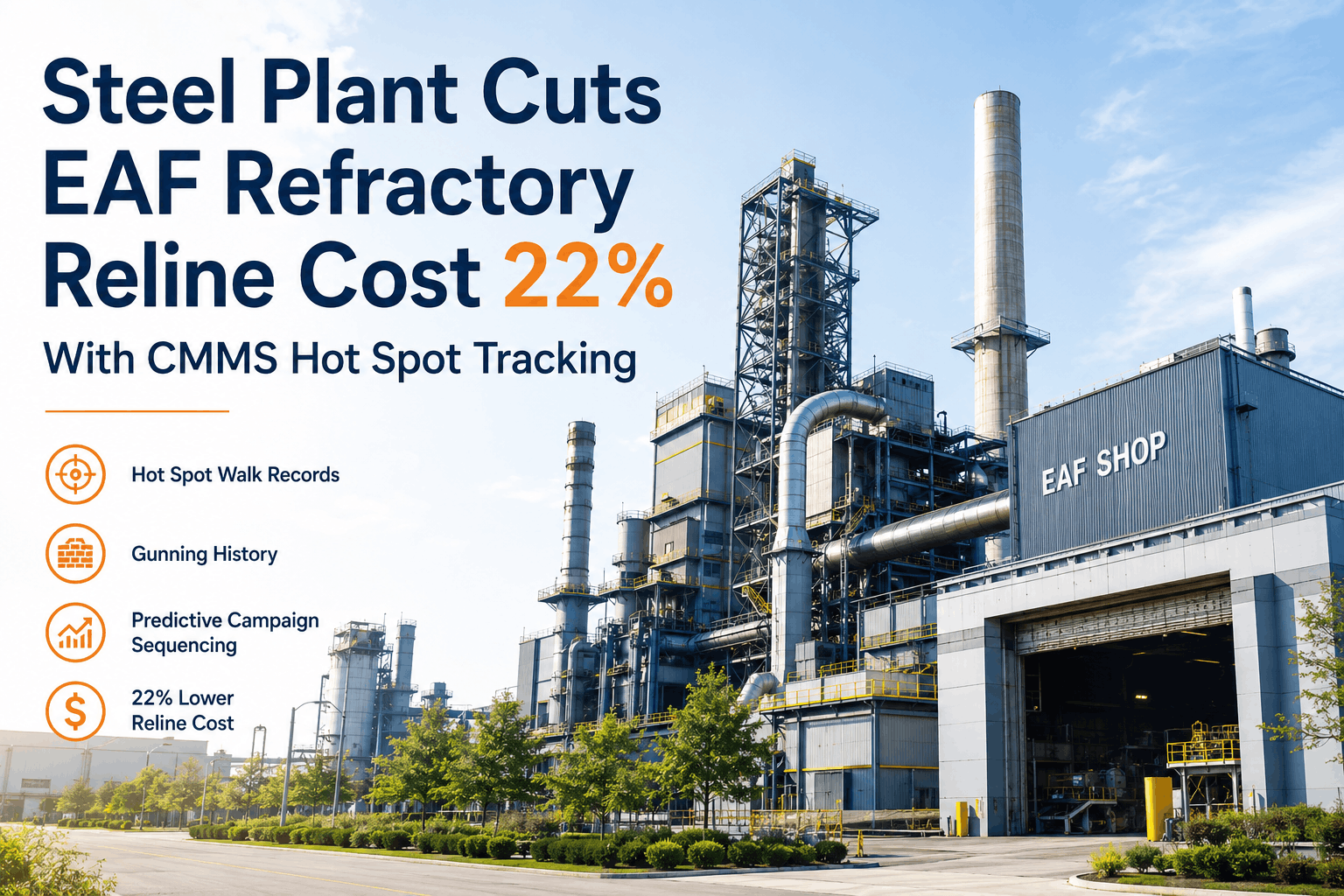
Mid-campaign repairs (gunning, patching, slag splashing) extend lining life at a fraction of reline cost — but have diminishing returns. OxMaint tracks gunning material consumption, post-repair wear rate vs. pre-repair, repair cost per additional heat gained, and cumulative repair cost as a percentage of reline cost.
Cost-per-Heat Analysis
Every campaign generates a complete cost picture: initial lining material, installation labour, mid-campaign repairs, production losses during reline, and total heats produced. OxMaint calculates cost per heat per vessel and trends it campaign-over-campaign.
Inventory & Procurement
Refractory materials have 4-16 week lead times for specialty bricks, high storage costs, and shelf-life limitations for some monolithics. OxMaint auto-triggers reorder based on upcoming reline schedules and consumption forecasting — eliminating both stockouts and overstocking.
Refractory Material Selection Guide
Material selection is the most consequential decision in refractory management. The cheapest option upfront often proves most expensive when frequent relining is needed. Here is how material types map to vessel zones and service conditions.
| Material Type | Max Temp | Primary Application | Wear Resistance | Cost Level |
|---|---|---|---|---|
| MgO-C (Magnesia-Carbon) | 1,700°C | BOF/EAF slag line, ladle slag zone | Excellent vs. basic slag | High |
| High-Alumina Brick (90%+) | 1,800°C | Ladle barrel, tundish permanent lining | Good general purpose | Medium |
| Alumina-Magnesia Castable | 1,750°C | Ladle bottom, well block areas | Good vs. steel erosion | Medium |
| Carbon Composite | 2,000°C+ | Blast furnace hearth | Excellent vs. iron penetration | Very High |
| Silica Brick | 1,700°C | Coke oven walls, hot blast stoves | Good in stable thermal conditions | Low-Medium |
| Gunning Mix (MgO-based) | 1,600°C | Mid-campaign repairs, all vessels | Moderate (repair material) | Low |
What OxMaint Tracks for Every Vessel
OxMaint's refractory lifecycle module builds a digital record for every lined vessel — tracking wear progression, repair history, material performance, and cost accumulation across every campaign. Sign up free to start tracking your first vessel.
Wear Rate Trending
Remaining thickness per zone per measurement date. Wear rate in mm/heat or mm/month. Minimum thickness alerts trigger inspection work orders automatically.
Campaign Life Prediction
Predicted remaining life per zone with confidence intervals. AI models ingest process variables — slag chemistry, temperature profiles, stirring intensity — to forecast end-of-campaign timing within 2 heats accuracy.
Cost-per-Heat Dashboards
Total refractory cost divided by total heats per vessel. Campaign-over-campaign trending. Material cost benchmarking vs. supplier alternatives. Repair cost vs. extension value analysis.
Reline Planning & QC
Automated reline scheduling based on predicted remaining life. Installation QC checklists for brick laying, castable curing, and dryout procedures. Material procurement triggered by upcoming reline schedules.
Refractory failure is the most expensive preventable event in a steel plant. A $4.8 million emergency reline becomes a $340,000 planned intervention when you have the data to predict it 6 weeks in advance.
-- Head of Asset Management, Integrated Steel Producer
Manage Every Lining. Predict Every Reline.
From blast furnace hearth to tundish nozzle, OxMaint tracks remaining lining thickness, trends wear rates, schedules repairs, manages refractory inventory, and calculates cost-per-tonne for every campaign. Convert refractory guesswork into precision-managed asset care.