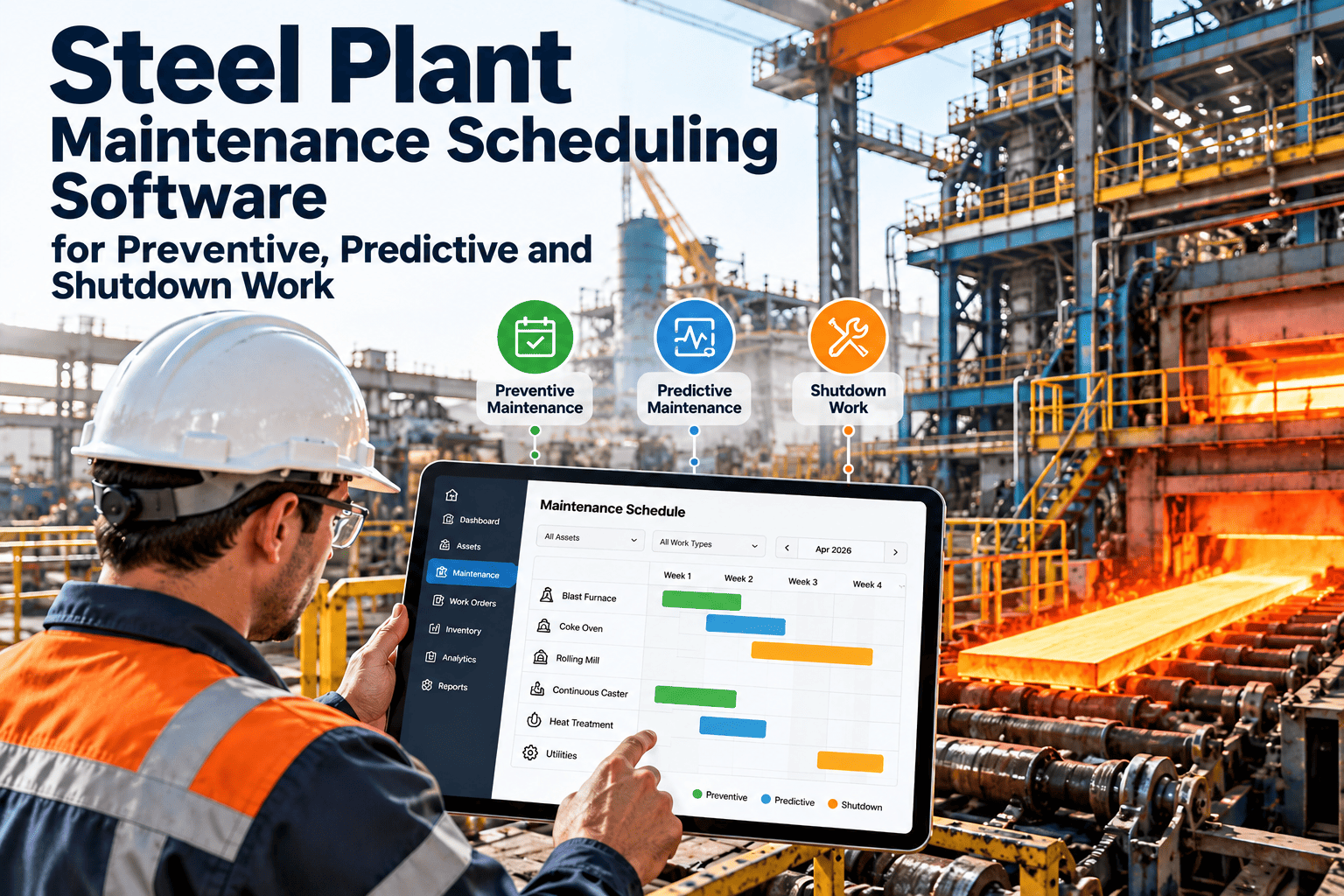
Every minute of unplanned downtime costs industrial operations thousands of dollars in lost productivity, emergency repairs, and missed deadlines. Traditional maintenance approaches—paper work orders, scattered spreadsheets, and reactive firefighting—leave maintenance teams constantly behind, struggling to keep equipment running while costs spiral out of control. A Computerized Maintenance Management System (CMMS) transforms this chaos into structured, data-driven maintenance operations that prevent breakdowns before they happen. Schedule a consultation to discover how Oxmaint CMMS can streamline your maintenance operations and reduce equipment downtime.
Why Modern Operations Need CMMS
Industrial facilities face mounting pressure from aging equipment, skilled labor shortages, and increasing compliance requirements. Manual maintenance tracking methods miss critical patterns and correlations that drive equipment failures, leaving significant cost savings undiscovered while downtime events multiply.
The Business Case for CMMS Implementation
$1.29B
Global CMMS market size in 2024, projected to reach $2.41B by 2030 at 11.1% CAGR growth rate
40-60%
Reduction in unplanned downtime through preventive and predictive maintenance scheduling
25-35%
Average maintenance cost reduction achieved by facilities with strategic CMMS implementations
300-500%
ROI achieved within 18-24 months through comprehensive CMMS deployment strategies
Ready to eliminate maintenance chaos and reduce downtime? Join thousands of facilities using CMMS to streamline operations and cut costs.
A Computerized Maintenance Management System centralizes all maintenance information into a single database, providing a structured framework for planning, executing, and tracking every maintenance activity. At its core, CMMS digitizes and integrates critical areas of maintenance management—from work order creation to asset tracking and inventory control.
CMMS Core FunctionalityFrom work request to completion and analysis
01
Work Order Management
Automate the entire work order lifecycle from initial request and approval through task assignment and completion. Track every maintenance task with detailed history, labor hours, and parts used for complete visibility.
02
Asset Registry & Tracking
Maintain a definitive register of every piece of equipment with complete service history, performance data, warranty information, and documentation. Know exactly what you have and its current condition at all times.
03
Preventive Maintenance Scheduling
Automatically schedule and assign proactive maintenance tasks based on time intervals, meter readings, or equipment condition. Never miss critical PM tasks that prevent costly breakdowns.
04
Inventory & Parts Management
Track spare parts availability, location, and usage in real-time. Automated reorder points ensure critical parts are always available while reducing carrying costs by 20-30%.
05
Reporting & Analytics
Transform maintenance data into actionable insights with customizable dashboards and KPI tracking. Make data-driven decisions that continuously improve reliability and reduce costs. Sign up for Oxmaint to access powerful maintenance analytics.
Key CMMS Features That Drive Results
Modern CMMS platforms go far beyond basic work order tracking. Advanced features leverage IoT sensors, mobile technology, and AI-powered analytics to transform maintenance from reactive firefighting into proactive asset management.
Essential CMMS Capabilities
Mobile Access
Technicians access work orders, asset history, and procedures from any device. Complete tasks, capture photos, and update records directly from the field without paperwork delays.
Predictive Maintenance
AI algorithms analyze sensor data and historical patterns to predict failures before they occur. Catch problems early and schedule repairs during planned downtime windows.
Compliance Tracking
Automated documentation and audit trails ensure regulatory compliance. Generate reports for OSHA, EPA, and industry-specific requirements with complete maintenance records.
System Integration
Connect CMMS with ERP, SCADA, and IoT platforms for unified operations. Share data across departments to align maintenance with production and procurement.
Resource Scheduling
Optimize technician assignments based on skills, availability, and workload. Reduce overtime costs and ensure the right person handles each job efficiently.
Real-Time Dashboards
Monitor KPIs including MTBF, MTTR, and equipment availability in real-time. Identify trends and make informed decisions with customizable performance visualizations.
See CMMS capabilities in action. Book a personalized demo and discover how Oxmaint features align with your maintenance challenges.
Understanding the difference between manual maintenance management and CMMS-driven operations reveals why organizations across industries are making the switch to digital maintenance platforms.
Maintenance Management Approach Comparison
Traditional Methods
Paper work orders lost or incomplete
Spreadsheet tracking prone to errors
Reactive maintenance after breakdowns
No visibility into equipment history
Parts shortages cause repair delays
800 hrsaverage annual unplanned downtime
CMMS-Powered Operations
Digital work orders with complete tracking
Centralized database with real-time updates
Preventive maintenance prevents failures
Complete asset history at your fingertips
Automated inventory management
27 hrsmonthly downtime with CMMS optimization
Industries That Benefit from CMMS
CMMS solutions serve organizations across virtually every industry where physical assets require maintenance. From manufacturing floors to hospital facilities, the principles of organized maintenance management deliver consistent value.
CMMS Applications by Industry
Manufacturing
Production lines, CNC machines, conveyors
Minimize production losses, extend equipment life, ensure quality
Organizations can choose between cloud-based CMMS solutions and on-premise installations. While on-premise systems dominated historically with 57% market share, cloud-based solutions are growing rapidly due to their flexibility, lower upfront costs, and automatic updates.
Deployment Model Comparison
Factor
Cloud-Based CMMS
On-Premise CMMS
Initial Cost
Low subscription fees, no hardware
Higher upfront investment in servers
Maintenance
Automatic updates by provider
Manual updates and IT management
Accessibility
Access from anywhere with internet
Limited to local network or VPN
Data Control
Stored on provider infrastructure
Complete control on local servers
Scalability
Easily scale users and features
Requires additional hardware investment
Cloud-based CMMS enables mobile access for technicians in the field, with offline capabilities that sync when connectivity returns.
Transform Your Maintenance Operations with Oxmaint CMMS
Stop losing money to unplanned downtime and reactive maintenance. Oxmaint CMMS centralizes work orders, automates preventive maintenance schedules, tracks assets and inventory, and delivers real-time analytics—all from one intuitive platform accessible on any device.
How quickly can we see ROI from CMMS implementation?
Most organizations identify significant savings opportunities within the first 30-60 days of deployment. Quick wins from work order organization and preventive maintenance scheduling often deliver measurable value within 3-6 months. Industry data shows 27% of organizations achieve full ROI within one year, with many experiencing 300-500% returns within 18-24 months. Schedule a consultation to discuss expected ROI for your facility.
What is the difference between CMMS and EAM software?
CMMS focuses on maintenance management—work orders, preventive maintenance, and asset tracking. Enterprise Asset Management (EAM) expands this scope to cover the complete asset lifecycle from procurement through disposal, integrating with financial systems for total cost of ownership analysis. Modern CMMS platforms like Oxmaint increasingly offer EAM-level functionality while maintaining ease of use.
How long does CMMS implementation typically take?
Basic CMMS deployment can be completed in 2-4 weeks for smaller operations. Comprehensive implementations including asset data migration, integration setup, and team training typically require 2-3 months. Oxmaint's intuitive interface reduces learning curves, with many teams productive within days of starting. Sign up for a free account to explore the platform immediately.
Can CMMS work offline for technicians in the field?
Yes. Modern cloud-based CMMS platforms include mobile apps with offline functionality. Technicians can view work orders, access procedures, and record completed work without internet connectivity. Data syncs automatically when connection is restored, ensuring nothing is lost and records remain accurate.
What size organization benefits from CMMS?
Organizations of all sizes benefit from CMMS. Large enterprises with 61% market share use CMMS to manage complex multi-site operations, while SMEs are the fastest-growing segment due to affordable cloud solutions and growing awareness of data-driven maintenance benefits. If you maintain equipment and want to reduce downtime and costs, CMMS delivers value regardless of organization size.