Steel manufacturing is one of the most asset-intensive industries on the planet. A single integrated steel plant can house over 10,000 individual assets—from mine-site crushers and ore conveyors to blast furnaces operating at 2,500°F, continuous casters, rolling mills, and finishing lines. Managing these assets with spreadsheets and reactive maintenance isn't just inefficient—it's a direct path to catastrophic downtime costing $125,000+ per hour. Enterprise Asset Management (EAM) software solves this by providing full lifecycle visibility across every asset, from procurement and commissioning through operation, maintenance, and eventual replacement. But not every EAM platform is built to handle the brutal realities of steel production. We evaluated the top 10 EAM solutions specifically for the steel industry, ranking them on real-world fit for the mine-to-mill value chain.
Why Steel Plants Need Purpose-Built EAM Software
Generic facility management tools weren't engineered for molten metal, 24/7 continuous casting, or multi-stage production lines spanning mines to finishing mills. Steel production throws challenges at maintenance and asset teams that demand specialized capabilities far beyond basic work order tracking.
Extreme Operating Environments
Equipment operates under intense heat exceeding 1,500°C, corrosive dust, and relentless vibration. EAM must track condition-based triggers from sensors embedded in the harshest zones of the plant floor.
Massive Cost of Downtime
A single blast furnace outage costs $50,000–$200,000 per hour in lost production, wasted energy, and refractory damage. Without lifecycle-level asset management, reactive maintenance drains millions annually.
Deep Asset Hierarchies
From mine-site crushers through smelting, casting, rolling, and finishing—steel operations manage thousands of interdependent assets that must be tracked as a unified system across the entire value chain.
Regulatory & Compliance Pressure
OSHA, EPA, ISO 14001, ISO 45001, and ISO 55001 demand tamper-proof maintenance logs, safety audit trails, and environmental documentation with zero tolerance for gaps.
Still managing steel plant assets on spreadsheets? Switch to Oxmaint's AI-powered EAM platform and gain full lifecycle visibility from mine to mill—deployed in days, not months.
How We Ranked: Evaluation Criteria
Each EAM platform was scored across six critical dimensions that matter most for steel manufacturing asset management. Here is how each criterion was weighted in our assessment.
Top 10 EAM Software Solutions for Steel Manufacturing
Oxmaint
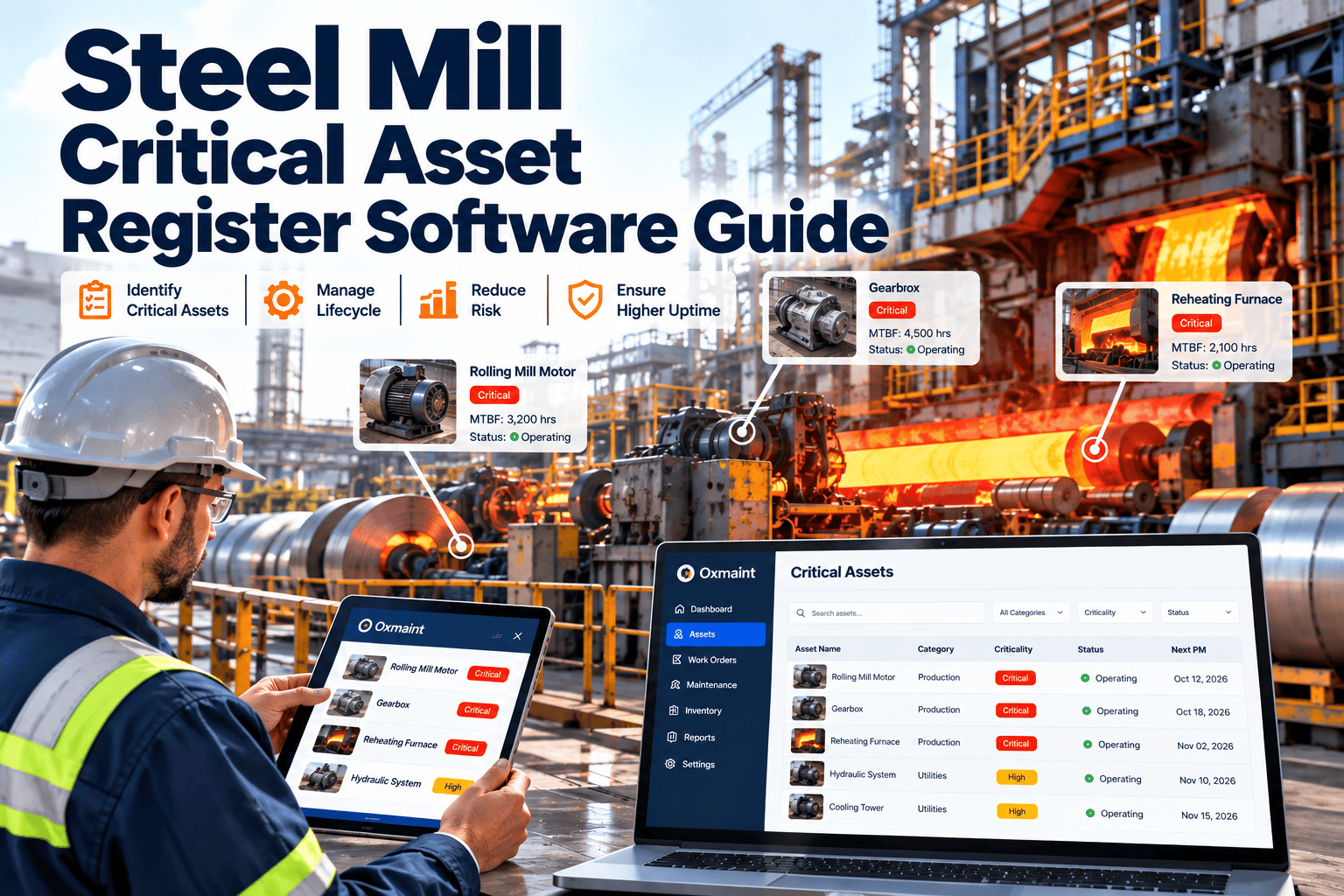
Best Overall EAM for Steel OperationsPurpose-built for heavy industry including steel, mining, and manufacturing. Oxmaint delivers complete asset lifecycle management with AI-driven predictive maintenance, automated work order generation from IoT sensor triggers, and multi-plant visibility—all through a mobile-first interface technicians adopt on day one. No six-month rollout required.
IBM Maximo
Best for Large Enterprise Steel CorporationsAn enterprise-grade EAM with deep asset lifecycle management, advanced analytics, and strong ERP integration. Ideal for multinational steel corporations with dedicated IT teams. However, implementation takes 6–12 months and annual costs can exceed $150K.
SAP Plant Maintenance (S/4HANA)
Best for SAP-Integrated Steel MillsTightly integrated with SAP ERP for finance, procurement, and supply chain. The natural choice for steel mills already running SAP. Powerful asset lifecycle tools but requires SAP consultants and significant customization for steel-specific workflows.
Infor EAM
Best for Multi-Location Steel EnterprisesTrue enterprise asset management with industry-specific configurations for metals and mining. Deep integration with Infor's ERP, supply chain, and HR modules. Best for large steel corporations managing complex multi-site operations with dedicated IT resources.
Fiix (by Rockwell Automation)
Best for Mid-Size Steel OperationsCloud-based CMMS/EAM with strong AI-driven analytics and an Integration Hub connecting SCADA, ERP, and MES without custom middleware. Fiix Foresight scores asset-failure risk automatically. Good fit for mid-size steel plants seeking quick cloud deployment with lifecycle capabilities.
LLumin CMMS+
Best for PLC/SCADA-Driven Asset ManagementBuilt for heavy manufacturing with modules wrapping directly around PLC and SCADA data. Live-data rules engine monitors temperature, vibration, and pressure from Siemens and Mitsubishi PLCs. Excellent for steel plants with extensive automation needing deep sensor-to-work-order integration.
MaintainX
Best Mobile-First ExperienceAward-winning mobile-first platform praised for ease of adoption. Excellent for digitizing paper-based maintenance workflows with strong work order management and real-time team communication. Less depth in full lifecycle management and heavy industrial IoT integration.
UpKeep
Best for Rapid DeploymentCloud-native, mobile-friendly platform excelling in rapid deployment and user adoption. Strong work order and inventory management. Better suited for smaller steel operations or secondary plants needing a quick digital upgrade without enterprise EAM complexity.
Limble CMMS
Best for Customizable WorkflowsHighly customizable cloud platform praised for adaptability across industries. Custom fields and flexible workflow configuration make it adaptable to steel-specific processes. Strong user satisfaction but limited in deep industrial IoT and full asset lifecycle capabilities.
Accruent Maintenance Connection
Best for Compliance-Heavy Steel OperationsScalable, enterprise-grade platform trusted by process manufacturers including steel producer SSAB. Strong compliance documentation, preventive maintenance scheduling, and multi-site asset management. Proven in metals manufacturing but less agile than cloud-native competitors.
Quick Comparison: Top 10 at a Glance
| Rank | EAM Solution | Best For | Deployment | Lifecycle Depth | Pricing |
|---|---|---|---|---|---|
| #1 | Oxmaint | Overall steel plant EAM | Cloud / Days | Excellent | $$ |
| #2 | IBM Maximo | Large enterprise | Cloud or On-Prem / 6–12 mo | Excellent | $$$$ |
| #3 | SAP PM (S/4HANA) | SAP-integrated mills | On-Prem / 6–12 mo | Good | $$$$ |
| #4 | Infor EAM | Multi-location enterprise | Cloud or On-Prem / 6–12 mo | Good | $$$$ |
| #5 | Fiix | Mid-size operations | Cloud / 4–8 weeks | Moderate | $$$ |
| #6 | LLumin CMMS+ | PLC/SCADA integration | Cloud / 4–8 weeks | Moderate | $$$ |
| #7 | MaintainX | Mobile-first teams | Cloud / 1–2 weeks | Basic | $$ |
| #8 | UpKeep | Quick deployment | Cloud / 1–2 weeks | Basic | $$ |
| #9 | Limble | Custom workflows | Cloud / 2–4 weeks | Basic | $$ |
| #10 | Accruent MC | Compliance-heavy plants | Cloud or On-Prem / 4–8 wks | Good | $$$ |
Ready to Manage Every Asset from Mine to Mill?
Oxmaint is trusted by steel manufacturers worldwide to deliver full asset lifecycle visibility, AI-powered predictive maintenance, and automated compliance tracking across every production stage.
What EAM Should Cover Across the Steel Value Chain
Steel manufacturing involves interconnected stages where a failure in one area cascades across the entire operation. Your EAM must provide lifecycle coverage across every critical zone—not just the flagship equipment.
Mining & Raw Materials
Conveyors, crushers, screening equipment. Predictive monitoring for belt wear and motor bearing degradation at mine sites.
Blast Furnace & Smelting
Refractory lining monitoring, cooling system checks, hot blast stove maintenance. Zero-tolerance zone for unexpected stops.
Casting & Rolling
Continuous caster roller alignment, rolling mill vibration analysis, hydraulic system health tracking across all lines.
Finishing & QC
Surface inspection systems, coating line maintenance, quality control calibration and compliance logging.
The ROI of EAM in Steel Manufacturing
Investing in the right EAM platform delivers measurable returns within months—not years. Here is what steel manufacturers typically see after implementation.
Want to calculate the exact ROI for your steel plant? Book a free consultation with our steel industry experts and get a customized savings analysis.
Frequently Asked Questions
What is the difference between EAM and CMMS for steel plants?
CMMS focuses primarily on maintenance management—work orders, preventive schedules, and inventory. EAM (Enterprise Asset Management) goes further by managing the entire asset lifecycle from procurement and installation through operation, maintenance, and eventual disposal or replacement. For steel plants with thousands of high-value assets, EAM provides the strategic visibility needed to optimize capital expenditure, plan replacements, and maximize asset utilization across the full mine-to-mill value chain.
What makes EAM software suitable for steel manufacturing specifically?
Steel plants operate under extreme conditions—temperatures exceeding 1,500°C, heavy mechanical loads, continuous 24/7 processes, and strict safety regulations. A steel-suitable EAM must handle complex asset hierarchies spanning mines, blast furnaces, rolling mills, and finishing lines. It must integrate with industrial IoT sensors monitoring vibration, temperature, and pressure in real time, support offline mobile access for technicians in low-connectivity areas, and maintain tamper-proof compliance logs for OSHA, EPA, and ISO audits.
How long does it take to implement EAM in a steel plant?
Implementation timelines vary dramatically. Cloud-native platforms like Oxmaint can deploy in days to weeks with phased rollouts across departments. Mid-tier solutions like Fiix typically take 4–8 weeks. Enterprise systems like IBM Maximo or SAP PM often require 6–12 months including data migration, customization, ERP integration, and training. Steel plants losing $100K+ per hour of downtime should prioritize platforms that match their IT capacity and urgency.
Can EAM software integrate with existing SCADA and PLC systems?
Yes—but integration depth varies significantly. Top-tier options like Oxmaint and LLumin offer direct PLC/SCADA integration via OPC UA protocols, allowing sensor data to automatically trigger work orders when readings exceed thresholds. Others like Fiix provide Integration Hubs with pre-built connectors. Enterprise platforms (Maximo, SAP) support integration but typically require middleware or custom development. Always verify support for your specific PLC vendors (Siemens, ABB, Rockwell, Mitsubishi) before committing.
What is the average cost of EAM software for a steel plant?
Costs range from $30–50 per user per month for cloud-based platforms (Oxmaint, MaintainX, UpKeep) to $100,000–500,000+ annually for enterprise solutions (IBM Maximo, SAP PM, Infor EAM) including licensing, implementation, and ongoing support. Mid-size steel plants typically invest $50,000–150,000 annually. The real calculation is ROI: if an EAM platform prevents even one major unplanned outage per year, it pays for itself many times over.
How does predictive maintenance work within EAM for steel equipment?
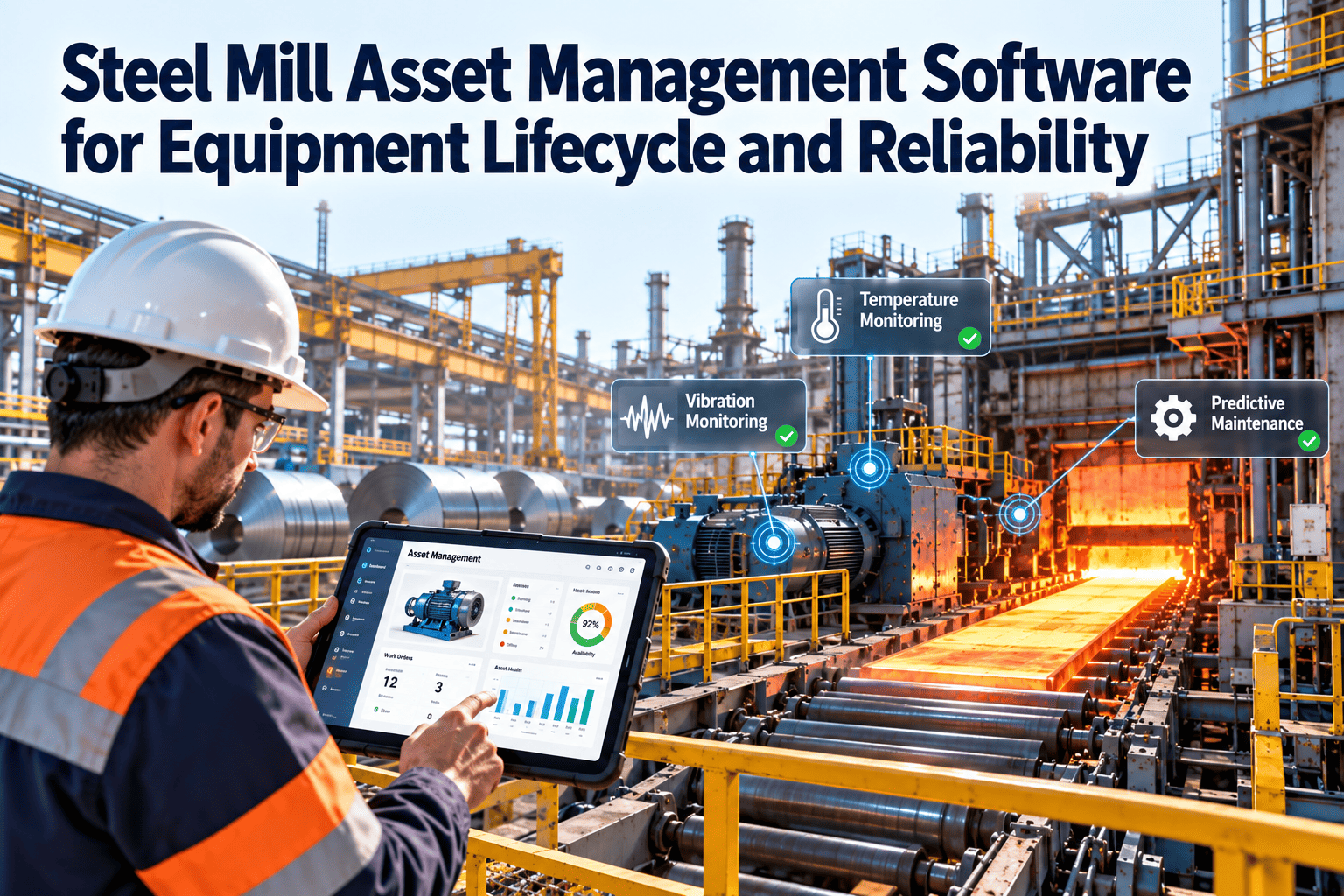
Predictive maintenance uses IoT sensors attached to critical steel equipment—motors, bearings, hydraulic systems, cooling circuits—to continuously monitor vibration, temperature, pressure, and current draw. The EAM platform collects this data and applies AI/ML algorithms to detect anomalies indicating early-stage degradation, often days or weeks before failure. When thresholds are breached, the system automatically generates prioritized work orders, assigns technicians, and reserves spare parts. This approach reduces unplanned downtime by up to 50% in heavy industry.
Stop Losing Revenue to Preventable Breakdowns
Oxmaint gives your steel plant full asset lifecycle visibility, AI-powered predictive maintenance, and automated compliance tracking—all in one platform that deploys in days, not months. Join the steel manufacturers who have already cut unplanned downtime by up to 40%.