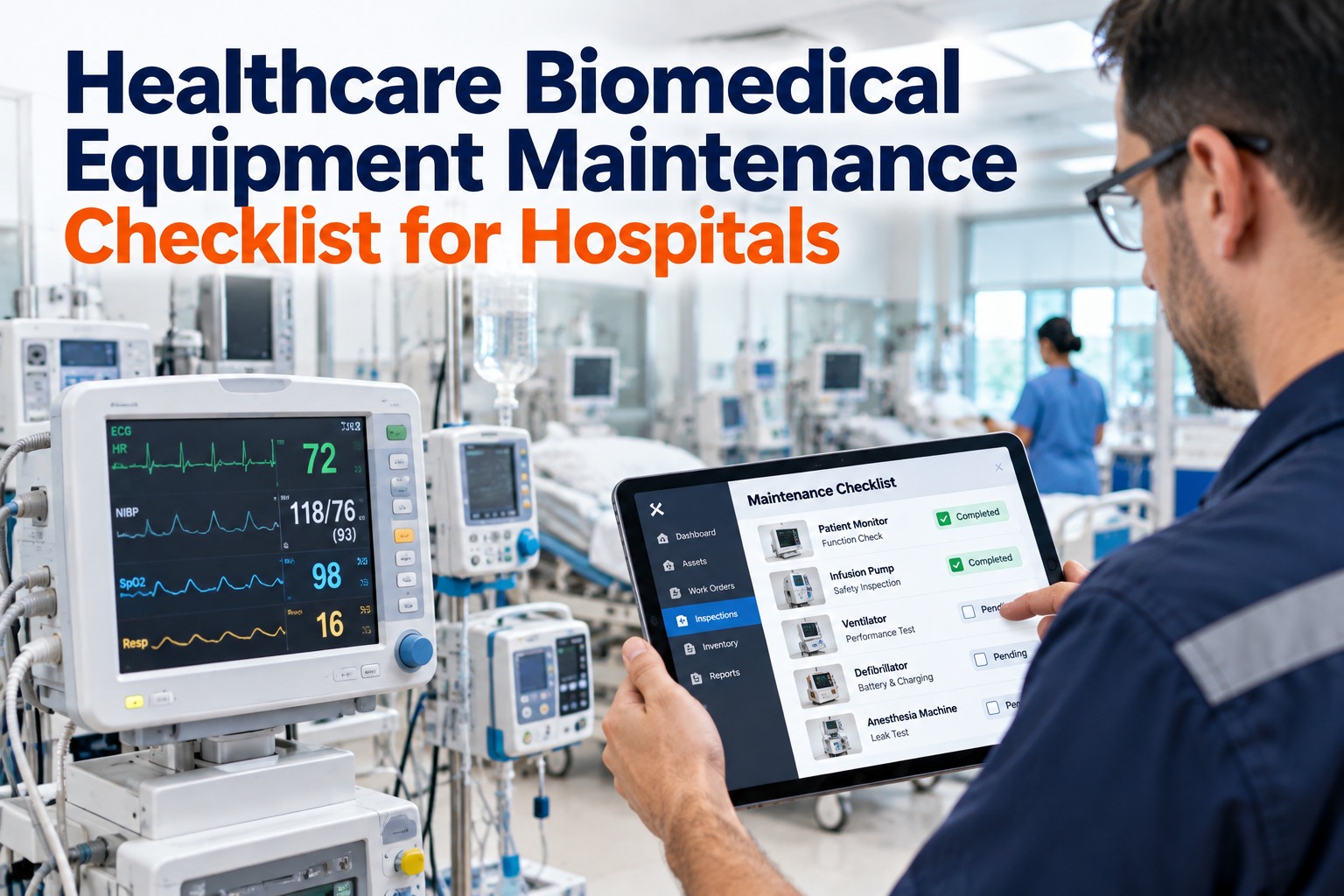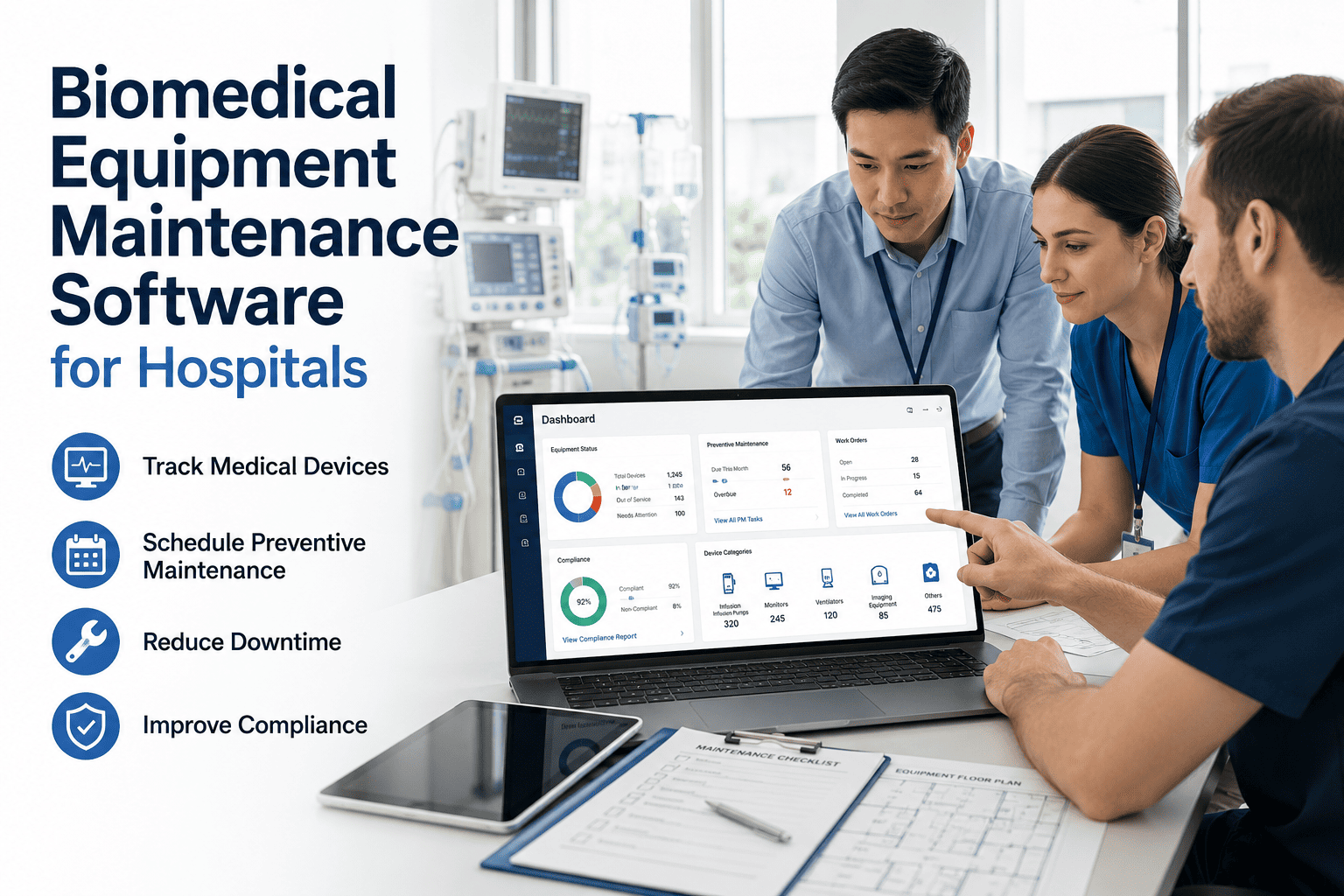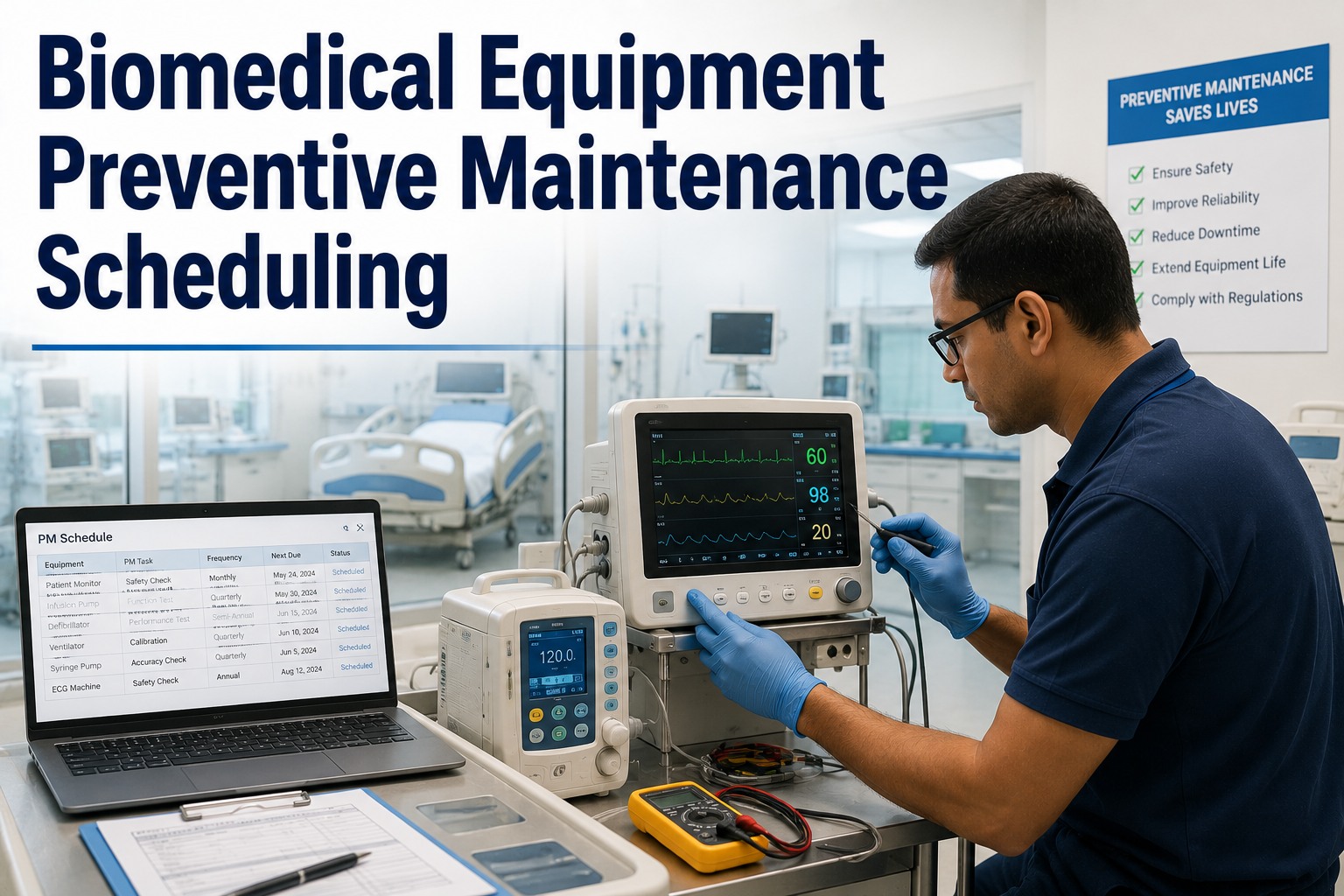
Biomedical equipment preventive maintenance scheduling is the backbone of every hospital clinical engineering program — it ensures that infusion pumps, ventilators, imaging systems and patient monitors stay safe, accurate and ready for the next patient. A risk-based biomedical PM schedule aligns inspection intervals with device criticality, regulatory requirements and manufacturer recommendations, so BMETs can defend their compliance posture during a Joint Commission or CMS survey. When biomedical equipment maintenance drifts into reactive chaos, missed PMs pile up, work orders get lost on paper, and survey readiness collapses. OxMaint brings AI-powered CMMS structure to the biomedical engineering department — mobile PM completion, automated interval assignment, AEM documentation and real-time compliance dashboards — so you can Start Free Trial and see your clinical equipment PM compliance climb within weeks.
Clinical Engineering PM Compliance
Is your biomedical equipment PM schedule built for survey readiness — or built for surprises?
Most hospital biomedical engineering departments lose 15–25% of their scheduled PMs to paperwork gaps, misplaced work orders and interval drift. OxMaint replaces spreadsheets and clipboards with a risk-based, mobile-first CMMS that keeps every clinical device — from infusion pumps to MRI scanners — tracked, compliant and audit-ready.
Risk-Based PM Strategy
How to build a risk-based biomedical PM schedule that surveyors trust
The most defensible biomedical equipment maintenance programs don't treat every device the same. They assign PM intervals based on a structured risk model — device function, physical risk, maintenance requirement and incident history — so high-risk life-support equipment gets more frequent attention than low-risk administrative devices. This is the foundation of an Alternative Equipment Management (AEM) program, and it's exactly what surveyors look for.
Device function classification
Group every asset by clinical function — life support, therapeutic, diagnostic, analytical or general — so BMETs can prioritize infusion pumps and ventilators over thermometers and exam lights.
Physical risk & criticality scoring
Score each device on the severity of harm if it fails mid-treatment. A defibrillator that won't deliver a shock is a catastrophic risk; a broken vital-signs monitor is serious but lower-acuity.
Maintenance requirement mapping
Cross-reference OEM service manuals, FDA recall history and internal incident logs to determine whether a device needs electrical safety, performance verification, calibration or simply a visual inspection.
Interval assignment & AEM justification
Assign PM intervals (3, 6, 12 or 24 months) using risk score + historical data. Any interval extended beyond OEM recommendation must be documented in your AEM program with a data-backed rationale.
Worked Example
What a 1,200-asset biomed department gains by switching from spreadsheets to OxMaint
Consider a mid-size hospital with 1,200 tracked clinical devices, two BMETs and one biomed manager running PM schedules on shared Excel files. On average, they miss 180 PMs per quarter, spend 12 hours per week reconciling completed paper work orders, and scramble for a week before every Joint Commission survey pulling records. Here's the before-and-after math.
Annual savings formula — biomed department
(Missed PMs eliminated × avg. remediation cost per device) + (BMET hours saved × loaded labor rate) + (avoided survey findings × mitigation cost)
= $48,000 – $72,000 / year for a typical 1,200-asset hospital biomed shop
Medical Device PM Intervals
Recommended biomedical equipment PM intervals by device category
Different clinical device classes carry different risk profiles and regulatory expectations. The table below reflects common PM intervals used by hospital biomedical engineering departments — your actual intervals should be validated against OEM recommendations, your AEM program data and accreditor requirements.
| Device Category | Examples | Risk Level | Typical PM Interval | Key PM Tasks |
|---|---|---|---|---|
| Life support | Ventilators, defibrillators, anesthesia machines | Critical | 3–6 months | Performance verification, electrical safety, alarm test |
| Therapeutic / infusion | Infusion pumps, syringe pumps, feeding pumps | High | 6–12 months | Flow accuracy, battery test, occlusion alarm |
| Diagnostic imaging | Ultrasound, X-ray, CT, MRI | High | 6–12 months | Calibration, image quality, leakage current |
| Patient monitoring | Telemetry, vital-signs monitors, pulse oximeters | Moderate | 12 months | Accuracy check, sensor calibration, safety test |
| General clinical | Thermometers, scales, exam lights, beds | Low | 12–24 months | Visual inspection, functional check, documentation |
OxMaint Platform
How OxMaint helps biomedical engineering teams stay survey-ready
OxMaint was built for the realities of hospital clinical engineering — not adapted from a facilities-management afterthought. Every capability below maps directly to a biomed pain point, from missed PMs to survey-day panic.
Automated risk-based PM scheduling
OxMaint auto-generates PM work orders based on each device's risk class, OEM interval and AEM-adjusted frequency. No more calendar arithmetic — the system pushes the right PM to the right BMET on the right day.
Outcome: 90%+ PM compliance within one quarter, typically lifting from 70–75% on spreadsheets.
Mobile PM completion at the bedside
BMETs open a work order on their phone or tablet, complete the PM checklist, photograph deficiencies, capture a signature and close the work order — all offline-capable and synced the moment they reconnect.
Outcome: Eliminate 8–12 hours/week of paper work-order reconciliation per technician.
AEM documentation & audit trails
When you extend a PM interval beyond the OEM recommendation, OxMaint captures the AEM justification, the data supporting it and the approver — all retrievable in one click during a survey.
Outcome: Survey prep drops from 5 days of scrambling to a same-day compliance report.
Real-time compliance dashboards
Live PM compliance by department, device class, facility or technician — with predictive alerts that flag devices trending toward overdue before they cross the threshold. Built for Joint Commission, DNV and CMS readiness.
Outcome: Catch compliance gaps 2–4 weeks earlier, cutting overdue PMs by 60–80%.
See OxMaint on your biomedical equipment — book a 30-min demo
Walk through a live PM schedule, mobile work-order completion and a Joint Commission–ready compliance dashboard tailored to your hospital's device inventory. No slides — just your data in the system.
Implementation Timeline
Switching your biomed PM schedule to OxMaint — a 4-week rollout
Hospital biomedical engineering teams worry that adopting a new CMMS means months of disruption. In practice, OxMaint's structured onboarding gets a typical 1,000–2,000 device inventory live in four weeks — including data migration from spreadsheets or a legacy CMMS.
Asset data migration & cleansing
Import your equipment master list, clean duplicate records, normalize device categories and assign risk scores. OxMaint maps your existing inventory data into the platform — no manual re-entry required.
PM schedule configuration
Define PM templates by device class, set intervals based on your risk model and AEM program, and configure checklist forms for electrical safety, performance verification and calibration tasks.
BMET training & mobile rollout
Technicians install the OxMaint mobile app, learn to open and close PM work orders at the bedside, and practice offline workflows. Most BMETs are proficient within a single shift.
Go-live & compliance baseline
Run the first full PM cycle on OxMaint, establish your compliance baseline dashboard and review the first week's metrics with your biomed manager. Adjust intervals and checklists as needed.
Frequently Asked Questions
Biomedical equipment preventive maintenance scheduling — your questions answered
How often should biomedical equipment undergo preventive maintenance?
PM frequency depends on device risk class, OEM recommendations and your facility's AEM program. Life-support equipment like ventilators and defibrillators typically require PM every 3–6 months, infusion pumps every 6–12 months, and low-risk devices like scales and exam lights every 12–24 months. OxMaint automates interval assignment based on your risk model so no device falls through the cracks — book a demo to see it configured for your inventory.
What is an Alternative Equipment Management (AEM) program and how does it affect PM scheduling?
An AEM program allows hospitals to extend PM intervals beyond manufacturer recommendations for certain devices when supported by historical data showing the extended interval maintains safety and effectiveness. Surveyors expect documented justification, the data behind the decision and the approver's name. OxMaint captures all three automatically whenever you adjust a PM interval, so your AEM program is always audit-ready.
How do I track biomedical PM compliance for Joint Commission or CMS surveys?
PM compliance is the percentage of scheduled PMs completed on time within a reporting period, typically measured by device class and department. OxMaint's compliance dashboard shows real-time completion rates, overdue PMs and trending devices — and generates a survey-ready report in one click. Most biomed managers aim for 95%+ compliance, which OxMaint helps sustain through automated work-order generation and predictive overdue alerts.
Can a CMMS really replace paper PM work orders for BMETs?
Yes — and the ROI is immediate. BMETs using OxMaint's mobile app complete PM checklists, photograph deficiencies, capture signatures and close work orders at the bedside, even offline. The average technician saves 8–12 hours per week previously spent on paperwork and data entry, and the department eliminates lost or illegible work orders entirely. You can start a free trial and run a pilot on one device category to measure the impact.
How long does it take to migrate from spreadsheets to a biomedical CMMS?
A typical 1,000–2,000 device inventory is live on OxMaint within four weeks. Week one covers data migration and cleansing, week two configures PM schedules and checklists, week three trains BMETs on the mobile app, and week four goes live with a compliance baseline. OxMaint handles the data import — no manual re-entry — and most technicians are proficient after a single shift of hands-on use.
Your biomedical PM compliance shouldn't depend on spreadsheets and memory
Join the hospital biomed departments using OxMaint to hit 96%+ PM compliance, cut paperwork by 80% and walk into every survey ready. Set up your account in minutes or see it live on your data first.
Free 14-day trial · No credit card