The average hospital manages more than 35,000 medical devices across 500 equipment categories — every one of them requiring a specific maintenance schedule, a documented calibration record, and a traceable service history that can be produced on demand during a Joint Commission survey or FDA inspection. A ventilator whose preventive maintenance was missed because it was tracked on a spreadsheet is not just a compliance failure. It is a patient safety event waiting to happen. The challenge facing biomedical engineering teams in 2025 is not awareness of what needs to be done — it is the operational system that ensures it gets done, gets documented, and stays audit-ready without requiring a two-day manual compilation every time an inspector arrives. Healthcare facilities that implement a purpose-built CMMS reduce device-related incidents by 50–70%, cut maintenance costs by 25–40%, and achieve 99.9% equipment availability. The facilities that do not are managing 35,000 devices on Excel spreadsheets, receiving Joint Commission citations for missing records, and discovering equipment failures at the bedside instead of during scheduled PM. Sign up for Oxmaint to implement medical equipment maintenance tracking at your facility today.
Why Medical Equipment Maintenance Demands a Different CMMS Approach
Generic maintenance management software built for manufacturing or facilities management fails in hospital environments for a specific reason: it does not understand the regulatory framework, the patient-safety priority hierarchy, or the documentation requirements that govern every maintenance action on a medical device. A missed PM on a conveyor is an efficiency problem. A missed PM on a defibrillator is a liability event. The CMMS that manages hospital equipment must reflect this distinction at every level — from how work orders are prioritised to how compliance records are stored and retrieved.
Paper-Based and Spreadsheet Systems Cannot Survive a Joint Commission Survey
When a Joint Commission surveyor asks for the maintenance history of every ventilator in the ICU, a facility running paper work orders has two days of manual work ahead of it — if the records are complete, filed correctly, and not lost. Most are not. FDA 21 CFR Part 11 requires traceable maintenance records for medical device safety. The Joint Commission's Environment of Care standards require documented PM completion rates. CMS Conditions of Coverage require that all patient care equipment be maintained in safe, reliable working order. Non-compliance is not just a citation risk — it is a direct path to penalties, jeopardised reimbursement, and in equipment failure cases, the legal exposure of having no documentation to defend the care standard.
Oxmaint eliminates this risk by creating a complete, timestamped, technician-signed maintenance record for every work order closed on every device — retrievable in seconds for any device, any date range, any inspection. The audit trail generates automatically as a by-product of normal maintenance execution. Sign up for Oxmaint to begin building your audit-ready maintenance record today.
Biomedical Teams Are Spending Time on Administration, Not Clinical Engineering
A biomedical technician's shift in a paper-based or legacy CMMS environment includes: searching through filing cabinets for the last service record before beginning a PM, manually transcribing work order data from paper to a spreadsheet at the end of each shift, calling nursing stations to locate equipment that has been moved from its registered location, and compiling monthly PM completion rate reports that require pulling records from three different sources. None of this is clinical engineering. All of it is administrative overhead that a modern CMMS eliminates.
Oxmaint's mobile work order system delivers the PM schedule, the device's complete service history, and the calibration checklist to the technician's mobile device before they arrive at the equipment. The work order closes at the device with a digital signature and timestamp. The PM completion rate updates in real time on the supervisor's dashboard. Book a demo to see the mobile workflow in action.
Seven Oxmaint Capabilities That Address Medical Equipment Maintenance Specifically
Each capability below addresses a specific clinical engineering or compliance requirement that generic CMMS platforms cannot meet — not a general maintenance feature repurposed for healthcare, but a workflow built around the actual requirements of a biomedical department. Sign up for Oxmaint to activate all seven at your facility.
Every medical device in Oxmaint is registered with its make, model, serial number, location, purchase date, warranty expiry, service contract status, and manufacturer's recommended PM schedule. The asset register is the foundation for PM scheduling, compliance reporting, and capital replacement planning. When a device is moved between departments, the location updates in Oxmaint — eliminating the equipment location problem that consumes biomedical team time in facilities with no centralised tracking system. The complete maintenance history, calibration records, and incident reports associated with each device are accessible instantly on mobile.
Oxmaint schedules PM work orders automatically based on the configured maintenance interval for each device class — calendar-based, usage-based, or condition-triggered. Life-critical devices (ventilators, defibrillators, infusion pumps) receive the highest priority classification, triggering immediate supervisor escalation when PM is overdue. The PM schedule reflects manufacturer recommendations, Joint Commission requirements, and the facility's Alternative Equipment Management (AEM) programme parameters simultaneously. When a PM is missed because a technician was pulled to an emergency, Oxmaint escalates it automatically — the missed PM is never silent. Book a demo to see PM automation configured.
Calibration schedules for diagnostic equipment, monitoring devices, and measurement instruments are managed as separate PM work order types in Oxmaint — with the calibration result, the standard used, the pass/fail determination, and the next calibration due date all captured as mandatory data fields. Electrical safety testing schedules align with AAMI HTM standards and the facility's biomedical programme requirements. The calibration certificate is attached to the work order as a document — stored permanently in the device's asset record and retrievable for regulatory inspection without physical filing or manual search. Sign up to configure calibration scheduling.
FDA medical device recalls and manufacturer safety alerts require rapid identification of affected devices and documented action. Oxmaint's recall management workflow allows the biomedical supervisor to enter the affected model and serial number range from the FDA or manufacturer notice — Oxmaint instantly identifies all affected devices in the register, generates inspection or removal work orders for each, and tracks completion. Every affected device that has been inspected, quarantined, or remediated is documented. The recall response record demonstrates due diligence in the event of a patient safety inquiry. Book a demo to see recall management in Oxmaint.
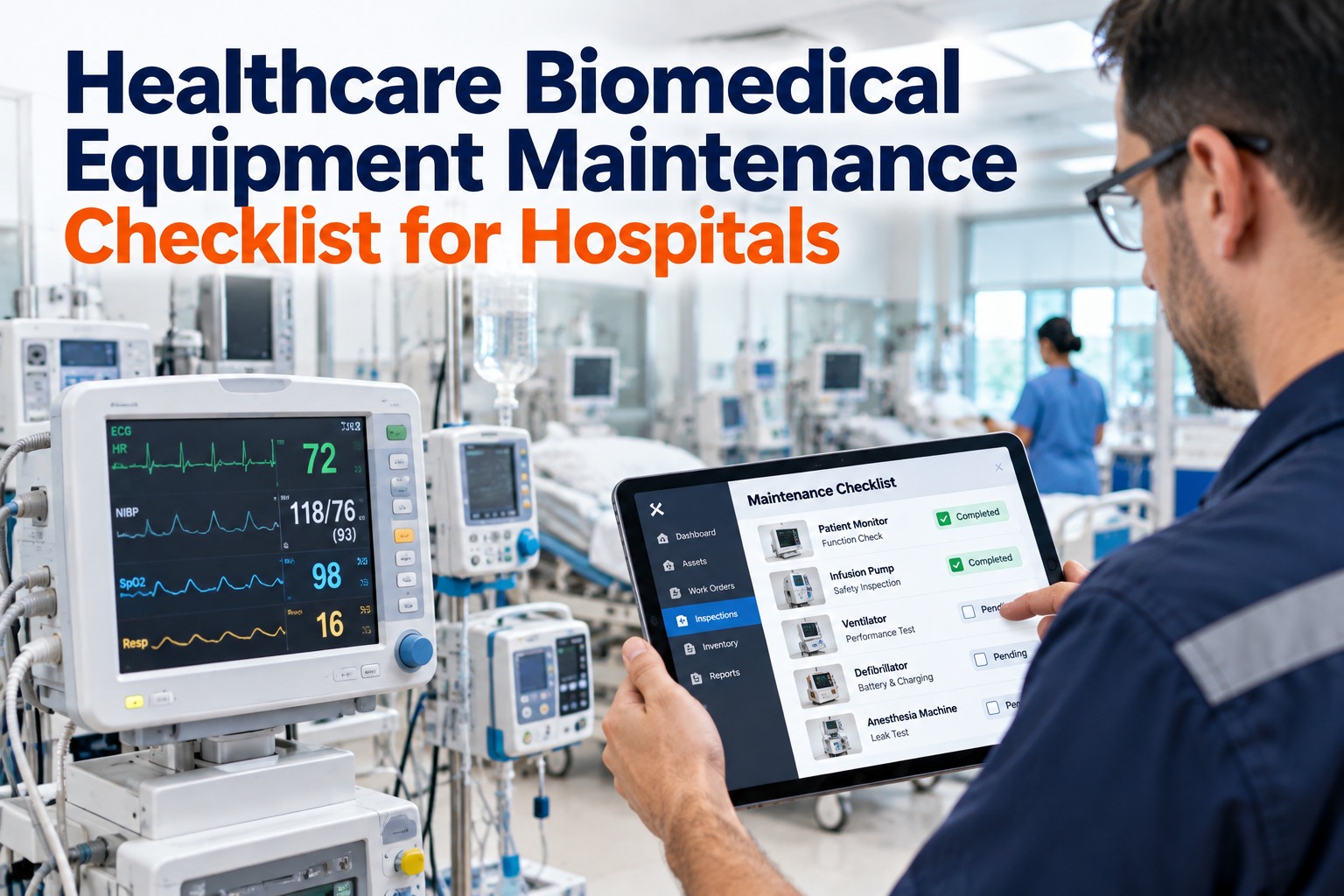
Biomedical technicians receive, execute, and close PM and corrective work orders entirely on mobile — with the device's maintenance history, the PM checklist, and any required test procedure displayed on their phone before they begin work. Test results, observations, parts used, and technician signature are all captured at the device on mobile. The work order closes with a GPS-tagged timestamp that confirms the work was performed at the registered device location. No paper form. No end-of-shift transcription. No missing records at the next survey. Sign up for mobile work orders.
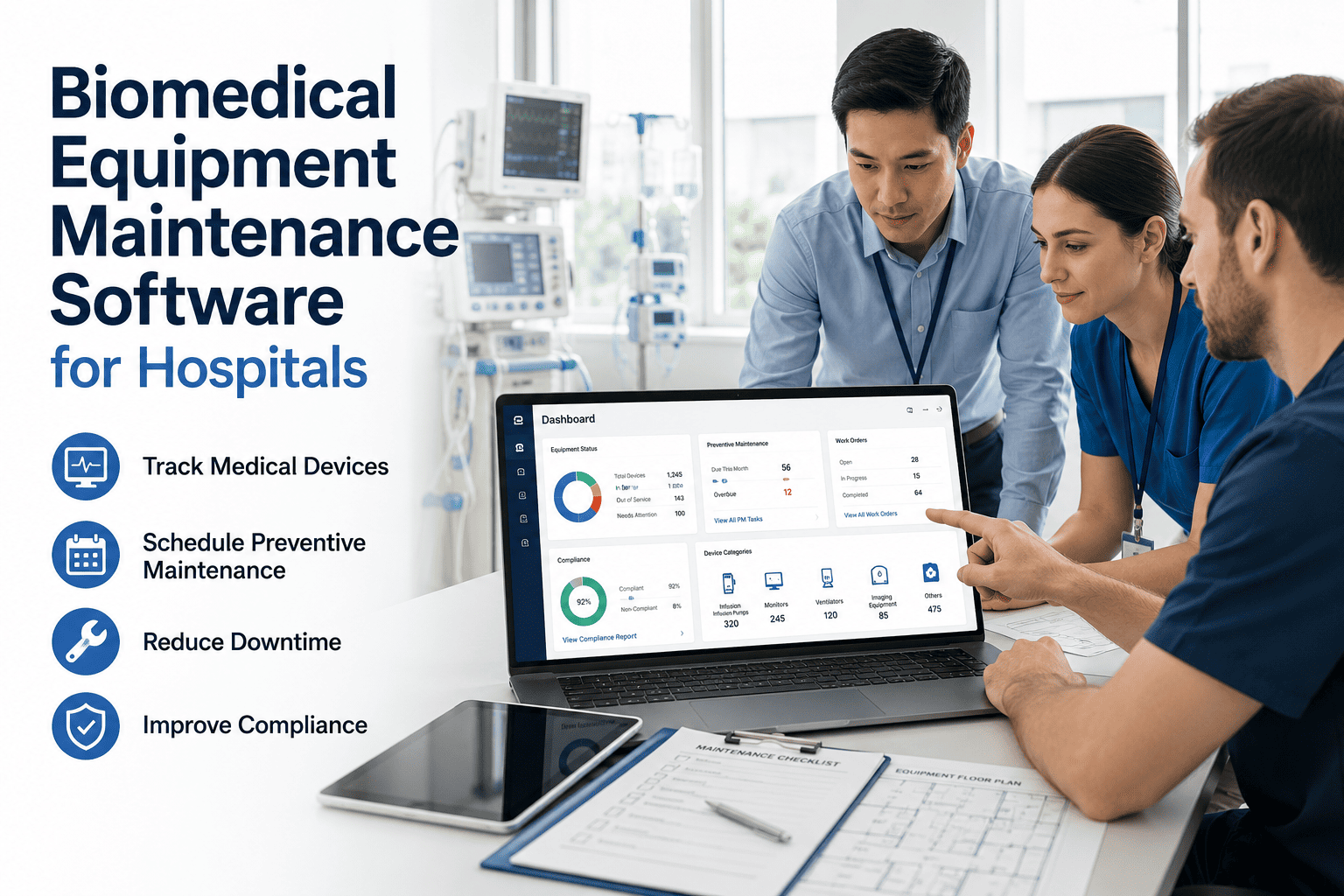
The Oxmaint compliance dashboard shows the biomedical director's key metrics in real time: PM completion rate by device category, overdue devices by department, upcoming calibrations in the next 30 days, and open recall actions. These are not monthly compiled reports — they are live metrics updated from every closed work order. When a Joint Commission surveyor asks about PM completion rates, the answer is available on a mobile phone in 30 seconds. The department that previously spent two days preparing for an inspection now spends 30 minutes confirming that the dashboard reflects reality. Book a demo to see the compliance dashboard.
Clinical staff submit equipment malfunction reports through the Oxmaint request portal — no login required, accessible from any web browser on the clinical floor. The request automatically creates a work order in Oxmaint, classifies the priority based on the device class and reported issue type, and assigns it to the biomedical technician responsible for that department. The nurse who reported the issue receives automatic status notifications when the work order is assigned and when it is completed. The biomedical team's phone stops ringing with status update calls. Equipment issues are documented from the moment they are reported, not from the moment a technician arrives — creating a complete incident timeline. Sign up to activate the request portal.
Oxmaint Manages All Medical Device Categories Across the Facility
Each device category in a hospital has distinct maintenance requirements, calibration intervals, and regulatory documentation standards. Oxmaint's asset register supports category-specific PM templates and compliance requirements for all device types. Sign up for Oxmaint to configure category-specific maintenance for your device inventory.
| Device Category | Critical Risk Level | Key Maintenance Actions | Compliance Requirement |
|---|---|---|---|
| Life Support (ventilators, infusion pumps) | Life-Critical | PM per manufacturer schedule; functional testing; alarm verification; electrical safety | Joint Commission EC; FDA 21 CFR Part 11; CMS Conditions |
| Diagnostic Imaging (X-ray, MRI, ultrasound) | High | Radiation output calibration; image quality verification; preventive maintenance; safety inspection | FDA radiation safety; state radiation control; AAMI standards |
| Patient Monitoring (ECG, pulse oximetry, BP) | High | Calibration verification; alarm function testing; electrode and sensor inspection; software updates | AAMI HTM standards; Joint Commission EC; FDA 21 CFR Part 820 |
| Surgical Equipment (electrosurgical, power tools) | High | Electrical leakage testing; power output calibration; blade and accessory inspection; sterilisation verification | AAMI ES1; Joint Commission; CMS Conditions of Coverage |
| Sterilisation (autoclaves, washer-disinfectors) | Medium-High | Cycle validation; biological indicator testing; chamber inspection; seal condition; temperature calibration | CDC guidelines; Joint Commission IC; FDA 510(k) |
| Laboratory Equipment (analysers, centrifuges) | Medium-High | Calibration verification; QC programme; maintenance per manufacturer; result accuracy validation | CLIA; CAP accreditation; FDA laboratory device regulations |
| Rehabilitation Equipment (therapy, mobility) | Medium | Structural integrity inspection; electrical safety; functional testing; surface and hygiene inspection | CMS; Joint Commission; state PT/OT licensing requirements |
Swipe to view full table
What Biomedical Teams Say After Implementing Oxmaint
Before Oxmaint, our Joint Commission survey preparation took three days of manual record pulling. We had no confidence that every device's PM history was complete or findable. After implementation, survey prep takes 30 minutes because everything is in one place, timestamped, and searchable. Our PM completion rate went from 71% — which we estimated, because we could not actually measure it — to 94% tracked and confirmed. The shift is from hoping we are compliant to knowing we are.
From 35,000 Devices on Spreadsheets to Audit-Ready in 60 Days
Oxmaint deploys in phases — starting with your highest-risk devices and expanding to the full device inventory as your biomedical team builds confidence in the system. The first compliance report generates automatically. The first PM escalation fires within days.
Medical Equipment Maintenance CMMS — Common Questions
Oxmaint generates survey-ready compliance reports directly from closed work order data — PM completion rates by device category, overdue device lists, calibration certificate records, and recall action documentation are all available as on-demand reports without manual compilation. When a Joint Commission surveyor asks about the maintenance history of a specific ventilator, a biomedical technician can produce a complete, timestamped service history for that device on mobile in under 60 seconds. The audit trail is created automatically as a by-product of normal maintenance execution — there is no separate compliance documentation step. Oxmaint also supports Environment of Care (EOC) rounding checklists and tracks open findings from previous surveys as work orders until they are resolved and documented. Sign up for Oxmaint to begin building your survey-ready maintenance record.
Yes. Oxmaint's recall management workflow allows a biomedical supervisor to enter the affected device model and serial number range from an FDA or manufacturer recall notice. Oxmaint immediately queries the asset register to identify all devices in the facility that match the recall criteria — regardless of whether they are in the ICU, stored in a storeroom, or on loan to another department. Work orders for inspection, quarantine, or remediation are generated automatically for each affected device. Completion is tracked per device, and the full recall response record — which devices were affected, what action was taken, by whom, and when — is stored in Oxmaint as the facility's documented recall response. This documentation is critical protection in any patient safety inquiry related to a recalled device. Book a demo to see the recall management workflow.
The Joint Commission's AEM programme allows hospitals to use risk-based PM intervals developed from their own performance data rather than prescriptive manufacturer intervals for non-life-critical devices. Oxmaint supports AEM programme management by allowing PM intervals to be configured by the facility's clinical engineering programme parameters — and by providing the PM completion rate, failure rate, and performance data per device category that the AEM programme requires as evidence to support the alternative interval. When the facility's AEM programme is inspected, Oxmaint generates the programme evidence report from actual maintenance data — showing that the risk-based intervals are working as intended and that device performance supports the programme. Sign up for Oxmaint to configure AEM programme support.
Most hospital biomedical departments achieve basic operational functionality — asset register loaded, PM schedules active, mobile work orders live — within 30–60 days. The implementation sequence typically follows: days 1–14 for asset register audit and data import from existing systems; days 15–30 for PM schedule configuration and mobile training for biomedical technicians; days 31–60 for compliance reporting configuration and calibration schedule activation. Facilities starting from a paper or basic spreadsheet baseline typically see their first PM completion rate measurement within 45 days — often revealing that their actual completion rate was lower than estimated. The improvement follows from visibility: the PM that is measured and escalated when overdue gets completed at a dramatically higher rate than the PM that silently slips when a technician is pulled to an emergency. Book a demo to discuss implementation for your facility size and structure.
35,000 Medical Devices. One Platform. Zero Compliance Surprises.
Oxmaint gives biomedical engineering teams the asset register, PM automation, calibration scheduling, recall management, mobile work orders, and compliance dashboard they need to manage every medical device in the facility — with the audit trail that eliminates survey preparation stress and the escalation system that ensures no PM silently slips through.



.png)