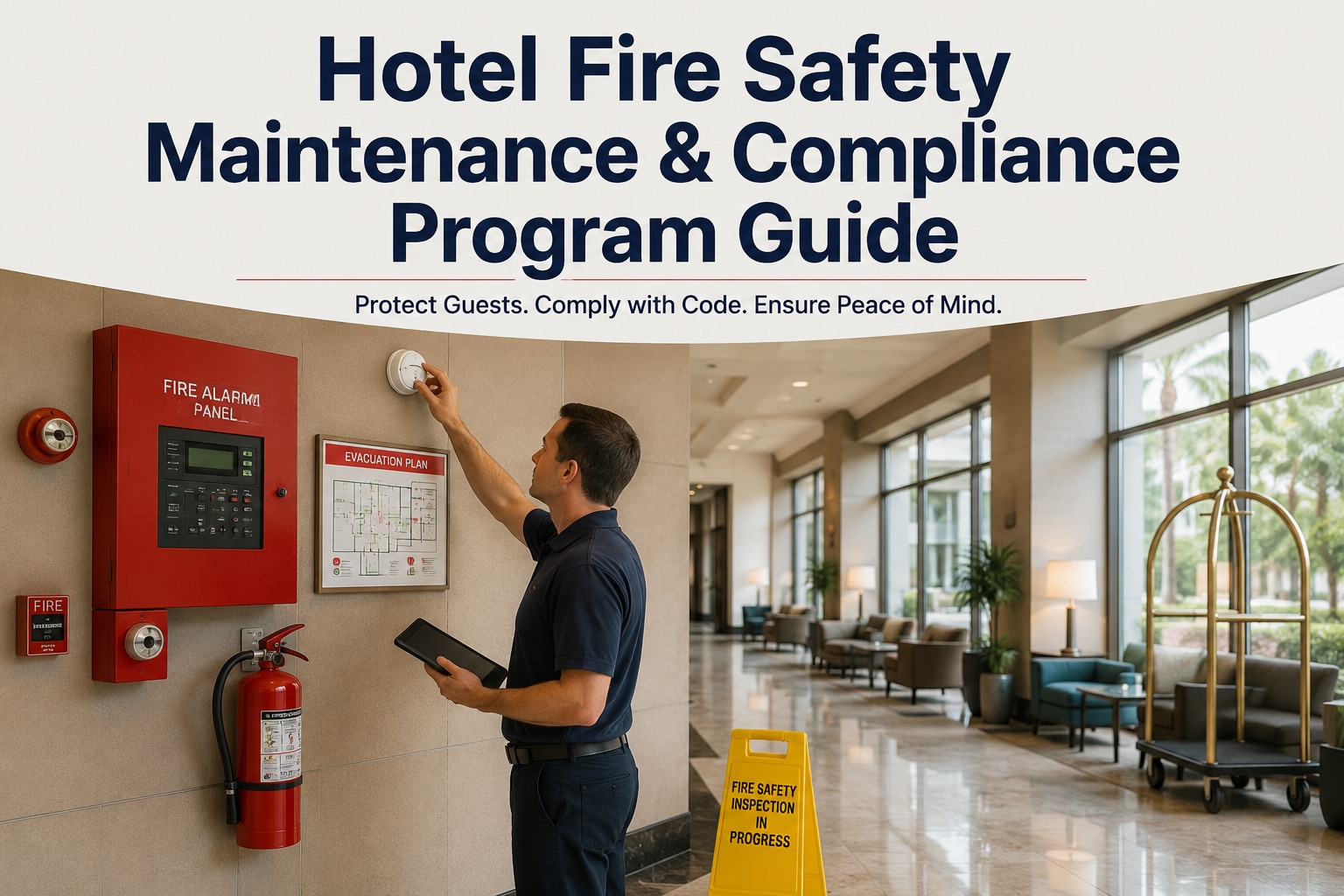
A hotel is one of the very few buildings in a city where guests spend the night while completely unfamiliar with the exit paths, the alarm sounds, or the evacuation stairs — and where they arrive expecting the property to have already thought about their safety on their behalf. That expectation is not casual. It is the operational contract between hospitality operator and guest, and every fire code, every NFPA standard, every franchise brand standard, and every insurance carrier's inspection cadence exists to make that contract enforceable. When it fails — a single smoke event that spreads because a sprinkler was blocked, a kitchen fire that escapes because a suppression tank was never recharged after last quarter's activation, an evacuation that stalls because a stairwell exit sign was dark — the consequences reach far beyond a repair bill. A single fire event at a branded property can trigger franchise termination, insurance non-renewal, litigation, and reputational damage that outlasts the physical rebuild by years. This guide walks through the response sequence that unfolds in the first 90 seconds after detection, the five interconnected life safety systems every hotel operates, the NFPA testing cadences that keep them functional, the kitchen suppression discipline that addresses the 46% of fires that start in commercial cooking areas, and the top-cited findings fire marshals actually document during inspection. OxMaint gives hotel engineering teams the platform that runs every one of these disciplines as tracked, documented, audit-ready operational work. Book a free demo to see hotel fire safety inside OxMaint.
0s
Smoke Detected
Ionization or photoelectric detector triggers · signal to fire alarm control panel
Requires: quarterly detector sensitivity test
5s
FACP Verifies & Confirms
Fire alarm control panel processes signal · initiates full alarm sequence · logs event
Requires: annual functional test · battery load test
15s
Notification Cascade
Horns, strobes, voice evacuation active on all floors · guest rooms receive alert
Requires: quarterly notification appliance test
30s
Elevator Recall Phase I
All elevators recalled to designated level · doors open · service mode locked out
Requires: monthly recall test · annual full inspection
45s
Egress Path Illuminated
Emergency lighting activates on battery backup · exit signs stay lit throughout evacuation
Requires: monthly 30-second test · annual 90-minute test
60-90s
AHJ Notification & Suppression
Fire department dispatched via monitoring service · sprinklers activate at 165°F fusible link
Requires: quarterly waterflow test · annual sprinkler visual
Every step of the sequence depends on maintenance discipline · a single missed PM breaks the chain and guests bear the consequence
~3,700
hotel and motel structure fires reported annually in the US according to NFPA · every property is inside the statistic
46%
of hotel structure fires originate in cooking equipment · kitchen suppression is the single highest-leverage safety system
4
NFPA standards drive the core testing cadence: NFPA 25 sprinklers · NFPA 72 alarm · NFPA 96 hoods · NFPA 101 life safety
The Five Life Safety Systems — Interconnected by Design
A hotel's life safety infrastructure is not five independent systems. It is five interlocking systems orchestrated by a single control brain — the Fire Alarm Control Panel — that must be maintained as an integrated whole. A working sprinkler system with a broken FACP interface delivers no protection. A functional detection network with disabled notification appliances leaves guests unaware of a live fire. A kitchen suppression tank that discharged three months ago and was never recharged does not exist as a control. The integration diagram below reflects how the five systems actually operate together — and how OxMaint tracks every asset in every system as a linked component of the integrated protection layer.
Life Safety Command Structure · FACP Orchestrates Every System
Detection
Smoke & Heat Detectors · Pull Stations
Photoelectric & ionization in guest rooms · heat detection in mechanical spaces · manual pulls at every stair landing
Suppression
Sprinklers · Standpipes · Kitchen Hood
Wet pipe throughout guest floors · Class III standpipes in stairs · UL 300 kitchen suppression over cooking
Command
Fire Alarm Control Panel
The orchestrating brain · processes every signal · commands every system · logs every event
Notification
Horns · Strobes · Voice Evac
Guest room and corridor notification · ADA-compliant strobe visibility · voice instructions during evacuation
Egress
Exit Signs · Emergency Lighting · Fire Doors
Illuminated exit paths on 90-minute battery backup · self-closing fire doors · unobstructed stairwells
Every asset in every node stored in OxMaint · every test result attached to the specific asset · every integration point verified in scheduled work orders
The NFPA Testing Cadence Matrix
Every life safety system in a hotel operates under a defined testing cadence that layers weekly, monthly, quarterly, semi-annual, annual, and multi-year tests. The reference matrix below covers the most consequential testing requirements per NFPA 25 (sprinklers), NFPA 72 (fire alarm), NFPA 96/UL 300 (kitchen suppression), and NFPA 10 (portable extinguishers). Fire marshal inspectors specifically look for the documented evidence that each test occurred at the correct interval — missing or late tests generate immediate citation risk.
OxMaint schedules every cell as a work order with due date, assigned technician, and documented completion · the exact evidence fire marshals request during inspection
Every Inspection Tag · Every Test Result · One Platform
OxMaint captures every NFPA-mandated test at the correct interval, links every result to the specific asset, and produces the audit package fire marshals request in a single export. See it live against your property.
Kitchen Suppression — Where 46% of Hotel Fires Actually Start
Commercial cooking equipment generates the single largest source of hotel fires. A grease fire in a broiler or fryer accelerates in seconds, easily reaches 1,000°F, and cannot be extinguished with water — a common mistake that spreads burning grease across the entire kitchen. The UL 300 hood suppression system is engineered specifically for this failure mode, and its components must be maintained at a level of discipline that reflects the consequence of failure. The anatomy diagram below shows the components every hotel engineering team must inspect and maintain against the NFPA 96 cadence.
UL 300 Kitchen Hood Suppression System
01
Wet Chemical Tank
Pressurized potassium-carbonate agent · discharges at all nozzles simultaneously · one shot only
Semi-annual certified service · hydrostatic test per manufacturer schedule
02
Distribution Piping & Nozzles
Fixed nozzles aimed at fryers, ranges, broilers, hood plenum · engineered flow pattern
Blow-off caps inspected · nozzle alignment verified · piping clear
03
Fusible Links (Detection)
Rated at 165°F or 212°F · melt on heat exposure · trigger mechanical actuation
Semi-annual replacement · grease loading is the leading failure mode
04
Control Head & Gas Shut-off
Actuator releases discharge · simultaneously closes gas supply · signals fire alarm panel
Actuation cartridge inspection · linkage verification · FACP integration test
05
Hood, Filters & Ductwork
Grease-laden vapor extraction · UL-listed baffle filters · welded seam ductwork
Weekly filter clean · quarterly hood degrease · semi-annual duct inspection
06
Class K Extinguishers
Wet chemical portable extinguisher · required within 30 ft of cooking equipment
Monthly visual · annual certified maintenance · 5-year internal
After any activation, the entire system is out of service until recharge · immediate cooking cessation and replacement service required
Fire Marshal's Top-Cited Findings
Fire marshal inspection findings are remarkably consistent across the hospitality industry — the same six or seven issues account for the majority of citations at hotels of every size and brand. The list below reflects what fire marshals actually document during inspection, ranked by frequency across recent industry data. Every one of these findings is preventable through disciplined PM execution, and every one becomes trivial to eliminate once tracked against the specific asset in OxMaint.
Top-Cited Findings · What Fire Marshals Actually Write Up
01
Blocked or Obstructed Exit Paths
Storage, laundry carts, luggage, decor blocking egress · single largest hospitality citation category
02
Missing or Expired Inspection Tags
Extinguisher, sprinkler, hood, alarm tags not current · documentation is the visible evidence of maintenance
03
Non-Functioning Exit Signs
Dark bulbs · dead batteries · missing signs at required locations · guest evacuation compromised
04
Fire Doors Propped Open
Stairwell and corridor smoke barriers held open with wedges · defeats the entire compartmentalization strategy
05
Obstructed Sprinkler Heads
Storage within 18" of sprinkler · decor covering heads · paint on sprinkler heads
06
Kitchen Hood Grease Accumulation
Filters not cleaned per cadence · grease buildup in ductwork · elevated flash-fire risk
07
Improper Storage in Mechanical Rooms
Combustibles near boilers, water heaters, electrical panels · commonly cited during walk-through
OxMaint's environmental round module captures these categories on scheduled walks — corrective actions logged before the fire marshal ever arrives
Executive Perspective · The Property That Passes Every Inspection
Every general manager knows there are two kinds of hotels: the ones that treat fire safety as an operational discipline embedded in every shift, and the ones that treat it as an annual scramble before the AHJ walk-through. The properties that treat it as annual scramble get findings every cycle, pay penalties, deal with insurance complications, and live one bad kitchen fire away from an incident that changes the property's history. The properties that treat it as continuous operational discipline pass with a clean report, hold their franchise standing, keep insurance premiums stable, and — more importantly — actually protect guests when a real event occurs. What separates the two is not budget. It is the operational system that captures every extinguisher inspection tag, every sprinkler visual, every kitchen hood clean, every exit sign 30-second test as a scheduled and documented event. Once that layer exists inside a CMMS like OxMaint, fire safety stops being an annual crisis and becomes the invisible operational function it should have always been. The guests never notice it working — which is exactly the point.
Every Tag Has a System
OxMaint holds the current inspection status of every extinguisher, sprinkler head, hood, and alarm device across the property.
Findings Never Wait for the AHJ
Environmental rounds catch obstructions, propped doors, and expired tags days before the fire marshal would.
The Guest Never Sees the Work
Invisible operational discipline is the highest form of hospitality · fire safety is the archetype.
Protect Your Property, Your Franchise, Your Guests
If your fire safety program still lives in paper tags, three-ring binders, and one engineer's memory, you are carrying preventable liability into every night's occupancy. See what OxMaint — a maintenance management platform built for hospitality life safety compliance — looks like against your property.
Frequently Asked Questions
What NFPA standards apply to hotel fire safety?
The core standards are NFPA 25 (sprinkler system inspection, testing, and maintenance), NFPA 72 (fire alarm and signaling systems), NFPA 96 combined with UL 300 (kitchen ventilation and hood suppression), NFPA 101 (Life Safety Code), and NFPA 10 (portable fire extinguishers). Local jurisdictions typically adopt these standards with amendments, and franchise brand standards often add layers on top. OxMaint pre-maps every hotel asset to its applicable NFPA standard so testing cadence flows automatically.
How often should hotel sprinkler systems be inspected?
Per NFPA 25: weekly for control valves in seismic areas, monthly for gauges and control valves, quarterly for waterflow alarms and main drain test, annually for full visual inspection of every sprinkler head plus trip test, and 5-year for internal pipe inspection and gauge recalibration. Sprinkler heads themselves have replacement cycles ranging from 20 years for QR heads to 50 years for standard response heads, depending on head type and environment.
How often should kitchen hood suppression be serviced?
NFPA 96 requires certified service every 6 months by a licensed contractor. Additional in-house maintenance includes weekly filter cleaning by kitchen staff, monthly self-inspection, quarterly fusible link inspection, and immediate service after any activation. Hood grease accumulation is the leading fire risk in commercial kitchens and drives more inspection frequency than the NFPA minimum in high-volume operations. OxMaint schedules every interval and documents completion for the AHJ inspection.
What are the most common fire marshal findings at hotels?
The consistent top-cited findings across the hospitality industry are: blocked exit paths, missing or expired inspection tags, non-functioning exit signs, fire doors propped open, obstructed sprinkler heads (storage within 18 inches), kitchen hood grease accumulation, and improper storage in mechanical rooms. Every one of these findings is preventable through disciplined environmental rounds and PM execution. OxMaint's inspection module catches all seven categories on scheduled walks before the fire marshal arrives.
What percentage of hotel fires start in kitchens?
Roughly 46% of hotel and motel structure fires originate in cooking equipment according to NFPA data — making commercial cooking areas the single highest-consequence fire safety focus in any hospitality property. The UL 300 hood suppression system is engineered specifically for grease fires, but it depends on maintained fusible links, clear nozzles, clean hoods, current tank pressure, and functional gas shut-off integration. Missing any one element compromises the entire protection layer.
How does a CMMS support hotel fire code compliance?
A hospitality-aware CMMS schedules every NFPA-mandated inspection at the correct interval, links every completion to the specific asset (down to individual sprinkler heads and extinguishers), captures technician signature and timestamp on completion, tracks corrective actions on findings from environmental rounds, and generates the audit-ready documentation package fire marshals and insurance carriers request. OxMaint's hospitality module includes pre-built NFPA templates that produce compliance evidence as a byproduct of routine execution.