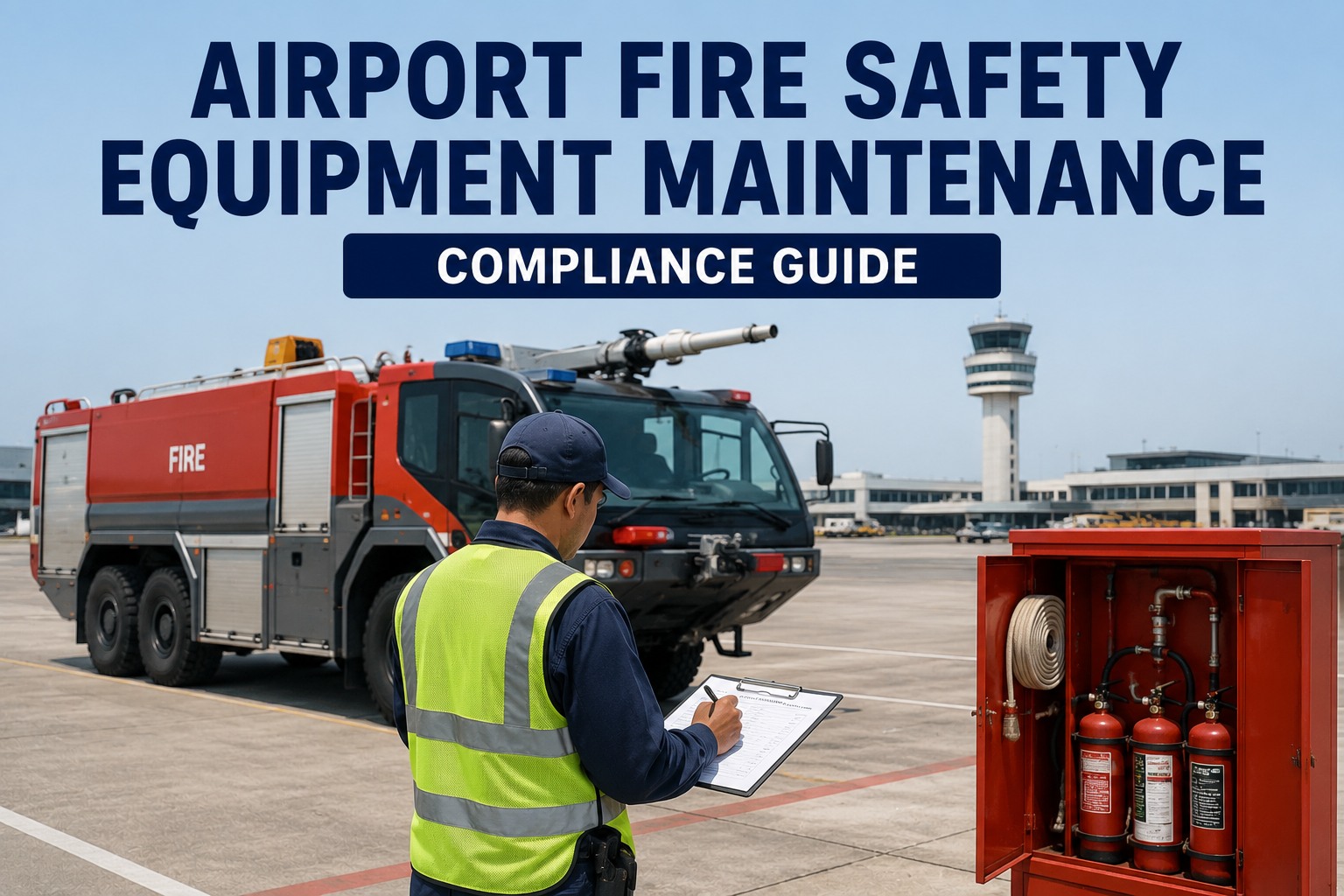
In almost every industry, a vehicle out of service is a maintenance problem. At a certificated airport, it is a certificate problem. Under 14 CFR §139.319, if a required aircraft rescue and firefighting vehicle goes down and the airport cannot restore its required Index level of capability within 48 hours, the operator must limit air carrier operations to those compatible with the equipment still working — and must notify the Regional Airports Division Manager and every air carrier using the field. There is no other maintenance domain where a single unserviceable truck downgrades the airport itself. That is what makes ARFF maintenance different: the PM schedule does not protect uptime, it protects the operating certificate and the three-minute window in which a first vehicle must reach the runway and begin applying agent. Behind that clock sits an equipment chain — the vehicle that must start, the pump and turret that must discharge at rated flow, the agent that must be within spec, and the suppression and emergency lighting systems in every terminal and hangar. This guide covers how to keep all of it compliant under NFPA 403, ICAO Annex 14, and Part 139. Start a free Oxmaint trial and schedule every ARFF and fire-system inspection on its required interval, or book a demo to see Index capability tracked against vehicle status.
Aviation · ARFF · Fire Safety Compliance
Airport Fire Safety Equipment Maintenance Compliance Guide
ARFF vehicle maintenance, fire suppression inspections, and emergency lighting — how airports meet NFPA 403, ICAO Annex 14, and 14 CFR Part 139 with CMMS-driven scheduling that keeps Index capability and response times intact.
-
48 hrs
to restore Index capability or limit air carrier operations
-
3 min
first vehicle to runway midpoint under Part 139
-
Index A–E
sets required vehicles, agent quantities, and staffing
-
15 min
NFPA 403 readiness window before and after flight ops
The Rule That Changes Everything
A Down Truck Downgrades the Airport
This is the compliance chain no other maintenance program carries. When a required ARFF vehicle becomes unserviceable, a regulatory clock starts — and if maintenance cannot beat it, the airport's own operations are restricted. Every PM in the program exists to keep this chain from ever starting.
-
1
A required vehicle goes out of service
A pump failure, a turret fault, a chassis defect — any condition that means the vehicle can no longer meet its agent discharge or response obligation. -
2
Index capability drops
The airport no longer holds the vehicles and agent quantities its assigned Index requires. Notification to the Regional Airports Division Manager and every air carrier is required. -
3
The 48-hour restoration clock runs
Replacement equipment must be in place, or capability otherwise restored, within 48 hours — the window in which parts, contractors, and reserve apparatus decide the outcome. -
4
Operations are limited to remaining capability
If the Index is not restored, air carrier operations must be limited to those compatible with the equipment still operative — the airport is effectively downgraded.
Which is why reserve-vehicle readiness, parts lead times, and PM compliance are not maintenance metrics at an airport — they are certificate metrics. Book a demo to see Index capability tracked live against vehicle status.
Three Standards, Three Clocks
The Response Time Your Equipment Must Deliver
FAA, ICAO, and NFPA each set a response-time obligation, and they do not match — the standard your airport answers to determines how tight the window is and therefore how reliable the fleet must be. All of them assume optimum visibility and dry pavement.
| Standard | First Vehicle | Target Point |
|---|---|---|
| FAA Part 139 | 3 minutes | Midpoint of farthest air carrier runway |
| FAA Part 139 | 4 minutes | All other required vehicles |
| NFPA 403 | 2 minutes | Any point on the operational runway |
| NFPA 403 | 3 minutes | End of runway, agent application begun |
| ICAO Annex 14 | Per 9.2.21 | Optimum visibility and surface conditions |
Response time drives station siting, staffing, and fleet size — but every one of those is worthless if the vehicle does not start and the turret does not flow. Sign up for Oxmaint to track vehicle readiness against your response obligation.
What the Program Must Cover
Three Equipment Domains, One Compliance Record
Airport fire safety maintenance reaches well beyond the apparatus bay. Three domains each carry their own inspection intervals, competent persons, and statutory records — and an audit examines all three.
-
ARFF Vehicles
Chassis, pump, turret, and agent systems maintained per NFPA 414 and the FAA guide specification. Class 1–5 apparatus carry different agent combinations — each demanding its own discharge-rate verification, foam-quality testing, and readiness check before every operational period. -
Fire Suppression Systems
Hangar foam-deluge, terminal sprinkler, and fuel-farm suppression systems on scheduled functional test and inspection — with agent compatibility verified, because mixing one vendor's foam with another's during re-servicing can gel the concentrate. -
Emergency Lighting & Alerting
Emergency and egress lighting on functional test, plus the siren and alarm systems Part 139 requires for alerting rescue and firefighting personnel to any existing or impending emergency — established, maintained, and provable.
Every responding ARFF vehicle must also carry, or have direct communications access to, the DOT Emergency Response Guidebook or equivalent hazmat guidance. Book a demo to see all three domains on one compliance record.
Index Drives the Fleet
Your Index Sets What Must Be Maintained
The airport's Index — determined by the length of the largest aircraft meeting the frequency threshold — is the regulatory basis for the minimum ARFF vehicle fleet, agent quantities, discharge rates, and staffing. Maintenance is what keeps each of those provable.
- Vehicles The minimum apparatus count is set by Index. A vehicle out of service is a gap in the regulatory fleet, not a spare capacity issue.
- Agents Agent types and quantities are quantified per Index — AFFF meeting specification, plus sodium- or potassium-based dry chemical for three-dimensional and engine fires.
- Discharge Minimum discharge rates are prescribed per Index. Pump and turret performance must be verified, not assumed — output-based testing is required after a fluorine-free foam transition.
- Staffing Personnel levels tie directly to Index so apparatus can be operated effectively and response times met, with qualifications benchmarked to NFPA 1003 and recurrent training documented.
NFPA 403 also requires readiness during flight operations and for 15 minutes before and after — a window that leaves no room for an unplanned repair. Sign up for Oxmaint to tie PM schedules to your assigned Index requirements.
Readiness Is a Record
You Cannot Prove Readiness You Did Not Document
An ARFF program is judged on evidence: that each vehicle was checked before the operational period, that pump and turret discharge was verified against the rated flow for the Index, that foam concentrate is within specification and compatible, that emergency lighting and alerting systems were functionally tested, and that every defect was driven to a documented repair. When those checks live on clipboards in the apparatus bay, a Part 139 inspection becomes an archaeology project and every gap is a finding. When each is a timestamped record generated by the daily readiness workflow, the evidence assembles itself — and the 48-hour clock is something you manage with parts and planning rather than something that manages you.
Oxmaint for Airport Fire Safety
How Oxmaint Runs ARFF Maintenance
-
Readiness Checks
Before Every Operational Period
Digital pre-operational checks on every ARFF apparatus — chassis, pump, turret, agent levels, and communications — signed, timestamped, and photo-backed, so readiness before flight operations is provable, not assumed.
-
Index Tracking
Capability Against Requirement
Track vehicle status against the fleet, agent quantities, and discharge rates your Index requires — so a unit going out of service immediately shows the capability gap and starts the 48-hour restoration clock with visibility.
-
Agent & Discharge
Foam Testing on Schedule
Schedule discharge-rate verification and foam-concentrate quality testing with results logged per vehicle — including the output-based testing required after a fluorine-free foam transition, and compatibility recorded on every re-service.
-
Fixed Systems
Suppression & Lighting PM
Recurring functional tests for hangar deluge, terminal sprinkler, fuel-farm suppression, emergency and egress lighting, and the siren and alarm systems that alert ARFF personnel — each with its own interval and record.
-
Defect to Repair
Findings That Beat the Clock
Any failed readiness item raises a prioritized work order with parts linked and lead times visible — giving the shop the head start that decides whether Index capability is restored inside 48 hours.
-
Audit Records
Part 139 Inspection Ready
Export the full inspection, discharge-test, training, and corrective-action history per asset — the documented evidence a Part 139 inspection, ICAO audit, or NFPA compliance review expects on request.
Frequently Asked
Airport Fire Safety Compliance Questions
What happens if an ARFF vehicle is out of service?
Under 14 CFR §139.319, if replacement equipment is not immediately available the airport operator must notify the Regional Airports Division Manager and each air carrier using the airport. If the required Index level of capability is not restored within 48 hours, the operator must limit air carrier operations to those compatible with the Index corresponding to the remaining operative rescue and firefighting equipment. In practice, a down truck can downgrade the airport — which is why ARFF PM is a certificate obligation, not a fleet metric. Book a demo to see Index capability monitored in real time.
What response time must ARFF vehicles meet?
It depends on the governing standard. FAA Part 139 §139.319(h) requires the first vehicle to reach the midpoint of the farthest air carrier runway within three minutes, and all other required vehicles within four. NFPA 403 is stricter: the first vehicle must reach any point on the operational runway in two minutes or less, and reach the end of any operational runway and begin agent application within three minutes. ICAO Annex 14 sets its own obligation. All assume optimum visibility and dry surface conditions.
What does the airport Index determine?
The Index — A through E, based on the length of the largest aircraft meeting the operational frequency threshold — is the regulatory basis for the minimum ARFF vehicle fleet, the types and quantities of extinguishing agents, minimum discharge rates, and staffing levels. Personnel qualifications are benchmarked against NFPA 1003 with documented recurrent training. Because each element is prescribed, maintenance must keep every one of them verifiable at any time. Sign up for Oxmaint to schedule PM against your Index requirements.
Why does foam compatibility matter during re-servicing?
Because mixing one vendor's foam concentrate with another's during re-servicing can cause the concentrate to gel, compromising the agent when it is needed most. AFFF agents must meet the applicable military specification, and compatibility must be confirmed before any re-service. Airports transitioning to fluorine-free foam also face required output-based testing after the transition — making agent quality and discharge verification a tracked, recurring maintenance task rather than a one-time commissioning check. Book a demo to see foam testing and compatibility logged per vehicle.
Ready · Verify · Restore · Prove
The Truck Is Not an Asset. It Is the Certificate.
Every unverified discharge rate, untested foam concentrate, and undocumented readiness check is Index capability you cannot prove and a 48-hour clock you cannot beat. Oxmaint gives airport fire safety teams one platform to run pre-operational readiness checks, track Index capability against vehicle status, schedule discharge and foam testing, maintain suppression and emergency lighting systems, and export the record a Part 139 inspection asks for — so the response time is guaranteed by equipment that is proven ready.