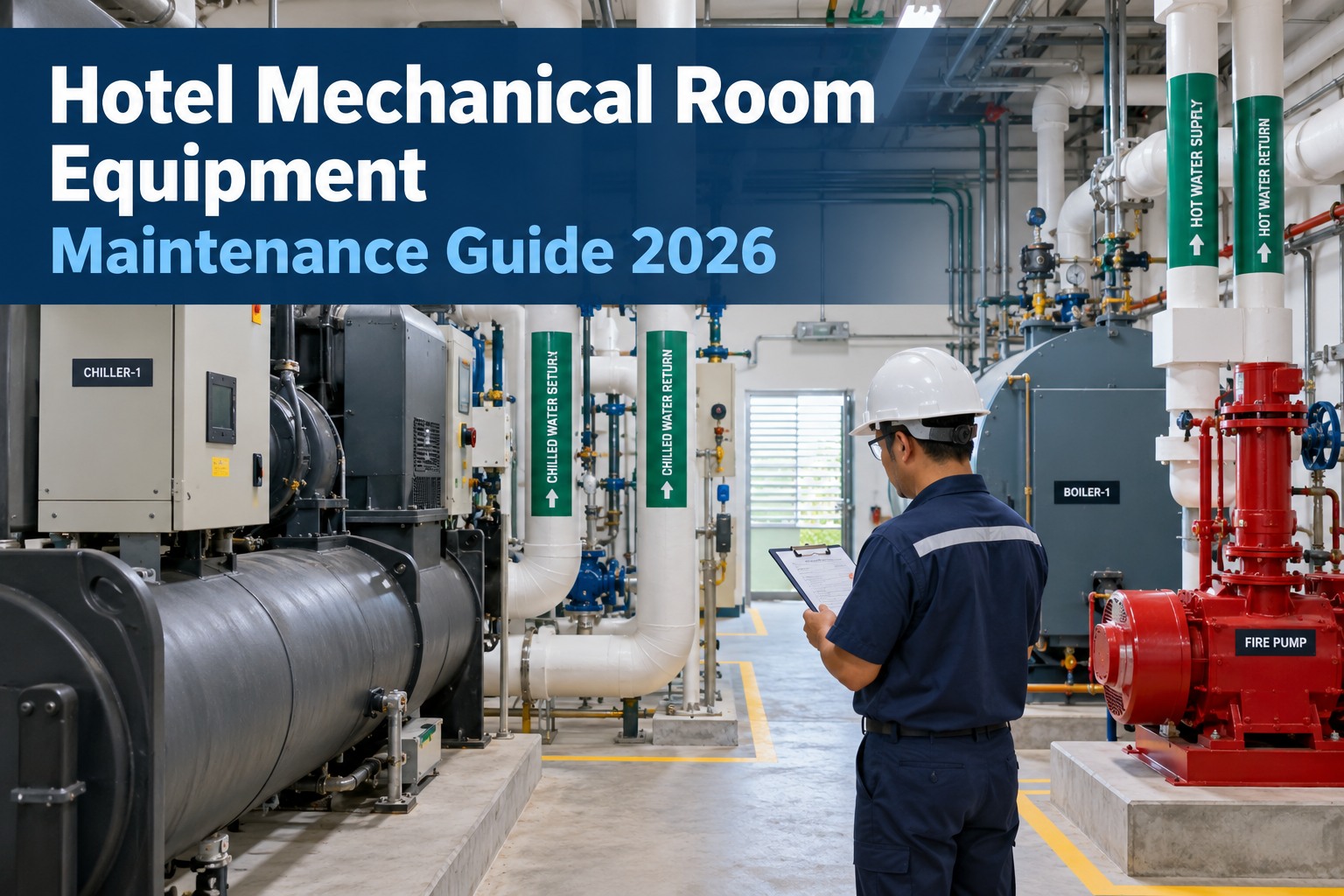
The hotel mechanical room is the one space no guest ever sees and every guest depends on. A hot shower at 6 a.m., a cool lobby in August, water pressure on the top floor, a fire pump that will actually run if it's needed — all of it starts behind that locked plant-room door. And unlike a factory, a hotel can't take the plant offline: it runs 24/7/365 at full occupancy on holiday weekends. This guide covers hotel mechanical room maintenance system by system — chiller and boiler PM, domestic hot water, fire pump testing, and the pressure-vessel compliance that carries real legal weight. Start free on OxMaint to build your plant-room program, or book a demo.
Chiller · Boiler · DHW · Fire Pump · Pressure Vessels
Hotel Mechanical Room Equipment Maintenance Guide
The systems no guest sees and every guest depends on — kept running through a building that never closes.
5
Core plant systems behind the door — chiller, boiler, DHW, fire pump, pressure vessels
24/7
Occupancy the plant serves — with no scheduled shutdown to lean on
Legal
Fire pump and pressure-vessel work carries code and inspection obligations, not just uptime
Guest
Every plant failure becomes a guest complaint, a refund, or a review
Why the Hotel Plant Room Is Its Own Discipline
A hotel mechanical room is not an industrial plant and not a home utility closet — it's a hybrid with pressures all its own. The equipment is commercial-grade and code-regulated, but the operating context is hospitality: no downtime window, guest comfort as the KPI, and a small engineering team covering everything from a dripping faucet to a fire-pump churn test. That combination is why plant-room maintenance needs a real program, not a clipboard on a nail by the door.
No Downtime Window
A factory schedules an outage; a hotel at full occupancy can't. PM has to be planned around continuous operation and redundancy, not a shutdown.
Comfort Is the KPI
A slow degradation that a plant would tolerate becomes a lukewarm shower and a one-star review here. The tolerance for drift is far lower.
Compliance Has Teeth
Fire pumps and pressure vessels carry code-mandated testing and inspection. Missing them is a liability and insurance exposure, not just a maintenance lapse.
Lean Engineering Team
A handful of engineers cover the whole property. Without a scheduled program, plant PM loses every time to the guest-facing emergency of the moment.
The Five Systems Behind the Door
A hotel plant room is really five distinct systems sharing a room, each with its own failure modes, PM rhythm, and — for two of them — legal compliance obligations. A program that treats the room as one thing misses that the fire pump answers to a code inspector while the chiller answers to the August heat.
Chiller Plant
Guest comfort · Summer-critical
Cooling for guest rooms and common areas. Condenser and evaporator upkeep, refrigerant charge, water treatment, and efficiency — fails hardest exactly when demand peaks.
Boiler Plant
Heat + hot water · Pressure vessel
Space heating and the hot-water base load. Combustion, controls, safety valves, and water treatment — and it doubles as a regulated pressure vessel.
Domestic Hot Water
Guest-facing · Legionella risk
Water heaters, storage, circulation pumps, and mixing valves. Temperature control is both a comfort and a waterborne-pathogen safety issue.
Fire Pump
Life safety · Code-tested
The life-safety asset that must run on demand. Subject to scheduled testing under fire code — the highest-consequence, most-regulated item in the room.
Pumps & Pressure Vessels
Distribution · Inspected
Circulation and booster pumps, expansion tanks, and pressure vessels — the distribution backbone, with vessels carrying inspection requirements.
Chiller & Boiler · The Comfort Core
These two carry guest comfort between them — cooling and heating — and both reward seasonal PM timing. The move that separates a run property from a reactive one is servicing each before its peak season, not during it.
Chiller — Pre-Summer PM
Condenser and evaporator tube cleaning
Refrigerant charge and leak check
Condenser-water treatment and tower upkeep
Compressor oil, controls, efficiency trend
Service before cooling season — a chiller failure in a heatwave is the worst-case guest event
Boiler — Pre-Winter PM
Combustion tuning and efficiency check
Safety and relief valve verification
Water treatment and blowdown routine
Controls, low-water cutoff, flue integrity
Service before heating season — and treat the safety-valve check as compliance, not optional
Put All Five Systems on One PM Schedule — Free Forever
A clipboard by the plant-room door loses every time to the guest emergency of the moment. Load your chiller, boiler, DHW, fire pump, and pressure vessels into OxMaint with seasonal PM and compliance dates that actually fire on schedule. No card, no time limit.
Domestic Hot Water · Comfort and a Safety Line
DHW is the most guest-facing plant system — nothing generates complaints faster than a cold shower — but it carries a safety dimension most comfort systems don't. Water temperature is a balance: hot enough to control Legionella growth in the storage and circulation loop, but delivered safe against scald risk at the tap. Getting that balance right, and documenting it, is core plant-room work.
Storage Temperature
Kept high enough in the tank to suppress bacterial growth — the primary Legionella control in the system.
Circulation Balance
Return-loop temperature maintained so no dead legs or cool spots let pathogens establish across the property.
Mixing / Scald Control
Thermostatic mixing valves deliver water safe at the tap even while storage runs hot — comfort and safety reconciled.
Documented Temps
Temperature logs kept as the record behind a water-safety plan — evidence the control is actually happening.
The Compliance Layer · Fire Pump & Pressure Vessels
Two systems in the room don't just need to work — they need to be proven to work, on a schedule an inspector can audit. This is where plant-room maintenance crosses from uptime into legal obligation, and where a missing record is a finding regardless of whether the equipment was fine.
Fire Pump
Scheduled Testing to Fire Code
Fire pumps are tested on a code-defined cadence — routine no-flow (churn) runs and periodic flow testing — with results documented. The exact regime follows the governing fire code and the authority having jurisdiction, but the principle is fixed: tested regularly, recorded every time, and any deficiency corrected and logged.
Pressure Vessels
Inspection & Certification
Boilers, expansion tanks, and other pressure vessels are subject to periodic inspection and certification under the applicable jurisdiction's boiler and pressure-vessel rules. Safety-valve verification, inspection intervals, and the current certificate all have to be tracked and kept current — an expired certificate is a compliance gap on its own.
Specific test intervals, inspection frequencies, and certificate requirements vary by jurisdiction and by the code edition in force. Treat this as the framework; confirm the exact cadence with your authority having jurisdiction and insurer — and build those confirmed dates into the schedule so they fire automatically.
How OxMaint Runs the Hotel Plant Room
All five systems, their seasonal PM, the DHW temperature logs, and the fire-pump and pressure-vessel compliance dates live on one platform — every asset in the plant room carried with its schedule, history, and certificate status, so nothing slips because the one engineer who remembered it was off that week.
Register
Whole Plant Room
Chiller, boiler, water heaters, pumps, fire pump, and vessels carried as assets with make, capacity, and service history.
Season
Pre-Peak PM Timing
Chiller PM scheduled before summer, boiler before winter — the seasonal cadence that prevents peak-season failures.
Log
DHW Temperature Records
Storage and circulation temperatures logged as the documented evidence behind the water-safety plan.
Comply
Fire Pump & Vessel Dates
Code test cadence and vessel inspection/certificate dates tracked with reminders before they lapse — never a surprise expiry.
Mobile
Rounds on a Phone
The lean engineering team runs plant rounds from a phone — readings, photos, and issues captured where the work happens.
Prove
Audit-Ready History
Every test, inspection, and PM retained per asset — the record an inspector or insurer can be shown on demand.
Keep the Plant Room Running While the Hotel Never Closes
Free forever plan — no card, no time limit. Register all five systems, set seasonal PM and compliance dates that fire on time, and give your engineers plant rounds on a phone. Or book 30 minutes and we'll map your property's mechanical room onto the platform end to end.
Frequently Asked Questions
What equipment is in a hotel mechanical room?
Typically five core systems: the chiller plant for cooling, the boiler plant for heating and hot-water base load, domestic hot water (water heaters, storage, circulation, mixing valves), the fire pump for life safety, and the distribution pumps and pressure vessels that move and buffer water through the building. Two of them — the fire pump and pressure vessels — carry code-mandated testing and inspection on top of ordinary PM.
When should hotel chillers and boilers be serviced?
Ahead of their peak season. Service the chiller before cooling season so it isn't discovered failing in a heatwave, and the boiler before heating season. Both benefit from PM timed to precede demand rather than coincide with it — a chiller failure at full summer occupancy is one of the worst guest-experience events a hotel can have, and it's almost always preventable with pre-season work.
Why does hotel domestic hot water need temperature management?
Because it's a safety balance, not just comfort. Hot-water storage has to be kept warm enough to suppress Legionella growth in the tank and circulation loop, while the water delivered at the tap must be tempered to prevent scalding — usually via thermostatic mixing valves. Maintaining that balance and documenting the temperatures is a core part of a hotel's water-safety plan.
Book a demo to see temperature logging.
How often does a hotel fire pump need testing?
On a code-defined cadence that combines routine no-flow (churn) runs with periodic flow testing, all documented. The exact frequency depends on the governing fire code and your authority having jurisdiction, so confirm the specifics locally — but the principle holds everywhere: the pump is tested regularly, every test is recorded, and any deficiency is corrected and logged. Missing the record is itself a compliance gap even if the pump works.
Why manage the plant room in a CMMS instead of a logbook?
Because a hotel runs 24/7 with a lean engineering team, and a paper logbook loses every time to the guest emergency of the moment — seasonal PM slips and compliance dates get missed. A CMMS carries all five systems with their schedules, holds DHW temperature logs and fire-pump and pressure-vessel certificate dates with reminders before they lapse, and gives engineers plant rounds on a phone with an audit-ready history for any inspector or insurer.
Start free to set it up.