A gas turbine bearing doesn't announce its failure — it degrades through a predictable sequence of thermal, vibrational, and acoustic changes detectable 30 days or more before the trip. Boiler tube weaknesses become visible 1–3 weeks before rupture. Generator insulation degradation shows measurable signals weeks before breakdown. Start your power plant CMMS in Oxmaint free — the gap between those warning signs and an automated work order is the entire business case for predictive maintenance.
Power Plant Maintenance Management: Boiler, Turbine and Generator CMMS Guide
Boiler tube monitoring · turbine vibration trending · generator insulation tracking · BOP asset management · NERC-compliant outage planning — one platform, every generation asset
Power plant maintenance is not equipment repair — it is grid reliability, regulatory compliance, and revenue preservation. A turbine trip removes megawatts from the grid instantaneously, triggering capacity payment clawbacks, NERC reliability penalties, and regulatory scrutiny that compounds the financial damage far beyond the repair bill. The gap between a plant running reactive maintenance and one running condition-based PM is typically $8.5M or more in annual preventable cost — from forced outage prevention, repair cost reduction, and outage schedule optimisation alone. Sign up for Oxmaint to begin building condition-based PM on your highest-consequence generation assets.
Of power plant shutdowns are due to preventable equipment failures. Boiler tube systems account for 52% of thermal plant forced outage hours. Gas and steam turbines account for 43% of all equipment failures. Both are detectable weeks before the forced outage — if the monitoring data connects to a maintenance action system.
Boiler Tube Monitoring, Water Chemistry, and HRSG Maintenance
Water wall tube leakages alone account for 60% of boiler outage hours at thermal plants — and the majority develop from water chemistry failures and scaling that are measurable weeks before rupture. A systematic CMMS-managed water chemistry programme catches pH drift, conductivity rise, and dissolved oxygen exceedances in the window when chemistry correction prevents tube damage. Tube wall thickness measurement at annual inspection detects thinning before the failure threshold. Sign up for Oxmaint to configure boiler water chemistry PM triggers and tube inspection work orders.
Turbine Vibration Monitoring, Blade Inspection, and Lube Oil System
Gas and steam turbines account for 43% of all power plant equipment failures — and virtually every failure mode generates detectable signals weeks to months before the forced outage. Turbine bearing failures are detectable 30 days or more in advance through vibration analysis. Blade erosion, seal degradation, and lube oil varnish contamination all follow predictable degradation sequences. The business case for turbine condition monitoring closes on the first prevented major failure: a gas turbine emergency replacement runs $1.8M in parts and contractor fees plus 11 days of lost generation at $420,000 per day. Book a demo to see turbine asset hierarchy and condition monitoring configuration in Oxmaint.
Generator Insulation Monitoring, Partial Discharge, and Stator Cooling
Generator failures are the most expensive single-event failure in a power plant — stator rewind costs $2–8M and takes 4–6 months, during which the unit cannot generate. Generator insulation degradation shows measurable signals weeks before failure through partial discharge monitoring and insulation resistance trending. Stator cooling water chemistry directly determines endwinding insulation condition in water-cooled generators. Sign up for Oxmaint to configure generator PM intervals and insulation trending records.
Cooling Towers, Condensers, Feedwater Pumps, and Auxiliary Systems
Balance of plant failures are the most common cause of partial load reduction and unplanned derates — not the spectacular failures that dominate incident reports. A condenser with fouled tubes reduces turbine backpressure performance by 3–8%, increasing heat rate and fuel cost continuously until the next cleaning cycle. A feedwater pump vibration problem that is not tracked will trip the unit at the worst possible grid moment. Oxmaint tracks BOP assets in the same asset hierarchy as the prime movers — giving plant managers zone-level KPI reporting that shows BOP as the hidden cost driver it typically is. Book a demo to see BOP asset configuration in Oxmaint.
CMMS-Driven Outage Planning: From 12-Month Scope to Day-of Execution
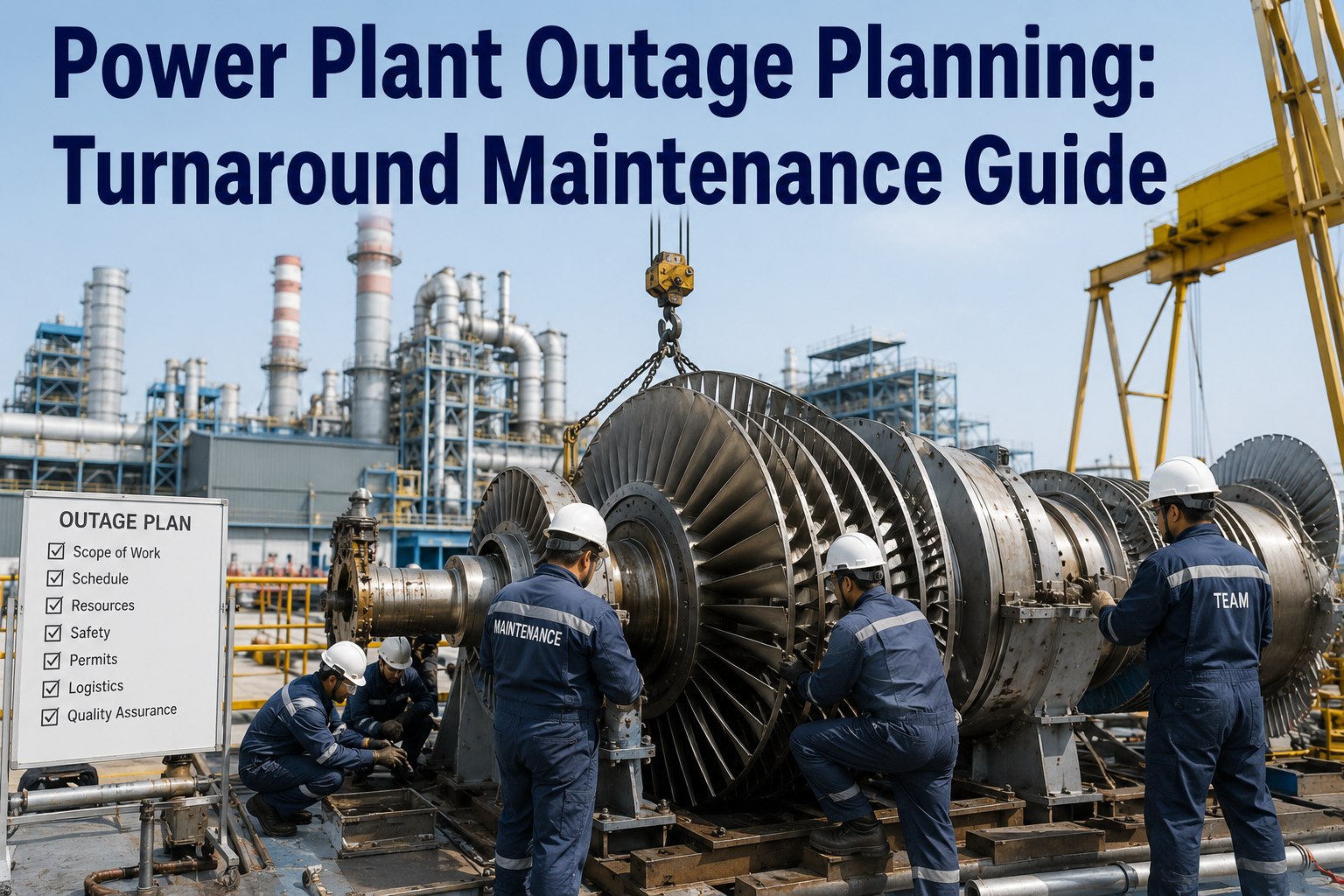
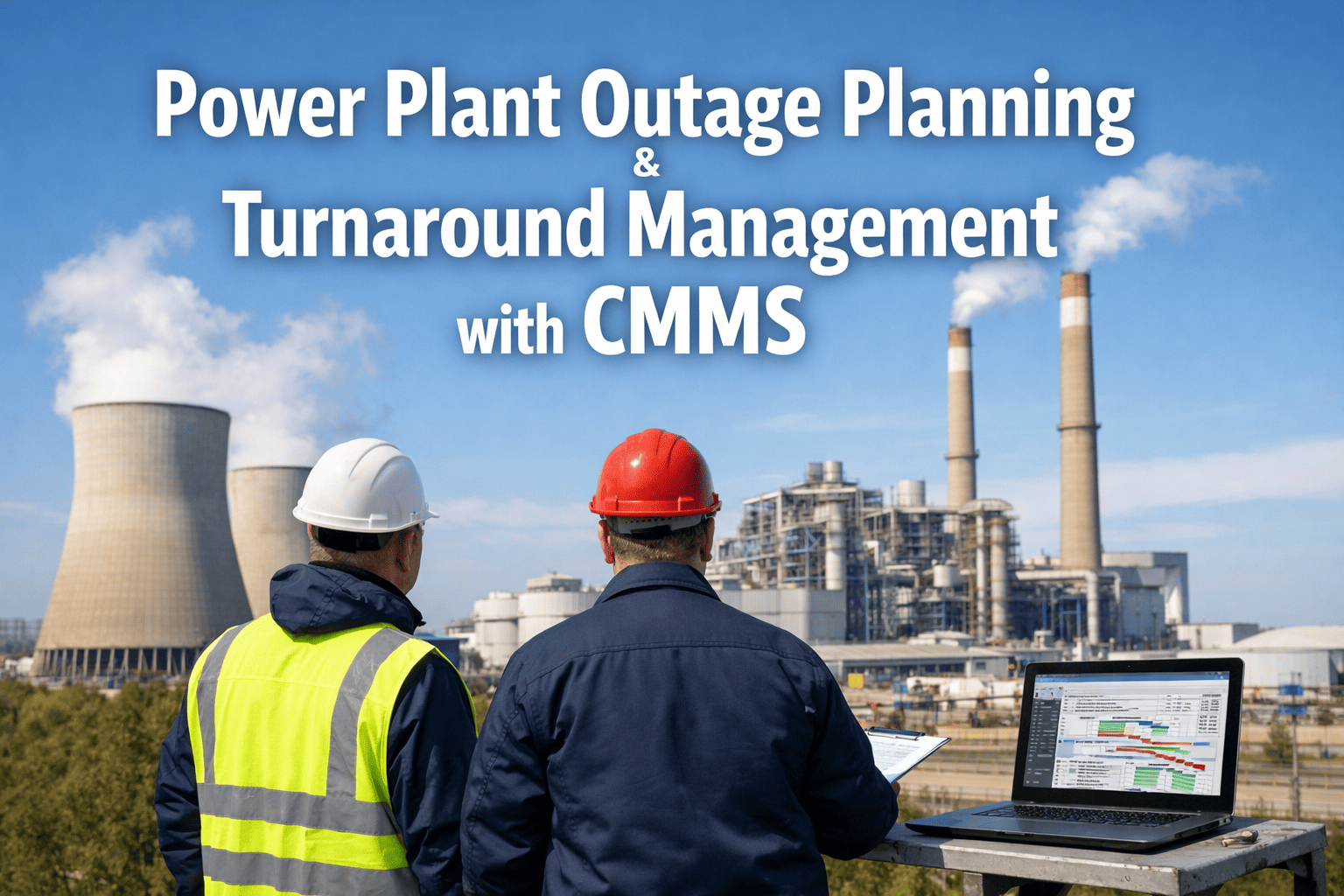
Most power plant outages are planned in spreadsheets disconnected from the CMMS — meaning scope items discovered in condition monitoring logs never make it into the outage work package until the casing is already open. Oxmaint connects every condition monitoring alert, every borescope finding, and every deferred PM directly to the outage scope — converting unplanned scope discoveries from outage duration penalties into pre-procured planned work orders. Sign up free to begin building your outage scope in Oxmaint.
Scope Assessment and Long-Lead Procurement
Review condition monitoring history, open borescope findings, and deferred PM backlog. Identify long-lead parts: combustion liner sets (6–20 weeks), turbine blade sets (6–18 months), generator stator components (16–24 weeks). Issue purchase orders before scope is final — procurement starts from condition data, not from opening the unit.
Work Package Development and Contractor Mobilisation
Oxmaint generates work packages for each discipline — turbine OEM team, electrical contractors, NDE inspectors, scaffolding. 5,000–10,000 discrete work orders within a single major overhaul event, grouped by discipline, system, and critical path dependency. Contractor schedule reviews confirm resource availability before mobilisation commitment.
Pre-Outage Inspection and Scope Finalisation
Final borescope and NDE inspection confirms or adds to the planned scope. Any new findings at this stage still allow parts procurement before outage start. Vibration and insulation baselines measured — post-overhaul performance comparison requires pre-outage reference data. LOTO procedures linked to each work package. Book a demo to see outage work package configuration.
Active Outage Execution — Real-Time Progress Tracking
Every contractor team sees assigned work packages, predecessor task status, and permit requirements in the Oxmaint contractor portal — without access to the full plant CMMS. Work permits link directly to work packages; contractors cannot start without an active permit. Outage managers see the full critical path status in real time. Access conflicts identified 24–48 hours before they become day-of disruptions.
Post-Outage Baseline and Documentation Close-Out
Post-overhaul vibration measurements compared against pre-outage baseline — any equipment returned in worse condition identified before the unit restarts. All work order records, NDE reports, and inspection certificates archived in Oxmaint with technician timestamp for NERC, insurance, and ISO audit readiness. Lessons learned captured for next outage cycle planning.
One prevented forced outage pays for a decade of CMMS
Plants implementing CMMS-driven predictive maintenance document $8.5M+ in annual value from forced outage prevention, repair cost reduction, and outage optimisation. Oxmaint connects to existing SCADA and DCS via OPC-UA, Modbus, and DNP3 — no infrastructure replacement required.
Power Plant PM Schedule: Asset, Frequency, Method, and Alert Threshold
Configure each row as a triggered PM in Oxmaint — calendar, operating hours, or sensor threshold. Sign up free to import this schedule.
| Asset / Parameter | Frequency | Method | Alert Threshold | Consequence if Missed |
|---|---|---|---|---|
| Boiler water chemistry | Daily | pH, hardness, conductivity, DO | Any pH outside 10.5–12.0 or any hardness detection | Scaling and corrosion — tube failure in 1–3 weeks |
| Turbine shaft vibration | Continuous | X-Y proximity probes per bearing | Rising trend above established baseline | Bearing failure: $1.8M+ emergency vs $140K planned |
| Turbine bearing temperature | Continuous | Embedded RTD per bearing | +8°C above thermal baseline | Loss of lube film → catastrophic seizure |
| Lube oil analysis (turbine) | Quarterly | Lab: MPC varnish, Fe/Cu, water, viscosity | MPC >25 or Fe rising trend two samples | Servo valve stiction → stop valve slow-stroke |
| Gas turbine borescope | Each combustion inspection | Fiber optic borescope — blades, liners, seals | Any erosion, cracking, or coating loss finding | Blade liberation → cascade damage to all hot section |
| Generator partial discharge | Continuous or annual | Online PD monitoring or offline test | Rising PD magnitude vs baseline | Stator fault: $2–8M rewind, 4–6 months offline |
| Generator insulation resistance | Annual | Megger test — PI ratio calculated | PI below 2.0 → investigation | Insulation breakdown under operational stress |
| Transformer dissolved gas | Annual | DGA oil sample — full gas analysis | C2H2 (acetylene) >1 ppm → immediate review | Internal arcing → catastrophic transformer failure |
| Condenser backpressure | Continuous vs load model | Performance trending — actual vs design | 1 in. Hg above design = 1% heat rate penalty | Ongoing fuel cost increase + output derate |
| Main stop valve stroke test | Quarterly | Full stroke with time measurement | Stroke time above OEM specification | Valve seize on trip → over-speed runaway |
Swipe to view all columns
Frequently Asked Questions
What is the realistic first-year value from implementing CMMS at a power plant?
The business case closes on the first prevented forced outage. A single avoided gas turbine trip at $420,000 per day for 5–11 days exceeds years of platform cost. Plants consistently document four value streams in the first year: forced outage prevention (largest component), repair cost reduction from shifting emergency to planned (5–15× cost differential), heat rate improvement from maintaining equipment at design condition, and outage duration reduction. A 200–800 MW plant typically documents $8.5M+ in annual value once condition monitoring and outage planning are both operational. The fastest payback comes from the repair cost differential — stopping one bearing replacement from becoming an emergency event rather than a planned job recovers the CMMS investment in a single work order. Start free to begin building the case from your own plant data.
How does Oxmaint integrate with existing plant DCS, SCADA, and historian systems?
Oxmaint connects to existing SCADA and DCS systems through standard industrial protocols — OPC-UA, Modbus, and DNP3 — using protocol gateways that install in days without any control system modification. Historian data from OSIsoft PI, AspenTech IP21, or proprietary DCS historians connects via API integration, allowing existing sensor data to automatically populate Oxmaint asset records and trend charts. Most plants achieve initial integration within 2–4 weeks and begin generating predictive work orders from existing data streams without deploying any new sensors. New sensor deployment is additive — focused on assets currently without instrumentation. Book a demo to see integration configuration for your specific DCS platform.
How does Oxmaint handle NERC reliability standard compliance documentation?
NERC reliability standards require documented maintenance intervals, completed inspection records, and traceable evidence for generating unit maintenance activities — including forced outage documentation for GADS reporting and equipment maintenance evidence for FAC-001/002 compliance. Oxmaint automates the documentation structure: every work order carries technician electronic signatures, supervisor sign-off, timestamped completion, and asset condition before/after fields. NERC non-compliance penalties can reach $1M per day per violation — the administrative time saving from automated documentation is secondary to the exposure reduction from eliminating undocumented maintenance. Forced outage records flow directly into GADS reporting formats. Sign up free to explore compliance documentation configuration.
Your plant dispatches 8,760 hours a year. Protect every one.
Oxmaint gives power plant reliability teams the predictive analytics, outage optimisation, and regulatory compliance tracking to keep units generating and maintenance costs controlled — so every megawatt-hour dispatched is profitable.