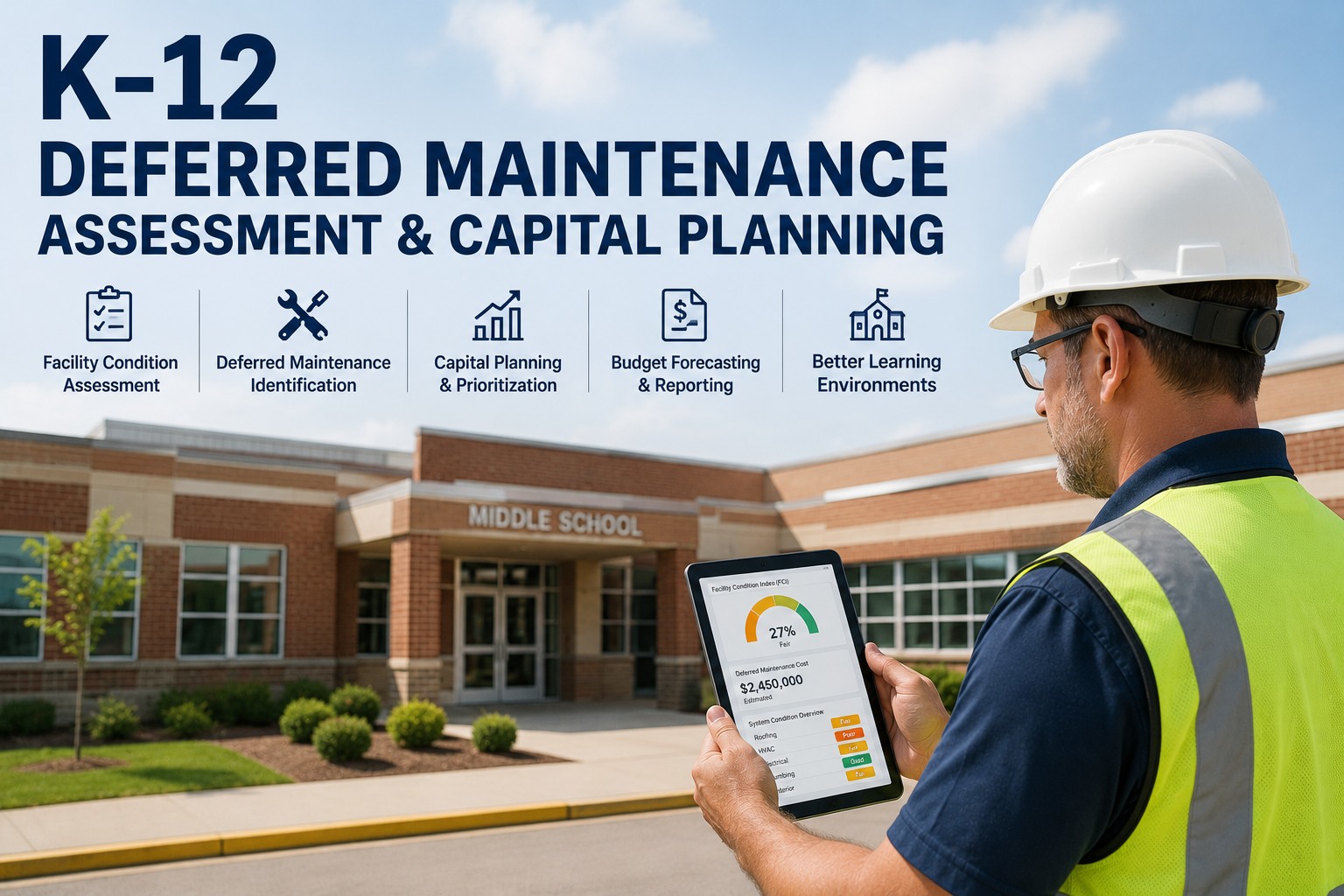
The deferred maintenance backlog across US K-12 school buildings has reached an estimated $85 billion, and the GAO found that 53% of school districts report buildings in fair or poor condition — a strategic crisis that has been silently compounding for a decade at construction cost inflation of 5 to 7% per year. For a Facilities Director walking into a board meeting or a bond referendum, three questions decide the outcome: which buildings are worst, which repairs are most urgent, and what does inaction cost over the next five years. The Facility Condition Index — deferred maintenance cost divided by current replacement value — is the industry-standard metric that answers all three, and every school district that runs a credible capital planning cycle uses it. But the traditional FCA model of a consultant walk-through every 3 to 5 years produces a snapshot that is stale within 12 months, undermined by every new failure and every completed repair, and unable to defend the capital request when the board asks why the numbers do not match reality. Oxmaint is the CMMS built for K-12 districts that need a live, defensible, board-ready FCI — updated automatically as work orders close, condition data is captured, and buildings age. Start a free Oxmaint trial to run K-12 facility condition assessment on the CMMS, or book a demo to see the FCI dashboard for a multi-building district portfolio.
Education · K-12 District · Facilities Director Playbook
K-12 Deferred Maintenance Assessment & Capital Planning — The 2026 Guide
Facility Condition Index framework, building system assessment methodology, prioritization matrix, and 20-year capital planning horizon — everything a Director of Facilities needs to run a credible, board-ready program.
-
$85B
estimated deferred maintenance backlog across US K-12 school buildings
-
53%
of US school districts report buildings in fair or poor condition (GAO)
-
4.8×
emergency repair cost premium versus planned maintenance intervention
-
$1 = $4
deferred maintenance cost multiplier — $1 deferred today becomes $4 in five years
Why This Is a Strategic Crisis
Four Conditions That Make K-12 Deferred Maintenance a Board-Level Problem
Deferred maintenance is not a maintenance department problem. It is a governance issue that the school board, superintendent, and state funding agencies each hold a stake in — and the Facilities Director is the person expected to make the data defensible. Understanding the four conditions that define the crisis is the starting point for any credible capital plan.
-
01
Aging Portfolio, Insufficient Reinvestment
Average US school building age is 44+ years. APPA benchmarks $3.20 per sq ft annual O&M spend; most districts spend $1.50 to $2.00 — 40 to 50% below adequate reinvestment.
-
02
Compounding Cost Escalation
Construction cost inflation runs 5 to 7% per year. $100,000 of deferred work today becomes $128,000 in five years without the underlying problem improving.
-
03
Bond Referendum Data Dependency
Every bond attorney, financial advisor, and state review agency asks the same question: quantified FCI per building with supporting condition data. No data, no defensible bond package.
-
04
Stale Consultant FCAs
Traditional FCA cycle: outside consultant every 3 to 5 years. Snapshot goes stale in 12 months. Board asks "is this current?" Answer that says "no" undermines the capital request.
The FCI Framework
Four Zones That Define Every Building's Condition
The Facility Condition Index is the industry-standard metric. Formula: deferred maintenance cost divided by current replacement value, expressed as a percentage. Four zones translate the number into a capital planning action. Most US districts carry portfolio-level FCI scores between 8% and 18% — meaning the majority sit somewhere in the Fair-to-Poor zones with significant unrecognized backlog. Oxmaint calculates FCI live per building, per system, and rolled up per portfolio.
Good
Building in good overall condition. District is keeping pace with maintenance. Selective investment maintains this state.
Action: Maintain PM program, monitor drift
Fair
Emerging deferred maintenance. Manageable within normal capital budgets. Prioritize selective investment to prevent drift toward Poor.
Action: Selective capital investment, 5-yr plan
Poor
Meaningful deferred maintenance backlog. Multiple systems approaching end of life. Occupant experience and operational efficiency degrading.
Action: Structured CIP required, prioritize by system
Critical
Significant deferred maintenance. Systems failing or failed. Emergency repairs the norm. Safety risk rising. Repair-vs-replace decision required.
Action: Urgent appropriation or NPV replacement study
Most US school districts have portfolio-level FCI between 8% and 18% — meaning the majority carry meaningful deferred maintenance backlogs not yet fully visible in their budgets.
The Eight Building Systems
Every FCA Inventories the Same Eight Systems Per Building
A credible Facility Condition Assessment inventories eight discrete building systems per facility — each with its own useful life, its own condition score, and its own remaining life estimate. System-level FCI beats portfolio-level FCI for capital planning because it tells the board which systems to fix inside the building, not just which building is worst.
-
Roofing
Membrane, decking, insulation, flashing, drainage. Deferred replacement multiplies project cost 1.5 to 2.2× through cascade damage to insulation and interior.
Useful life: 20–30 years
-
HVAC
Boilers, chillers, air handlers, ductwork, controls. Highest emergency cost risk when deferred. 41% of US districts need HVAC updates (GAO).
Useful life: 15–25 years
-
Plumbing
Domestic water, waste, storm, fixtures. Legacy piping in old buildings frequently past end of life. Fixture accessibility ADA compliance.
Useful life: 30–50 years
-
Electrical
Service, distribution, panels, switchgear, lighting. Switchgear replacement drives major FCI events. Aging systems limit modern load capacity.
Useful life: 30–40 years
-
Building Envelope
Walls, windows, doors, insulation, sealants. Envelope failures cascade into every other system through moisture and thermal loss.
Useful life: 25–40 years
-
Interior Finishes
Flooring, ceilings, walls, casework. Shortest useful life of any category. High-visibility to community and voter perception of building condition.
Useful life: 10–20 years
-
Life Safety
Fire alarm, sprinklers, emergency lighting, egress hardware. Non-negotiable priority regardless of FCI. Code compliance gaps carry direct liability.
Useful life: 20–30 years
-
Site & Infrastructure
Parking, walkways, playfields, drainage, security. Highly visible to community. Often defers first, most visible when it does.
Useful life: 15–30 years
The FCA Methodology
Five Steps From Building Walkthrough to Board-Ready Package
A credible Facility Condition Assessment runs through five sequential stages — from the systematic building walkthrough that inventories every system, through the FCI calculation and prioritization, to the board-ready capital improvement plan. Oxmaint runs the whole workflow on mobile inspection forms, so field assessors score assets and attach photos directly in the system.
-
01
Asset Inventory & Baselining
Every building system entered against the facility record with age, model, install date, current replacement value. Baseline established.
-
02
Field Condition Scoring
Systematic building walkthrough by trained assessor. Each system scored on condition, remaining useful life, and deficiency cost. Photos attached.
-
03
Deferred Maintenance Costing
Every deficiency costed with labor, materials, contractor fees, disruption. Costs older than 12 months escalated at 5–7% annually for inflation.
-
04
FCI Calculation & Ranking
Deferred cost divided by current replacement value, per building and per system. Portfolio roll-up produced. Buildings ranked, systems prioritized.
-
05
Capital Plan Assembly
Rolling 5 to 10-year plan built. Annual spend targets aligned to budget cycle and bond timeline. Board-ready CapEx package exported.
The Board-Readiness Reality
A Three-Year-Old Consultant FCA Cannot Defend the Capital Request You Are Making Today
Every failed bond referendum and every rejected capital request in the last decade shared the same fatal weakness — the data underlying the ask was stale. New failures had emerged that were not on the list. Completed repairs had not been credited. Inflation had moved the numbers. Oxmaint keeps the FCI live and defensible, updated every time a work order closes or condition data is captured.
The Prioritization Matrix
Four Categories That Rank Every Deferred Item
Not every deferred item competes on the same terms. A four-category prioritization matrix separates the requests by consequence, safety, code compliance, and enrollment impact — the categories the board actually uses to approve or defer. Oxmaint holds category as a required field on every deferred work order.
Emergency
Immediate safety hazard or building unusable. Roof active leak into occupied space, boiler failure in heating season, life safety code violation.
Window: Within 30 days
Critical
System failure imminent or code compliance gap. HVAC replacement past end of life, ADA accessibility gap, IAQ threshold non-compliance.
Window: Current fiscal year
Priority
Approaching end of useful life. Replacement will be required within 3 years. Planned execution avoids the emergency premium.
Window: 1 to 3 years
Deferred
Documented deficiency with acceptable current performance. Tracked and costed, but not scheduled for immediate capital spend.
Window: 3 to 10 years
The Capital Planning Horizon
Every K-12 Capital Program Runs Four Parallel Time Horizons
A working capital planning program plans against four time horizons simultaneously — the current-year budget, the near-term bond cycle, the mid-range asset renewal, and the long-range replacement horizon. Each horizon uses the FCI data differently and reports to a different stakeholder.
-
1 Yr
Annual Operating & CapEx Budget
Emergency and Critical category items funded from current-year budget. Feeds superintendent's budget request and school board approval cycle.
-
5 Yr
Bond Referendum Horizon
Priority category items grouped into bond issuance packages. FCI-supported project list, cost escalation projections, repair-vs-replace analysis.
-
10 Yr
Mid-Range Asset Renewal Plan
Systems approaching end of life scheduled for planned replacement. Roof cycles, HVAC replacements, switchgear renewals aligned across the portfolio.
-
20 Yr
Long-Range Portfolio Strategy
Full building replacement decisions. NPV analysis at FCI 0.40–0.60 threshold. Enrollment projections. Consolidation or expansion scenarios.
Where Manual Programs Break
Four Gaps That Undermine Every K-12 Capital Request
-
01
FCI Data Sits in Consultant Reports
Three-year-old PDF from an outside consultant. Board asks "is this current?" Facilities Director cannot say yes. Capital request loses credibility instantly.
-
02
Asset Records Scattered
Spreadsheets, binders, individual principal files. No single view of what the district owns. Every capital decision made on estimates instead of documented data.
-
03
No Repair-vs-Replace Analysis
Buildings at FCI 0.40 or higher continue getting repair investment. No NPV comparison against planned replacement. Money spent that would have been better spent on the replacement.
-
04
Bond Package Assembly Takes Months
Bond referendum package pulled together from a dozen sources. Board attorney asks questions the data cannot answer. Referendum weakened before it even gets to voters.
Built for K-12 Facilities Leadership
How Oxmaint Runs the Full FCA and Capital Planning Program
-
Mobile FCA
Field Assessors Score On Mobile, Not Clipboards
Every system scored inside the mobile app with photos, condition rating, remaining useful life, cost estimate. Baseline captured directly against the building record.
-
Live FCI
FCI Updated Every Time a Work Order Closes
No more stale consultant PDFs. Every completed repair reduces the deferred backlog. Every new deficiency raises it. FCI reflects reality — always.
-
System-Level Breakdown
FCI Per Building and Per System
Portfolio-level roll-up for board reporting. System-level breakdown for capital planning. Roof FCI, HVAC FCI, electrical FCI — each ranked across the portfolio.
-
Prioritization Categories
Emergency, Critical, Priority, Deferred
Every deficiency assigned a category. Reports pull by category for annual budget, bond referendum, and long-range planning. Board sees what it approves and defers.
-
Repair-vs-Replace
NPV Analysis at High-FCI Buildings
Buildings above FCI 0.40 trigger a lifecycle comparison — continued repair spend versus planned replacement over 10 years. Decisions defensible to the board.
-
Bond-Ready Package
Referendum Package Exports in One Click
FCI per building, prioritized project list with 5-year escalation, condition photos, repair-vs-replace analysis. Everything the bond attorney and financial advisor ask for.
Measured Outcomes
What K-12 Districts Gain With Oxmaint Running the Program
-
Live
Defensible FCI
FCI updated automatically as work orders close and conditions change. Board question "is this current?" now has a defensible yes.
-
40%
Faster Capital Decisions
Dynamic FCI tracking accelerates capital allocation decisions 40% versus static annual consultant assessments.
-
One Click
Bond Referendum Package
Everything the bond attorney needs — FCI per building, prioritized list, cost escalation, repair-vs-replace — exports in one action.
-
Backlog
Growth Slowed or Reversed
Structured prioritization plus PM discipline slows or reverses the growth of deferred backlog — the single strongest signal of program effectiveness.
Frequently Asked
K-12 Facility Assessment & Capital Planning Questions
How is the Facility Condition Index calculated?
Total deferred maintenance cost divided by current replacement value, expressed as a percentage. A $500K deferred maintenance backlog in a building with a $5M replacement value produces an FCI of 10%. Deferred maintenance cost must come from a documented Facility Condition Assessment covering all eight systems — roofing, HVAC, plumbing, electrical, envelope, interior finishes, life safety, and site. Sign up for Oxmaint to run live FCI calculation on every building in the district portfolio.
How often should a K-12 district update its FCA?
The traditional cycle is every 3 to 5 years from an outside consultant, but this snapshot goes stale within 12 months as systems age, new failures emerge, and completed repairs improve condition. A CMMS-integrated approach updates FCI continuously — every completed work order, every reassessed condition, every deferred cost inflation adjusts the FCI automatically. Live FCI is defensible to a board at any time; a three-year-old consultant PDF is not.
What documentation does a bond referendum actually require?
Three documents: quantified FCI per building showing condition of each facility with documented backlog, a prioritized project list with 5-year cost escalation projections showing what each deferred item costs in years 1, 3, and 5, and a repair-vs-replace analysis for major assets with FCI above 30%. Oxmaint exports all three in one board-ready package. Book a demo to see the bond referendum package export in Oxmaint.
When does a district need a repair-vs-replace analysis on a building?
At FCI 0.40 to 0.60 a Net Present Value analysis comparing continued repair spend against planned replacement over 10 years is required to make a defensible capital decision. Beyond FCI 0.60 the analysis frequently shows continued repair is economically irrational — the money should go into a new building instead. This is the analysis that convinces school boards to include new construction in bond referendums instead of another round of patchwork. Sign up for Oxmaint to run repair-vs-replace on the district's highest-FCI buildings.
Assess · Prioritize · Fund
Every Rejected Capital Request Had the Same Missing Piece — Defensible Live Data
The stale consultant FCA. The FCI number the board could not verify. The bond referendum package assembled from binders. The repair-vs-replace analysis nobody ever ran. Every one of them closable with a CMMS that runs the FCA workflow on mobile, calculates FCI live per building and per system, and exports the board-ready capital package in one action. Oxmaint is the maintenance software built for K-12 Facilities Directors leading the capital planning conversation.


.png)
