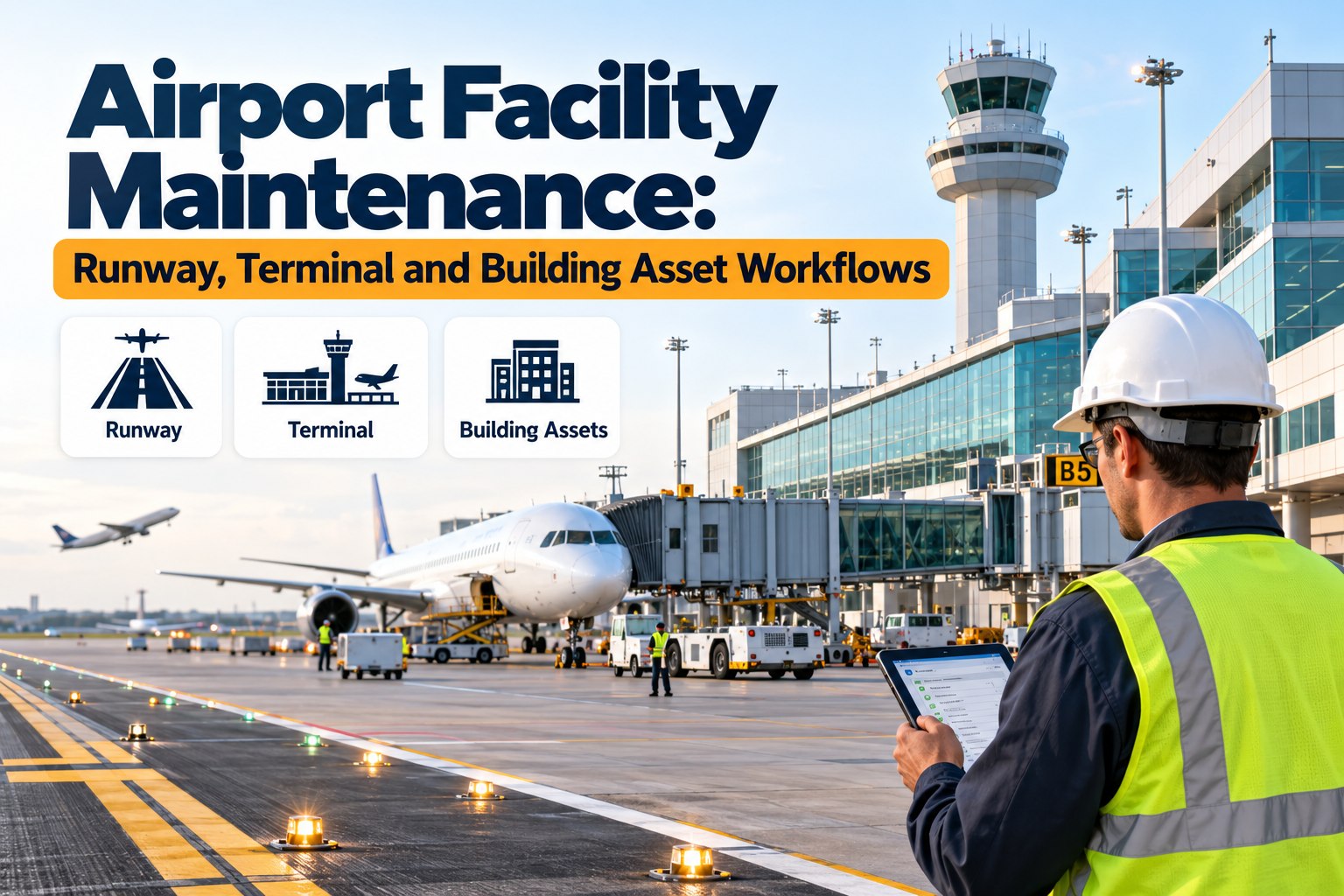
A single airport runs three maintenance operations that barely resemble each other. On the airfield, a cracked light lens means a NOTAM and an emergency crew before the next landing. In the terminal, a failing escalator is a scheduled fix squeezed into a low-traffic window around the airlines. In the back-of-house building systems, a worn pump waits for the next planned round. Same facility, same team, three completely different workflows — different clocks, different regulators, different consequences for getting it wrong. Run them all on one generic maintenance process and the airside emergency waits behind a landside routine. OxMaint AI maintenance management software gives each zone the workflow it actually needs, while keeping every asset in one connected system.
Airport Facility Maintenance: Runway, Terminal and Building Asset Workflows
A runway light, a jet bridge, and a car-park pump don't fail the same way or get fixed on the same clock — airside is NOTAM-and-now, terminal is scheduled around flights, landside runs on routine. A generic work-order flow serves none of them well. OxMaint AI routes each asset through the workflow its zone demands — priority, access window, and compliance record — so an airfield emergency never queues behind a routine repair, and every zone stays in one asset registry.
The Same Chain, Tuned Three Ways
Every zone runs the same four-step chain — inspect, flag, work order, close — but the priority, the access window, and the record requirement change completely. That's the integration. Start free and run all three workflows in OxMaint AI.
Where the Disruption Actually Comes From
Not every asset carries equal risk. A handful of failure types drive most operational disruption — and knowing the distribution tells you where the workflow has to be tightest. Book a demo to prioritize your highest-risk assets in OxMaint AI.
| Failure type | Share of disruption | Why it bites |
|---|---|---|
| Baggage system | 35% | Peak-hour penalties run to ~$120K/hr |
| Airfield lighting (AGL) | 26% | Triggers a NOTAM within 15 minutes |
| HVAC / mechanical | 16% | Terminal comfort & airside-support risk |
| Jet bridge | 8% | A down gate ripples through the schedule |
| Power / UPS | 4% | Cascades across dependent systems |
Most of it is preventable: around 72% of airfield lighting and ILS failures are avoidable through structured lamp-replacement cycles and documented PM. Start free and put those cycles on schedule in OxMaint AI.
One Generic Work Queue Makes the Runway Wait Behind the Car Park.
When every asset flows through the same undifferentiated process, a P1 airfield defect sits in the same list as a routine landside fix — and priority goes to whoever shouted. Zone-aware routing sends the airside emergency to a NOTAM-and-now flow and the landside job to the next PM window, automatically. OxMaint AI knows the difference.
The Unifying Workflow
Three zones, but one backbone — the chain every asset follows, with the zone deciding the priority and the record. This is the loop OxMaint AI runs across all of them. Start free and run the unified loop in OxMaint AI.
How OxMaint AI Runs Airport Facility Workflows
The challenge isn't any one zone — it's running three workflows on thousands of assets without letting the urgent slip behind the routine. That's what a zone-aware CMMS is for. Start free and connect every zone in OxMaint AI.
Frequently Asked Questions
Give Each Zone the Workflow It Needs — in One System.
An airport's airside, terminal, and landside run on different clocks, and the maintenance that keeps them running has to as well. Route each asset through its own zone workflow — immediate for the runway, scheduled for the terminal, routine for the building — while holding them all in one registry, and the urgent moves fast while the routine never gets dropped. OxMaint AI runs all three as one connected system.

.png)