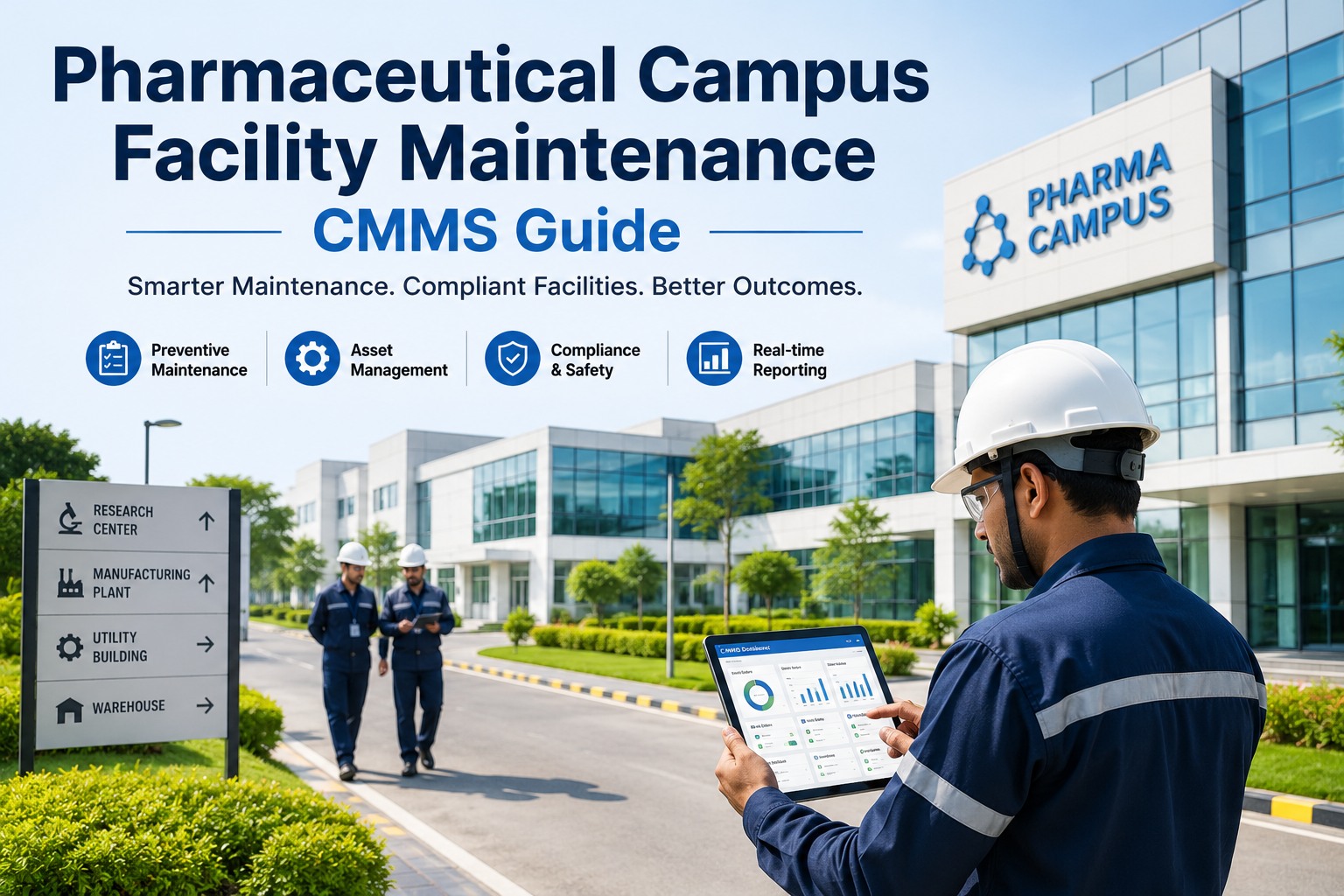
A pharmaceutical campus is not one building. It is often twenty — offices, discovery research labs, cafeterias, warehouses, fitness centers, security posts, parking structures, central utility plants, grounds and landscaping, all wrapped around the manufacturing and quality operations that pay for the property. The regulatory attention lives on the GMP side of that map: the manufacturing suites, the filling lines, the cleanrooms, the QC labs — everything covered under 21 CFR Parts 210 and 211 with validation packages, change control, and audit trails documented to a level of discipline that permeates every operational decision. But the other 60-80% of the campus square footage — the non-GMP portfolio — is where most of the facilities workforce actually spends its day. And when something breaks in that non-GMP portfolio, the impact often does not stay contained. A cafeteria hood incident can trip the shared electrical distribution that also feeds the GMP HVAC. A landscaping crew hitting a buried utility can cascade into a central plant excursion. A research lab chemical spill can trigger a site-wide emergency response that halts commercial production. This guide is for the site facilities director who needs the non-GMP program to run at the same operational discipline as the GMP program — because on a shared campus, the boundary between them is more permeable than the org chart suggests. OxMaint gives pharma campus teams the platform to manage the full portfolio with the visibility that protects the GMP operations from non-GMP failures. Book a free demo to see pharma campus FM inside OxMaint.
GMP Operations
Under 21 CFR 210/211 · Not this guide's focus
Manufacturing suites
Filling & packaging lines
API & product warehouses
Cleanrooms (ISO Class 5-8)
QC laboratories
Validation program
Change control processes
Non-GMP Portfolio
60-80% of campus square footage · This guide's focus
Office buildings
Discovery research labs
Cafeterias & food service
Fitness centers & amenities
Grounds & landscaping
Parking & roadways
Central utility plants (shared)
The boundary is administrative · the operational risk is not · every non-GMP asset that can affect a GMP outcome belongs in the same CMMS with the same maintenance discipline
60-80%
of typical pharma campus square footage falls outside the GMP boundary but supports operations that touch every regulated product
1 Platform
enterprise visibility across GMP and non-GMP portfolios prevents the cross-zone failures that halt manufacturing
2 Regimes
GMP validated PM versus non-GMP standard PM · same platform, different rigor, no data reconciliation needed
The Campus Building Portfolio — Every Type, Its Own Discipline
A single pharmaceutical campus can contain six or seven fundamentally different building types, each with its own maintenance regime, its own regulatory backdrop, and its own risk profile. Treating them uniformly under a single generic PM template leaves the highest-consequence buildings under-serviced and the lowest-consequence buildings over-inspected. The portfolio view below reflects how mature campus facilities programs actually classify their building stock — and how OxMaint stores each building with its specific PM cadence flowing from the classification.
Non-GMP Building Types · Portfolio Classification
Type A
Office & Administrative
HVAC · lighting · plumbing · IT infrastructure · fire safety · elevators
Standard commercial building PM · quarterly walk
Type B · Elevated
Discovery & Research Labs
Fume hoods · biosafety cabinets · autoclaves · lab gas · emergency shower/eyewash · chemical hygiene
Elevated cadence · annual fume hood certification
Type C
Cafeteria & Food Service
Commercial kitchen · hood suppression · walk-in cooler/freezer · grease traps · dining HVAC
Food safety + hospitality cadence overlay
Type D
Amenities & Wellness
Fitness equipment · pool/aquatics · locker rooms · showers · outdoor spaces
Recreational facility PM · daily walk-through
Type E
Grounds & Site Services
Landscaping · roadways · parking · signage · stormwater · exterior lighting · security infrastructure
Seasonal PM · storm-event response readiness
Type F · Critical
Central Utility Plant
Boilers · chillers · air compressors · water treatment · emergency generators · distribution
Elevated cadence · GMP-adjacent risk profile
Central Utility Plant — Shared Infrastructure, Shared Risk
The central utility plant is where the GMP-vs-non-GMP boundary breaks down operationally. A single boiler house, chilled water plant, compressed air network, and emergency power system typically serves both sides of the campus. When it fails, it fails for everyone. This is why utility plant PM discipline is the single highest-leverage investment in a campus facilities program — a $50,000 preventive intervention on a shared chiller can protect a $5 million commercial batch that would otherwise be lost to an environmental excursion. The Y-branch structure below reflects how central plant equipment feeds both sides of the campus.
Central Utility Plant · Serving Both Sides of the Campus
Central Utility Plant
Boilers
Chillers
Air Compressors
Water Treatment
Emergency Generators
Electrical Distribution
GMP Side
Validated Distribution
Change-controlled utility feeds · validated pressure/temp/quality · continuous monitoring · alarm integration
Non-GMP Side
Standard Distribution
Office HVAC · lab utilities · cafeteria services · amenities · grounds irrigation · standard PM cadence
Every central plant asset stored in OxMaint with dual-classification tag · both sides of the campus see the same equipment condition and the same maintenance history in real time
Research Lab Safety Tier Structure
Discovery and research laboratories occupy an unusual space in the pharma campus portfolio: they are non-GMP, so they do not carry the validation obligations of commercial manufacturing — but they carry their own regulatory framework built around biosafety, chemical hygiene, and radiation safety. The tier structure below reflects the maintenance obligations that apply to each research lab classification, and OxMaint stores each lab space with its specific tier so cadence and inspection scope apply automatically.
Research Lab Safety Classifications
BSL-1
Biosafety Level 1
Minimum risk agents · standard microbiological practices · open bench work permitted
Standard HVAC · handwash sinks · sharps disposal
BSL-2
Biosafety Level 2
Moderate risk agents · biosafety cabinet required for aerosol procedures · restricted access
Annual BSC certification · autoclave PM · negative pressure verification
BSL-3
Biosafety Level 3
Indigenous or exotic agents with airborne transmission · controlled access · specialized ventilation
HEPA-filtered exhaust · directional airflow · specialized certifications
CHP
Chemical Hygiene Plan
29 CFR 1910.1450 compliance · fume hoods · chemical storage · SDS management · MOC controls
Annual fume hood cert · face velocity test · emergency equipment PM
RAD
Radiation Use Area
NRC-licensed use of radioactive materials · shielded storage · monitored badging · waste tracking
Radiation Safety Officer coordination · specialized service contracts
EWS
Emergency Wash Stations
ANSI Z358.1 · eyewash and safety shower within 10 seconds of hazard · weekly activation test
Weekly flush · annual thermal test · tepid water verification
One Platform Across Every Building, Every Tier
OxMaint stores each campus building with its specific classification · applies the correct PM cadence per tier · and gives site leadership enterprise visibility across GMP-adjacent and standard portfolios in one operational view.
The Cross-Zone Impact Chain — Why Non-GMP Discipline Matters
The strongest business case for running non-GMP maintenance at high discipline is not compliance — it is the cross-zone impact chain. The scenarios below reflect actual patterns where a non-GMP failure cascaded into a GMP consequence. Every scenario is preventable through PM discipline that OxMaint operationalizes automatically. Site leadership that has not walked through this chain typically underinvests in the non-GMP portfolio — until the day one of these scenarios happens on their watch.
Cross-Zone Failure Scenarios · Non-GMP → GMP Consequence
Non-GMP Origin
Cafeteria hood grease fire trips electrical distribution
GMP Consequence
Shared power feed drops · GMP HVAC pressure loss · cleanroom classification excursion · batch disposition
Non-GMP Origin
Landscaping crew strikes buried utility line
GMP Consequence
Compressed air or water supply interrupted · manufacturing line shutdown · production schedule impact
Non-GMP Origin
Research lab chemical spill triggers site alarm
GMP Consequence
Site-wide evacuation halts filling operations · half-completed batches disposition · deviation investigation
Non-GMP Origin
Central plant chiller loses charge over the season
GMP Consequence
Chilled water supply temp drifts · cleanroom cooling insufficient · humidity excursion · product quality risk
Non-GMP Origin
Office building fire alarm fails routine test
GMP Consequence
Site emergency management posture degraded · insurance carrier flags full-site coverage · corrective action across GMP program
Every scenario preventable · every prevention captured in a single OxMaint work order · the cost of the platform is a rounding error against one prevented batch loss
Executive Perspective · The Full-Campus Operational View
Every site facilities director eventually has the same realization: the org chart says GMP and non-GMP are separate programs, but the campus does not read the org chart. The steam plant does not know which side of the boundary it serves. The electrical distribution does not know which downstream load is validated and which is standard commercial. The landscaping contractor digging near the property line does not know they are 40 feet from a fiber run that carries the entire QC data network. Once you have lived through even one incident where a non-GMP failure caused a GMP consequence, the answer becomes obvious: the two programs need to be one operational program, run in the same system, with visibility that spans the entire campus. That does not mean applying GMP rigor to grounds maintenance — that would waste budget and demoralize the team. It means applying the correct rigor per asset per zone, but under one platform where site leadership sees the full picture and where a work order created on the non-GMP side is instantly visible to the GMP leadership if it touches shared infrastructure. That single-platform visibility is what separates modern pharma campus operations from the fragmented programs of the last decade.
One Enterprise View
OxMaint holds both GMP and non-GMP portfolios in a single asset tree · leadership sees the full campus in one operational picture.
Right Rigor Per Zone
Validated PM cadence on GMP assets · standard commercial PM on office and amenities · one platform applying the right rigor per classification.
Cross-Zone Alerts
Non-GMP work orders touching shared infrastructure automatically flag GMP stakeholders · cross-zone incidents get caught before they cascade.
Run Your Full Campus From One Platform
If your GMP program lives in one system, your non-GMP portfolio lives in spreadsheets and paper logs, and your central utility plant lives in a third tool, you are carrying preventable cross-zone risk into every operating hour. See what OxMaint — a maintenance management platform built for enterprise pharma campus operations — looks like against your site.
Frequently Asked Questions
What is the difference between GMP and non-GMP facility management?
GMP facility management operates under 21 CFR Parts 210 and 211 with validated PM procedures, formal change control, and audit-ready documentation of every intervention. Non-GMP FM covers the remainder of the campus — offices, discovery research labs, cafeterias, grounds, amenities, and the central utility plant — under standard commercial building maintenance practice. OxMaint holds both portfolios in one asset tree with the correct rigor applied per classification, so cross-zone visibility exists without over-servicing standard assets.
Why does non-GMP maintenance matter to GMP operations?
Because the campus does not respect the administrative boundary. A cafeteria fire can trip shared power. A landscaping strike can sever a utility feed. A research lab spill can trigger site-wide evacuation. A central plant excursion can propagate directly into cleanroom classification. Every cross-zone scenario carries real GMP consequences — batch loss, deviation investigations, insurance impact. Running non-GMP at proper discipline is one of the highest-leverage risk mitigations available to site leadership.
How should a pharma campus classify its buildings for maintenance?
By type and risk profile: Type A office and administrative; Type B discovery and research labs (elevated cadence); Type C cafeteria and food service; Type D amenities and wellness; Type E grounds and site services; Type F central utility plant (GMP-adjacent, elevated cadence). Each classification drives its specific PM template, inspection frequency, and technician competency requirement. OxMaint stores each building with its classification so the correct discipline applies automatically without manual reassignment.
What regulations apply to research labs on a pharma campus?
Research labs operate under a distinct regulatory framework from GMP manufacturing — including OSHA 29 CFR 1910.1450 (Chemical Hygiene Plan) for chemical handling, CDC/NIH biosafety guidelines for BSL-1/2/3 classifications, NRC licensing for radioactive materials, ANSI Z358.1 for emergency wash stations, and applicable state and local codes for laboratory ventilation. OxMaint holds each lab space with its specific classification and applies the required maintenance and inspection cadences per applicable standard.
Should central utility plant assets be treated as GMP or non-GMP?
Central utility plant assets that feed GMP operations are treated with GMP-adjacent rigor — elevated PM cadence, formal change control on modifications, and validated performance parameters. Even assets that primarily serve non-GMP loads carry elevated cadence when they share infrastructure with GMP feeds. The utility plant is the single highest-leverage investment in pharma campus reliability because failures cascade to both sides of the campus simultaneously.
Can OxMaint manage both GMP and non-GMP assets in the same platform?
Yes. OxMaint stores GMP and non-GMP assets in a single enterprise asset tree with classification-driven PM cadence, validation status flags on GMP assets, and cross-zone alerts when non-GMP work orders touch shared infrastructure. GMP-specific fields (validation state, change control reference, calibration status) apply only to assets tagged GMP. Non-GMP assets run standard commercial PM. Site facilities leadership sees the full campus in one operational view without reconciling data across separate systems.


.png)
