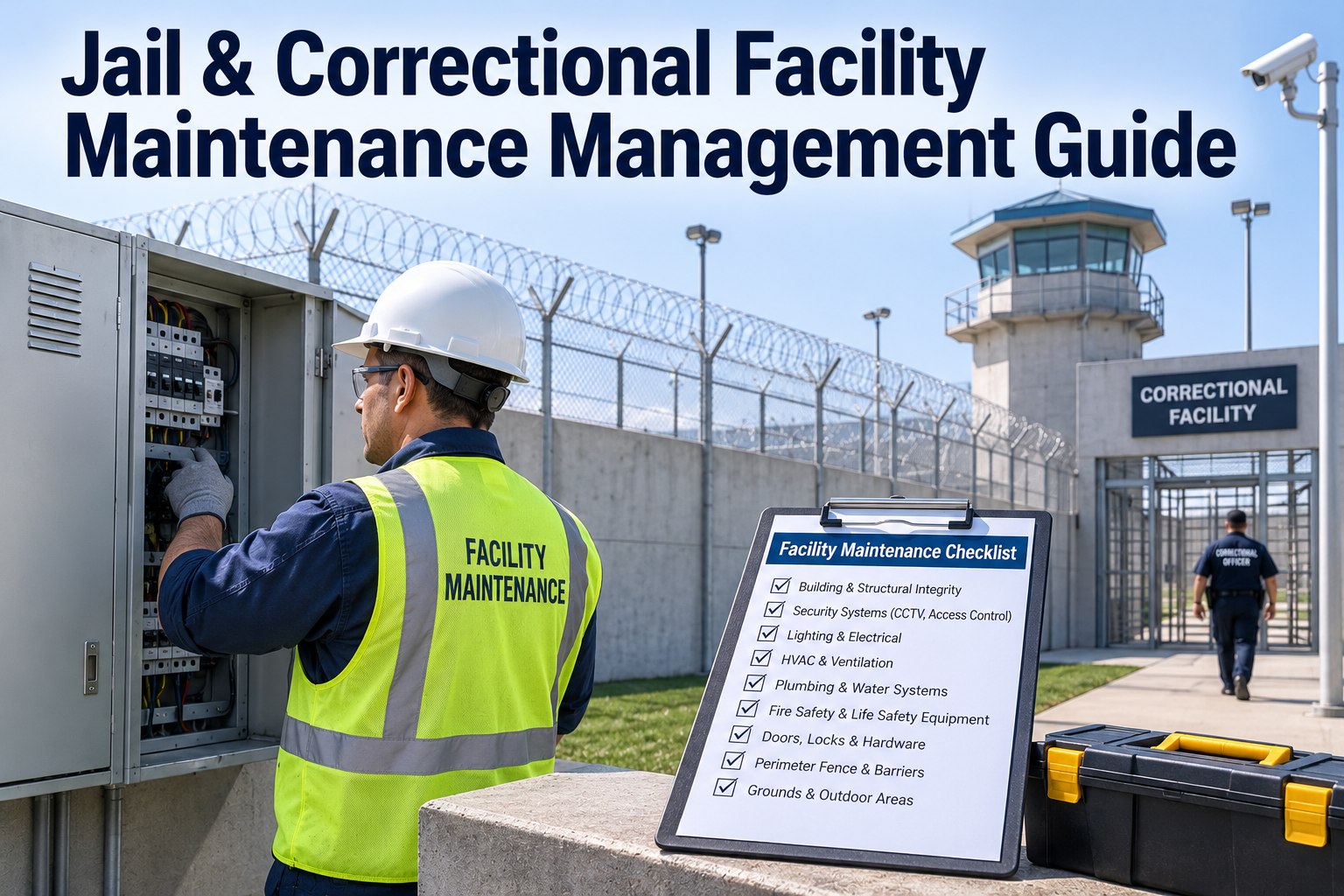
Correctional facility maintenance is a high-stakes discipline where a single failed cell-door interlock, dark perimeter floodlight, or untested emergency generator can trigger a security incident, inmate harm, or a DOJ or ACA compliance citation. Jail and prison maintenance teams operate under strict security protocols, restricted-access workflows, and life-safety mandates that generic CMMS platforms and spreadsheet tracking simply cannot handle. OxMaint is an AI-powered correctional CMMS built to keep every work order, PM, and inspection defensible—managing security-critical assets, ACA-aligned documentation, and perimeter infrastructure at the compliance standard the sector demands. You can explore the platform with a Start Free Trial or schedule a guided walkthrough with our team.
Correctional Facility Maintenance Management
Can your facility prove every PM, cell-door check, and generator test is audit-ready?
Jails and prisons lose defensible compliance documentation when maintenance runs on clipboards and siloed spreadsheets. OxMaint structures every restricted-access work order, life-safety inspection, and preventive maintenance task to meet DOJ, ACA, and state DOC standards.
What Makes Jail Maintenance Different
Correctional facility maintenance is not standard facility management
A medium-sized county jail typically manages 1,200 to 2,500 assets behind controlled-access perimeters—from electrified fence lines and sally-port door interlocks to HVAC systems serving 24/7 occupied housing pods. Every work order carries security constraints: tool check-in/check-out logs, inmate movement freezes, and two-officer escort requirements for tradespeople entering housing units. A commercial CMMS that ignores these realities creates blind spots that can lead to equipment failure, security breaches, or failed inspections.
Critical Asset Categories
Security-critical assets that correctional CMMS must track
Prison infrastructure maintenance divides into four asset categories, each with distinct compliance drivers and failure consequences. A purpose-built jail maintenance system must tag, schedule, and document PMs across all four simultaneously.
Perimeter & Physical Security
Electrified fences, perimeter intrusion detection, sally-port interlocks, surveillance camera power feeds, and exterior lighting. Failure = escape risk.
Cell Door & Locking Systems
Pneumatic and electric cell-door actuators, manual override mechanisms, control-panel electronics. PM intervals typically 30 to 90 days.
Life Safety & Fire Suppression
Smoke detectors, sprinkler valves, fire alarms, emergency lighting, and exit signage. Subject to NFPA and local fire marshal mandates.
Emergency Power & HVAC
Standby generators, ATS switches, fuel-polishing systems, and housing-unit ventilation. ACA requires weekly generator tests and monthly load-bank runs.
How OxMaint Helps
How OxMaint structures correctional facility work orders & PM compliance
OxMaint replaces paper logs and disconnected spreadsheets with a centralized, audit-grade CMMS that maps directly to the way correctional operations teams actually work—inside secure perimeters, under escort, and under regulator scrutiny.
Restricted-Access Work Orders
Tag every work order with housing-unit, security clearance, tool-checkout list, and escort requirements. Technicians see the security protocol before the task opens—reducing escort delays by up to 40%.
ACA-Aligned PM Scheduling
Automated preventive maintenance for cell-door cycles, generator load tests, and fire-suppression inspections on the exact intervals ACA auditors expect. Never miss a 30-day or annual cycle again.
Audit-Ready Documentation
Every completed work order captures technician identity, timestamp, parts used, and a digital signature—exportable to a DOJ or ACA auditor's binder in one click. Cuts audit prep from weeks to hours.
Predictive Failure Alerts
AI-driven analytics on equipment runtime, vibration, and temperature data flag impending failures on generators, HVAC, and door actuators 2 to 4 weeks before breakdown—preventing security-critical outages.
Reactive vs. Proactive
Spreadsheets vs. a purpose-built correctional CMMS
A county detention center running 1,800 assets on spreadsheets and paper logs typically spends 35% of maintenance hours on admin, misses 12 to 18 preventive maintenance tasks per quarter, and faces 3 to 5 days of audit prep per cycle. Here is how the status quo compares to OxMaint.
| Capability | Spreadsheets & Paper Logs | OxMaint Correctional CMMS |
|---|---|---|
| PM Schedule Visibility | Manual calendar reminders; 15–20% missed tasks | Automated, asset-linked PM calendar with missed-task escalation |
| Security Protocol Tagging | Not captured; verbal briefings only | Escort level, tool list, and clearance attached to every work order |
| Audit Documentation | Days of manual binder assembly; gaps common | One-click compliance export with full chain-of-custody |
| Emergency Generator Testing | Paper log sheets, easily misplaced | Digital test records with runtime data and fuel-level tracking |
| Downtime from Unplanned Failures | High—reactive only, 4–8 hr response | 30–50% lower via predictive failure alerts |
Worked Example
A 1,400-bed county jail cuts audit prep and unplanned downtime with OxMaint
A 1,400-bed county detention center was spending $48,000 annually on overtime for audit prep and emergency repair calls. After implementing OxMaint, they cut missed PMs from 18 per quarter to zero, reduced unplanned equipment downtime by 42%, and collapsed ACA audit prep from 5 days to 4 hours.
— Facility Maintenance Director, County Department of Corrections
See OxMaint on your facility's assets—book a 30-minute demo
Walk through a live correctional CMMS environment: restricted-access work orders, generator test logs, cell-door PM schedules, and one-click ACA audit exports.
Frequently Asked Questions
Correctional facility maintenance software: common questions
What is a correctional facility CMMS and why is it different from a standard CMMS?
A correctional CMMS is a maintenance management system designed specifically for jails, prisons, and detention centers, where every work order must account for security clearances, inmate movement, tool control, and escort protocols. Unlike a standard CMMS, it tags assets by housing unit and security level, enforces restricted-access workflows, and generates documentation aligned with ACA, DOJ, and state DOC audit requirements. Book a Demo to see how OxMaint handles these constraints.
How does OxMaint handle emergency generator testing compliance?
OxMaint automatically schedules weekly no-load generator tests and monthly load-bank tests per NFPA 110 and ACA standards, capturing runtime hours, fuel levels, and technician signatures in a digital record. If a test is missed or documentation is incomplete, the system escalates an alert to the maintenance supervisor so corrective action happens before an auditor finds the gap.
Can OxMaint track cell door and locking system preventive maintenance?
Yes. OxMaint treats every cell-door actuator, manual override, and control panel as a tracked asset with its own PM schedule, typically set at 30, 60, or 90-day intervals depending on manufacturer specs and facility policy. Each completed PM logs the technician, cycle count, parts replaced, and a digital verification—creating a defensible record that the locking system was maintained on schedule.
How long does it take to switch from spreadsheets to OxMaint?
Most correctional facilities are live on OxMaint within 2 to 4 weeks. The platform imports your existing asset list, PM schedules, and compliance requirements during onboarding, and our team configures security clearances, housing-unit tagging, and audit-report templates so your first inspection cycle runs on the new system. You can start the process with a Start Free Trial today.
Does OxMaint support ACA and DOC audit documentation requirements?
Yes. OxMaint generates compliance reports mapped to ACA standards and state DOC requirements, pulling from the same work-order and PM data your team uses daily. Auditors receive a timestamped, signature-backed export for each asset category—fire suppression, emergency power, perimeter security, and life safety—without your team spending days assembling binders manually.
Make every PM, inspection, and work order audit-ready
Join correctional facilities using OxMaint to cut unplanned downtime 30 to 50%, eliminate missed PMs, and pass ACA audits without overtime. Get started in minutes—no credit card required.
Free 14-day trial · No credit card


.png)
