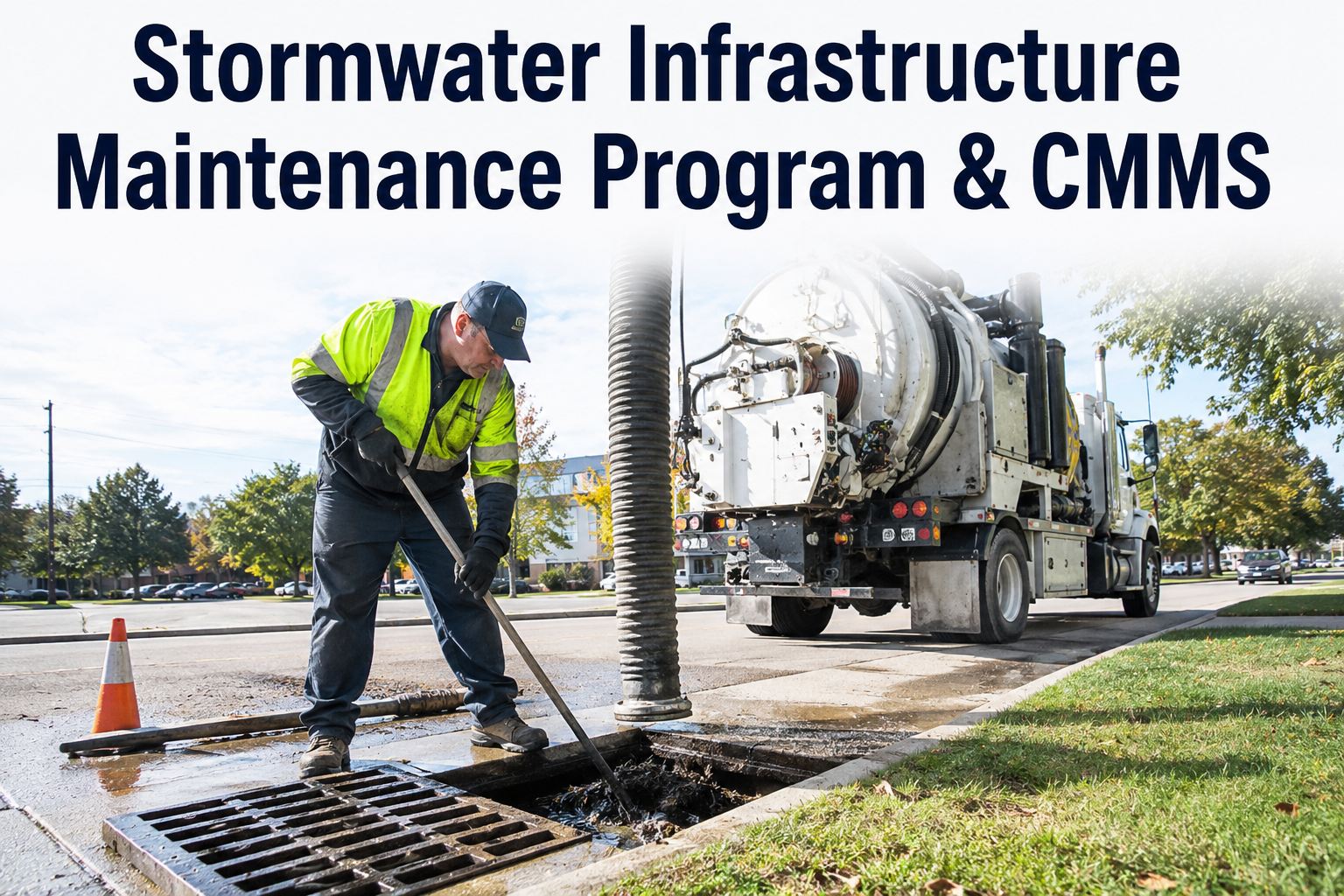
A single clogged catch basin at the corner of Elm and 3rd Street can turn a heavy Tuesday afternoon rain into a $250,000 flooding claim from the property owner whose basement fills with contaminated stormwater. Multiply that risk across the 4,000 catch basins, 60 miles of storm pipe, 12 detention ponds, and 40 outfalls that a mid-sized municipal stormwater system typically owns — and the operational stakes of stormwater infrastructure maintenance become clear. This is not a nice-to-have utility function. It is a regulated program under the federal Clean Water Act, enforced through the NPDES MS4 permit each of the roughly 7,250 permitted MS4 systems in the United States operates under, with civil penalties up to $25,000 per violation per day, mandatory electronic annual reporting, and a public accountability profile that shows up directly on the town council agenda after every significant flood event. This guide walks through the water's actual journey through a municipal system, the six mandatory Minimum Control Measures every MS4 permit requires, the catch basin cleaning cadence tied to sediment loading, the risk-based prioritization matrix that turns a limited maintenance budget into maximum flood-risk reduction, and the enforcement escalation ladder that follows compliance failure. OxMaint gives public works directors the platform that operationalizes every one of these functions as a single audit-ready system. Book a free demo to see stormwater infrastructure management inside OxMaint.
01
Street & Impervious Surface
Runoff origin · picks up sediment, oil, salt, litter
Street sweeping program
02
Curb Inlet & Catch Basin
First capture point · sediment sump · debris grate
Annual cleaning cycle
03
Storm Sewer Pipe
Underground conveyance · gravity flow · manhole access
CCTV inspection cycle
04
Detention & Retention Pond
Flow attenuation · pollutant settling · pre-discharge storage
Sediment removal · vegetation
05
Outfall to Receiving Water
Discharge point · monitored for illicit discharge · erosion risk
Outfall reconnaissance
Every asset in the journey stored in OxMaint with GIS location, inspection history, and PM cadence · the operational baseline for MS4 compliance
~7,250
permitted MS4 systems nationwide operating under NPDES MS4 permits · every one required to satisfy the same six control measures
$25K/day
civil penalty per violation under the Clean Water Act · MS4 compliance failure is enforcement-active
Electronic
MS4 annual report submission required nationwide as of December 21, 2025 · paper submission no longer accepted
The Six MS4 Minimum Control Measures
Every MS4 permit — Phase I large system or Phase II general permit — requires the operator to develop and implement a Stormwater Management Program (SWMP) built around six mandatory Minimum Control Measures. Each MCM has its own permit-specified goals, its own documentation requirements, and its own inspection cadence. Missing any one of them during an EPA or state permit review generates a compliance finding that the MS4 must respond to formally, in writing, on a defined schedule. OxMaint structures the SWMP work plan around the six MCMs so program status against each one is visible continuously — not reconstructed annually.
The Six Minimum Control Measures · Every MS4 Must Address All Six
MCM 1
Public Education & Outreach
Community-facing awareness · web content · flyers · school presentations · resident actions
MCM 2
Public Participation & Involvement
Public comment periods · stakeholder input · volunteer programs · notice compliance
MCM 3
Illicit Discharge Detection & Elimination
Outfall reconnaissance · dry-weather flow investigation · illegal dumping response · storm sewer map
MCM 4
Construction Site Runoff Control
Sites disturbing ≥1 acre · erosion & sediment controls · site inspection · enforcement authority
MCM 5
Post-Construction Stormwater Management
Long-term BMP maintenance · development review · low-impact design · retention standards
MCM 6
Pollution Prevention · Good Housekeeping
DPW yards · salt storage · fleet washing · road maintenance · winter salt management
Catch Basin Sediment Loading — Why Timing Matters
A catch basin does its job by collecting sediment, debris, and trash before that material reaches downstream pipes and receiving waters. But the collection is finite — sediment accumulates in the sump over months, gradually reducing storage volume and eventually overwhelming the outlet pipe. Left long enough, the basin overflows during heavy rain, allowing the trapped pollutants back into the system and creating the exact flooding risk the basin was installed to prevent. The five gauge readings below reflect the typical progression across a 12-month cleaning cycle in a moderate-loading urban environment — with the intervention trigger at 50% capacity and the overflow risk zone above 80%.
Catch Basin Sediment Loading Over 12 Months
5%
Month 0
Post-clean baseline
25%
Month 3
Normal accumulation
50%
Month 6
Cleaning trigger
75%
Month 9
Reduced capacity
95%
Month 12
Overflow risk
50% cleaning trigger
80% overflow risk zone
High-loading basins (commercial corridors, construction proximity, tree canopy) require semi-annual or quarterly cleaning · OxMaint sets the cadence per basin, not per city
The Risk-Based Inspection Priority Matrix
No municipal stormwater program has the budget to inspect every asset at every cadence. The stormwater departments that consistently pass MS4 audits and keep flood claims low use a formal risk-based prioritization framework — plotting each asset on a two-axis matrix of probability of failure versus consequence of failure. High-consequence assets in flood-prone zones get elevated inspection cadence even when their condition looks fine. Low-consequence assets in low-traffic areas can operate on extended intervals. The matrix below is the operational lens through which mature MS4 programs allocate their limited maintenance capacity.
Risk-Based Inspection Prioritization Matrix
Consequence of Failure
Plan Ahead
Low probability · high consequence · elevated cadence despite good condition · flood-critical locations
Immediate Priority
High probability · high consequence · top of the capital budget list · daily monitoring during storm events
Routine Monitor
Low probability · low consequence · standard cadence · minimal capital investment
Batch Address
High probability · low consequence · address efficiently through routine sweeps · low unit priority
Probability of Failure
OxMaint stores each asset with its criticality tier · inspection cadence, escalation triggers, and capital planning flow from a single classification
Run Your MS4 Program From One Platform
OxMaint captures every catch basin, storm pipe, detention pond, and outfall as a GIS-linked asset · schedules inspection at the correct risk-based cadence · and generates the electronic annual report EPA and state regulators now require. See it live against your system.
The Enforcement Escalation Ladder — What Happens If Compliance Slips
Municipal stormwater compliance is enforcement-active regulation. The federal Clean Water Act gives EPA and authorized state agencies real tools when an MS4 fails to meet its permit obligations — and those tools escalate rapidly. The escalation ladder below reflects how compliance failures actually progress, and why the plants that consistently pass MS4 audits treat documentation as continuous operational discipline rather than annual report preparation. Every level of the ladder is more expensive than the level above it — and the entry cost of the top level makes robust CMMS-driven compliance operations look like the bargain they are.
MS4 Enforcement Escalation · Increasing Consequence
Level 1
Compliance Assistance / Warning Letter
Deficiencies noted · written response and corrective action plan required within 30-60 days
Level 2
Notice of Violation (NOV)
Formal finding of non-compliance · specific corrective actions on defined timeline · public record
Level 3
Administrative Consent Order
Legally binding agreement with agency · milestone-driven compliance schedule · penalties for missed deadlines
Level 4
Civil Penalty Assessment
Up to $25,000 per violation per day · calculated across duration of non-compliance · significant municipal budget impact
Level 5
Federal Court Action
DOJ referral · injunctive relief · citizen suit exposure · reputational and political consequences
Every escalation level makes the following level more likely · the cost of the top level dwarfs the cost of continuous compliance operations by orders of magnitude
Expert Perspective · The Stormwater Program That Never Makes the News
Public works stormwater programs live in a peculiar space of visibility. When the program is working perfectly, no one notices. When it fails — a flooded basement, an illicit discharge into the creek that a resident photographs, a Clean Water Act enforcement action that hits the local paper — every failure becomes an evening council meeting. The programs that consistently stay off the news are not the ones with the biggest budgets. They are the ones running every catch basin, every pipe segment, every detention pond, every outfall as a tracked asset with a documented inspection history, a defined maintenance cadence, and a risk-based prioritization that focuses limited resources where they matter most. When we moved to a CMMS-driven operation, the change was not just efficiency. It was accountability. Every asset had a name. Every inspection had a date. Every deficiency had a corrective action. Every annual report wrote itself from the operational data. The MS4 audit that used to take three weeks of manual preparation now takes a report export. That is what a mature municipal stormwater program looks like.
Every Asset Has a Name
OxMaint stores every catch basin, pipe segment, pond, and outfall as a GIS-linked asset with full history · the operational baseline for MS4 compliance.
Risk Drives the Cadence
Inspection frequency scales with consequence-of-failure · limited budget concentrated where flood risk actually lives.
Annual Report Writes Itself
Electronic MS4 annual report generated from operational data · not reconstructed from spreadsheets and paper logs.
Make Your Next MS4 Audit a Report Export
If your stormwater program still runs on paper logs, disconnected inspection sheets, and annual report scrambles, your enforcement exposure is higher than it needs to be and your team is doing weeks of reconstruction work that a CMMS eliminates. See what OxMaint — a maintenance management platform built for municipal stormwater compliance — looks like against your system.
Frequently Asked Questions
What is an MS4 and why does it require a permit?
An MS4 is a Municipal Separate Storm Sewer System — a collection of catch basins, curbs, gutters, ditches, storm drains, detention ponds, and outfalls owned by a municipality that captures stormwater runoff and discharges it directly to local rivers, lakes, or coastal waters without treatment. Under Section 402(p) of the Clean Water Act, MS4 operators must obtain an NPDES permit from EPA or the state authority. Roughly 7,250 MS4 systems nationwide operate under these permits.
What are the six Minimum Control Measures every MS4 must address?
MCM 1: Public Education and Outreach; MCM 2: Public Participation and Involvement; MCM 3: Illicit Discharge Detection and Elimination (IDDE); MCM 4: Construction Site Stormwater Runoff Control for sites disturbing ≥1 acre; MCM 5: Post-Construction Stormwater Management for developed areas; MCM 6: Pollution Prevention/Good Housekeeping for municipal operations including DPW yards, salt storage, and fleet operations. Every MS4 permit requires demonstrated implementation of all six.
How often should catch basins be cleaned?
Cleaning cadence should be set per-basin based on sediment loading rate. Baseline urban catch basins typically need annual cleaning to stay ahead of the 50% sump capacity threshold. High-loading basins — commercial corridors, areas with heavy tree canopy, sites near construction — need semi-annual or quarterly cleaning. Loading above 80% creates overflow risk during heavy rain events. OxMaint schedules cleaning per basin, not per city.
What are the penalties for MS4 permit violations?
Civil penalties under the Clean Water Act reach up to $25,000 per violation per day. Enforcement typically escalates through five levels: warning letter, notice of violation, administrative consent order, civil penalty assessment, and federal court action. Each level carries increasing legal and public exposure. As of December 21, 2025, all MS4 annual reports must be submitted electronically — paper submissions no longer satisfy the reporting obligation.
What documentation does MS4 compliance require?
A written Stormwater Management Program (SWMP), annual reports on progress against all six MCMs, storm sewer system maps with outfall inventory, catch basin cleaning records, pipe inspection results, detention pond inspection and sediment removal records, illicit discharge investigation reports, construction site inspection logs, and post-construction BMP maintenance records. OxMaint captures every category as a byproduct of routine operations.
How does risk-based prioritization improve stormwater program efficiency?
By plotting each asset on a two-axis matrix of probability of failure versus consequence of failure, the program focuses limited maintenance and inspection budget on assets where a failure would cause the highest impact. High-consequence assets in flood-prone zones get elevated cadence even when condition looks fine. Low-consequence assets in low-impact areas operate on extended intervals. This approach delivers materially better flood-risk reduction per maintenance dollar than uniform cadence programs.


.png)