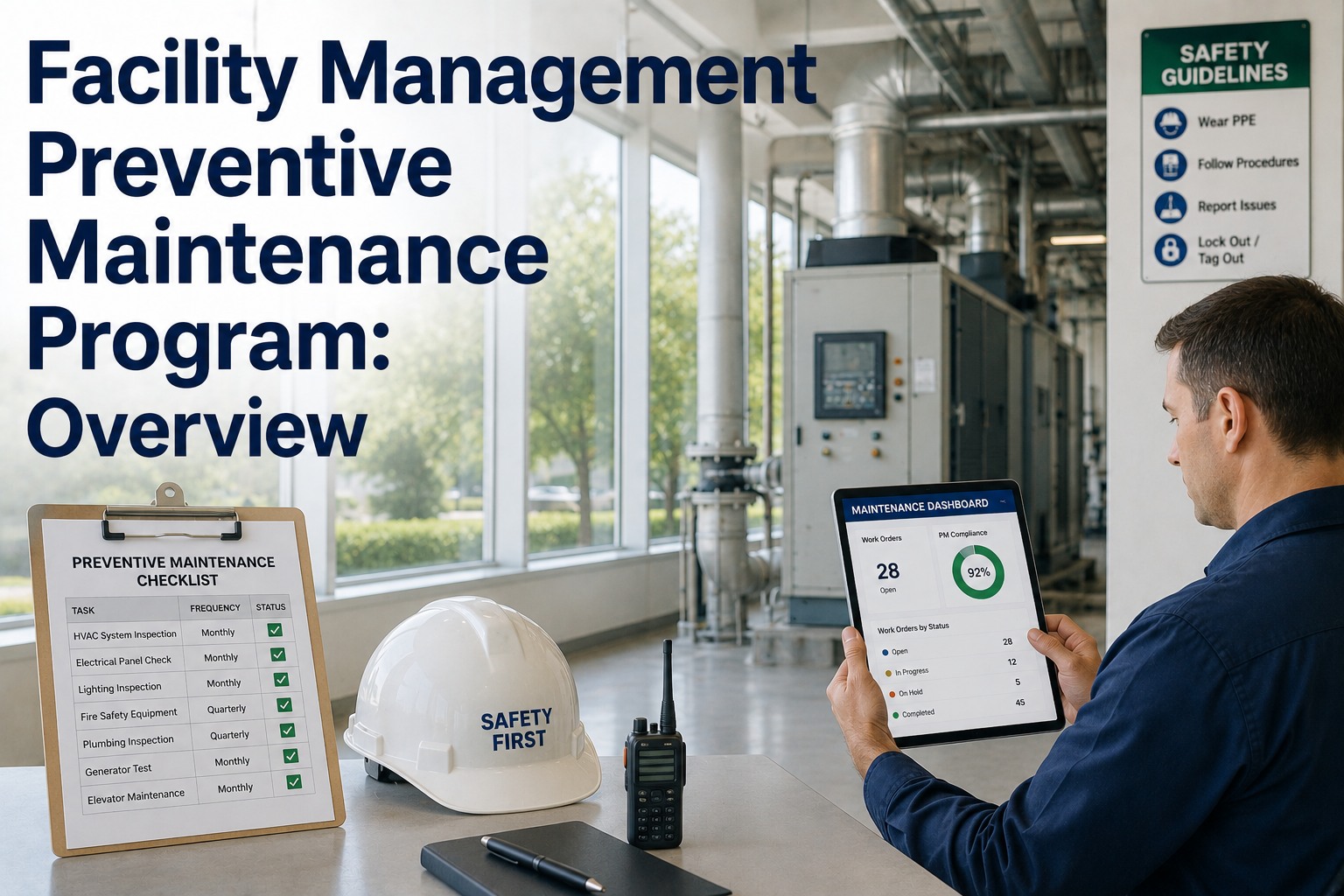
A facility management preventive maintenance program is a structured, repeatable schedule of inspections, servicing and part replacements that keeps building systems — HVAC, electrical, plumbing, fire safety and critical assets — running before failures happen, and the template below gives US maintenance teams every checkpoint, interval and threshold needed to run one. Programs built on memory or photocopied paper forms miss steps, and missed steps become missed failures that turn into unplanned downtime, OSHA citations and emergency repair bills that run 3–5x the cost of planned work. This guide lays out the complete facility management preventive maintenance program template: mechanical checks, electrical readings, lubrication points, wear indicators, safety verifications and the calibration or replacement thresholds that decide whether an asset stays in service. OxMaint's CMMS turns this checklist into a living program — auto-generated PM work orders on the right interval, mobile execution with mandatory photo proof, e-signatures on completion and a full audit-ready history logged against every asset. Start Free Trial and digitize your first PM schedule in under an hour.
What does an audit-ready facility PM program actually look like?
It is not a binder of paper checklists or a spreadsheet nobody updates. It is a standardized, measurable system where every inspection point is assigned, executed with photo proof, signed electronically and logged against the asset — so when OSHA, BOMA or your insurance auditor asks for records, you pull them in 30 seconds instead of 3 days.
Facility Management Preventive Maintenance Program Template: The 6 Core Inspection Tiers
A defensible facility PM program covers six inspection tiers across every visit. Each tier below lists the checkpoints your technicians must touch — skip any of them and you create a gap that becomes a breakdown, a compliance citation or a safety incident.
Mechanical Systems
- HVAC belt tension & wear inspection
- Bearing vibration & temperature readings
- Pump seal leakage & alignment check
- Compressor oil level & pressure test
- Valve operation & packing condition
Electrical Systems
- Panel thermal imaging for hot spots
- Voltage & amperage readings on motors
- Breaker trip test & torque verification
- UPS battery load & impedance test
- Ground fault & GFCI outlet testing
Lubrication & Fluids
- Grease points per OEM spec & interval
- Oil analysis sampling (viscosity, metals)
- Coolant level, pH & concentration check
- Hydraulic fluid condition & filter delta-P
- Lubricant storage & contamination audit
Safety & Compliance
- Fire extinguisher pressure & tag date
- Emergency lighting & exit sign function
- Machine guard & interlock verification
- Lockout/tagout procedure walkthrough
- OSHA 300 log cross-reference check
Wear & Condition Indicators
- Belt crack, fray & glazing inspection
- Filter differential pressure reading
- Brake pad / lining thickness measurement
- Chain stretch & sprocket tooth wear
- Insulation resistance (megger) test
Calibration & Replacement Thresholds
- Pressure gauge calibration vs. master
- Thermostat / sensor drift verification
- Filter replacement at OEM hour limit
- Belt replacement at wear-indicator mark
- Battery replacement at 80% capacity
How Often Should Each Facility PM Task Run? Interval & Compliance Table
Interval discipline is where most facility PM programs break down — tasks set too infrequently miss failures, tasks set too often waste labor hours. This table gives defensible starting intervals aligned with OSHA, NFPA and BOMA best practices; adjust based on asset criticality, runtime hours and manufacturer specs.
| PM Task | Interval | Standard / Reference | Compliance Risk if Missed |
|---|---|---|---|
| HVAC filter replacement | Monthly – Quarterly | ASHRAE 52.2 / OEM spec | IAQ complaints, 15% energy waste |
| Fire extinguisher inspection | Monthly visual / Annual cert | NFPA 10 / OSHA 1910.157 | OSHA citation up to $16,131/violation |
| Emergency lighting test | Monthly 30-sec / Annual 90-min | NFPA 101 / OSHA 1910.37 | Life-safety citation, liability exposure |
| Electrical panel thermal scan | Quarterly – Semi-annual | NFPA 70B recommended practice | Arc flash, fire, unplanned outage |
| Backflow preventer test | Annual | Local plumbing code / EPA | Water contamination, code violation |
| Elevator safety inspection | Annual + 5-yr full load | ASME A17.1 / state code | Shutdown order, liability, fines |
| Roof & gutter inspection | Semi-annual (spring/fall) | BOMA preventive guide | Water intrusion, structural damage |
| Generator load-bank test | Annual (2-hr min) | NFPA 110 Level 1/2 | Backup power failure in outage |
What Reactive Facility Maintenance Actually Costs You
Facilities running reactive maintenance spend an average of 3–5x more per repair than those on a structured PM program — and that multiplier does not include downtime, tenant complaints, OSHA penalties or shortened asset life. Here is the math on a real scenario.
A 120,000 sq ft commercial facility with 85 tracked assets (HVAC units, pumps, electrical panels, fire systems, elevators) runs reactive maintenance at $68,000/year in emergency repairs, overtime and expedited parts. After implementing a structured PM program through OxMaint — auto-scheduled work orders, mobile checklists with photo proof, and threshold-based alerts — the same facility cuts emergency spend to $24,000/year, a 65% reduction. Add avoided downtime (estimated $18,000/yr in tenant disruption and productivity loss) and one avoided OSHA citation ($16,131), and the first-year payback exceeds $60,000 against a software cost under $6,000.
See OxMaint run this exact PM program on your assets
Book a 30-minute demo and we will walk you through auto-scheduled PM work orders, mobile checklists with photo capture and audit-ready reporting — configured for your facility type.
Turn This Template Into a Running Program With OxMaint
A template on paper is a starting point — OxMaint turns it into a system that assigns, tracks, verifies and reports every PM task automatically. Four capabilities map directly to the gaps that kill facility PM programs.
Auto-Generated PM Work Orders
Set the interval once — daily, weekly, monthly, quarterly, annual or meter-based — and OxMaint generates and assigns the work order automatically. No calendar reminders, no missed cycles. Facilities report 95%+ PM completion rates within 60 days of switching from manual scheduling.
Mobile Checklists With Photo Proof
Technicians execute every checklist on their phone with mandatory fields, photo capture and pass/fail readings. No paper forms to lose, no illegible handwriting, no skipped steps. Every completed PM is timestamped, geo-tagged and stored against the asset record permanently.
E-Signatures & Audit-Ready Records
Every completed PM captures a digital signature from the technician and supervisor. When OSHA, BOMA or your insurance auditor requests maintenance records, you export a complete, timestamped history in seconds — not days of digging through filing cabinets and email threads.
PM Compliance Analytics & Alerts
Dashboards show PM completion rate, overdue tasks, cost per asset and mean time between failures — so you can prove program value to leadership and catch compliance gaps before an auditor does. Threshold alerts flag assets approaching calibration or replacement limits automatically.
How to Launch a Facility PM Program in 30 Days
Most facilities can go from zero to a running PM program in 30 days. This timeline assumes you are starting from spreadsheets or paper — if you already have asset records in a legacy CMMS, the migration is even faster.
Asset Registry & Criticality Ranking
Walk the facility and log every maintainable asset into OxMaint — HVAC units, pumps, panels, fire systems, elevators, plumbing fixtures. Tag each with a criticality score (A/B/C) based on safety impact, downtime cost and replacement lead time. This becomes your PM master list.
Build PM Templates & Set Intervals
Use the six-tier checklist above to build digital PM templates inside OxMaint for each asset class. Assign intervals based on the compliance table, OEM specs and your criticality ranking. Load calibration and replacement thresholds so the system alerts you before limits are hit.
Train Technicians & Go Mobile
Roll out the OxMaint mobile app to your maintenance team. Walk through 2–3 live PM executions together so every technician is comfortable with the checklist flow, photo capture and e-signature process. Most teams are fully proficient within 3–5 work orders.
Activate Scheduling & Monitor Compliance
Turn on auto-scheduling so PM work orders generate and assign themselves on interval. Monitor the compliance dashboard daily for the first two weeks to catch adoption issues. By day 30 you have a running, measurable, audit-ready facility preventive maintenance program.
Facility Preventive Maintenance Program FAQs
What is a facility management preventive maintenance program?
A facility management preventive maintenance program is a documented, scheduled system of inspections, servicing and part replacements performed on building assets — HVAC, electrical, plumbing, fire safety and structural systems — before failures occur. It replaces reactive "fix it when it breaks" maintenance with planned work that extends asset life, reduces emergency repair costs by 25–30% and keeps the facility compliant with OSHA, NFPA and local code requirements.
What should a facility PM checklist include?
A complete facility PM checklist covers six tiers: mechanical systems (belts, bearings, pumps), electrical systems (panels, breakers, batteries), lubrication and fluids, safety and compliance items (fire extinguishers, emergency lighting, LOTO), wear and condition indicators, and calibration or replacement thresholds. Each item needs a defined interval, a pass/fail criterion and a responsible technician. OxMaint digitizes all six tiers with mandatory fields and photo capture — Start Free Trial to build yours.
How often should facility preventive maintenance be performed?
Intervals depend on the asset and its regulatory requirements. HVAC filters typically need monthly-to-quarterly replacement, fire extinguishers require monthly visual checks and annual certification per NFPA 10, emergency lighting needs monthly 30-second and annual 90-minute tests per NFPA 101, and electrical panels should get thermal scans quarterly to semi-annually per NFPA 70B. Always cross-reference OEM specifications and adjust for asset criticality and runtime hours.
How much does a facility PM program cost vs. reactive maintenance?
Reactive maintenance costs 3–5x more per repair than planned preventive work when you factor in emergency labor rates, expedited parts, downtime and secondary damage. A mid-size facility spending $68,000/year on reactive repairs can typically cut that to $24,000/year with a structured PM program — a payback that dwarfs the cost of CMMS software. Book a Demo and we will model the ROI for your specific facility.
How do I prove PM compliance during an OSHA or BOMA audit?
You need timestamped, signed records showing every PM task was completed on schedule, by whom, with what result. Paper logs and spreadsheets are difficult to verify and easy to challenge. OxMaint stores every completed PM with photo evidence, e-signatures and asset-linked history — you can export a complete audit trail for any asset or date range in under 30 seconds, which is exactly what OSHA inspectors and BOMA auditors expect to see.
Stop running your facility on memory and paper
OxMaint turns this facility management preventive maintenance program template into a running, measurable, audit-ready system — auto-scheduled work orders, mobile checklists, photo proof and compliance analytics included.




.png)