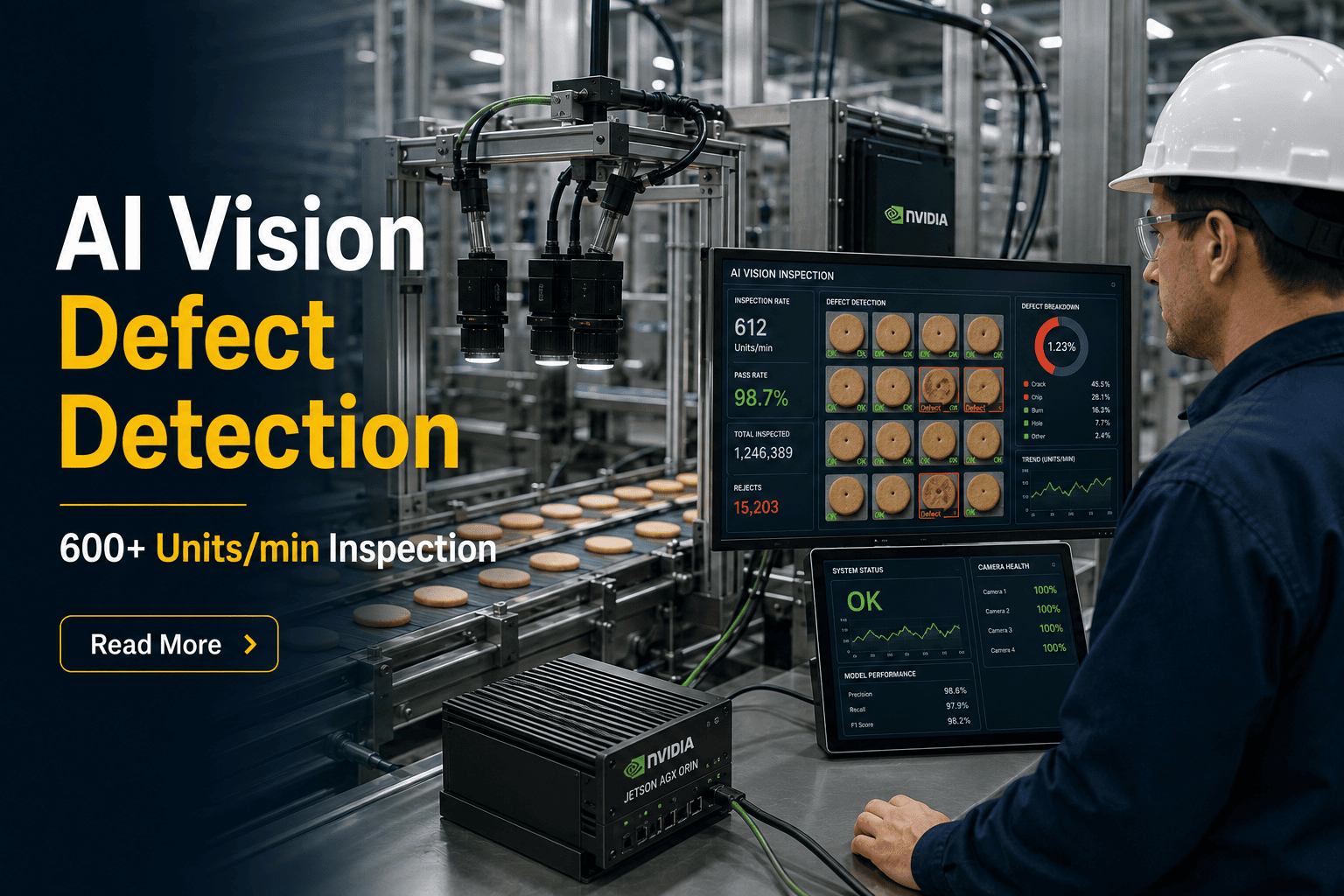
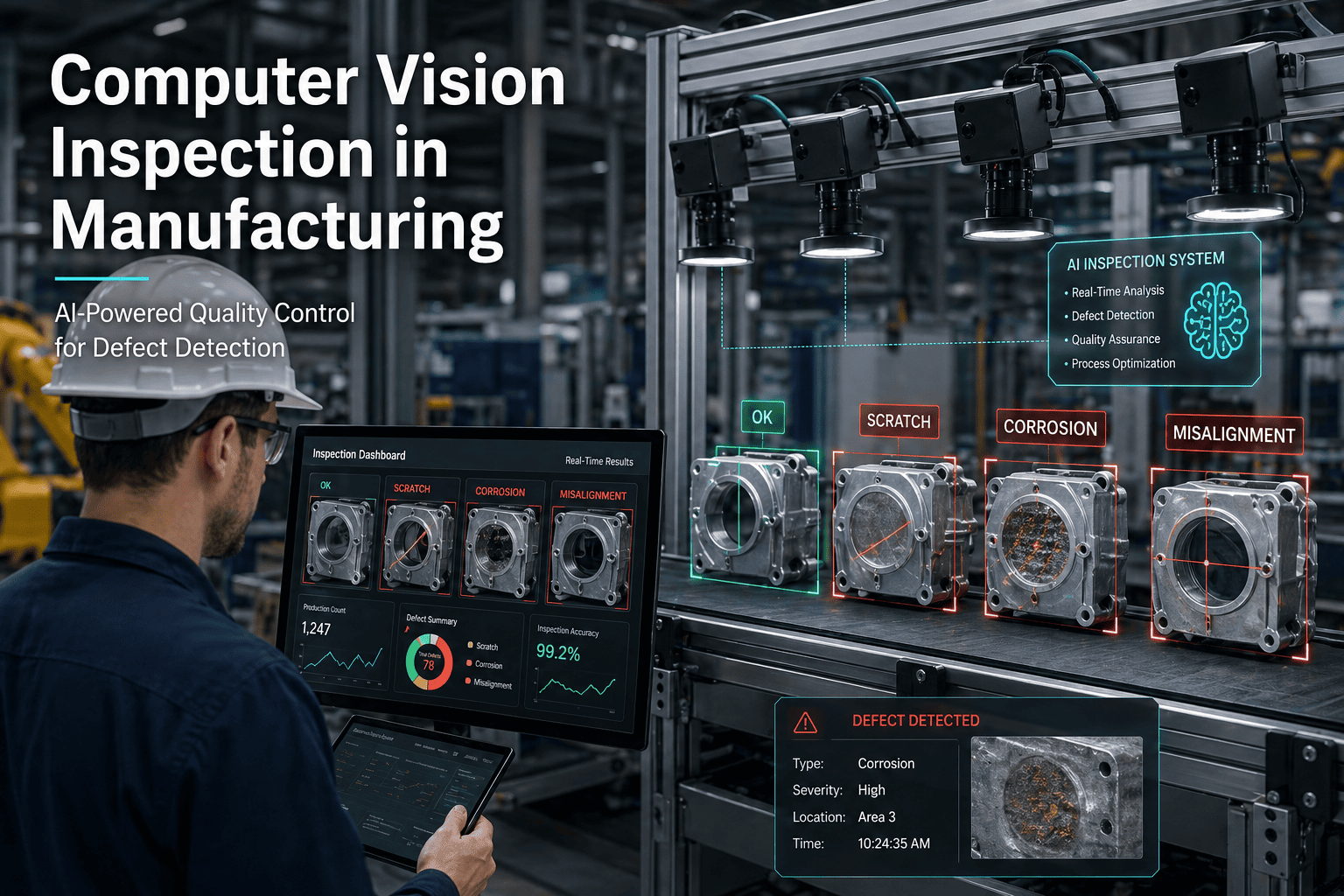
An electronics manufacturer produces 12,000 circuit boards per shift. A human inspector examines each board at the end of the line — 2 to 3 boards per minute, flagging visible solder defects, misaligned components, and surface scratches. By hour six, fatigue reduces detection accuracy by 30%. A hairline crack in a capacitor joint passes inspection. Then another. Then forty more. Three weeks later, the customer reports field failures. The recall costs $1.8 million. The defect that caused it was 0.3 millimetres wide. An AI-powered computer vision system inspects the same boards at 200 per minute with greater than 99% detection accuracy — 24 hours a day, with zero fatigue. It catches the 0.3mm crack on board number one. The line adjusts. Zero defective boards ship. This is not a future scenario. This is AI anomaly detection in manufacturing in 2026. The global defect detection market reached $3.3 billion in 2024 and is projected to hit $6.6 billion by 2034. Companies still relying on manual inspection lose nearly 20% of annual revenue to the cost of poor quality. The technology to eliminate that loss exists now. Book a demo to see how Oxmaint's AI-powered CMMS connects quality data to maintenance intelligence — from $8 per user per month.
UPCOMING OXMAINT EVENT
AI-Powered Predictive Maintenance: Eliminate Unplanned Downtime in Manufacturing
Join Oxmaint's expert-led session covering how AI anomaly detection connects quality signals to maintenance execution — preventing both equipment failures and product defects in a single unified workflow.
Of total sales revenue lost to the cost of poor quality in manufacturing — most of it hidden beneath visible scrap costs
99%+
Defect detection accuracy achieved by AI computer vision — vs 70–80% for fatigued human inspectors on long shifts
90%
Reduction in defect rates achievable through automated AI visual inspection — with 50%+ throughput improvement
$6.6B
Projected global defect detection market by 2034 — doubled from $3.3B in 2024 as manufacturers adopt AI quality systems
THE HIDDEN COST PROBLEM
The Cost of Poor Quality Iceberg: What You See vs What You Pay
Most manufacturers calculate quality cost by counting the scrap bin. That number is typically 2–3% of revenue. The real cost — including rework labour, lost machine capacity, warranty claims, expedited shipping, engineering firefighting time, and customer trust erosion — is 10× higher. AI anomaly detection attacks this iceberg at the waterline, catching defects at the source before they multiply through the production chain.
Visible Costs (What You Count)
Scrap materialRework labourFailed inspections
2–3% of revenue
Hidden Costs (What You Actually Pay)
Warranty Claims
Field failures cost 10–100× more to fix than catching defects in-plant
Lost Machine Capacity
Every defective unit consumed production time that could have made a good part
Engineering Firefighting
Engineers solving recurring defects instead of improving products
Customer Trust Erosion
Reduced orders, cancelled contracts, reputational damage that compounds over years
Expedited Shipping
Rush replacements to avoid penalties and retain customer relationships
Regulatory Exposure
Recalls, compliance failures, and legal liability from defects that reach the field
15–20% of revenue
HOW AI SEES WHAT HUMANS MISS
4 Layers of AI Anomaly Detection in Manufacturing
Zero-defect manufacturing in 2026 uses multiple AI techniques layered together — each catching different types of anomalies at different stages of production. No single method is sufficient. The combination creates a detection net that achieves greater than 99% accuracy across visual, sensor, and process data.
01
Computer Vision Inspection
What it detects
Surface scratches, cracks, misaligned components, dimensional errors, colour inconsistencies, missing parts — at 200+ items per minute with sub-millimetre precision.
CNNs • Deep Learning • High-res Cameras
02
Sensor Anomaly Detection
What it detects
Vibration signature changes, temperature drifts, pressure fluctuations, acoustic anomalies — the process deviations that cause defects before they appear visually.
Time-Series ML • IoT Sensors • Edge AI
03
Statistical Process Control + AI
What it detects
Process drift beyond control limits, batch-to-batch variation, slow-moving parameter shifts that traditional SPC misses because the change happens gradually.
Adaptive Thresholds • Multivariate SPC • ML
04
Cross-Signal Correlation
What it detects
Patterns that only appear when multiple data streams are analysed together — a bearing vibration + temperature rise + quality dip that individually look normal but together signal impending failure.
Multi-modal AI • Data Fusion • CMMS Integration
ACCURACY COMPARISON
Human Inspection vs AI Anomaly Detection: A Direct Comparison
Metric
Human Inspector
AI System
Detection Accuracy
70–85% (degrades with fatigue)
99%+ (consistent 24/7)
Inspection Speed
2–3 items/minute
200+ items/minute
Minimum Defect Size
~0.5mm (visible range)
<0.1mm (sub-pixel detection)
Shift Consistency
30% accuracy drop after 6 hours
Zero degradation across shifts
Documentation
Manual paper records
Auto-logged with timestamps & images
Learning Ability
Training takes months
Models train on 10 samples in hours
THE MISSING CONNECTION
Why Quality and Maintenance Must Be Connected — And How Oxmaint Does It
Most defects are symptoms of maintenance problems. A clogged filter causes coating defects. A worn bearing causes dimensional drift. A miscalibrated sensor causes temperature overshoot. When quality data is disconnected from maintenance data, the same defect recurs because the root cause — the equipment — is never fixed. Oxmaint bridges this gap.
AI Detects Quality Drift
Anomaly detection flags increasing defect rate or process parameter deviation on a specific production line.
Oxmaint Correlates to Asset
CMMS overlays defect data with asset maintenance history — identifying that the machine is overdue for calibration or PM.
Work Order Auto-Generated
Oxmaint creates a prioritised maintenance work order — assigned to the right technician, with asset history and parts list attached.
Root Cause Eliminated
Equipment repaired. Quality returns to specification. The defect never recurs because the cause — not just the symptom — was fixed.
COMMON QUESTIONS
AI Anomaly Detection for Manufacturing: What Teams Ask
How does AI anomaly detection connect to a CMMS like Oxmaint?
When AI detects a quality anomaly — whether through computer vision, sensor analysis, or process monitoring — Oxmaint receives the signal and correlates it with the equipment responsible. If the anomaly maps to a machine that is overdue for maintenance, drifting out of calibration, or showing a pattern of increasing defects, Oxmaint auto-generates a prioritised work order. The technician sees exactly which asset needs attention and why. Start your free trial to see this workflow in action.
Can we achieve zero-defect manufacturing without expensive AI hardware?
Yes. The highest-impact step toward zero defects is connecting your existing quality data to maintenance execution. Most quality failures are caused by equipment issues that a well-maintained asset registry and proactive PM programme would prevent. Oxmaint starts at $8 per user per month and builds the maintenance intelligence that eliminates the root cause of most manufacturing defects — without requiring vision systems or sensor infrastructure to start.
What ROI can manufacturers expect from AI quality + maintenance integration?
Manufacturers implementing AI-driven quality systems report 90% reductions in defect rates, 5–15% yield improvements, and 10–20% reductions in scrap and rework. When connected to maintenance through a platform like Oxmaint, the ROI compounds — fewer defects mean fewer emergency repairs, and fewer equipment-driven quality escapes mean fewer warranty claims. Most teams achieve positive ROI within 6–12 months. Book a demo for a projection specific to your operation.
Every Defect That Reaches Your Customer Started as a Maintenance Problem. Fix the Root Cause. Start Today.
Oxmaint starts at $8 per user per month with AI-powered work orders, predictive scheduling, full asset intelligence, and mobile-first execution. Connect quality signals to maintenance action. Deploy in days.