AI Vision Fire and Smoke Detection for Facility Maintenance Operations

Connect with Industry Experts, Share Solutions, and Grow Together!

Join Discussion Forum
ai-vision-fire-and-smoke-detection-for-facility-maintenance-operations

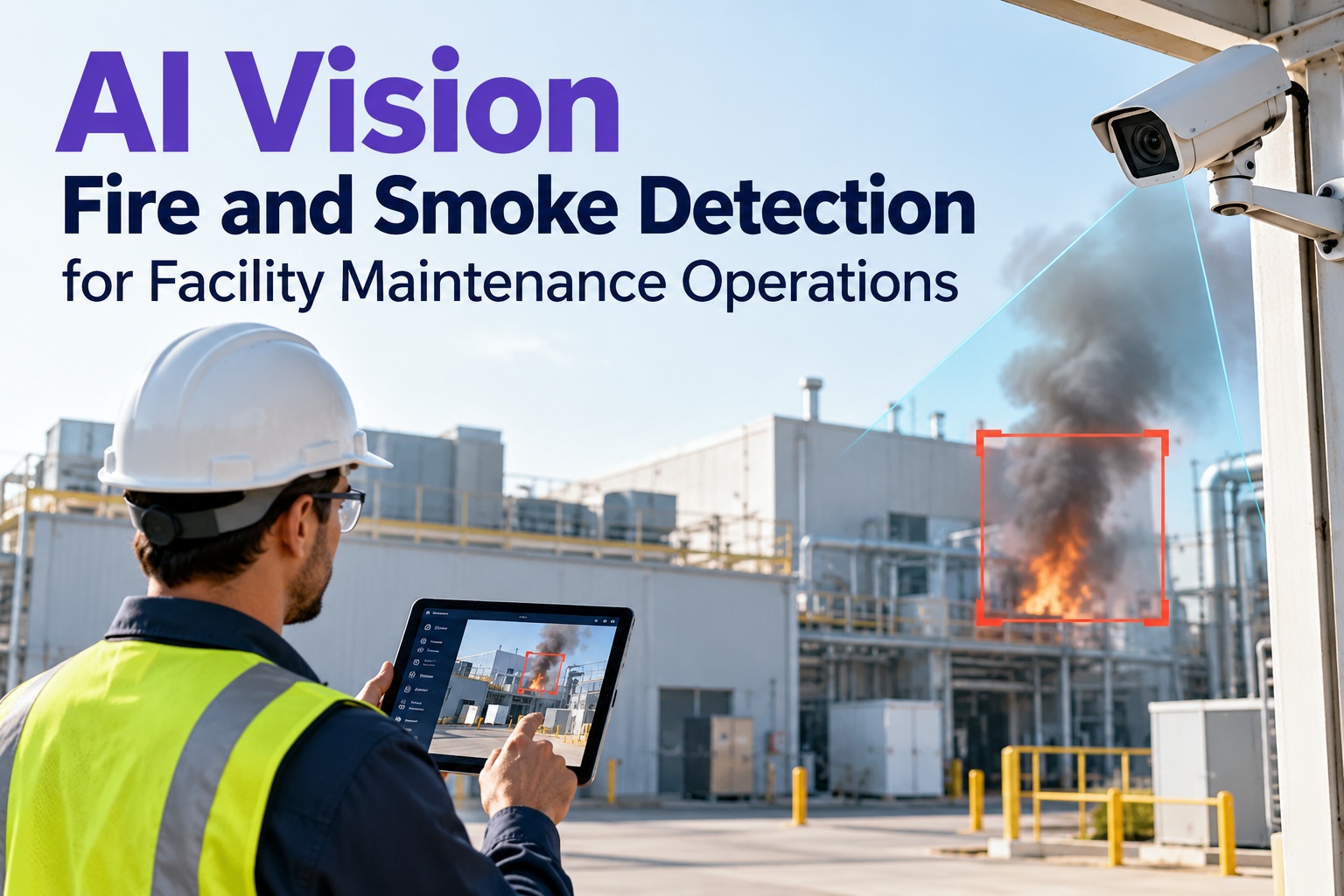
A spot smoke detector on a 12-metre warehouse ceiling waits for smoke to climb through cooler air and reach it — and in a high bay, a chemical store or an outdoor yard, that smoke can stratify and spread long before a single sensor trips. AI vision sees the first wisp in the camera frame, classifies it, and turns it into an alert and a work order in seconds. This guide shows how camera-based fire and smoke detection works as an early-warning layer for facility operations, and how OXMAINT AI, the AI-powered facility CMMS, routes every detection from camera to classified work order to closed-out inspection.

Facility Operations · AI Vision · Fire & Smoke Early Warning · 2026

AI Vision Fire and Smoke Detection for Facility Maintenance Operations

Smoke that stratifies below a high ceiling, a smoulder in an outdoor yard with no detector near it, an overheating panel nobody is watching — the gap between the first sign and the first alarm is where facilities lose time. OXMAINT AI, the AI-powered facility CMMS and maintenance management software, watches existing camera feeds, classifies a fire or smoke signature by severity, and raises an alerted, evidence-attached work order the moment it's seen.

CAMERA TO WORK ORDER
1
CaptureExisting IP / thermal feed

2
AnalyzePixel signature for smoke / flame

3
ClassifyCritical / High / Medium

4
AlertInstant mobile notification

5
Work orderEvidence attached, asset linked by zone
Seconds
from a smoke signature to a classified alert
Existing cameras
ONVIF IP, thermal and industrial feeds reused
Zone-linked
every detection tied to the right asset & location
NFPA 72
video image detection recognized in the code

Why A Camera Sees It Before A Ceiling Sensor

A conventional spot detector is a point device — it only acts once enough smoke physically reaches it. In a tall or open space, warm smoke cools as it rises, loses buoyancy and spreads sideways before it ever touches the ceiling, so the sensor stays silent while the event grows. Video image detection analyses the whole frame for the visual signatures of smoke and flame, so it responds to what the camera can see across the volume rather than waiting for particles to arrive at one spot, and you can book a demo to see vision detection in OXMAINT AI.

Spot detector alone
Point device — acts only when smoke reaches it
Defeated by thermal stratification in high bays
Hard to place in open yards and outdoor areas
No visual record of what happened
Vision layer added
Reads the whole frame for smoke / flame signatures
Sees the plume before it reaches a ceiling sensor
Covers high-ceiling, open and outdoor volumes
Captures annotated video evidence with the alert

Vision is an early-warning layer that works alongside — not instead of — the building's listed fire alarm system.

Where Vision Detection Earns Its Place

Camera-based detection is strongest exactly where traditional spot devices struggle: large, high-ceiling and open volumes, outdoor areas with no detector infrastructure, and hazardous spaces where non-contact sensing and a live video feed let a responder assess the scene before entering. It depends on maintained line-of-sight and adequate lighting, so placement and lens care become maintenance tasks in their own right, and you can start free and map camera zones in OXMAINT AI.

▲
High-Ceiling Spaces
Warehouses, atria and plant halls where smoke stratifies and cools before a ceiling detector can sense it.
▲
Outdoor & Open Yards
Storage yards, loading areas and sites with no practical place to mount conventional point detectors.
▲
Hazardous Areas
Labs, chemical stores and process areas where non-contact detection and a live feed support safe assessment.
▲
Unmanned Zones
Electrical rooms, archives and back-of-house spaces that are rarely walked but carry real ignition risk.

A Detection Is Only Useful If It Becomes An Action.

An alert on a screen that nobody owns is a missed event. Routed into the CMMS, a fire or smoke detection becomes a classified, assigned work order with the clip attached, the asset and zone identified, and an SLA clock running — so the response is tracked, not assumed.

From Frame To Fixed: The OXMAINT AI Workflow

OXMAINT AI treats a fire or smoke detection the same disciplined way it treats any AI-vision finding — capture, analyse, detect, classify, alert, act — and ties the whole chain to the asset and zone so nothing lands in an unowned inbox. The same camera layer also watches for the hazards that precede a fire, and you can book a demo to see the safety module in OXMAINT AI.

01
Severity Classification
Each detection is graded Critical, High or Medium, setting work-order priority and who gets paged first.
02
Evidence Attached
The annotated frame or clip travels with the work order, so the responder sees exactly what the camera saw.
03
Zone & Asset Link
The camera zone maps to the location and asset record, pointing the crew to the right place without a hunt.
04
Auto-Assignment & SLA
The task routes to the on-call technician with a response clock, and the timeline is logged for review.

The Hazards That Come Before The Fire

Most facility fires are preceded by a condition a camera can catch — an overheating component, a chemical spill, a blocked egress, a thermal anomaly on a panel. Feeding those into the same detection-to-work-order loop turns fire safety into preventive work rather than emergency response.

Thermal anomalies
Overheating motors, bearings and electrical panels flagged from thermal feeds before ignition.
Spills & leaks
Fluid and chemical spills identified and raised as a clean-up and inspection task.
Blocked egress
Obstructed exits and fire lanes detected so they are cleared before they matter.
PPE & zone access
Missing PPE and unauthorized entry into hazard zones surfaced for the safety record.

Standards And The Compliance Line

Video image detection for smoke and flame is recognized in NFPA 72, the National Fire Alarm and Signaling Code, which addresses it in its video image detection sections — with requirements for listed components, engineered coverage and tamper or trouble supervision. The sensible reading is that AI vision adds an early-warning and maintenance layer on top of a facility's listed, code-compliant fire alarm system, never a substitute for it. Treat camera placement, line-of-sight and lighting as supervised assets with their own PM, and keep the authority having jurisdiction in the design conversation.

NFPA 72
Recognizes video image smoke and flame detection; listed components, coverage and supervision
Listing
Use detection components that carry the appropriate listing for the application
Line-of-sight
Maintained sightlines and lighting are prerequisites — and recurring PM tasks
AHJ
Engineer coverage and keep the authority having jurisdiction in the loop

What OXMAINT AI Brings To It

The vision layer only pays off when detection, evidence and the maintenance response live in one system. OXMAINT AI connects the camera feed to work orders, assets, inspections and analytics so a detection is acted on and then trended, and you can start free and connect your cameras in OXMAINT AI.

◉
Works With Existing Cameras
ONVIF IP, thermal, industrial and USB feeds — no rip-and-replace to add a detection layer.
◉
Cloud or Edge Processing
Run analysis in the cloud or locally on-network with buffering where connectivity is constrained.
◉
Auto Work Orders
Every detection becomes a prioritized, evidence-attached work order linked to the asset by camera zone.
◉
Safety & Hazard Module
Fire and smoke sit alongside spills, PPE, egress and zone-access monitoring in one safety record.
◉
Camera Zones As Assets
Each camera and its sightline is a supervised asset with its own PM for lens care and alignment.
◉
Detection Analytics
Events trend by zone and type, turning repeat hazards into targeted preventive work.
“

Our high-bay store always made us nervous — the ceiling detectors were so far up that we knew a smoulder could spread before anything tripped. Layering vision detection on the cameras we already had, and wiring it straight into the maintenance system, changed the posture entirely: a signature now raises a graded work order with the clip attached and a technician paged, and the near-misses we used to argue about are a trended list we actually act on. It sits on top of our code fire panel, not in place of it.

Facilities & EHS Manager · Distribution Centre

Frequently Asked Questions

Does AI vision replace my fire alarm system?
No. It's an early-warning and maintenance layer that works alongside the building's listed, code-compliant fire alarm system, not a substitute for it. The value is seeing the first signature sooner in spaces where spot detectors struggle, and turning it into a tracked response. Book a demo to see how it layers in OXMAINT AI.
Why can a camera detect smoke faster in a tall space?
Because a spot detector only acts when smoke physically reaches it, and in a high or open space smoke cools and spreads sideways before touching the ceiling. Video image detection reads the whole frame for smoke and flame signatures, so it responds to what's visible across the volume rather than waiting for particles to arrive at one point.
What standard covers camera-based fire detection?
NFPA 72, the National Fire Alarm and Signaling Code, recognizes video image smoke and flame detection and sets requirements for listed components, engineered coverage and supervision. Coverage should be engineered for the site and reviewed with the authority having jurisdiction.
What are the limitations I should plan for?
Vision detection needs maintained line-of-sight and adequate lighting, professional placement and calibration, and a settling period while the system learns a scene. Treat camera sightlines, lenses and lighting as supervised assets with recurring PM so coverage doesn't quietly degrade.
What happens after the system detects something?
OXMAINT AI classifies the detection by severity, attaches the annotated frame, links it to the asset and zone, auto-assigns it to the on-call technician with an SLA clock, and logs the timeline — so the event becomes a tracked work order, and repeat hazards trend into preventive tasks. Start free and route detections in OXMAINT AI.

See The First Signature, Not The First Alarm.

Add an AI vision fire and smoke early-warning layer on the OXMAINT AI maintenance management software — detection on the cameras you already have, severity classification, evidence-attached auto work orders linked by zone, and the hazards that precede a fire folded into preventive work. Layer it on your code fire panel and turn near-misses into a list you act on.


By Willam Jerry

✨

Experience
Oxmaint's
Power

Take a personalized tour with our product expert to see how OXmaint can help you streamline your maintenance operations and minimize downtime.

Book a Tour

Share This Story, Choose Your Platform!

Connect all your field staff and maintenance teams in real time.

Report, track and coordinate repairs. Awesome for asset, equipment & asset repair management.

Schedule a demo or start your free trial right away.

iphone

Get Oxmaint App
Most Affordable Maintenance Management Software

Download Our App