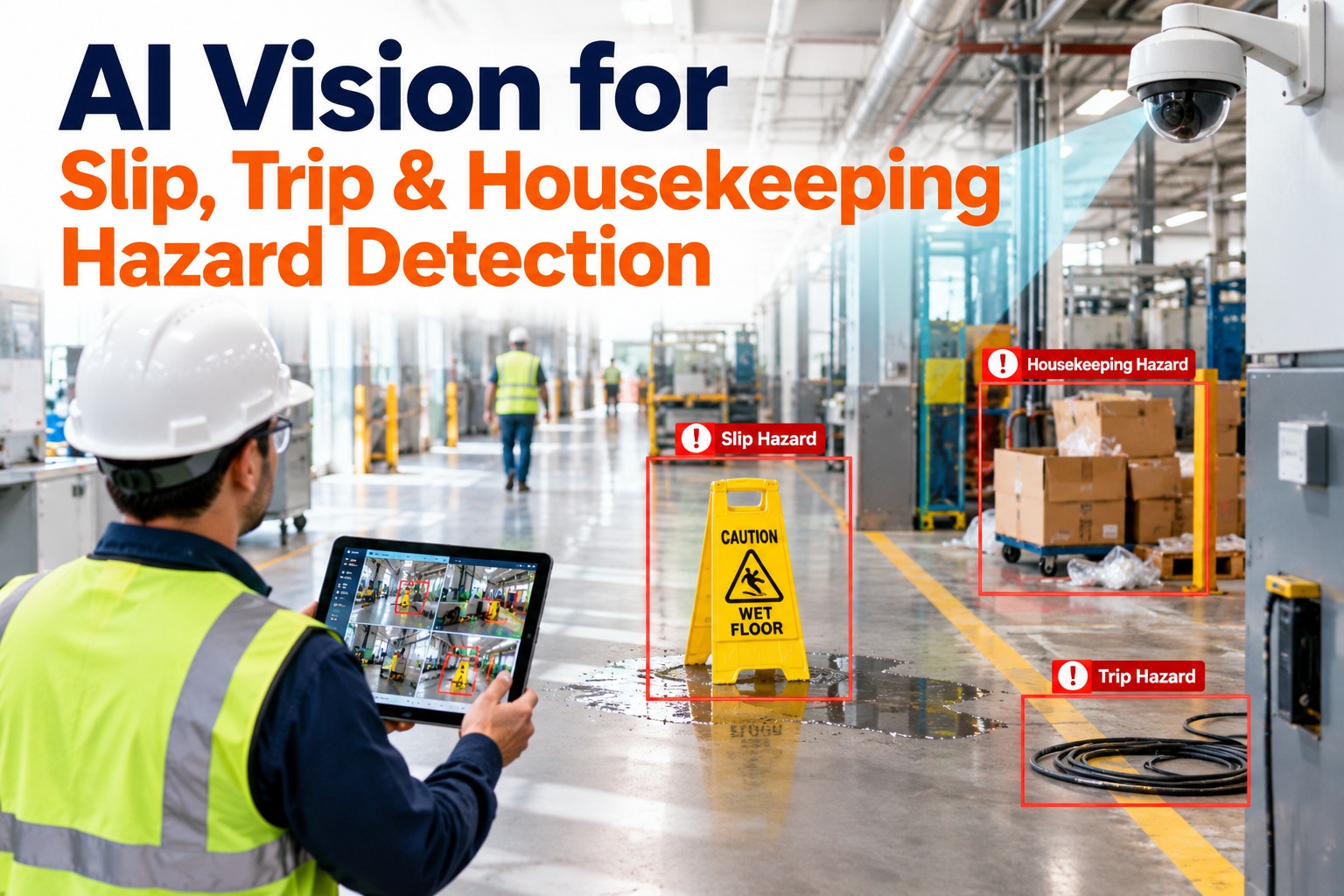
Slip, trip and fall remain the number-two source of recordable workplace injuries after sprains, and the number-one source of guest-liability claims in commercial facilities. The hazards — a wet floor two minutes after a spill, a loose extension cord in a corridor, a pallet left in a fire-exit path, a dim stairway landing — are almost always visible, and almost always visible for minutes before anyone reports them. AI vision closes that window. A camera already on the ceiling, a model trained on hazard categories, a WO raised in OXMAINT AI the moment the hazard is seen, and a janitor dispatched before the next person walks past. OXMAINT AI is the AI-powered facility maintenance software that ingests the vision model's detections, tags severity, raises the WO on the right janitorial zone and keeps the detection + response record for safety-audit and insurer review.
AI VISION · SLIP, TRIP & HOUSEKEEPING HAZARD DETECTION · 2026
AI Vision for Slip, Trip & Housekeeping Hazard Detection
Six hazard categories, four severity tiers, one live board. OXMAINT AI ingests the vision model's detections, raises the WO on the right janitorial zone and keeps the detection + response record audit-ready.
4
severity tiers · critical to log-only
< 60 s
from detection to janitorial WO
4
privacy guardrails on every pipeline
Six Hazard Categories The Model Actually Learns
An AI vision deployment that tries to detect every hazard class is a model that detects none well. Six categories cover 90%+ of recordable slip / trip events and almost all housekeeping findings. OXMAINT AI holds each as a tagged event so the WO lands with the right remediation task in the facility maintenance software.
01
Wet floor / spill
Reflective puddle, dark stain, visible liquid flow. Classic post-cleaning window and post-rain lobby pattern.
SLA: 2 min to WO · wet floor sign + mop
02
Cord / cable in walkway
Loose extension, data cable, Christmas lighting across a traffic lane. The most common 72-hour recurrence.
SLA: 5 min to WO · secure or re-route
03
Obstruction in path
Pallet, trash bag, delivery box, folded sign in corridor or fire-exit lane. Code-triggering in exit paths.
SLA: 5 min + egress check if in exit path
04
Damaged flooring
Lifted tile edge, worn carpet seam, cracked concrete, raised threshold. Chronic hazard — repair, not clean.
SLA: 1 h to WO + barricade placed
05
Poor lighting / fixture out
Dim stair landing, blown bulb in corridor, dark area at night from the sensor's history baseline.
SLA: 1 h to WO · relamp request
06
Housekeeping deficiency
Overflowing bin, piled debris, prolonged litter, missing matting. Pattern-level finding, not single-event.
SLA: next shift · housekeeping schedule check
The Detection-To-WO Pipeline — Six Stages, Under A Minute
A hazard detection is only useful if it becomes a dispatched WO quickly. The pipeline below runs end-to-end in under a minute for a typical facility — OXMAINT AI owns stages 4-6.
01
Camera frame
Existing ceiling or wall-mount camera streams to the vision model (edge or cloud); 1-5 fps for hazard class.
→
02
Inference
Object + segmentation model classifies the hazard; confidence score pinned to the bounding box.
→
03
Dwell & dedup
Alert fires only after a dwell threshold (e.g., 20 s) and dedupe window; avoids flagging a janitor's own mop.
→
04
Severity tag
OXMAINT AI tags severity by category × location × context (occupied hall, exit path).
→
05
WO + dispatch
WO auto-raised to the janitorial zone owner; mobile push to the nearest responder; thumbnail attached.
→
06
Verify & close
Responder photo of resolved area; vision model confirms clear state; WO closes with timestamp.
Four Severity Tiers — What Each One Earns
A detection without a severity tier is noise. OXMAINT AI assigns one of four tiers at ingest, each with its own SLA and notification path.
CRITICAL
Active fall-in-progress / fire-exit obstruction
Fall event detected, or an obstruction in a code-mandated egress path, or a spill in a high-traffic occupied area. Immediate dispatch + supervisor notification.
Dispatch: < 60 s · Alert chain: supervisor + safety
HIGH
Visible wet floor, cord in walkway, damaged flooring
Classic slip / trip source visible in an occupied area. Dispatch to janitorial / facilities on the next-available responder.
Dispatch: 2-5 min · Alert chain: zone janitorial
MEDIUM
Housekeeping deficiency, poor lighting zone
Lower immediate risk but recurring. Routed to next shift's zone sweep; pattern-level reporting to supervisor.
Dispatch: next shift · Alert chain: zone supervisor
LOG-ONLY
Low-confidence or short-dwell detection
Below the alert threshold but recorded for pattern analysis; model retraining signal.
Dispatch: none · Logged for pattern
Zone Hazard Heatmap — Where The Risk Really Lives
Over a quarter of detections, patterns emerge. Some zones are repeat offenders; some hours of day cluster. The heatmap below is what a facility director opens weekly — OXMAINT AI renders it from the detection log.
Zone × hour
06-10
10-14
14-18
18-22
22-06
Food court / dining
2
14
9
4
0
Loading dock corridor
7
8
4
1
0
Public restrooms
3
6
7
3
0
Garage / parking deck
1
2
1
1
2
0-4
5-8
9-12
13+ · investigate
Food court lunch cluster — housekeeping shift coverage conversation, not an AI tuning conversation
Privacy Guardrails — Four Non-Negotiables
AI vision in a facility is a privacy conversation before it is a safety conversation. These four guardrails live on every pipeline OXMAINT AI runs.
01
No face identity
Model trained for objects and surfaces, not people. Any face captured in a saved frame is blurred before storage, including in the WO thumbnail.
02
No audio
Hazard vision uses image only; audio stream not ingested. Discarded at the camera layer where possible.
03
Retention cap
Raw frames retained only as long as needed for WO verification; detection metadata (not the frame) retained for pattern analysis.
04
Signage & disclosure
Camera coverage disclosed to occupants per local jurisdiction; worker representatives consulted where applicable.
Live Hazard Detection Board — What A Safety Lead Sees
The live board shows every open detection by severity, the dispatched WO and the current response status. OXMAINT AI renders it from the detection + WO log.
AI VISION HAZARD BOARD · CAMPUS · 17:13
Loading dock corridor · CAM-07Obstruction in fire-exit path · dwell 48 sCRITICAL · dispatched 00:34
Lobby entry mat · CAM-02Wet floor detected · 92% confidenceHIGH · ETA 02:00
Dining hall S · CAM-14Spill in walkway · dwell 24 sHIGH · en route
Corridor 2-N · CAM-21Cord in walkway · detected 00:12 agoHIGH · dispatched
Stair B landing · CAM-33Light fixture out · night baselineMEDIUM · next shift
The Mop Arrives Before The Fall. That's The Whole Program.
Vision alone is a demo. Vision + a dispatched WO + a janitor on the way is the program. OXMAINT AI is the layer between the detection and the dispatch.
Program ROI — Why The Camera Pays For Itself
Slip-and-fall liability is the easiest ROI case in facility safety. The ranges below are working estimates for a mid-size commercial facility.
Avg slip-fall claim
$30-50k
Industry-average workers’ comp / guest-liability claim for a serious slip-and-fall event, before legal cost escalation.
Response-time reduction
10x
Average response time to a visible hazard typically falls from 15-30 min (walk discovery) to under 2 min (vision + dispatch).
Payback
6-18 mo
For most commercial facilities where cameras already exist. Capex is the model licensing + integration, not new hardware.
How OXMAINT AI Runs The Vision + WO Program
The vision-model ingest, severity tagging, dispatched-WO workflow, verify-and-close loop, zone heatmap and privacy guardrails all live natively in the OXMAINT AI facility maintenance software — open a free account and wire up the vision pipeline in OXMAINT AI.
Vendor-Agnostic Ingest
OXMAINT AI reads detections from major vision vendors via webhook / API; the hazard event is the unit, not the camera.
Severity Classifier
Category × location × context assigns a severity tier at ingest; CRITICAL / HIGH / MEDIUM / LOG-ONLY.
Dispatched WO
WO auto-raised to the zone janitorial / facilities owner with thumbnail, severity, SLA and mobile push.
Verify-And-Close Loop
Responder closeout photo + optional model re-check that the area is clear; WO closes with timestamp.
Zone Heatmap
Weekly / monthly matrix by zone × hour; recurring clusters surface as housekeeping schedule conversations.
Audit Record
Detection + response record retained for safety audit, OSHA review and insurer loss-prevention submission.
Frequently Asked Questions
Do we need new cameras to deploy AI hazard vision?
Almost never. Existing ceiling and corridor cameras usually meet the resolution and frame-rate requirements. The investment is in the model licensing and the integration into the WO system — where OXMAINT AI sits.
What's the false-positive rate like?
Modern hazard-vision models typically run below 5% false-positive on common classes once dwell and dedup are tuned. OXMAINT AI builds in the dwell-and-dedup gate so a janitor's own mop or a short-lived shadow does not fire a WO.
How does this interact with staff privacy?
The pipeline is tuned for objects and surfaces, not identities. Faces are blurred before any frame is stored, audio is not ingested, retention of raw frames is capped and coverage is disclosed to occupants. Worker representatives are consulted where local policy requires. OXMAINT AI enforces the guardrails on every pipeline.
What's the highest-leverage first deployment zone?
Lobby entries, food-court / cafeteria areas and public restrooms — the three places where wet-floor events cluster most predictably. First deployment typically delivers payback inside the first slip-fall event avoided.
Detect · Dispatch · Clear · Record.
Wire the vision model into the OXMAINT AI facility maintenance software — six-category tagging, four-tier severity, dispatched WO, verify-and-close loop, zone heatmap and the privacy guardrails. The mop arrives before the fall, every time.