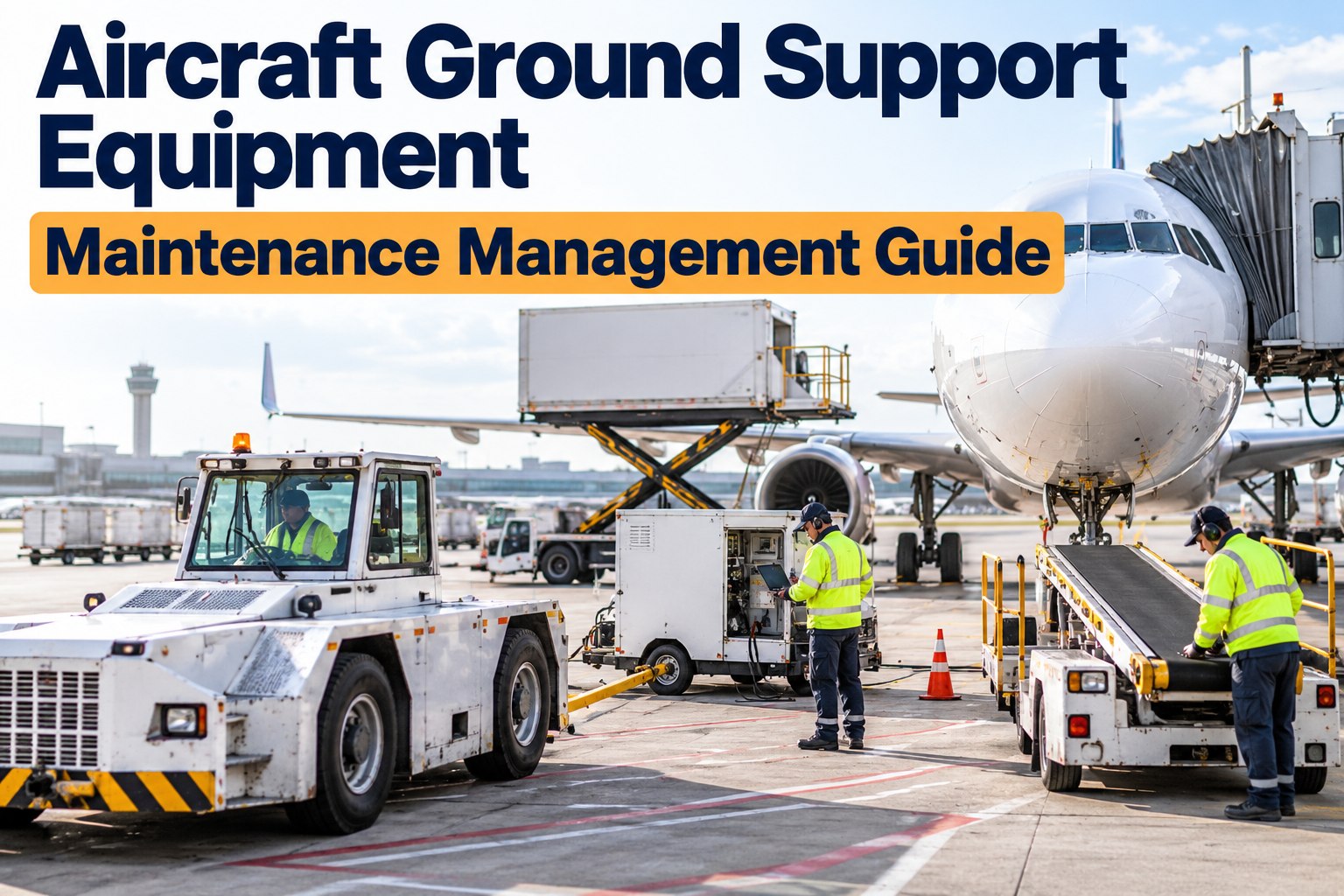
Aircraft Ground Support Equipment Maintenance Management Guide

Connect with Industry Experts, Share Solutions, and Grow Together!

Join Discussion Forum
aircraft-ground-support-equipment-maintenance-management-guide

Ground support equipment is the machinery an airport can't see past until it stops. A pushback tug that won't start, a belt loader down at the gate, a GPU that fails on a hot turn — each one ripples straight into a delayed departure. Yet GSE is one of the hardest fleets to maintain well: dozens of equipment types, brutal duty cycles, and relentless turnaround pressure that tempts crews to defer the PM and keep the unit rolling "just one more shift." Good GSE maintenance management is what keeps that fleet available without letting deferred work pile into failures. This guide lays out how to run it and how OXMAINT AI, the AI-powered CMMS, turns inspections into scheduled work orders across the whole fleet.

Airport & Aviation · Ground Support Equipment · Maintenance Management

Aircraft Ground Support Equipment Maintenance Management Guide

Turnaround pressure pushes GSE maintenance to "later" — until a tug or loader fails at the gate and the delay is yours. OXMAINT AI keeps the fleet ahead of it: every unit on one asset register with its criticality, PM schedules that auto-generate, and pre-shift inspection findings that become tracked work orders before a failure hits the ramp.

Mixed fleet
many equipment types, each with its own PM needs
Turnaround
gate pressure that pushes maintenance to "later"
Availability
the metric that matters — a down unit is a delayed flight
Finding → WO
pre-shift checks that become tracked work, not notes

The Fleet You Have to Keep Running

GSE isn't one machine — it's a mixed fleet of specialized units, each on its own duty cycle and PM regime. Managing it well starts with treating every type as its own asset class with its own schedule, not lumping "the equipment" together.

Start free and register every GSE type in OXMAINT AI.

Tugs & Pushback
Tractors and towbarless units — engine, transmission, hydraulics and safety systems under heavy load.
Belt Loaders
Conveyor, drive and lift systems cycling constantly through every bag load.
Ground Power (GPU)
400 Hz power units — engine or solid-state, critical on every turn without a jet bridge.
Air & Air-Con Units
Air start and pre-conditioned air carts — compressors, refrigerant and hoses.
Container Loaders
High-lift platforms and rollers — hydraulics, structure and controls on wide-body turns.
De-icing Rigs
Seasonal, safety-critical — booms, fluid systems, heaters and spray controls.
Water & Lav Carts
Potable water and lavatory service units — pumps, tanks and sanitation systems.
Stairs & Steps
Passenger and maintenance stairs — structure, brakes, tires and safety rails.

The Real Enemy: Turnaround Pressure

The core tension in GSE maintenance is time. A tight turn wants every unit available now, so a due PM gets pushed and a small squawk gets ignored — until it becomes the failure that strands an aircraft. Managing GSE is really about keeping maintenance ahead of that pressure.

Book a demo to keep PM ahead of the turn in OXMAINT AI.

RUN-IT-TILL-IT-BREAKS
Where Availability Erodes
  • PMs deferred to keep units on the gate
  • Squawks noted verbally, then forgotten
  • No fleet view of what's due or overdue
  • Failures happen mid-turn, at the worst moment
  • Parts not staged because nothing's planned
MANAGED IN OXMAINT AI
Where Availability Holds
  • PM schedules per unit, tracked and enforced
  • Every squawk logged as a work order on the asset
  • Live view of due, overdue and down across the fleet
  • Repairs planned into low-demand windows
  • Parts staged against upcoming scheduled work

The Five Pillars of GSE Maintenance Management

A GSE program that holds up under ramp pressure rests on five connected pillars — each feeding the next, and all living in one system rather than scattered across whiteboards and radios.

Sign up free and build these pillars in OXMAINT AI.

1
Fleet Register & Criticality
Every unit recorded with type, hours/cycles and a criticality rank — a GPU on a remote stand outranks a spare stair.
↓
2
PM Scheduling
Time- and usage-based PMs per equipment type, auto-generated so nothing is skipped under gate pressure.
↓
3
Inspection to Work Order
Pre-shift and periodic checks that turn a squawk into a tracked, assigned work order on the spot.
↓
4
Parts & Inventory
Work orders linked to parts, so common GSE spares are staged against planned work instead of chased mid-repair.
↓
5
Reliability Data
Closed work orders build the history that shows which units and failure modes drive downtime — so you fix causes.

A Squawk on the Radio Is a Failure Waiting for the Worst Moment.

The check caught it; only a work order fixes it. OXMAINT AI turns every pre-shift squawk into a tracked, prioritized work order on the unit — so it gets handled in a window, not mid-turn at the gate.

From Pre-Shift Check to Work Order

The daily rhythm of GSE maintenance is the pre-shift inspection. Here's how one finding moves through OXMAINT AI — from the operator's walkaround to a closed work order on the unit.

Book a demo to see this on your own GSE checks.

Check

Operator runs the pre-shift walkaround on a digital checklist tied to that unit — the same points every time.
Squawk

A defect is raised against the unit — low hydraulic level, a worn tire, a fault code — with a photo, on the spot.
Prioritize

Severity and criticality rank it — a safety or critical-unit issue takes the unit out of service; minor items are scheduled.
Assign

A work order goes to the GSE shop — with the checklist, history and parts, planned into a low-demand window where possible.
Close

Completed and logged against the unit — building the reliability history that sharpens the next PM interval.

Common GSE Failure Points & PM Focus

SystemCommon failure pointsPM focus
Powertrain Engine, transmission, batteries, charging Fluids, filters, battery health, fault-code checks
Hydraulics Leaks, cylinders, hoses, pump wear Fluid level & condition, leak checks, hose inspection
Lift & Conveyor Belts, rollers, chains, lift mechanisms Belt/chain tension, lubrication, wear inspection
Tires & Brakes Wear, pressure, brake fade Pressure & tread checks, brake testing
Electrical Connectors, output quality, controls Connection integrity, output verification, control checks
Safety Systems Interlocks, lights, guards, e-stops Function tests every inspection cycle

Exact failure points and PM intervals depend on the equipment type, manufacturer and duty cycle — always follow the OEM's maintenance schedule and your operator's procedures. Configure per-type schedules in your CMMS so each unit gets the right tasks at the right time.

Frequently Asked Questions

What makes GSE maintenance harder than other fleets?
The mix and the pressure — dozens of equipment types each with their own PM needs, run under constant turnaround urgency that tempts crews to defer maintenance. Managing it means keeping PM ahead of that pressure across every type. Start free and manage the mixed fleet in OXMAINT AI.
How do you stop turnaround pressure from killing PM?
Auto-generate PM schedules per unit, make due and overdue visible across the fleet, and plan repairs into low-demand windows — so maintenance is scheduled work, not a decision made under gate pressure. Book a demo of fleet-wide PM scheduling.
Should GSE units be prioritized differently?
Yes — by criticality. A GPU serving a remote stand or a de-icer in season outranks a spare unit, so its PM and repairs take priority. Recording criticality on each asset routes attention where a failure hurts most. Sign up free and rank your fleet by criticality in OXMAINT AI.
What's the role of the pre-shift inspection?
It's the daily catch point — a consistent walkaround that surfaces squawks before a unit goes to the gate. The value comes when each finding becomes a tracked work order instead of a verbal note that's forgotten. Book a demo of inspection-to-work-order.
How does a CMMS improve GSE availability?
By putting the whole fleet on one system — schedules that hold, squawks that become work orders, parts staged against planned work, and reliability history that shows which units drive downtime so you fix root causes. Start free and lift fleet availability with OXMAINT AI.

Keep the Whole Fleet Ahead of the Turn.

Put every GSE unit on one register with its criticality, run PM schedules that hold under pressure, and turn every pre-shift squawk into a tracked work order — with OXMAINT AI, so equipment is ready when the aircraft is.



By William Jerry

✨

Experience
Oxmaint's
Power

Take a personalized tour with our product expert to see how OXmaint can help you streamline your maintenance operations and minimize downtime.

Book a Tour

Share This Story, Choose Your Platform!

Connect all your field staff and maintenance teams in real time.

Report, track and coordinate repairs. Awesome for asset, equipment & asset repair management.

Schedule a demo or start your free trial right away.

iphone

Get Oxmaint App
Most Affordable Maintenance Management Software

Download Our App