A cement plant in the Midwest had 14 critical rotating assets — kilns, mills, conveyors, compressors — and a maintenance team of 9 technicians. Every asset competed for the same PM budget and the same technician hours. When everything is treated as equally important, nothing gets the attention it actually needs. The kiln was scheduled on the same 30-day PM cycle as the breakroom HVAC. That changed after a kiln bearing failure cost $880,000 in downtime and emergency repair in a single weekend. Asset criticality ranking — a structured process that scores every asset by failure consequence, not just age — eliminates that blind spot. Plants that implement a formal criticality matrix reduce unplanned downtime by up to 47% within 12 months. If your maintenance strategy treats a conveyor belt the same as a primary production asset, it's time to start a free trial with OxMaint and rebuild prioritisation from the data up — or book a demo to see how OxMaint maps criticality to your PM schedules.
Maintenance Strategy / Reliability Engineering
Asset Criticality Ranking Guide for Smart Maintenance Planning
Not every asset deserves the same maintenance attention. A criticality matrix scores each asset by failure impact, safety risk, and production consequence — so your team focuses resources where failure costs most.
47%
Reduction in unplanned downtime after criticality matrix implementation
$880K
Typical cost of a single unplanned failure on a Tier 1 rotating asset
60%
Of assets in most facilities are non-critical and over-maintained
4.8x
Emergency repair cost premium vs. planned maintenance
What Is Asset Criticality Ranking?
Asset criticality ranking is a structured scoring process that evaluates every maintainable asset against defined failure-impact criteria — production loss, safety exposure, environmental consequence, regulatory compliance risk, and repair cost. The output is a criticality score that places each asset into a tier (Critical, Important, Standard, Minor), which directly drives maintenance strategy: how often it's inspected, whether it receives condition monitoring, and how much spare parts stock it warrants. Without a formal criticality framework, maintenance budgets are allocated by squeaky-wheel — whoever reported the last breakdown gets attention, regardless of actual failure consequence.
Tier 1
Critical Assets
Single-point failure causes full production loss, safety incident, or regulatory breach. Requires CBM, redundancy plan, and dedicated PM schedule.
~15% of assets
Tier 2
Important Assets
Failure causes partial output loss or elevated safety risk. Requires preventive maintenance and standby spares coverage.
~25% of assets
Tier 3
Standard Assets
Failure causes minor disruption, has workaround options. Calendar-based PM with corrective maintenance acceptable.
~35% of assets
Tier 4
Minor Assets
Failure has negligible production or safety impact. Run-to-failure with basic inspection is the cost-optimal strategy.
~25% of assets
The 6 Dimensions of a Criticality Matrix
A rigorous criticality matrix scores each asset across six dimensions, each weighted by the operations profile of your facility. The combined score places the asset into a tier that determines its entire maintenance strategy.
Production Impact
If this asset fails, what % of production capacity is lost?
0% loss = 1
25–75% = 5
100% = 10
Safety Consequence
Does failure create potential for injury, fatality, or fire/explosion?
No risk = 1
Minor = 5
Fatality risk = 10
Repair Cost and Time
What is the total cost and lead time to restore the asset to service?
<$1K, <4hr = 1
$10–50K = 5
>$100K = 10
Regulatory / Compliance
Is failure reportable to a regulator or does it breach mandatory compliance?
No requirement = 1
Internal = 5
Statutory = 10
Environmental Impact
Does failure create environmental release, discharge, or reportable incident?
None = 1
Contained = 5
EPA notifiable = 10
Redundancy Available
Is there a backup system, spare asset, or workaround that maintains operation?
Full redundancy = 1
Partial = 5
None = 10
Why Most Maintenance Teams Don't Have a Criticality Framework — And Pay For It
The absence of structured criticality scoring isn't accidental. These four patterns explain why organisations default to reactive, equal-treatment maintenance — and what it costs them.
01
Tribal Knowledge Drives Priority
Senior technicians know which assets are "the important ones" — but that knowledge isn't documented, isn't consistent, and leaves when they retire. New maintenance managers inherit no framework, only instinct.
02
Budget Squeezed Without Logic
When PM budgets are cut by 20%, teams reduce maintenance uniformly across all assets — instead of cutting Tier 4 non-critical assets and protecting Tier 1 critical ones. The result: unplanned failures on assets that matter most.
03
Over-Maintaining Low-Impact Assets
Industry research consistently finds that 40–60% of PM hours go to assets where run-to-failure is the technically correct strategy. Those hours are stolen from assets that genuinely need more attention.
04
No Data for CapEx Justification
Without criticality scores, plant managers can't demonstrate to CFOs why a specific asset replacement needs to happen before budget year end. Every capital request looks the same — a machine that's old — rather than a risk-scored liability.
How OxMaint Embeds Criticality into Every Maintenance Decision
OxMaint's asset hierarchy and scoring engine translate your criticality rankings into automated maintenance strategies — so a Tier 1 asset automatically receives more intensive scheduling, faster work order response targets, and dedicated spare parts stock levels.
1
Build Your Asset Registry
Every maintainable asset entered into OxMaint's hierarchy — Portfolio, Property, System, Asset, Component. Each asset gets a criticality score assigned by your maintenance engineer.
2
Score Each Asset Across 6 Dimensions
OxMaint's criticality module guides assessors through each scoring dimension. Weighted scores are calculated automatically and assets are placed into Tier 1–4 with audit trail documentation.
3
PM Schedules Align to Tier Automatically
Tier 1 assets receive condition-based triggers, tighter inspection frequencies, and mandatory supervisor sign-off. Tier 4 assets move to run-to-failure with basic visual inspections only. Budget follows risk.
4
Spare Parts Tied to Criticality Tier
OxMaint links minimum stock levels to criticality — Tier 1 assets have defined safety stock of all lead-time-critical spares. Tier 4 assets have no dedicated stock. MRO spend is justified by risk data.
5
CapEx Forecasting Tied to Condition + Criticality
OxMaint's 5–10 year CapEx forecast model weights replacement urgency by both asset condition score and criticality tier — giving finance teams risk-ranked capital justification, not just age-based lists.
Build Your Criticality Matrix
OxMaint turns criticality scores into automated maintenance strategies — PM schedules, spare parts, and CapEx forecasts aligned to actual risk.
Stop treating every asset the same. Start a free trial and import your first asset register today, or book a demo to see how OxMaint maps criticality to PM frequency, stock levels, and capital planning in one workflow.
Criticality-Based vs. Age-Based Maintenance: The Business Case
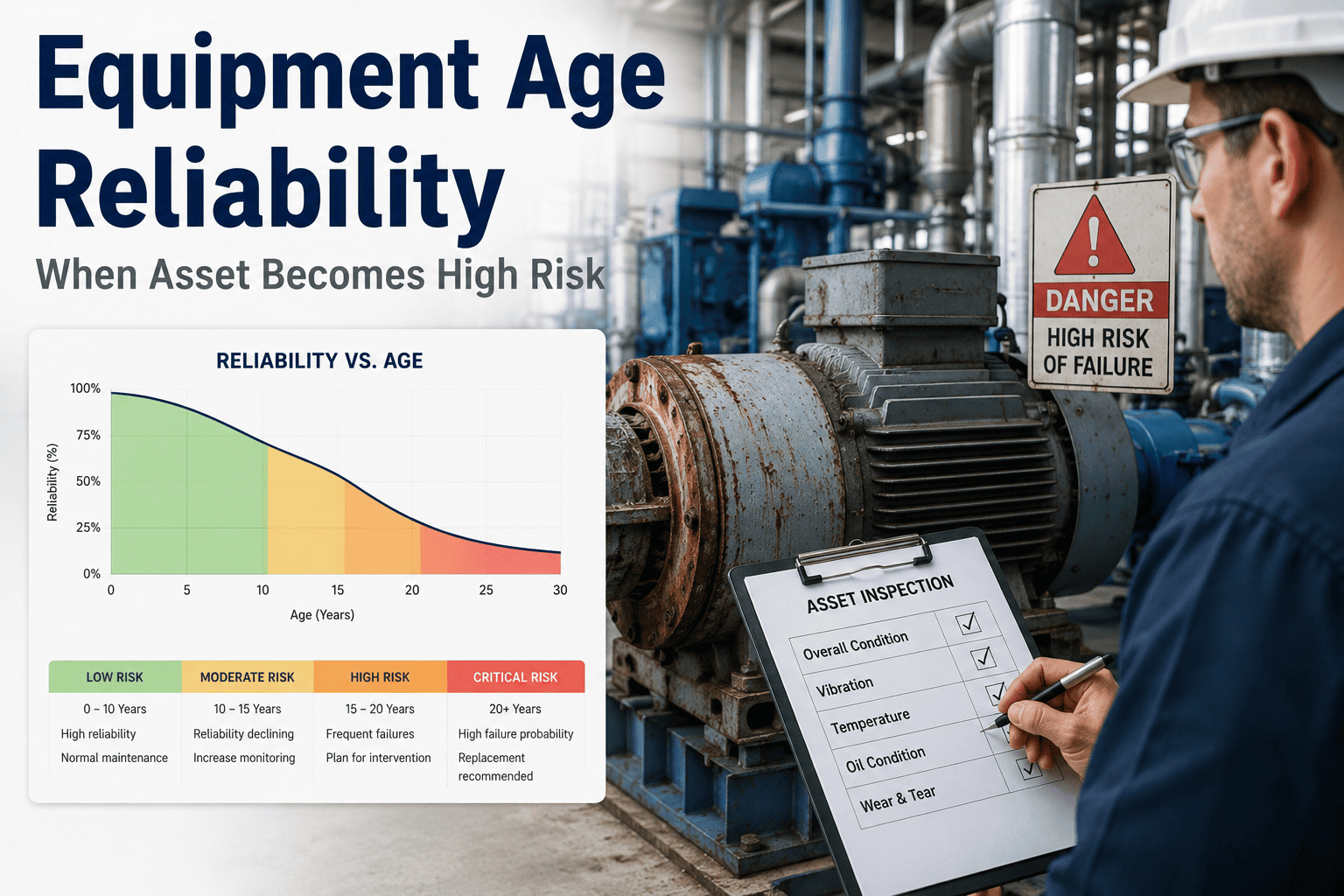
Most facilities default to age-based PM scheduling because it's easy to implement. Criticality-based maintenance requires more upfront work — but the operational and financial outcomes are categorically different.
| Planning Dimension |
Age-Based / Uniform Maintenance |
Criticality-Based (OxMaint) |
| PM Scheduling Logic |
Calendar interval — same for all assets |
Frequency driven by tier, condition, and failure mode |
| Budget Allocation |
Equal distribution across asset pool |
Weighted to Tier 1/2 assets by risk score |
| Spare Parts Strategy |
Fixed stock for all assets regardless of importance |
Safety stock set by criticality tier and lead time |
| CapEx Justification |
"This asset is 12 years old" |
Condition score × criticality tier = replacement priority rank |
| Technician Dispatch Priority |
First-in, first-out queue |
Tier 1 faults trigger priority dispatch regardless of queue |
| Budget Cut Response |
Reduce PM uniformly — highest-risk assets lose coverage too |
Cut Tier 4 run-to-failure; protect Tier 1 fully |
Results: What a Criticality-Driven Maintenance Programme Delivers
47%
Reduction in unplanned downtime
Tier 1 assets receive condition-based monitoring that catches degradation 3–6 weeks before failure
23%
Reduction in total PM spend
Eliminating unnecessary PM on Tier 3/4 assets frees budget for critical asset protection
68%
Faster CapEx approval cycle
Risk-scored asset data accelerates finance sign-off vs. narrative-only capital requests
31%
Reduction in MRO inventory cost
Criticality-linked stock levels eliminate over-stocking on non-critical asset spares
Frequently Asked Questions
How many assets need criticality scoring to make it worthwhile?
Facilities with as few as 50 assets benefit meaningfully from a criticality framework — even a simple 2-tier split between critical and non-critical assets produces better resource allocation than uniform treatment. For plants with 200+ assets, a full 4-tier matrix is strongly recommended. OxMaint supports criticality scoring from initial setup, so even new asset registries can start with criticality-driven PM from day one.
Who should be involved in building the criticality matrix?
Effective criticality scoring requires cross-functional input: maintenance engineers provide failure mode knowledge, operations managers score production impact, safety officers score health and safety consequence, and finance teams validate repair cost data. The scoring process itself takes 2–4 hours for a 200-asset plant when using a structured template. OxMaint's criticality module guides each assessor through their specific input dimensions, then aggregates scores automatically.
How often should criticality scores be reviewed and updated?
Criticality scores should be reviewed annually as a baseline, and immediately following any significant process change, asset modification, production volume shift, or regulatory update. Assets that receive redundancy upgrades may move from Tier 1 to Tier 2. Assets involved in expanded production roles may move the other direction. OxMaint maintains a full audit trail of criticality score changes with the date, user, and reason for each revision.
Can OxMaint import existing asset lists and apply criticality scoring retrospectively?
Yes. OxMaint supports CSV import of existing asset registers from spreadsheets, legacy CMMS systems, and ERP asset masters. After import, the criticality scoring module guides assessors through each asset. For large asset pools, OxMaint supports batch scoring where a facility type template pre-populates scores for common asset categories, which assessors then verify and adjust rather than scoring from scratch.
Prioritise What Actually Matters
Every Asset in Your Plant Has a Risk Score. Do Your PM Schedules Reflect It?
OxMaint's asset criticality module scores every asset across production impact, safety risk, environmental consequence, repair cost, regulatory exposure, and redundancy availability — then automatically aligns PM frequency, spare parts stock, and CapEx forecasting to the result. Maintenance strategy driven by risk data, not habit.