A utility-scale battery is not a passive storage tank you check on a calendar — it is a live electrochemical system where cell temperature gradients, state-of-health decline, and charge-cycling history interact in ways that can escalate from manageable degradation to thermal runaway with very little warning. That single fact defines battery energy storage maintenance, and it is why BESS is the hardest asset class in modern grid infrastructure to get right: it is the fastest-growing, yet it carries the least institutional maintenance knowledge, the fewest purpose-built O&M tools, and the highest consequence when thermal management fails. The compliance framework around it — NFPA 855, UL 9540A, and IEC 62619 — exists precisely because a series of high-profile thermal-runaway fires at utility sites in the US, Korea, and Australia showed how fast a single cell fault can become a container explosion. Several of those incidents, including Arizona in 2019, traced not to a bad cell but to a BMS that failed to coordinate with cooling and fire systems. This guide covers how to run a BESS maintenance program that tracks the right parameters at the right intervals. Start a free Oxmaint trial and convert BMS fault alerts into structured work orders, or book a demo to see cell-health trending and compliance records for BESS.
Power Plant · Battery Energy Storage · O&M
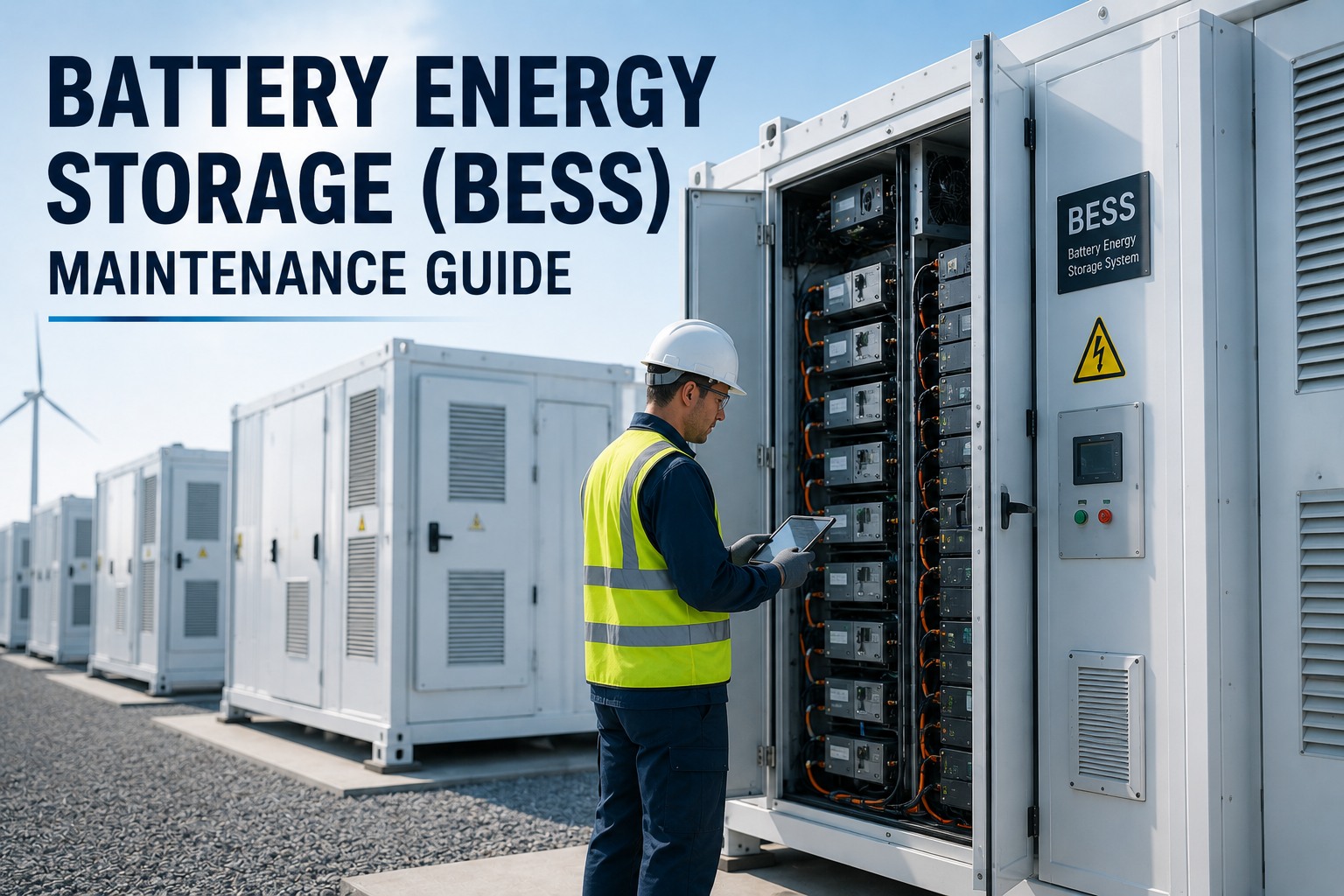
Battery Energy Storage (BESS) Maintenance Guide
Cell health monitoring, thermal management PM, BMS maintenance, and inverter servicing — how utility-scale battery storage operators run a maintenance program that catches degradation early, prevents thermal runaway, and satisfies NFPA 855 and UL 9540A.
-
SOH
state-of-health decline is the core parameter to trend
-
NFPA 855
plus UL 9540A and IEC 62619 govern BESS safety
-
Thermal
management is the highest-consequence failure point
-
BMS
integration failures cause fires even with healthy cells
The Defense That Prevents Runaway
Thermal Runaway Is Stopped by a Chain, Not a Sensor
Fire prevention in a BESS is not one device — it is a layered chain where each stage catches what the last did not, and the integration between stages is as critical as the stages themselves. The Arizona 2019 explosion happened despite functioning parts because the layers were not coordinated. This is the chain your maintenance program keeps intact.
-
1
BMS Cell Monitoring
The first line: the Battery Management System continuously tracks voltage, current, temperature, SOC, and SOH for every cell and module, flagging an anomaly and isolating a cell before it cascades. -
2
Thermal Management Response
When a temperature limit is approached, cooling must act — HVAC or liquid loops ramp, charge/discharge current is reduced, and an overheated module is isolated to hold the pack in range. -
3
Fire Detection & Suppression
If a cell still trips a voltage or temperature alarm, detection ties into the BMS to shut down and vent before ignition — suppression inside the enclosure is the last barrier. -
4
Integration Between Layers
The failure mode that matters most: a BMS that does not coordinate with HVAC and fire suppression. Maintenance must verify the handoffs, not just each device in isolation.
The majority of BESS fires trace to thermal runaway from internal cell faults, electrical faults, or overcharge — every one of them a link this chain is designed to catch. Book a demo to see BMS, thermal, and fire-system checks tracked as one chain.
The Four Subsystems
Four Systems, Four Maintenance Programs
A BESS bundles high-energy cells, control electronics, cooling, and power conversion in one enclosure — and each subsystem needs its own PM cadence and tracked parameters. Here is what each demands.
-
Cells & BMS
Track capacity per module per test date, the SOH curve across test history, and module outlier flags. Map BMS fault codes to work-order templates so an alert becomes a tracked job, not a log entry. -
Thermal Management
For liquid cooling, trend differential pressure, fluid-sample results, flow rate per circuit, and delta-T across 90-day cycles. For HVAC, filters and airflow — the system that keeps hotspots from forming. -
PCS / Inverter
The bidirectional power-conversion gateway between DC cells and the AC grid. Service cooling fans, torque checks, connection thermography, and firmware — the hardest-worked electronics on site. -
Fire & Protection
Functional-test suppression, detection, DC disconnects, fuses, pyro-fuses, and SPDs — combining routine visual inspection with thermal imaging and periodic functional testing per manufacturer intervals.
Because BESS carries little legacy maintenance knowledge, the parameters and intervals must be built deliberately — not inherited from rotating-equipment habits. Sign up for Oxmaint to build a PM program across all four BESS subsystems.
The Parameter That Predicts Everything
Trending Capacity Fade Before It Becomes Risk
State of health is the parameter that turns BESS maintenance from reactive to predictive. Capacity fades with every cycle, and a module drifting from its neighbors is the earliest sign of a developing problem — visible only if you trend it across test history rather than reading it once.
| Parameter | What to Track | Why It Matters |
|---|---|---|
| State of Health | Capacity per module per test date | Reveals degradation and augmentation need |
| Module outliers | SOH drift vs pack average | Earliest sign of a failing module |
| Cell temperature | Gradient across the pack | Hotspots precede thermal runaway |
| Cooling delta-T | Trend across 90-day cycles | Rising delta-T flags cooling loss |
| Cycle count | Charge/discharge history | Drives warranty and augmentation planning |
Tracking SOH per module also feeds augmentation planning — the scheduled capacity additions that keep a storage asset meeting its contracted output as it ages. Book a demo to see SOH curves and module outliers trended automatically.
Compliance Is Built From Records
After a Fire, the First Question Is What You Documented
The BESS compliance framework grew directly out of thermal-runaway incidents, and NFPA 855, UL 9540A, and IEC 62619 each impose specific inspection, documentation, and record-keeping obligations that generic maintenance software is not structured to fulfill. An Authority Having Jurisdiction inspection — and any post-incident investigation — turns on whether every thermal check, functional suppression test, BMS fault resolution, and capacity test is documented and retained. When BMS alerts convert automatically into work orders and every inspection is timestamped against the asset, that record is a byproduct of daily O&M rather than a scramble before an audit. On the fastest-growing, highest-consequence asset class on the grid, the documentation is not paperwork — it is part of the safety case.
Oxmaint for Battery Storage
How Oxmaint Runs BESS Maintenance
-
BMS Integration
Fault Codes to Work Orders
Integrate directly with the Battery Management System and map fault codes to work-order templates, so a BMS alert becomes a structured, assigned, tracked job — not an alarm that scrolls past unlogged.
-
Cell Health
SOH & Outlier Trending
Track capacity per module per test date, plot the SOH curve across test history, and flag module outliers automatically — turning capacity-fade data into an early-warning and augmentation-planning tool.
-
Thermal Tracking
Cooling Trended, Not Guessed
Log differential pressure, fluid-sample results, flow rate per circuit, and delta-T across 90-day cycles — so a slow loss of cooling performance surfaces as a trend before it becomes a hotspot.
-
Thermal Alerts
Thresholds That Escalate
Configure thermal alert thresholds that raise prioritized work orders when a reading approaches a limit — keeping the temperature response inside the maintenance system, not just the control room.
-
Asset Hierarchy
Site to Cell
A BESS asset hierarchy from site to container to rack to module, each with its own PM schedule, history, and parameters — so PCS, cooling, and fire systems are all tracked against the right level.
-
Compliance Records
NFPA 855 & AHJ Ready
Generate the inspection and documentation records NFPA 855, IEC 62619, and AHJ inspections require — every functional test, thermal check, and fault resolution timestamped against the asset.
Frequently Asked
BESS Maintenance Questions
What makes BESS maintenance different from other power assets?
A battery storage system is an active electrochemical asset where cell temperature, state-of-health decline, and cycling history interact and can escalate from normal degradation to thermal runaway with little warning. It is also the fastest-growing grid asset class with the least institutional maintenance knowledge and few purpose-built O&M tools. That combination means the program must deliberately track cell-level parameters at the right intervals and keep the BMS, cooling, and fire systems coordinated — a very different discipline from rotating-equipment PM. Sign up for Oxmaint to run a purpose-built BESS program.
How does maintenance prevent thermal runaway?
By keeping the layered defense chain intact and coordinated. The BMS monitors every cell and isolates anomalies; thermal management responds when temperature limits approach; fire detection and suppression act as the last barrier; and critically, these layers must be integrated. Several major BESS fires, including Arizona 2019, happened because the BMS did not coordinate with HVAC and fire systems — so maintenance must verify the handoffs between layers, not just test each device alone, and trend cell temperature gradients that precede a runaway event.
What is state of health and why track it per module?
State of health (SOH) measures a battery's remaining capacity against its original rating, and it fades with every charge/discharge cycle. Tracking it per module across test history reveals two things: the overall degradation curve that drives augmentation planning, and module outliers — a pack drifting from its neighbors is often the earliest sign of a developing fault. Reading SOH once tells you little; trending it per module turns capacity data into a predictive maintenance signal. Book a demo to see per-module SOH trending.
What compliance standards apply to BESS maintenance?
Grid-scale battery storage sits under a layered framework including NFPA 855 (the installation and operation standard for stationary energy storage), UL 9540A (the thermal-runaway fire-propagation test method), and IEC 62619 (safety requirements for industrial secondary lithium cells and batteries). Each imposes inspection, documentation, and record-keeping obligations, and an Authority Having Jurisdiction can require evidence of them. Because these grew out of real fire incidents, the maintenance record is effectively part of the site's safety case. Sign up for Oxmaint to keep NFPA 855-ready records.
Monitor · Cool · Verify · Document
On the Newest Grid Asset, the Program Is the Safety Margin
Every untrended SOH curve, uncoordinated BMS handoff, and undocumented thermal check is risk accumulating on the highest-consequence asset class on the grid. Oxmaint gives BESS operators one platform to convert BMS faults into work orders, trend cell health and cooling performance, keep the thermal-runaway defense chain coordinated, service PCS and fire systems on schedule, and hold the NFPA 855 and AHJ records the asset demands — so a fast-growing storage fleet stays reliable and safe as it ages.