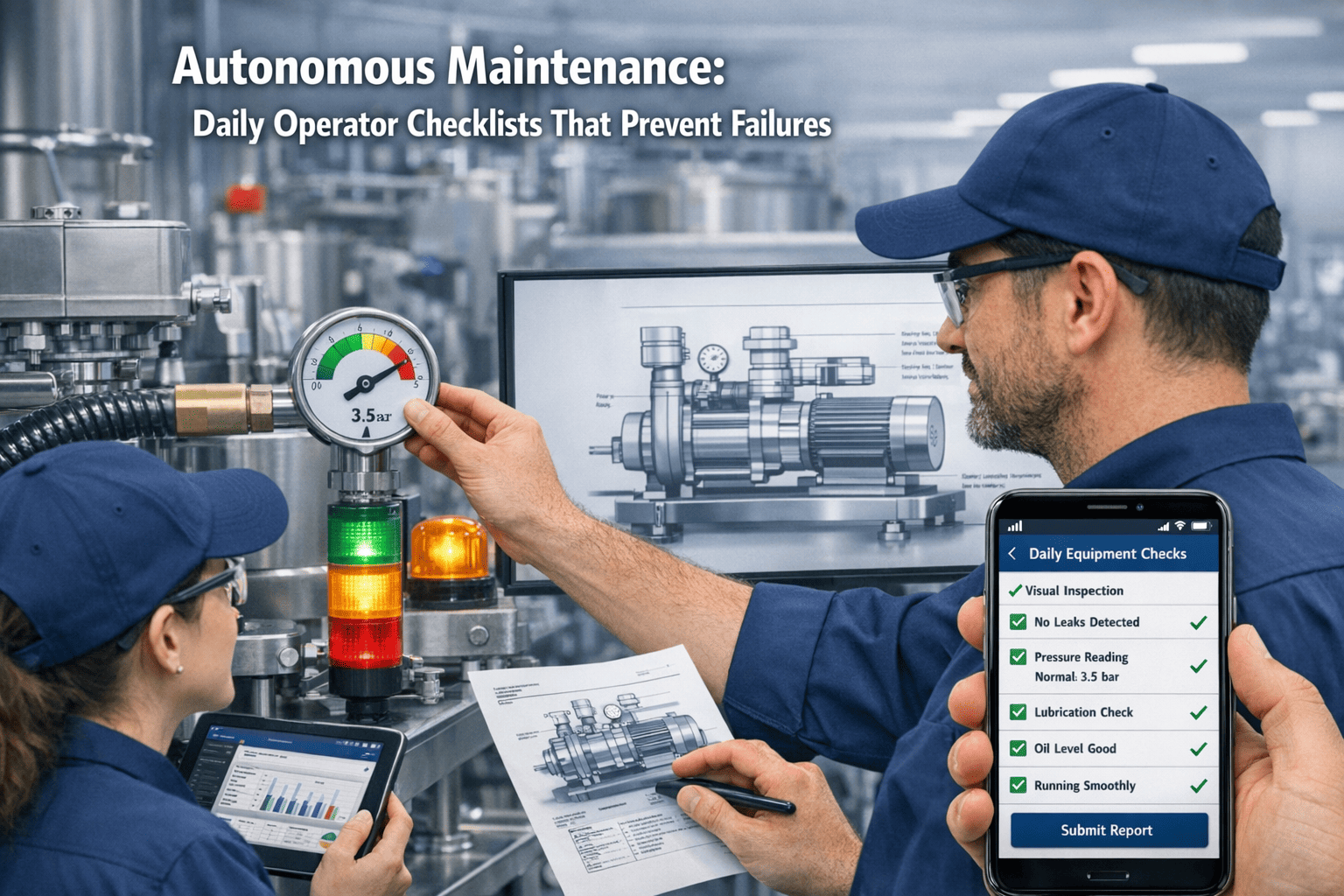
In 78% of manufacturing plants, operators stand next to equipment for 8 hours a day and never inspect it — they wait for the maintenance team to arrive after something breaks. This disconnect between production and maintenance is the single largest source of preventable equipment failure in industrial operations. Autonomous maintenance — the first and foundational pillar of Total Productive Maintenance (TPM) — closes this gap by training and empowering operators to perform routine equipment care: cleaning, inspection, lubrication, and minor adjustments that prevent 40–60% of all equipment breakdowns before they start. Facilities that implement structured autonomous maintenance programs with CMMS-backed digital checklists report 10–20% reduction in unplanned downtime, 5% OEE improvement within six months, and a measurable cultural shift where operators take ownership of "their" machines instead of treating every issue as "a maintenance problem." Start a free trial to build operator-led maintenance workflows in Oxmaint, or book a demo to see how Oxmaint digitizes autonomous maintenance across your production floor.
Turn Every Operator Into Your First Line of Equipment Defense
Oxmaint gives operators mobile-first checklists, guided inspection routines, and instant defect tagging — so basic equipment care happens every shift, not just when maintenance shows up after something breaks.
What Is Autonomous Maintenance in TPM?
Autonomous maintenance (Jishu Hozen) is the TPM pillar that transfers ownership of basic equipment care — cleaning, inspecting, lubricating, tightening, and detecting abnormalities — from the maintenance department to the machine operators who work with the equipment every day. The principle is straightforward: the person who operates a machine for 8 hours is in the best position to notice that a bearing sounds different, a guard vibrates more than usual, a fluid level has dropped, or a belt is showing wear. When operators are trained, equipped with standardized checklists, and supported by a CMMS that makes reporting effortless, they become a continuous early-warning system that catches 40–60% of developing issues before they escalate into failures requiring skilled technician intervention. This is not about turning operators into maintenance technicians — it is about enabling them to perform the 15–20 minutes of daily care that prevents 60% of the problems maintenance technicians currently spend their time fixing. Start a free trial to deploy digital operator checklists in Oxmaint.
Why Autonomous Maintenance Fails Without Digital Tools
Studies show that 65% of TPM implementations fail to sustain results beyond 18 months — and the primary reason is that paper-based checklist compliance drops below 40% within the first year. Operators lose forms, skip checks during busy shifts, and supervisors cannot verify completion in real time. The data from paper-based AM programs is functionally unusable for trend analysis because it sits in filing cabinets rather than dashboards. Digital CMMS-backed autonomous maintenance solves every one of these failure modes by making operator routines mobile, trackable, and integrated with the maintenance work order system. When an operator flags a defect on a digital checklist, it instantly becomes a tagged work order for maintenance — instead of a note on a paper form that gets lost in a shift handover. Book a demo to see how Oxmaint eliminates paper-based AM failure modes.
How Oxmaint Powers Autonomous Maintenance at Scale
Oxmaint transforms autonomous maintenance from a training initiative into a sustainable digital system. Every operator checklist, defect report, inspection result, and escalation is captured, tracked, and analyzed — creating the continuous improvement loop that separates successful TPM programs from abandoned ones. Start a free trial to configure autonomous maintenance workflows for your production floor.
Guided Operator Inspection Routines
Equipment-specific checklists with photo references, acceptance criteria, and step-by-step guidance delivered to operator mobile devices. Checklists auto-populate based on shift schedule and machine assignment — operators open the app and their AM tasks are ready.
Instant Photo-Tagged Defect Escalation
When an operator finds an abnormality — unusual noise, fluid leak, worn belt, loose guard — they photograph it, tag the location, and submit. Oxmaint auto-generates a maintenance work order with priority classification, eliminating the gap between operator observation and maintenance action.
Real-Time AM Completion Dashboard
Supervisors see checklist completion status across all machines and shifts in real time. Red/amber/green compliance indicators per machine, per shift, per operator — with automatic alerts when AM routines are missed or overdue beyond the grace window.
Defect Frequency and Location Analysis
Oxmaint aggregates operator-reported defects into trend reports showing which machines, components, and zones generate the most findings. This data feeds focused improvement (Pillar 2 of TPM) — directing engineering attention to the root causes operators keep flagging.
Autonomous Maintenance ROI: The Measurable Impact
The financial case for autonomous maintenance is driven by three factors: reduced unplanned downtime, extended equipment lifespan through consistent basic care, and freed maintenance technician capacity for higher-value work. The numbers below represent typical results for a manufacturing facility with 15–25 production machines after 6–12 months of structured AM implementation with Oxmaint. Want to calculate your facility's AM potential? Book a demo and we will model the impact based on your current downtime and maintenance workload data.
Frequently Asked Questions
How much time does autonomous maintenance add to an operator's shift?
A well-designed AM routine takes 10–15 minutes per shift — covering cleaning, lubrication checks, and a structured inspection of 20–30 checkpoint items. This is not additional work layered on top of production — it replaces the unstructured time operators currently spend dealing with equipment problems reactively. Facilities consistently find that the 15 minutes of structured AM saves 45–90 minutes of unplanned stoppage time per shift by catching issues before they escalate. With Oxmaint's mobile checklists, the routine is guided, timed, and efficient — operators know exactly what to check, in what order, and what "good" looks like. Start a free trial to see how Oxmaint structures operator AM routines.
How do you overcome operator resistance to autonomous maintenance?
Operator resistance stems from three sources: "that is not my job" mindset, lack of confidence in identifying equipment issues, and past experience with failed initiatives that added work without visible benefit. Successful AM programs address all three by starting with a pilot on one or two machines (not plant-wide rollout), providing hands-on training that builds operator confidence, and using CMMS visibility to show operators the direct impact of their inspections — "your defect report on Machine 4 prevented a $12,000 bearing failure." When operators see their observations creating real maintenance actions and preventing real breakdowns, engagement shifts from resistance to ownership within 8–12 weeks.
What is the relationship between autonomous maintenance and the other 7 TPM pillars?
Autonomous maintenance is Pillar 1 because it creates the foundation for every other TPM pillar. Pillar 2 (Focused Improvement) uses defect data from AM inspections to identify chronic loss sources. Pillar 3 (Planned Maintenance) shifts to higher-value work because AM handles routine tasks. Pillar 4 (Training) develops operator competence to support AM expansion. Pillar 5 (Early Equipment Management) uses AM feedback to improve new equipment design. Without sustainable AM, the other pillars lack the operational stability and data quality they require. Book a demo to see how Oxmaint supports multi-pillar TPM programs.
Can autonomous maintenance work in regulated industries like food, pharma, or medical devices?
Autonomous maintenance is not only compatible with regulated industries — it strengthens compliance. Regulatory frameworks (FDA, GMP, HACCP, BRCGS) require documented equipment care and inspection records. Paper-based AM programs create compliance risk because forms are lost, incomplete, or illegible. Oxmaint's digital AM checklists generate timestamped, photo-verified, operator-signed inspection records that satisfy audit requirements automatically. In food manufacturing specifically, operator-led equipment cleaning and hygiene inspections are prerequisite program requirements — making AM not just a TPM initiative but a compliance obligation that CMMS makes audit-ready.
Build the Foundation of Your TPM Program — Digital Autonomous Maintenance With Oxmaint
Manufacturing facilities across the USA, UK, Germany, UAE, and Australia use Oxmaint to deploy sustainable autonomous maintenance programs — with mobile checklists, instant defect escalation, real-time compliance dashboards, and the data infrastructure that keeps AM programs alive beyond the first 18 months.