A smart factory is not defined by the number of robots on its floor — it is defined by the quality of decisions its systems make without human intervention. When a CNC cell adjusts its own maintenance schedule based on spindle vibration data, when a conveyor system notifies the CMMS about a drive anomaly before a shift supervisor notices, or when an AI model reschedules a planned shutdown to align with a predicted failure window rather than a calendar date, Industry 4.0 maintenance is happening. The gap between collecting industrial data and using it to make better maintenance decisions is the gap that smart factory CMMS integration closes. Start a free trial to see how Oxmaint integrates with IoT and AI systems in smart factory environments, or book a demo and walk through a live Industry 4.0 maintenance workflow.
Industry 4.0 · Smart Factory Maintenance
Smart Factory AI CMMS: Building Industry 4.0 Maintenance Systems
How smart factories integrate AI, IoT sensor networks, digital twins, and CMMS to create predictive, automated, and continuously optimising maintenance ecosystems — and what the technology stack looks like in practice for manufacturing operations in 2026.
$421B
Global smart factory market value by 2028 — maintenance systems are the second-largest technology investment category
52%
Reduction in unplanned downtime reported by manufacturers with mature IIoT-CMMS integration after 24 months of operation
18%
Average OEE improvement in smart factories deploying integrated AI maintenance versus conventional preventive programs
3.2x
Faster MTBF improvement rate for assets monitored through IIoT-CMMS integration versus calendar-based PM programs
The Industry 4.0 Maintenance Technology Stack
Smart factory maintenance is not one technology — it is a layered architecture where each component amplifies the capability of the others. The CMMS is not just a work order system in this stack — it is the operational intelligence hub that converts signals from IoT, AI, and digital twin layers into executed maintenance actions with documented outcomes. Understanding each layer and its relationship to maintenance operations is the starting point for building the stack deliberately rather than accumulating disconnected tools. Start a free trial to see how Oxmaint serves as the CMMS layer in an Industry 4.0 maintenance stack, or book a demo and explore the integration architecture with your specific technology environment.
Layer 1 · Sensing
IIoT Sensor Networks
Vibration, temperature, current, pressure, flow, and process quality sensors deployed on production assets. Edge computing nodes aggregate sensor streams locally before transmission — reducing bandwidth requirements and enabling real-time local alert triggering without cloud latency. Wireless HART, OPC-UA, MQTT, and Modbus are the dominant industrial protocols in 2026 deployments.
Layer 2 · Connectivity
Industrial Data Infrastructure
Historian servers (OSIsoft PI, Aveva, InfluxDB), MES systems, SCADA platforms, and ERP integrations that aggregate operational data across the plant. The connectivity layer is where most Industry 4.0 implementations encounter their first complexity barrier — legacy equipment with no digital output requires retrofit sensor solutions or protocol gateways.
Layer 3 · Intelligence
AI and Machine Learning Models
Anomaly detection models, failure prediction algorithms, remaining useful life (RUL) estimators, and root cause analysis engines operating on the sensor data streams. Model performance depends directly on data quality, historical failure records, and the accuracy of asset metadata — all of which the CMMS layer provides when properly integrated.
Layer 4 · Simulation
Digital Twin Integration
Virtual asset models that replicate real asset behaviour using live sensor data — enabling maintenance teams to simulate failure scenarios, test maintenance interventions virtually, and predict how a specific maintenance action will affect asset operating envelopes. Digital twins are most mature in high-capital assets: turbines, compressors, injection moulding machines, and CNC machining centres.
Layer 5 · Execution
CMMS as the Action Layer
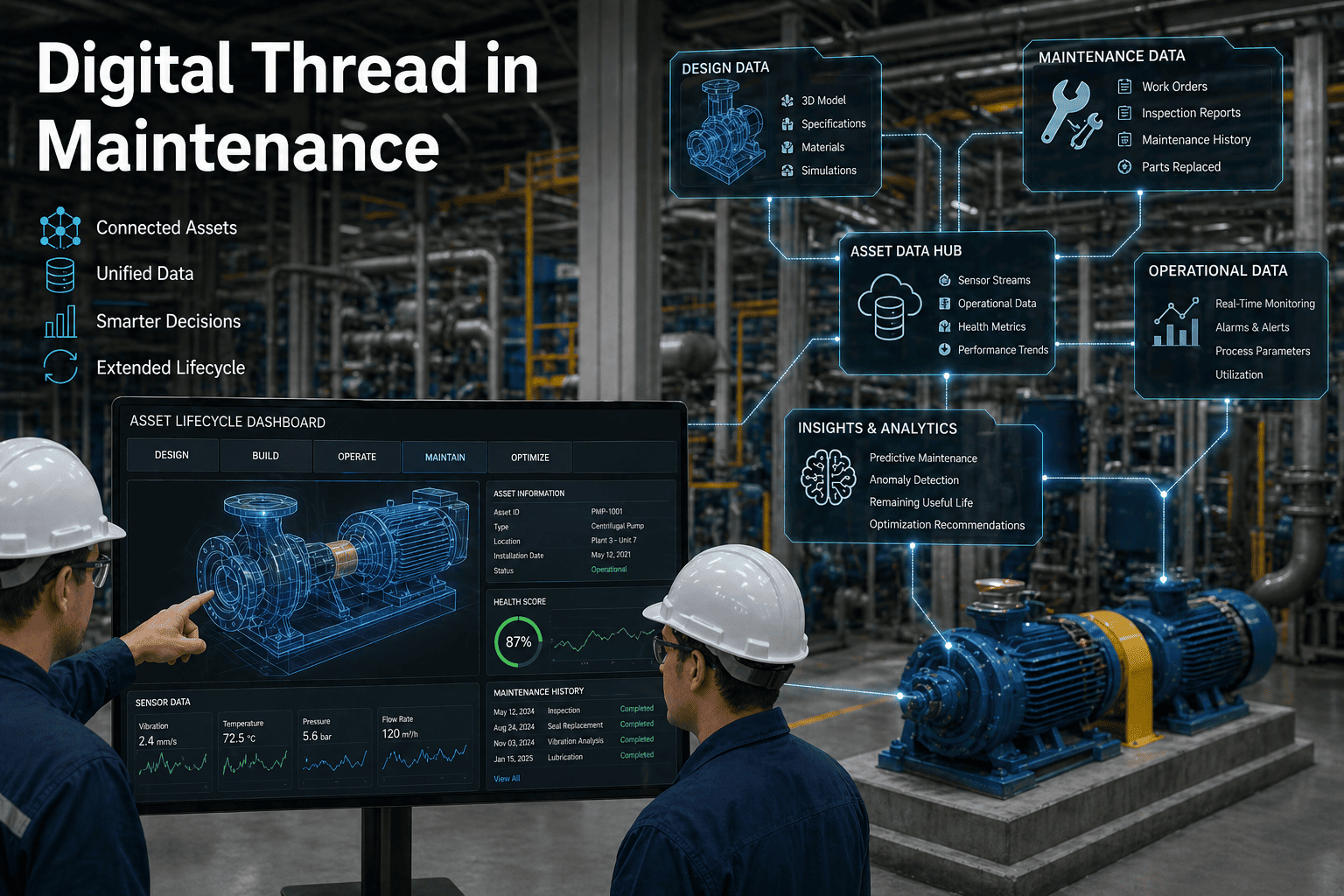
The CMMS receives signals from AI, IoT, and digital twin layers and converts them into work orders, PM schedule adjustments, parts requests, and technician assignments. The CMMS also feeds the intelligence layers back — completed work order outcomes, repair findings, and parts used improve AI model accuracy over time through a continuous learning loop.
Layer 6 · Optimisation
Continuous Improvement Analytics
Portfolio-level reporting combining OEE data, maintenance cost per asset, MTBF trends, and AI prediction accuracy metrics — enabling operations and maintenance leadership to track technology investment ROI, identify the highest-value next improvement targets, and drive the continuous optimisation cycle that defines world-class smart factory maintenance.
Oxmaint Is the CMMS Layer Your Industry 4.0 Stack Needs
IoT integration, AI-triggered work orders, digital inspection workflows, OEE dashboards, and production-based PM triggers — the smart factory maintenance execution layer, ready to connect to your existing industrial data infrastructure.
Conventional Factory Maintenance vs Smart Factory Maintenance
| Maintenance Dimension |
Conventional Factory |
Industry 4.0 Smart Factory |
Operational Outcome |
| Failure Detection |
Operator observation or alarm threshold breach — after condition has deteriorated visibly |
AI anomaly detection on continuous sensor streams — precursor identified 4–8 weeks before symptom |
52% fewer unplanned stoppages — intervention while repair scope is still minor |
| PM Schedule |
Fixed calendar — monthly, quarterly, annually — regardless of actual asset condition or production load |
Condition-based and production-based triggers — PM when asset condition or throughput indicates it, not the calendar |
30% fewer unnecessary PMs, 18% improvement in OEE availability component |
| Work Order Creation |
Manual entry by maintenance manager or supervisor after fault is reported |
Automatic generation from AI alert, IoT threshold breach, or digital twin deviation — minutes after signal |
Response time 6x faster — work order exists before the failure escalates |
| Maintenance Knowledge |
Institutional knowledge — lives with long-tenure technicians, lost when they leave |
Documented in CMMS asset history — every technician has access to full repair and symptom records |
First-visit fix rate 28% higher — technicians arrive with full context, not starting from scratch |
| Asset Lifecycle Planning |
Replacement decisions based on age or visible deterioration — reactive capital planning |
Condition score trending feeds CapEx model — 5-year replacement forecast built from real asset performance data |
Capital budget approval 2.1x faster with data-backed replacement scenarios |
| Supplier and Parts Integration |
Manual purchasing — triggered when stock runs out or after fault diagnosis reveals parts need |
AI-predicted maintenance triggers parts reservation and reorder before the work order is assigned to a technician |
Zero wait-for-parts delays on predictable maintenance interventions |
Digital Twin and CMMS: How Integration Works in Practice
01
Live Asset State Synchronisation
The digital twin model ingests real-time sensor data — temperature, load, vibration, speed — and updates the virtual asset state continuously. When the twin's simulated behaviour diverges from the physical asset's actual sensor readings beyond a defined threshold, a maintenance investigation flag is generated and sent to the CMMS.
02
Remaining Useful Life Estimation
Digital twin models calculate remaining useful life (RUL) for key components — bearing life, seal life, liner life — using actual operating stress data fed into degradation models. RUL estimates update continuously and trigger CMMS work orders with a configurable lead time before the predicted end-of-life window.
03
Maintenance Impact Simulation
Before a major maintenance intervention, the digital twin simulates its effect on asset operating envelope — will bearing replacement at current wear level restore full load capacity, or is secondary damage already limiting output? Simulation results inform work scope before the technician opens the asset, reducing diagnostic time during the maintenance window.
04
Post-Maintenance Verification
After maintenance completion, the digital twin compares expected post-repair performance against actual sensor readings. If the asset does not return to expected operating envelope within a defined commissioning period, the twin generates a follow-up inspection work order in the CMMS automatically — catching inadequate repairs before the next production cycle reveals them.
Smart Factory Maintenance Results: What the Technology Delivers
52%
Unplanned downtime reduction
Manufacturers with mature IIoT-CMMS integration (24+ months operational) versus their pre-integration baseline
18%
OEE improvement
Average OEE gain driven by availability improvement — fewer unplanned stops, faster MTTR from better diagnostic information
35%
Maintenance cost reduction
Total maintenance spend reduction from reactive-to-predictive shift enabled by IIoT sensor and CMMS integration
3.2x
Faster MTBF improvement
MTBF improvement rate for IIoT-monitored assets versus identical assets on conventional PM programs over a 24-month comparison period
How Oxmaint Integrates with Smart Factory Infrastructure
Integration Type
IoT and Sensor Platform Connection
Oxmaint connects to industrial IoT platforms via REST API, MQTT broker, and OPC-UA — receiving sensor readings, alert events, and device status updates against registered asset records. Each sensor event is linked to the specific machine or component it monitors, creating a condition timeline for every asset in the registry.
Integration Type
AI Alert to Work Order Pipeline
When an AI model or rule engine generates a maintenance alert — bearing anomaly, temperature deviation, efficiency degradation — the signal flows into Oxmaint and creates a structured work order with the asset ID, alert description, sensor evidence, and recommended action. No human required in the alert-to-work-order conversion step.
Integration Type
MES and ERP System Integration
Production schedule data from MES systems informs Oxmaint's maintenance scheduling — planned maintenance windows are coordinated with production downtime allocations rather than conflicting with them. Work order completion data flows to ERP for maintenance cost allocation and asset depreciation updates.
Integration Type
SCADA and Historian Data Access
Oxmaint integrates with SCADA and historian platforms (OSIsoft PI, Aveva, InfluxDB) to pull asset operating data for condition trending, PM trigger calculation, and downtime event logging. Production hour meters and cycle counters from SCADA feed production-based PM intervals directly — no manual meter reading required.
Frequently Asked Questions
What is the right starting point for a manufacturer transitioning to Industry 4.0 maintenance?
The majority of Industry 4.0 maintenance value is captured in the first two technology layers — sensor connectivity and CMMS integration — before AI and digital twin complexity is added. The highest-ROI starting point is almost always: identify the 8–10 highest-criticality production assets, instrument them with vibration and temperature sensors, connect the sensor stream to a CMMS with condition-based PM triggering, and begin building failure data history. This alone typically delivers 25–35% maintenance cost reduction within 12–18 months. AI models added to this foundation then have the data they need to be accurate from the beginning.
Start a free trial to begin building your smart factory maintenance foundation in Oxmaint.
How does a CMMS integrate with existing SCADA and historian systems without disrupting production?
Oxmaint integrates with SCADA and historian systems through read-only API connections — no write access to production control systems is required or used. The integration pulls operating data (meter readings, alarm events, production counters) from the historian and uses it to update asset condition records and trigger PM work orders in Oxmaint. This architecture means CMMS integration has zero risk of affecting production control system behaviour. Implementation is typically completed in 2–4 weeks for a standard Modbus or OPC-UA historian integration without production impact.
Book a demo to discuss integration requirements for your specific control system environment.
What is a digital twin in the context of maintenance, and does every smart factory need one?
A digital twin in maintenance is a virtual model of a physical asset that updates in real time from sensor data and predicts future behaviour — including remaining component life and next failure probability. Digital twins deliver the most value for high-capital, complex assets where the cost of unplanned failure is very high and the operating conditions are variable: turbines, large compressors, injection moulding machines, and precision machining centres. For most production assets, IIoT sensor integration with AI anomaly detection delivers 70–80% of the preventive benefit of a full digital twin at a fraction of the implementation complexity. Digital twins are the next layer for organisations that have already captured value from sensor-CMMS integration and want to optimise further.
How does OEE tracking in Oxmaint connect to maintenance performance management?
Oxmaint's OEE dashboard tracks Availability, Performance, and Quality for each production line — with the Availability component driven directly by equipment downtime data from work order records. When an unplanned stoppage occurs, the downtime duration is logged against the asset in the work order that responds to it. This creates a direct line between maintenance response time, failure frequency, and OEE availability — so maintenance managers and plant managers see the same metric, understand its driver, and can quantify the production impact of reducing MTTR or improving PM compliance. Asset-level OEE data also informs CapEx decisions — assets with persistently low OEE Availability due to maintenance frequency are identified as replacement or rebuild candidates with production evidence supporting the decision.
Start a free trial to begin OEE tracking for your production assets today.
Smart Factory Maintenance Is Not a Future State. The Technology Exists Today.
Oxmaint provides the CMMS execution layer that makes Industry 4.0 maintenance operational — IoT integration, AI-triggered work orders, digital inspection workflows, production-based PM triggers, OEE dashboards, and 5-year CapEx forecasting built from real asset condition data. Start building your smart factory maintenance stack now.