The next generation of CMMS is not a better work order system — it is an autonomous maintenance agent. Agentic AI does not wait for a sensor threshold alert or a technician to open a fault ticket. It monitors asset condition continuously, evaluates failure probability across hundreds of variables simultaneously, makes the maintenance decision, and dispatches the work order — all without human intervention. The role of the maintenance team shifts from executing reactive tasks to supervising an AI system that handles the operational layer. This is not a prediction about 2035. Agentic AI is entering industrial maintenance now, and the CMMS platforms that integrate it will define operational performance standards for the next decade. Start a free trial to see how Oxmaint's AI-driven maintenance platform works today, or book a demo and explore the autonomous maintenance roadmap.
AI and Future Tech · Autonomous CMMS
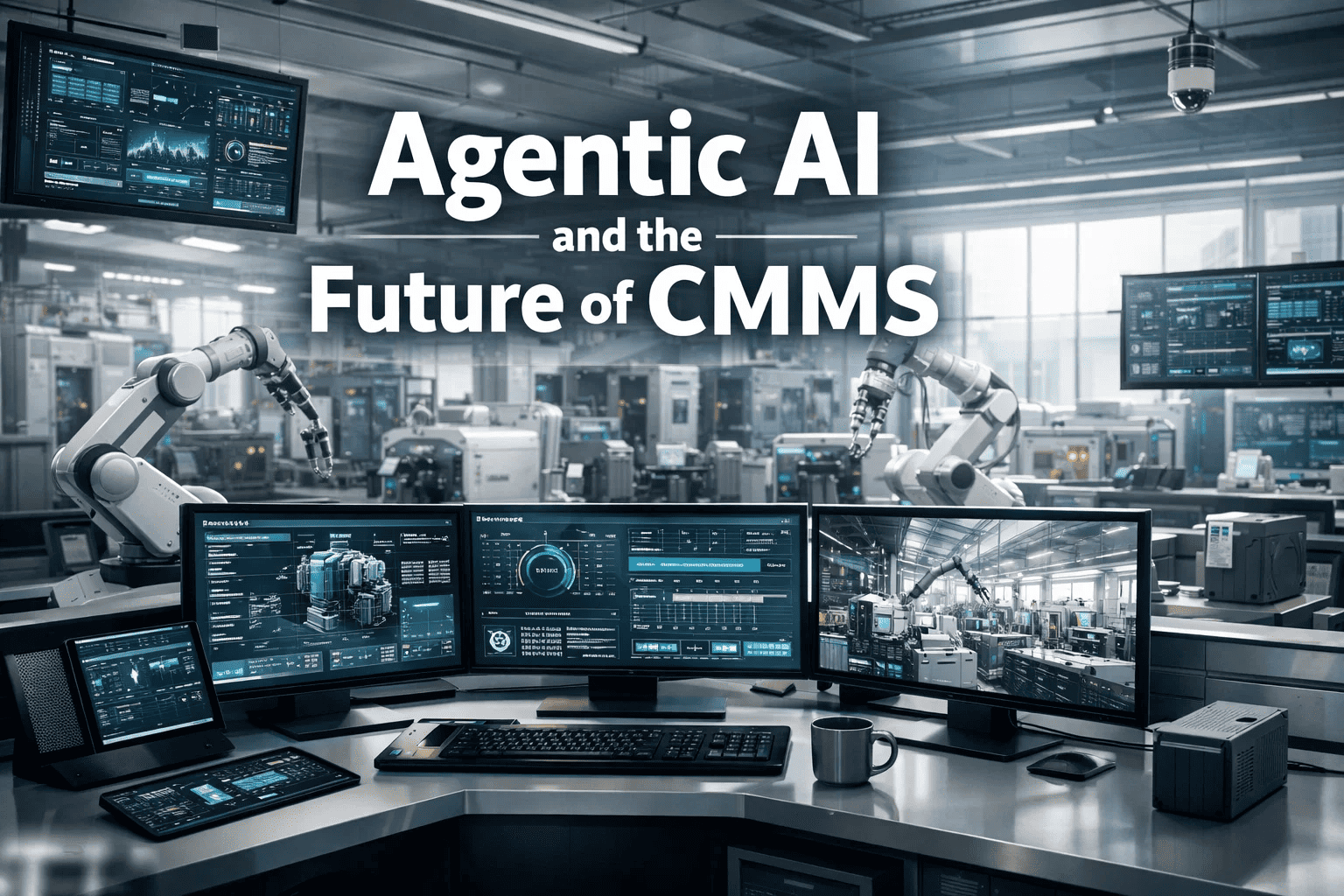
Agentic AI and the Future of CMMS: Autonomous Maintenance Explained
How agentic AI transforms CMMS from a work order management system into an autonomous maintenance decision engine — detecting failures, evaluating options, dispatching technicians, and learning from every outcome without waiting for human instruction.
89%
Of maintenance decisions in advanced facilities will involve AI assistance or full AI autonomy by 2028
47%
Reduction in unplanned downtime achieved in early agentic AI maintenance deployments versus baseline
6x
Faster maintenance response from AI-autonomous work order generation versus human-triggered dispatch
2026
Year in which autonomous CMMS capabilities move from pilot to mainstream industrial deployment globally
What Agentic AI Actually Means in a CMMS Context
The word "agentic" distinguishes AI that acts from AI that merely informs. Conventional AI maintenance tools generate insights and recommendations — a human decides what to do with them. Agentic AI goes further: it perceives the environment (sensor data, asset condition, work order backlog, parts availability, technician schedules), reasons about the optimal maintenance action, and executes that action autonomously — creating work orders, scheduling technicians, ordering parts, and updating records without waiting for a human decision point in the loop. Start a free trial and explore Oxmaint's AI-assisted maintenance capabilities, or book a demo to see how AI-generated work orders flow into the platform today.
Perceive
Continuous Multi-Source Data Ingestion
Agentic AI consumes sensor streams, historical work order data, asset condition scores, production schedules, parts inventory levels, and technician availability simultaneously — building a real-time picture of maintenance system state that no human team can replicate at scale.
Reason
Multi-Variable Failure Probability Modelling
Rather than applying a single threshold alert rule, agentic AI evaluates hundreds of variable combinations against learned failure patterns — computing a probability-weighted risk score for each asset and selecting the maintenance action with the highest expected value across cost, risk, and operational impact dimensions simultaneously.
Act
Autonomous Work Order Generation and Dispatch
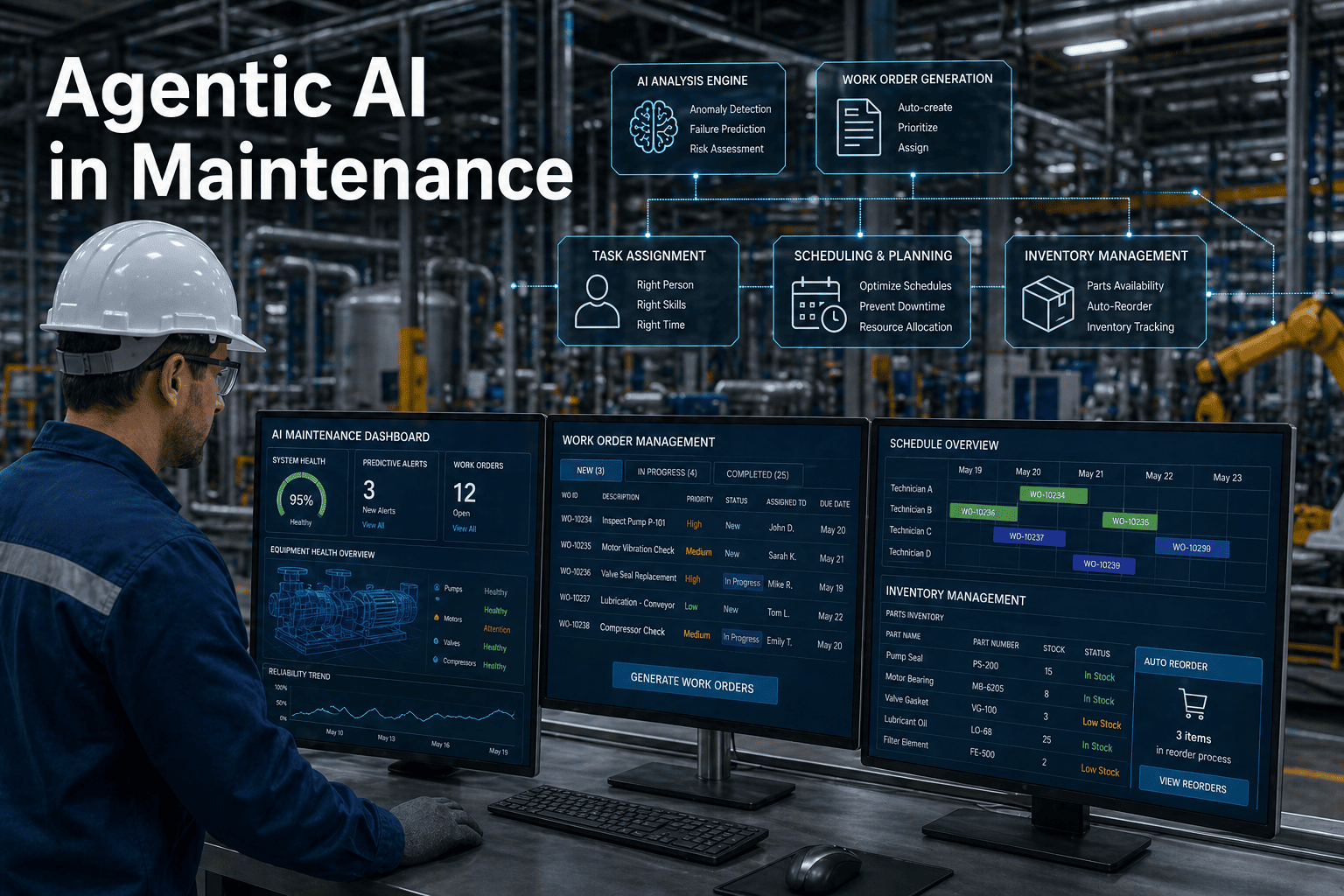
When the agentic system determines that maintenance action is required, it creates a structured work order — with asset ID, fault description, recommended procedure, priority classification, parts list, and technician assignment — without waiting for a maintenance manager to log in and make the decision.
Learn
Outcome Feedback and Model Refinement
Every completed work order — the technician's findings, the actual fault, the repair taken, and the time-to-next-event — feeds back into the model. Agentic AI becomes progressively more accurate for each specific asset and operating environment, compounding its predictive advantage over time.
Oxmaint Brings AI-Driven Maintenance Into Your Operations Today
IoT integration, predictive maintenance triggers, and automated work order generation — the foundational layer of autonomous maintenance is available now, without a multi-year implementation project.
The Agentic AI Maintenance Architecture: Layer by Layer
Layer 1 · Data
Sensor and IoT Infrastructure
Vibration sensors, temperature monitors, current transformers, pressure transducers, and process data historians provide the raw signal stream. Without reliable, high-frequency sensor data, agentic AI has no perception layer — this hardware investment is the precondition for autonomous maintenance capability.
Layer 2 · Intelligence
Machine Learning and Anomaly Detection Models
Trained on historical asset performance and failure data, ML models establish normal operating envelopes for each asset and detect deviations that correlate with failure precursor patterns. Ensemble models combine multiple algorithms — time-series analysis, isolation forest, LSTM networks — to reduce false positive rates below 8% in mature deployments.
Layer 3 · Decision
Autonomous Decision Engine
The agentic layer that evaluates detected anomalies against production schedule, parts availability, technician capacity, and criticality weighting — and selects the optimal maintenance action from a defined action space. This layer is configurable: operators set the boundaries of autonomous action and the escalation conditions that require human approval.
Layer 4 · Execution
CMMS Integration and Work Order Dispatch
The decision engine connects to the CMMS to create work orders, assign technicians, check parts inventory, and update the maintenance schedule — all in the same action sequence. In Oxmaint, this integration is bidirectional: AI actions appear as work orders, and work order outcomes feed AI model learning.
Layer 5 · Oversight
Human Supervision and Exception Management
Mature agentic deployment does not eliminate human oversight — it elevates it. Maintenance managers review AI decision logs, approve high-cost interventions, and investigate exception cases where the agent's action was overridden or wrong. The manager becomes a system supervisor, not a task dispatcher.
Layer 6 · Improvement
Continuous Model Performance Monitoring
Agentic AI systems track their own prediction accuracy — true positive rate, false alarm frequency, missed fault events — and surface these metrics to the maintenance organisation. Model drift is detected and corrected through retraining cycles, ensuring accuracy does not degrade as asset populations and operating conditions change over time.
Conventional CMMS vs Agentic AI CMMS: What Changes
| Workflow Element |
Conventional CMMS |
Agentic AI CMMS |
Operational Difference |
| Fault Detection |
Technician reports fault or alarm threshold breached |
AI detects precursor pattern and raises finding before symptom is visible |
Detection 48–72 hours earlier — intervention while damage is still minor |
| Work Order Creation |
Maintenance manager or technician creates manually after fault reported |
Autonomous agent creates structured work order with asset data, priority, and parts list attached |
Work order created in seconds rather than hours — no human bottleneck in dispatch |
| Technician Assignment |
Supervisor assigns based on current knowledge of team availability |
AI assigns from current technician schedule, skills matrix, and proximity data |
Optimal assignment without supervisor coordination — 27% faster technician arrival on reactive jobs |
| Parts Management |
Inventory checked manually when work order is being started |
AI checks parts availability at work order creation and triggers reorder if needed stock is low |
Zero wait-for-parts delays on preventable shortage scenarios |
| PM Scheduling |
Calendar-based — fixed intervals regardless of asset condition |
Condition-based — AI adjusts PM intervals based on actual asset stress and wear rate data |
30–40% fewer unnecessary PM interventions, with better coverage of actual high-risk periods |
| RCA After Failure |
Manual investigation from historian data — days to weeks |
AI generates probable cause ranking from signal stack within minutes of failure |
Root cause identified before the repair team has finished their debrief — recurrence prevention accelerated |
The Agentic AI Maturity Journey for CMMS Users
Phase 1
Connected Foundation
Sensors connected to CMMS, digital work orders running, asset history being built. The data infrastructure that agentic AI requires exists and is actively populated. Most organisations starting their AI journey are here.
Uptime improvement: 8–12% over reactve baseline
Phase 2
AI-Assisted Decision Making
ML models generate risk scores and maintenance recommendations. Maintenance managers review AI suggestions and act on high-confidence alerts. Human still authorises every work order — AI provides the intelligence layer.
Uptime improvement: 18–28% with 70%+ true positive rate on alerts
Phase 3
Supervised Autonomy
AI creates and dispatches work orders for defined asset categories and fault types without human approval. High-value or safety-critical interventions still require sign-off. Maintenance managers focus on exception management, not routine dispatch.
Uptime improvement: 35–47% — emergency repair cost reduced by 40%+
Phase 4
Full Agentic Operation
Agentic AI manages the entire maintenance decision loop autonomously across all non-safety-critical assets — detection, scheduling, dispatch, parts ordering, and performance tracking. Human team operates in a quality assurance and continuous improvement supervisory role.
Uptime improvement: 50–65% — approaching theoretical maximum preventable downtime elimination
Frequently Asked Questions
What is the difference between predictive maintenance AI and agentic AI in a CMMS?
Predictive maintenance AI detects anomalies and generates alerts or recommendations — it still requires a human to review the finding and create the maintenance response. Agentic AI closes the loop: it detects the anomaly, evaluates the situation across multiple operational variables, makes the maintenance decision, and executes it by creating and dispatching the work order autonomously. The distinction is not in the quality of prediction — it is in whether a human is required in the decision-to-action path. Agentic AI removes that requirement for routine maintenance decisions.
Book a demo to see where Oxmaint sits on this spectrum today.
How much historical data does an agentic AI system need to become useful?
Most ML models for asset failure prediction require 12–18 months of operational data to establish a reliable baseline and detect meaningful failure precursor patterns. Organisations with good historian data from existing systems can accelerate this by using historical sensor data to pre-train models before live deployment. Transfer learning — applying patterns learned on similar assets at other facilities — can reduce the cold-start period to 3–6 months for common industrial asset types such as pumps, motors, and compressors.
Start a free trial to begin building your asset data history now.
What safeguards prevent agentic AI from making incorrect or costly maintenance decisions autonomously?
Responsible agentic AI deployment uses a layered authority structure. Low-risk, high-confidence actions (scheduling a standard PM, ordering a routine spare part) are fully autonomous within defined parameters. Medium-confidence actions generate a recommendation that requires manager approval before execution. Safety-critical and high-cost interventions always require human sign-off, regardless of AI confidence level. Operators configure these boundaries — the AI operates within the authority structure defined by the maintenance organisation, not beyond it. False positive rates, missed event rates, and autonomous action accuracy are monitored as ongoing system performance metrics.
How does Oxmaint support the transition toward agentic maintenance operations?
Oxmaint provides the CMMS infrastructure layer that agentic AI requires — structured asset data, maintenance history, work order records, parts inventory, and technician skill profiles. IoT integration connects sensor data to asset records. Condition-based PM triggers and automated work order generation from threshold rules are available now — representing Phase 1 and Phase 2 agentic capability. The platform is designed to receive and action AI-generated signals as maintenance operations mature toward supervised autonomy.
Book a demo to discuss how Oxmaint fits your AI maintenance roadmap.
The First Step Toward Autonomous Maintenance Is a CMMS With the Right Data Architecture
Agentic AI needs asset history, sensor integration, structured work order records, and parts data to operate. Oxmaint builds that foundation now — so when your AI layer is ready, the CMMS is already the intelligent backbone it needs to act on.