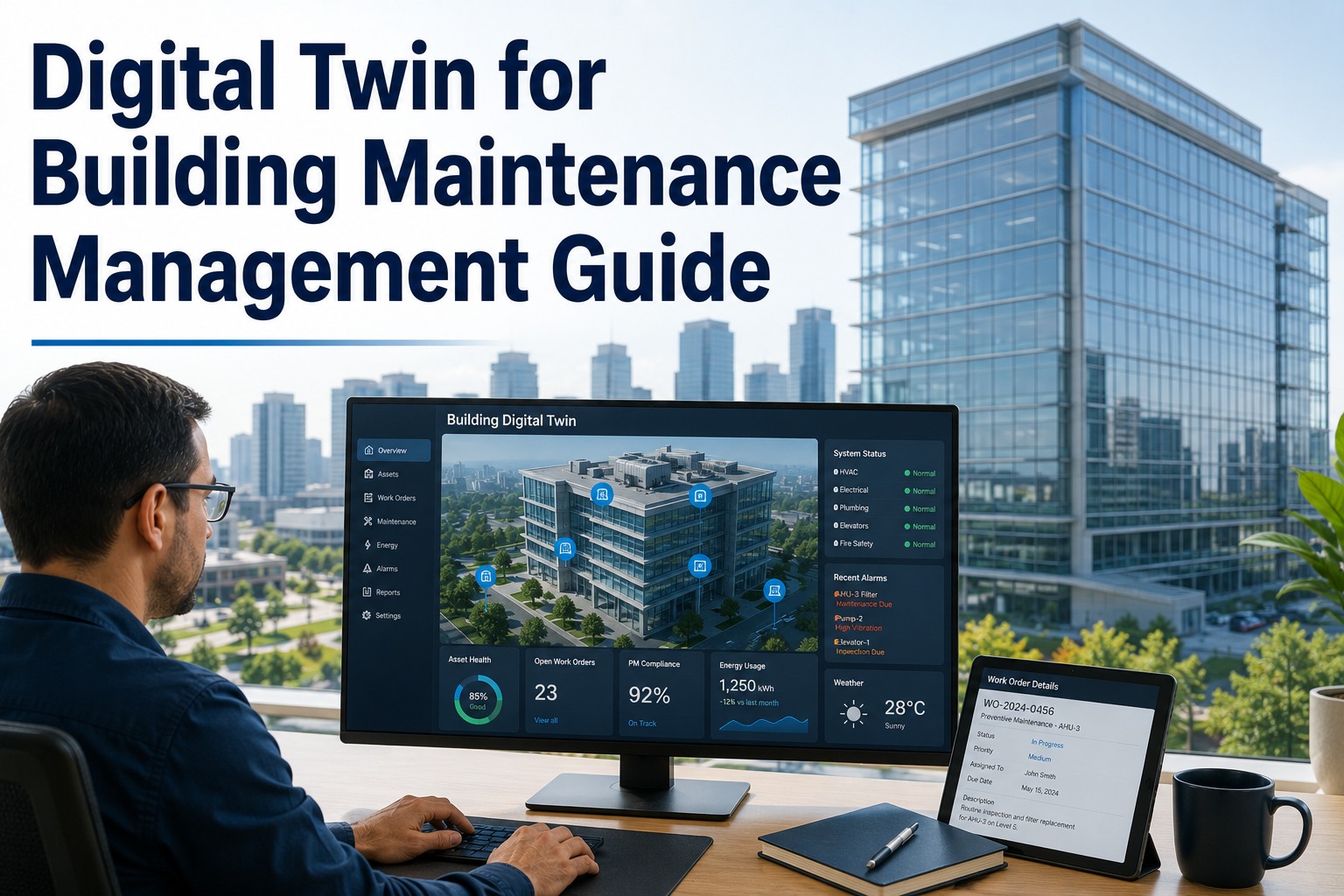
A digital twin for building maintenance is a live, data-linked virtual replica of your facility's physical assets, systems, and spaces that fuses BIM geometry, real-time sensor telemetry, and CMMS work-order execution into one operating model. Facility teams deploy a building digital twin to move from reactive, calendar-based upkeep to condition-driven, model-based maintenance planning—cutting unplanned downtime, extending asset life, and shrinking energy spend by 15–25% within the first year. OxMaint operationalizes that vision by making every work order twin-linked, every asset model-driven, and every preventive task traceable to live BAS and BIM data. Ready to see the platform on your portfolio? You can Start Free Trial or book a personalized walkthrough today.
Digital Twin + CMMS Integration Guide
What if every work order opened directly inside a living 3D model of your building?
A facility digital twin fuses BIM, live IoT sensors, and maintenance execution into one source of truth—so technicians see the asset, its history, its current health, and the exact task in a single screen. OxMaint is the CMMS layer that makes the twin actionable.
Why Digital Twins for Building Maintenance
The shift from static BIM models to living facility twins
Building Information Modeling (BIM) gives you a precise geometric model at handover—but within 18 months, over 60% of that data goes stale because it is disconnected from daily operations. A smart building digital twin solves this by continuously syncing the 3D model with live building automation system (BAS) feeds, meter data, and CMMS work-order histories.
Consider a 500,000 sq ft commercial portfolio spending roughly $1.2M annually on reactive HVAC and electrical repairs. By mapping assets into a digital twin facility management platform, the team identifies vibration anomalies in primary chillers 3–6 weeks before catastrophic failure—deferring a $120K emergency replacement into a planned $25K weekend service.
Implementation Timeline
How to deploy a building maintenance digital twin in 6 months
Operationalizing a digital twin for FM is not a single software purchase; it is a phased integration of asset data, telemetry, and maintenance workflows. Here is the realistic month-by-month path to value.
Asset Hierarchy & BIM Ingestion
Consolidate spreadsheets, PDFs, and COBie data. OxMaint structures the hierarchy so every asset has a GPS/3D coordinate linking it to the twin model.
BAS & Sensor Integration
Connect building automation feeds (BACnet, Modbus) and IoT meters to the twin. Live temperature, pressure, and vibration data begin flowing into asset records.
Work Order Linkage
Activate digital twin work orders. Click an asset in the 3D model to view history, open a corrective task, or trigger a PM—bridging the gap between model and CMMS.
Failure Simulation & Analytics
Run predictive scenarios. The twin flags assets approaching failure thresholds based on historical run-time and live sensor degradation curves.
Model-Driven Maintenance Optimization
Shift PMs from rigid calendar schedules to condition-based triggers. The twin optimizes spare-parts inventory and routes technicians automatically.
Capability Comparison
Smart building twin vs. legacy CMMS and static BIM
Facility leaders often ask whether a digital twin CMMS is just a repackaged BIM viewer or a standard CMMS with a 3D plugin. The structural differences below show why integrated twin-linked work orders deliver measurably better outcomes.
| Capability | Static BIM / COBie | Legacy CMMS | Digital Twin CMMS |
|---|---|---|---|
| Asset Data Freshness | Decays after handover | Updated manually | Live sensor sync |
| Spatial Context | High (3D geometry) | None (text rows) | Full 3D + live telemetry |
| Work Order Trigger | Not supported | Calendar / meter-based | Condition / anomaly-based |
| Failure Simulation | Not supported | Reactive history only | Predictive modeling |
| Mean Time to Repair (MTTR) | N/A | Baseline (4–8 hrs) | Reduced 20–30% |
How OxMaint Helps
Operationalizing the facility digital twin with OxMaint
A digital twin is only as valuable as the maintenance actions it triggers. OxMaint is the AI-powered CMMS and EAM layer that turns 3D models and sensor streams into daily operational value—transforming how teams plan, execute, and audit facility maintenance.
Twin-Linked Work Orders
Click any asset in the virtual model to instantly view its maintenance history, open PMs, and live sensor status. Technicians arrive with full context, eliminating diagnostic time and cutting MTTR by up to 30%.
Model-Driven Maintenance Planning
OxMaint analyzes twin data to auto-generate PM schedules based on actual asset degradation, not arbitrary calendar dates. This eliminates unnecessary maintenance and reduces labor costs by 15–20%.
BAS & BIM Data Integration
Native connectors for BACnet, Modbus, and COBie ensure your building twin management platform is never out of sync. Real-time telemetry feeds directly into predictive maintenance algorithms.
Audit-Ready Compliance Tracking
Every action taken on the twin is automatically logged against the asset record. Achieve ISO 55000 alignment and pass safety, insurance, and regulatory audits with one-click reporting.
Real-World Impact
Measuring the ROI of a building maintenance digital twin
When facility digital modeling is tied to work execution, the financial impact is immediate and measurable. Here is the typical value breakdown for a mid-sized commercial portfolio.
Reduction in HVAC energy spend by tuning equipment operation to real-time load profiles and occupancy data from the twin.
Added to major equipment (chillers, AHUs) by catching micro-failures early and optimizing preventive maintenance cadence.
Reduction in carrying costs by linking parts consumption to predictive models and actual condition data.
See OxMaint on your assets — book a 30-min demo
Discover how to connect your building data, sensors, and work orders into one intelligent operating model.
Frequently Asked Questions
Digital twin building maintenance FAQs
What is a digital twin in building maintenance?
A digital twin for building maintenance is a dynamic virtual replica of a facility's physical assets, systems, and spaces. Unlike a static 3D model, it continuously ingests real-time sensor data from building automation systems and links directly to CMMS work orders, allowing facility teams to monitor performance, simulate failures, and trigger maintenance actions from within the model.
How does a digital twin integrate with a CMMS?
Integration happens by linking the asset hierarchy in the CMMS to the objects in the 3D model using shared identifiers. When a sensor in the twin detects an anomaly, it automatically generates a work order in the CMMS. OxMaint acts as this bridge natively—learn how by scheduling a demo at Calendly.
What is the difference between BIM and a digital twin for FM?
BIM (Building Information Modeling) is primarily a design and construction tool that produces a static geometric model. A digital twin for facility management (FM) takes that BIM data and makes it "live" by continuously feeding it real-time IoT sensor data, occupancy metrics, and maintenance execution histories, turning it into an operational tool rather than just a design document.
How much does it cost to implement a facility digital twin?
Costs vary based on portfolio size and sensor infrastructure, but facilities typically see ROI within 12–18 months. The largest cost drivers are IoT sensor installation and data integration. Starting with a CMMS that supports digital twin workflows, like OxMaint, minimizes integration costs. You can explore pricing and features by starting a free trial.
Can a digital twin predict equipment failures?
Yes. By analyzing historical run-time data alongside live sensor inputs like vibration, temperature, and pressure, a smart building digital twin can identify degradation patterns. This allows maintenance teams to simulate failure scenarios and perform condition-based interventions 3–6 weeks before a catastrophic breakdown occurs, significantly reducing unplanned downtime.
Turn your building data into daily maintenance value
OxMaint unifies BIM, sensors, and work orders into one AI-powered platform. Stop reacting to failures and start optimizing your assets.
Free 14-day trial · No credit card