Total Productive Maintenance (TPM): Complete Implementation Guide

Connect with Industry Experts, Share Solutions, and Grow Together!

Join Discussion Forum
blogposttotal-productive-maintenance-tpm-guide

Total Productive Maintenance emerged in Japan during the 1960s as manufacturing plants shifted from reactive repairs to proactive equipment ownership. TPM transforms maintenance from a cost center into a competitive advantage by engaging operators, technicians, and managers in eliminating the six big losses that suppress production output. Manufacturing plants implementing TPM report OEE improvements from 45–65% baseline to 85% world-class performance within 18–24 months — translating to 15–30% reduction in maintenance costs and 20–40% increase in equipment availability. Start a free trial of OxMaint to build autonomous maintenance schedules, track OEE by asset, and deploy the 8 TPM pillars across your facility with structured PM programs and operator-led inspection workflows. Book a demo to see TPM implementation tracking in OxMaint.

Lean Manufacturing · Zero Breakdowns · OxMaint

Total Productive Maintenance (TPM): Complete Implementation Guide

8 pillars to eliminate equipment losses, achieve 85% OEE, and transform operators into maintenance partners — structured for manufacturing plants in OxMaint.

OEE Journey with TPM
Baseline — No TPM
48%
Reactive maintenance · High breakdown rate
6 Months — AM + PM Active
62%
Operator ownership · Planned downtime only
18 Months — Full TPM Rollout
85%
World-class · Zero unplanned stops
85%
world-class OEE benchmark — most plants start at 45–65% before TPM and reach 80–85% within 18–24 months

30%
reduction in maintenance costs reported after full TPM implementation across all 8 pillars

6 Big Losses
equipment failures, setup/changeover delays, minor stops, reduced speed, startup defects, production rejects

5S Foundation
Sort, Set in Order, Shine, Standardize, Sustain — the workplace organization base required before TPM rollout
Definition

What is Total Productive Maintenance?

Total Productive Maintenance is a company-wide equipment effectiveness strategy that eliminates the six major production losses by engaging operators, maintenance teams, and managers in proactive equipment care. TPM shifts maintenance responsibility from a centralized department to frontline operators who clean, inspect, and perform basic maintenance on their own equipment — while specialized maintenance teams focus on planned preventive work and technical repairs. The goal is zero breakdowns, zero defects, and zero accidents through systematic improvement of Overall Equipment Effectiveness.
Origin
Developed by Seiichi Nakajima at Nippondenso in Japan between 1950–1970 as a response to increasing equipment complexity and the need for higher reliability.
Core Principle
Equipment ownership by operators — not just operation, but cleaning, inspection, lubrication, and minor adjustments to prevent deterioration.
Key Metric
OEE — Overall Equipment Effectiveness calculated as Availability × Performance × Quality, targeting 85% world-class standard.
Who Participates
Everyone — operators perform autonomous maintenance, maintenance teams execute planned work, managers lead Kaizen events, and engineers optimize equipment design.
Core Framework

The 8 Pillars of TPM — Your Complete Implementation Roadmap

Each pillar targets specific equipment losses and requires cross-functional ownership. Successful TPM plants implement pillars sequentially, starting with Autonomous Maintenance and Planned Maintenance as the foundation. Start a free trial to configure TPM pillar tracking in OxMaint or book a demo to see pillar-based reporting dashboards.

01
Autonomous Maintenance
Operators take ownership of basic equipment care — cleaning, inspection, lubrication, and minor adjustments. This frees maintenance teams to focus on technical work while operators catch deterioration early before it causes failures.
7-Step AM Rollout
Initial cleaning to expose abnormalities
Eliminate sources of contamination and inaccessible areas
Create cleaning and lubrication standards
Conduct general equipment inspection training
Autonomous inspection execution
Workplace organization and standardization
Full autonomous maintenance deployment
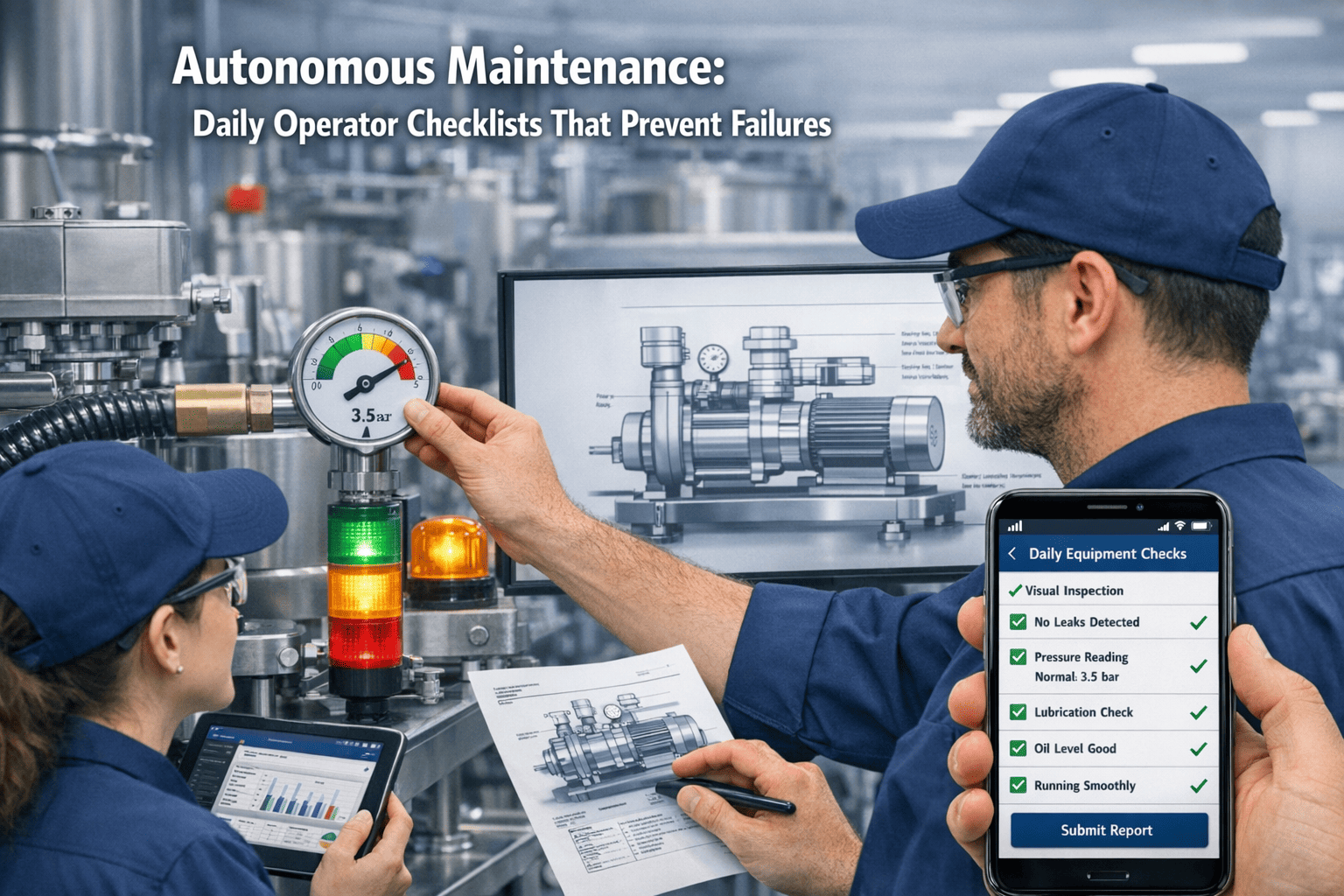
OxMaint: Operator inspection checklists with photo capture, digital lubrication schedules, and mobile-first execution — all tracked per asset with completion history.
02
Planned Maintenance
Scheduled preventive maintenance based on time, operating hours, or production cycles to prevent breakdowns before they occur. PM tasks are designed to maintain equipment in optimal condition and extend asset life.
PM Program Elements
Equipment criticality assessment and PM priority ranking
Time-based and condition-based PM schedule development
Spare parts inventory optimization for PM requirements
PM vs CM cost analysis and interval optimization
OxMaint: Auto-generated PM work orders by calendar, runtime hours, or production units — with parts lists, procedure attachments, and downtime coordination with production schedules.
03
Focused Improvement (Kaizen)
Cross-functional teams systematically eliminate chronic losses through root cause analysis and structured problem-solving. Kaizen events target recurring issues like micro-stops, speed losses, setup delays, and quality defects that traditional maintenance cannot fix.
Kaizen Process
Select high-impact loss area from OEE data
Form cross-functional improvement team
Root cause analysis using 5 Why and Fishbone
Implement and verify countermeasures
Standardize the improvement and share learnings
OxMaint: Loss tracking by category, Kaizen project management module, and before/after OEE comparison dashboards to prove improvement ROI.
04
Quality Maintenance
Link maintenance activities directly to product quality by preventing defects at the source. Equipment condition variations — worn guides, contamination, temperature drift — cause most quality issues before they are detected in final inspection.
Quality-Maintenance Connection
Identify equipment conditions that affect product specs
Establish condition tolerances for quality-critical parameters
Integrate quality checks into PM and operator inspections
Trigger maintenance before quality drift occurs
OxMaint: Quality parameter logging on inspection checklists, defect-triggered maintenance workflows, and quality-linked asset condition scoring.
05
Training & Education
Build technical competency and TPM culture through structured training programs. Operators learn basic maintenance skills, maintenance teams develop advanced diagnostic capabilities, and managers master continuous improvement methodologies.
Training Tracks
Operator — equipment function, cleaning, basic troubleshooting
Maintenance — root cause analysis, predictive techniques
Engineering — equipment design for maintainability
Management — TPM leadership and performance tracking
OxMaint: Training records per user, competency tracking, and work order assignment based on certified skills — ensuring only qualified personnel execute critical tasks.
06
Early Equipment Management
Design maintenance requirements into new equipment before installation. Incorporate lessons learned from existing assets — access for cleaning, spare parts standardization, mean time to repair targets — into procurement specifications and commissioning plans.
New Equipment Checklist
Maintenance requirements defined in equipment spec
Spare parts inventory established before installation
Operator and maintenance training during commissioning
PM schedules and autonomous maintenance standards ready at startup
OxMaint: New asset onboarding workflow — PM templates, parts lists, documentation uploads, and training tracking built into the asset record before go-live.
07
Safety, Health & Environment
Eliminate accidents, hazardous conditions, and environmental incidents through proactive hazard identification and risk mitigation. TPM philosophy of zero accidents aligns with zero breakdowns — unsafe equipment is unreliable equipment.
Safety Integration
Equipment safety inspections in autonomous maintenance
Lockout/tagout procedures verified before PM execution
Near-miss reporting and corrective maintenance
Environmental compliance checks on lubrication and waste disposal
OxMaint: Safety observation logging, LOTO checklist enforcement, incident-triggered work orders, and HSE reporting per asset and facility.
08
Office TPM
Apply TPM principles to administrative and support functions — production scheduling, materials management, engineering, HR — to eliminate waste in information flow, reduce lead times, and improve cross-department coordination that impacts equipment uptime.
Support Function Targets
Production scheduling — optimize equipment utilization and PM windows
Procurement — reduce spare parts lead time and stockouts
Engineering — design for reliability and ease of maintenance
Data management — accurate asset records and work order documentation
OxMaint: Cross-department visibility into maintenance schedules, automated procurement workflows, and asset data integrity tools for engineering and operations.

Ready to Deploy the 8 TPM Pillars in Your Facility?

Autonomous maintenance checklists · Planned PM schedules by asset · OEE tracking with loss categorization · Kaizen project management · Training records per user · Safety observation workflows.

Six Big Losses

What TPM Eliminates — The Equipment Losses Killing Your OEE

TPM targets six categories of production loss that suppress equipment effectiveness. Each loss maps to specific OEE components and requires different pillar interventions.

Availability Loss
1
Equipment Failures
Unplanned breakdowns requiring repair. Targeted by Autonomous Maintenance and Planned Maintenance pillars.
2
Setup & Changeover
Time lost switching between products or adjusting equipment. Reduced through Focused Improvement and operator training.
Performance Loss
3
Minor Stops
Short interruptions under 5 minutes — jams, sensor trips, material feed issues. Eliminated through root cause Kaizen.
4
Reduced Speed
Running below ideal cycle time due to wear, poor adjustment, or operator hesitation. Fixed by Quality Maintenance and training.
Quality Loss
5
Startup Rejects
Defective parts produced during equipment warmup or after changeover. Prevented by Early Equipment Management standards.
6
Production Defects
Bad parts during normal running caused by equipment condition drift. Caught early through Quality Maintenance integration.
TPM Prevention Strategy
AM
Autonomous Maintenance
Operators prevent losses 1, 3, 4 through daily cleaning, inspection, and minor adjustments that catch deterioration early.
PM
Planned Maintenance
Scheduled technical work prevents losses 1, 2, 4, 5 by maintaining equipment in optimal condition before failures occur.
OEE Formula

How TPM Improves Overall Equipment Effectiveness

OEE = Availability × Performance × Quality
Availability
Operating Time ÷ Planned Production Time
Time equipment is actually running vs scheduled time. TPM improves this through Autonomous Maintenance and Planned Maintenance — preventing breakdowns and minimizing changeover time.
Example: 420 min operating ÷ 480 min planned = 87.5%
Performance
(Ideal Cycle Time × Total Count) ÷ Operating Time
Speed efficiency — how close to maximum design rate. TPM targets this through Focused Improvement to eliminate minor stops and speed losses.
Example: (6 sec × 3800 units) ÷ 25200 sec = 90.5%
Quality
Good Count ÷ Total Count
First-pass yield — parts meeting spec without rework. TPM improves this via Quality Maintenance linking equipment condition to defect prevention.
Example: 3685 good ÷ 3800 total = 97.0%
Final OEE Calculation
87.5% × 90.5% × 97.0% = 76.8%
This plant is 8.2 points below world-class 85% — TPM Focused Improvement would target the performance gap first
Before vs After

Reactive Maintenance vs TPM — The Shift That Transforms Production

Dimension Reactive Maintenance TPM Approach
Equipment Ownership Operators run equipment, maintenance fixes breakdowns — clear role separation with no cross-training Operators own basic maintenance (cleaning, inspection, lubrication), maintenance teams handle technical PM and repairs
Maintenance Trigger Equipment fails, production stops, maintenance is called — unplanned downtime averages 4–8 hours per event Time-based or condition-based PM prevents failures before they occur — downtime scheduled during production gaps
Typical OEE Range 40–55% with high variability week to week due to unpredictable breakdowns 75–85% with stable performance as chronic losses are systematically eliminated
Maintenance Cost Profile High emergency repair costs, expedited parts shipping, overtime labor — reactive work costs 3–5x planned work Predictable PM budgets, bulk parts ordering, scheduled labor — 25–30% lower total maintenance spend
Operator Engagement Operators wait for maintenance to arrive, limited understanding of equipment condition or failure modes Operators detect abnormalities early through daily inspections, participate in Kaizen to solve recurring problems
Data Availability Maintenance history exists but not analyzed — no loss tracking, root causes unknown, repeat failures common OEE tracked per asset with loss categorization, trends analyzed monthly, improvement projects prioritized by data
Quality Impact Equipment condition drifts until defects appear in final inspection — quality issues detected late with high scrap cost Quality Maintenance links equipment parameters to product specs — condition monitoring prevents defects at source
Cultural Outcome Firefighting mentality, blame between departments, resignation to "that machine always breaks" Continuous improvement culture, cross-functional problem solving, pride in equipment reliability achievements
Implementation Results

TPM Impact — Real Performance Gains from Manufacturing Plants

30.6% → 71.6%
OEE Improvement
Electronics manufacturer implementing full TPM across machining centers over 18 months — availability and performance gains drove 41-point OEE increase.
Source: Manufacturing case study, 2020
80% Reduction
Breakdown Costs
Polymer component plant adding Autonomous Maintenance and Planned Maintenance pillars — unplanned failures nearly eliminated, OEE rose from 75% to 85%.
Source: Plastics industry TPM analysis
15–20%
OEE Gain First Year
Automotive and pharmaceutical manufacturers reporting typical first-year OEE improvements after implementing Pillars 1–3 (AM, PM, Focused Improvement).
Source: Multi-industry TPM survey data
25–30%
Maintenance Cost Reduction
Typical cost savings over 3–5 years of sustained TPM — shift from expensive reactive repairs to predictable planned work with better parts procurement.
Source: TPM implementation benchmarks
54% → 62%
Machining Center OEE
Precision machining plant using TPM with SMED and line balancing to improve CNC machining center effectiveness within 6 months.
Source: CNC machining OEE study, 2020
12% Profit Increase
Bottom-Line Impact
Small manufacturer achieving 10-point OEE gain through TPM — higher throughput and lower maintenance costs directly improved profitability.
Source: Small plant TPM ROI analysis

Start Your TPM Journey — See OxMaint Managing the 8 Pillars

Build operator inspection checklists · Schedule PM by time, hours, or production units · Track OEE per asset with automated loss calculation · Manage Kaizen projects with before/after comparison · Log training records and certify operators · Integrate safety observations into maintenance workflows.

FAQ

Total Productive Maintenance — Common Questions

How long does TPM implementation take to show measurable OEE improvement?

Most plants see initial OEE gains within 3–6 months after deploying Autonomous Maintenance and Planned Maintenance pillars on a pilot production line. Baseline OEE is established in month 1, operator training and 5S cleanup occurs in months 2–3, and autonomous inspections with scheduled PM begin in month 4 — producing measurable availability and minor stop reductions by month 6. Full facility rollout across all 8 pillars typically takes 18–36 months to reach world-class 85% OEE, with continuous improvement sustaining gains long-term. Start a free trial to configure TPM pilot tracking in OxMaint.

What is the difference between TPM and preventive maintenance?

Preventive maintenance is one pillar within TPM — it focuses on scheduled maintenance tasks to prevent failures. TPM is a broader cultural transformation that includes PM but also adds operator ownership through Autonomous Maintenance, systematic loss elimination via Focused Improvement Kaizen, equipment-quality linkage through Quality Maintenance, and continuous skill development through Training. Traditional PM programs keep maintenance as a separate department activity, while TPM distributes maintenance responsibility across operators, technicians, engineers, and managers working together toward zero breakdowns. Book a demo to see how OxMaint supports both PM schedules and full TPM pillar deployment.

Which TPM pillar should we implement first?

Start with Pillar 1 Autonomous Maintenance and Pillar 2 Planned Maintenance simultaneously on a single pilot production line. Autonomous Maintenance builds operator ownership and catches deterioration early, while Planned Maintenance ensures technical work is scheduled before failures occur — together these two pillars form the foundation that enables other pillars to succeed. Attempting Focused Improvement or Quality Maintenance before establishing basic AM and PM routines typically fails because there is no stable baseline to improve from. After 4–6 months of AM and PM execution with measurable OEE gains, expand to Pillar 3 Focused Improvement to tackle chronic losses the first two pillars cannot eliminate. Sign in to OxMaint to build your TPM pilot roadmap.

Can TPM work in small manufacturing plants or is it only for large facilities?

TPM scales effectively to small plants — the principles of operator ownership, planned maintenance, and loss elimination apply regardless of facility size. Small manufacturers often see faster TPM deployment because there are fewer organizational layers and operators have closer relationships with equipment. A 10-person machine shop can implement Autonomous Maintenance and basic PM on 5 critical assets within 90 days, while a 500-person automotive plant may take 6 months to pilot the same pillars on one production line due to coordination complexity. The key success factor is management commitment and willingness to train operators in basic maintenance skills, not facility size. Book a demo to see TPM configuration for small and mid-size plants in OxMaint.
By Jack Edwards

Experience
Oxmaint's
Power

Take a personalized tour with our product expert to see how OXmaint can help you streamline your maintenance operations and minimize downtime.

Book a Tour

Share This Story, Choose Your Platform!

Connect all your field staff and maintenance teams in real time.

Report, track and coordinate repairs. Awesome for asset, equipment & asset repair management.

Schedule a demo or start your free trial right away.

iphone

Get Oxmaint App
Most Affordable Maintenance Management Software

Download Our App