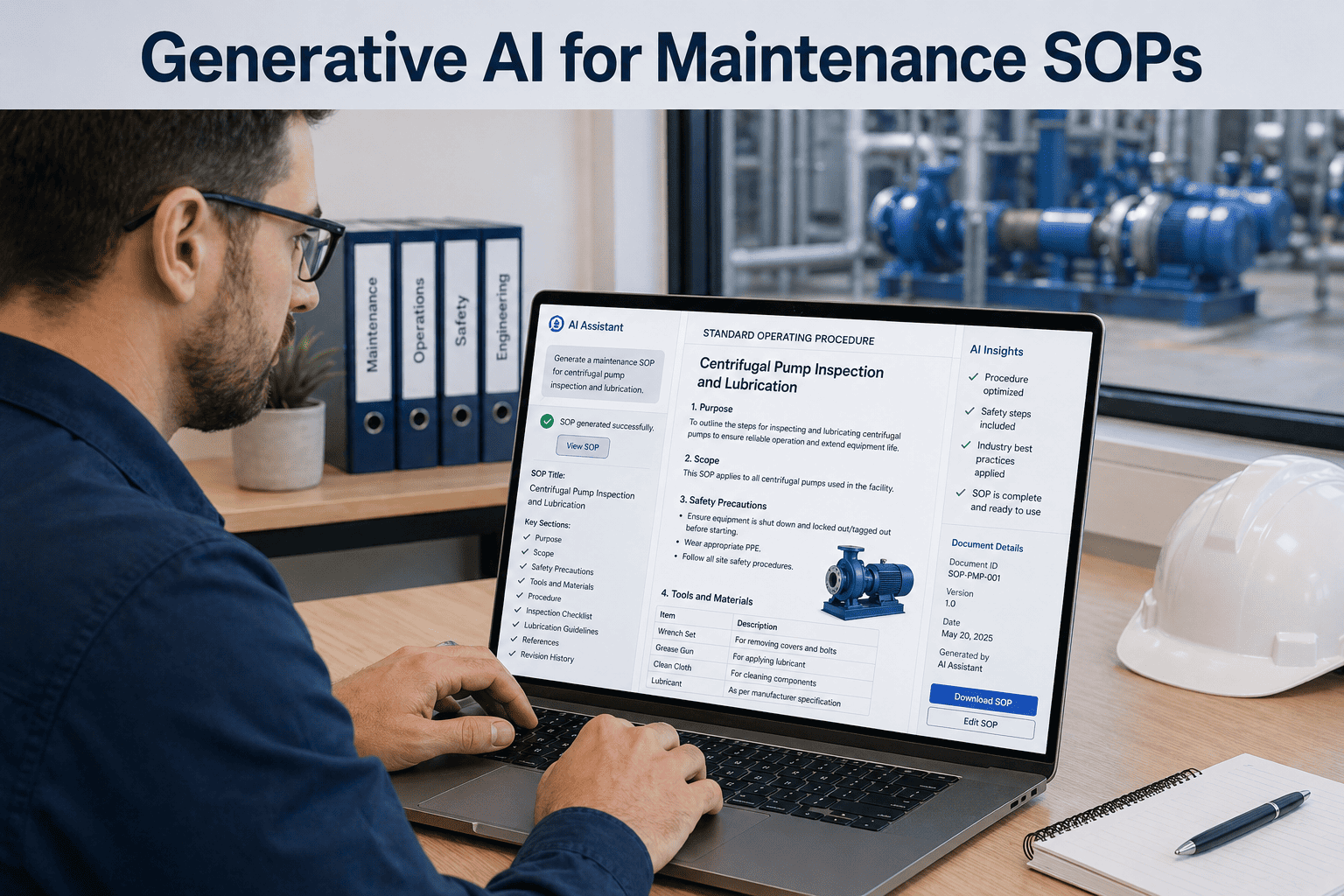
A reliability engineer at a continuous-process plant spent eleven hours last quarter writing a 14-page Standard Operating Procedure for replacing the seal stack on a centrifugal pump. The SOP needed to align with ISO 55000, OSHA lockout-tagout, the OEM service manual, the plant's safety permit framework, and the existing PM history of similar pumps. The same engineer can now produce that same document in 9 minutes — not because she types faster, but because OxMaint's generative AI module reads the asset record, pulls the OEM specs, references prior similar work orders, applies the plant's compliance template, and drafts an SOP that she edits rather than writes from scratch. Maintenance teams using generative AI for documentation report 78% faster SOP creation, 64% fewer documentation gaps in audits, and 3.2x more current procedures across their asset library. The shift is not from "human writing" to "AI writing" — it is from "starting blank" to "editing a strong draft." If you want to see the SOP generator produce a procedure for one of your real assets, you can start a free trial and run your first generation in five minutes, or book a demo with a solutions engineer who will walk through the document quality controls.
Generative AI · Maintenance Documentation
Generative AI for Maintenance SOPs & Documentation
A practical guide to using generative AI to draft SOPs, inspection reports, failure summaries, and compliance documents — producing procedures in minutes that used to take days, with the consistency audit teams expect.
Reduction in time spent drafting maintenance SOPs and procedures with generative AI assistance
64%
Fewer documentation gaps identified in compliance audits across plants using AI-assisted documentation
3.2x
More current SOPs across the asset library — documentation backlog measurably shrinks within 90 days
11 hrs to 9 min
Typical drop in time-to-draft for a complex multi-step maintenance procedure (industry averaged)
Documentation as a Solved Problem
Your Best Engineers Should Not Be Spending Friday Afternoons in a Word Document
Every SOP, inspection report, failure summary, and audit response your team writes from scratch is hours of senior reliability time spent on a task generative AI can complete in minutes — with the asset context, prior history, and compliance framing already wired in. The output still gets reviewed and approved. The starting line just moves from blank to 80% drafted.
What Generative AI for Maintenance Documentation Means
Generative AI for maintenance documentation is a class of system that produces structured, compliant, asset-specific maintenance documents from a combination of three inputs: the asset's data record, the plant's documentation templates and compliance requirements, and a brief natural-language prompt from the engineer ("draft an SOP for replacing the seal stack on Pump CT-04"). The model outputs a fully formatted document — with safety prerequisites, tools, parts, step-by-step procedure, verification checks, and references — that the engineer reviews, edits, and approves. The AI does the synthesis. The human does the verification. To see the generator produce a procedure for one of your real assets, you can book a demo with the OxMaint AI team.
6 Document Types Generated Inside OxMaint
Standard Operating Procedures
Step-by-step procedures with safety prerequisites, isolation steps, tool list, parts list, verification checks, and acceptance criteria. ISO 55000 and OEM-aligned.
Generation: 6-12 min
Inspection Reports
Auto-summary of inspection findings, photos, condition scores, and recommended actions — consolidated into a board-ready report from raw inspection data.
Generation: 2-4 min
Failure Investigation Summaries
Root-cause analysis drafts with timeline reconstruction, contributing factor identification, and corrective action proposals — from work order data and operator notes.
Generation: 4-8 min
Permit-to-Work Documents
Hot-work, confined-space, lockout-tagout, and electrical permits drafted from the asset profile and the work scope — with hazard list and control measures pre-populated.
Generation: 3-5 min
Audit & Compliance Responses
First-draft replies to audit findings — OSHA, FDA, ISO 55001, FAA, NHS Estates — with corrective action plans and supporting evidence references.
Generation: 5-10 min
Toolbox Talks & Briefings
Pre-shift safety talks, hazard-of-the-week briefings, and craft-specific knowledge-share documents tied to actual recent events on the plant.
Generation: 2-3 min
6 Pain Points Manual Documentation Creates Every Day
P1
Senior-Engineer Time Drain
Reliability engineers earning $140-180k spend 18-26% of their week writing documentation that AI can draft to 80% completion in minutes.
P2
Inconsistent Format & Voice
Different authors produce different SOP styles, depth, and structure. Audit teams flag inconsistency as a control weakness even when content is correct.
P3
Outdated Procedures
Average plant has 30-50% of its SOPs more than 24 months out of date. Equipment changes, but the documentation refresh cycle never closes the gap.
P4
Compliance Template Drift
ISO, OSHA, and FDA template requirements update; legacy documents do not. Audit response cycles consume weeks fixing format that AI templates enforce automatically.
P5
Tribal Knowledge Lost
Senior technicians retire with undocumented procedures stuck in their heads. Without AI-assisted capture from work order notes, that knowledge walks out the door.
P6
Translation Bottleneck
Multi-site operations require SOPs in 3-7 languages. Manual translation is slow and inconsistent. Generative AI handles localisation as part of the same workflow.
How OxMaint Generates Documents That Pass Review
The generation pipeline is not a generic prompt to a public model. OxMaint grounds every output in four sources of truth that determine document quality and audit-readiness, and applies a four-stage quality control loop before the engineer ever sees the draft. To inspect the document quality controls and grounding sources for your industry's compliance frame, you can start a free trial and load a sample SOP for refinement.
A
Asset Context
Make, model, serial, install date, OEM service manual references, current condition score, runtime hours, recent failure history.
B
Compliance Templates
Plant's approved SOP format, regulatory framework (OSHA, FDA, ISO 55001, FAA), safety permit structure, and approval workflow.
C
Historical Procedures
Existing SOPs for similar assets, prior work orders for the same maintenance activity, lessons-learned from prior failures, technician notes.
D
Engineer Prompt
A short natural-language description of the document to generate. The engineer specifies scope, audience, and any specific constraints.
4-Stage Quality Control Before Engineer Review
QC 01
Factual Grounding
Every claim about the asset (specs, runtime, failure history) is verified against the actual data record — not generated. Hallucination at this layer is structurally prevented.
QC 02
Compliance Check
The draft is verified against the plant's compliance template — required sections, mandatory safety steps, approval signatures — before it reaches the engineer.
QC 03
Safety Logic Validation
Lockout-tagout, isolation, and confined-space prerequisites are validated against the asset's hazard profile. The model cannot produce an SOP that skips required safety steps.
QC 04
Reference Citation
Every figure, spec, or torque value is annotated with its source — OEM manual page, prior WO ID, ISO clause — so the engineer can verify each piece in seconds.
Manual SOP Creation vs OxMaint Generative AI
Stage
Manual Authoring
OxMaint Generative AI
Initial draft time
8-14 hours per SOP
9-12 minutes per SOP
Asset data lookup
Manual cross-reference of 4-6 systems
Auto-pulled from asset record
Compliance template adherence
Author memory and judgement
Template-enforced structure
Safety step completeness
Author discretion
Hazard-profile-driven validation
Format consistency across authors
High variance
Single template output
Translation to other languages
Separate workflow, weeks of lag
Integrated — same generation, multiple languages
Update cycle when equipment changes
Manual edit, often skipped
Re-generation with new asset data
Engineer time per document
8-14 hours
30-60 minutes (review & approve)
ROI Snapshot from AI-Documented Plants
78%
Faster SOP creation cycle
From 11 hours average to 2.4 hours including engineer review
64%
Fewer audit documentation gaps
Template enforcement closes the structural compliance shortfall
3.2x
More current procedures
Re-generation cost low enough to keep documentation fresh
$184K
Annual senior engineer time saved
Per 4-engineer reliability team at typical compensation rate
Frequently Asked Questions
How does OxMaint prevent hallucinations in technical specifications and torque values?
Specifications are not generated — they are retrieved. Every torque value, clearance, fluid spec, and dimension cited in a generated SOP is pulled from a verified source (OEM manual, asset record, prior approved SOP) and annotated with its origin. The model writes the structure and prose around the verified data, but cannot invent specifications. This grounding is the core differentiator from generic LLM document tools.
What level of engineer review is still required after generation?
Engineer review is non-optional and built into the workflow. The AI produces a structured draft — typically 80-90% complete — that the engineer reviews for technical accuracy, plant-specific judgment, and final approval. Time per document drops from 8-14 hours of authoring to 30-60 minutes of review and refinement, freeing the engineer for higher-value reliability engineering work.
Which compliance frameworks does the document generator align with?
Pre-built templates exist for OSHA 1910 LOTO, ISO 55001, FDA 21 CFR Part 11 and Part 820, FAA Part 145, NHS Estates HTM/HBN, EU Machinery Directive, and Vision 2030 facility standards. Custom templates can be added per plant or per regulatory regime — the model adapts to the template structure rather than imposing its own format.
Does the AI work for multi-language plants and translated documentation?
Yes — document generation is multi-lingual at the core. A single source SOP can be generated in English, Spanish, German, French, Arabic, Hindi, Mandarin, or Portuguese as part of the same workflow. The translation is grounded in the same source data, so technical specifications and safety steps remain consistent across language variants without separate translation projects.
Generative AI · Documentation That Stays Current
Stop Writing Documentation From Scratch. Start From a Strong Draft.
Your reliability engineers, maintenance managers, and compliance leads have better things to do than spend Friday afternoons rewriting an SOP that hasn't been touched in three years. OxMaint's generative AI module produces audit-ready documents grounded in your real asset data, your real templates, and your real compliance framework — in minutes, not days. The engineer's role moves from author to reviewer. The documentation backlog shrinks. The audit response gets faster. The procedures stay current.