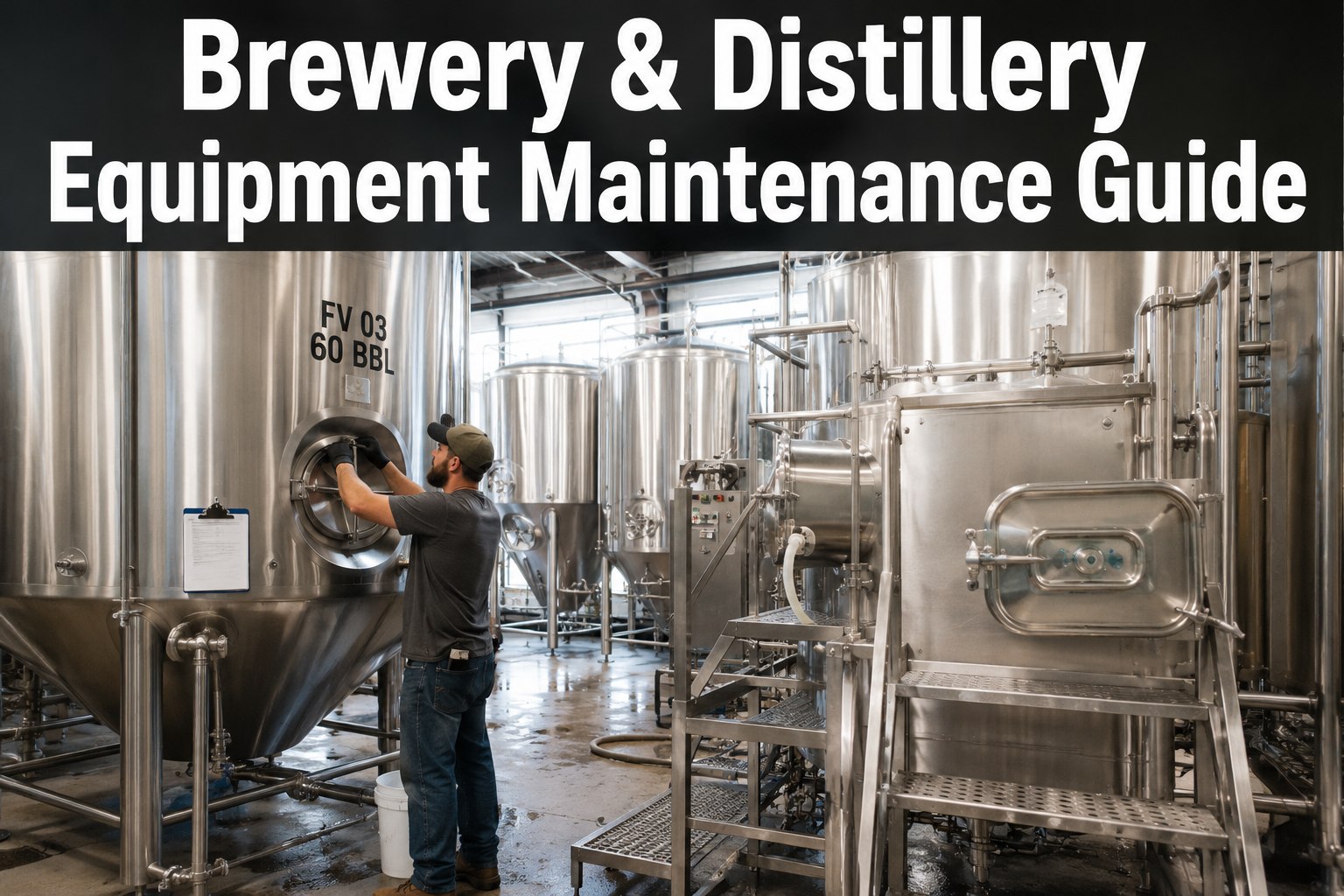
A craft brewery or distillery is a food manufacturing plant with the temperament of a biology laboratory and the regulatory backdrop of a taxed federally-controlled substance. The 30-barrel fermenter that produces $12,000 of finished beer per batch is a stainless-steel pressure vessel with a food-contact interior that must be sanitized to a specification tight enough to keep wild yeast, lactobacillus, and pediococcus from ending an entire brand. The plate-and-frame heat exchanger cooling wort from a rolling boil to yeast-pitching temperature is a fouling-prone precision instrument that will silently reduce heat transfer 20% before anyone notices. The counter-pressure filler on a canning line rated for 150 cans per minute is a hydraulic-pneumatic system whose seals, sensors, and fill valves fail in dozens of ways, each of which turns product-run day into rework day. And every batch, every gallon, every case produced, and every drop dumped is recorded in the brewer's or distiller's daily register that the TTB may audit at any time during the standard three-year retention window. This guide walks through the production process flow that gives every piece of equipment its purpose, the CIP sanitation cycle that separates a functioning brewery from a contaminated one, the fermentation progression curve that dictates when the next tank turn can begin, the equipment portfolio that mature programs classify for PM discipline, and the TTB record-keeping framework that keeps the federal permit intact. OxMaint gives brewmasters, distillery managers, and head brewers the CMMS platform that operationalizes every one of these disciplines with the tank-side execution the industry actually requires. Book a free demo to see brewery and distillery maintenance inside OxMaint.
01
Milling
Ambient
Roller mill · grain silo · augers
02
Mash
148-158°F
Mash tun · lauter tun · rakes
03
Boil & Whirlpool
212°F
Kettle · whirlpool · hop dosing
04
Cool & Aerate
68°F
Plate heat exchanger · O2 injection
05
Fermentation
64-72°F
Cylindroconical fermenter · glycol jackets
06
Condition & Filter
32-38°F
Brite tank · centrifuge · DE filter
07
Package
36-40°F
Canning · bottling · kegging · counter-pressure filler
Every stage is a CIP surface · every temperature target is a control point · OxMaint stores each piece of equipment against its stage and its cleaning cadence
3 Years
standard TTB record retention · brewer's daily register · production, receipt, disposition, and equipment records
6-Stage
standard CIP sanitation cycle · every tank, every line, every batch · single missed step risks the entire brand
7-14 Days
typical fermentation timeline · every day of extension is deferred capacity · every early crash is dumped batch
The CIP Sanitation Cycle — Six Stages, Zero Compromises
Clean-in-Place is the single most consequential operational discipline in brewing and distilling. A functional fermenter that has been improperly cleaned is not a fermenter — it is an infection vector. The industry-standard CIP cycle runs six sequential stages, each with defined temperature, chemical concentration, and contact time parameters. Every parameter is measurable, every parameter is verifiable, and every parameter must be documented per batch. The framework below reflects the CIP discipline mature breweries actually execute — with OxMaint capturing the CIP execution as a work order against the specific tank, with concentration titration results, temperature verification, and technician signature attached. Start a free trial to run CIP verification inside OxMaint.
Standard CIP Cycle · Six Sequential Stages
01
Pre-Rinse
100-120°F · 5-10 minutes · fresh water
Displace product residue · reduce chemical demand in caustic stage
02
Caustic Wash
160-180°F · 20-30 minutes · 2-3% NaOH
Remove organic soils · protein, hop resin, yeast residue · titration verified per cycle
03
Intermediate Rinse
Ambient · 5-10 minutes · fresh water
Displace caustic · avoid neutralization reaction with acid stage
04
Acid Wash
140-160°F · 15-20 minutes · 1-2% phosphoric or nitric
Remove mineral scale · beer stone (calcium oxalate) · passivate stainless steel
05
Final Rinse
Ambient · 10-15 minutes · brewery-quality water
Displace acid · verify pH neutral · prepare for sanitizer
06
Sanitize
Ambient · 5-10 minutes · PAA or iodophor
Final microbial reduction · vessel ready for product · no-rinse chemistry
Every parameter measured · every measurement logged · OxMaint captures the CIP cycle as a per-tank per-batch work order with photo evidence and technician signature
The Fermentation Progression Curve — Reading the Tank
Fermentation is where brewing becomes biology. A tank pitched with viable yeast at 68°F progresses through a defined sequence of phases over 7-14 days, and reading the progression correctly is the difference between a batch that finishes on schedule and a batch that stalls, over-attenuates, or develops off-flavors requiring dumping. The curve below reflects a typical ale fermentation from wort to finished green beer, with the four phases every brewer manages and the operational implications of each. OxMaint captures gravity readings, temperature, and observations against the specific tank so fermentation trends are visible across batches and across yeast generations. Book a demo to see fermentation tracking in action.
Fermentation Progression · Gravity, Temperature, Phase
1.060
1.045
1.030
1.015
1.010
D0
D1
D2
D3
D4
D5
D7
D9
D12
D14
Lag · yeast acclimation
Active · vigorous · CO2 evolution
Attenuation · gravity falling
Conditioning · diacetyl rest · cold crash
Every gravity reading logged against the tank · every temperature deviation flagged · fermentation trends visible batch-over-batch for yeast generation planning
Brewery Equipment Portfolio — PM Regime by Category
A typical craft brewery operates six or seven distinct equipment categories, each with its own PM discipline, its own failure modes, and its own consequence when it fails. The portfolio classification below reflects how mature brewing programs actually organize their maintenance schedules. OxMaint stores each piece of equipment with its category, its PM cadence, and its assigned technician so the correct discipline applies automatically. Start a free trial to classify your brewery equipment portfolio.
Brewery & Distillery Equipment Categories
Vessels
Tanks & Fermenters
Mash tun · kettle · whirlpool · fermenters · brite tanks · liquor tanks
CIP per turn · gasket & valve annual · passivation as needed
Heat Exchange
Plate Heat Exchangers
Wort chillers · glycol systems · plate packs · gaskets · sensors
Weekly performance check · quarterly plate inspection · annual full teardown
Rotating
Pumps & Centrifuges
Sanitary pumps · seals · bearings · centrifuge bowls · yeast recovery
Weekly seal check · monthly bearing · quarterly rebuild interval
Packaging
Canning & Bottling Lines
Filler · seamer · rinser · labeler · conveyor · case packer
Pre-run inspection · fill weight verification · daily changeover PM
Utilities
Steam · CO2 · Compressed Air
Boiler · CO2 tanks · air compressors · pressure regulators · gauges
Boiler certification · CO2 leak test · monthly air quality
Refrigeration
Glycol Chillers & Cold Storage
Chiller units · glycol loops · cold room · refrigerant management
Weekly temperature verify · quarterly service · annual full PM
Distillation
Stills & Column Systems
Pot stills · column stills · condensers · parrot · barrel storage
Post-run cleaning · gasket & sight glass inspection · TTB seal verification
Every Tank · Every Cycle · Every Reading — One Platform
OxMaint captures CIP execution, fermentation readings, packaging line PMs, and TTB records against the specific tank or piece of equipment · brewery operations from a tablet on the cellar floor.
TTB Compliance Records — What the Federal Auditor Reviews
Every licensed brewery and distillery in the United States operates under federal permit issued by the Alcohol and Tobacco Tax and Trade Bureau, and every permit carries record-keeping obligations that determine both federal excise tax liability and permit continuation. The record categories below reflect the standard framework brewers and distillers maintain — with three-year retention as the typical baseline and immediate production availability to the auditor during an examination. OxMaint holds every category as tracked operational data so the audit response is a report export, not a two-week reconstruction from paper logs. Book a demo to see TTB-ready record keeping inside OxMaint.
TTB Record Categories · Standard Retention Framework
Production
Daily Production Records
Brewer's or distiller's daily production register · batch number · quantity produced · classification
3-year retention
Movement
Receipt & Disposition
Ingredients received · finished goods shipped · destruction records · sample removals · losses
3-year retention
Tax
Excise Tax Returns
Federal excise tax filings · Form 5000.24 or 5130.9 · payment records · adjustments
3-year retention
Equipment
Plant & Equipment Records
Equipment inventory · capacity changes · installation records · notifications to TTB
Life of equipment
Label
Formula & Label Approvals
COLA (Certificate of Label Approval) · formula approvals · standards of identity compliance
Life of product
Physical
Inventory & Physical Counts
Bulk inventory · packaged inventory · reconciliation of production to disposition · loss accounting
3-year retention
Every category captured as operational data in OxMaint · TTB audit response becomes a report export rather than a two-week reconstruction from paper logs
Brewmaster Perspective · The Cellar Floor Is the Workplace
Every brewmaster knows the moment when the batch turns. You take a gravity reading on day four and it is exactly where it should be. You taste from the sample port and the aroma is clean, the profile is right, and the yeast is doing what it is supposed to do. That moment happens because a thousand smaller moments happened correctly before it — the CIP verification on the fermenter passed, the heat exchanger delivered wort at the target temperature, the yeast was pitched at the right cell count, the glycol jacket held temperature within a degree overnight. When any one of those thousand moments fails, the batch tells you a week later. The brewery that runs consistently is the brewery whose maintenance program treats every one of those thousand moments as tracked operational data rather than tribal knowledge in the head of one senior brewer. Once we moved to OxMaint, that transition happened almost instantly. Every CIP cycle logged against the tank. Every gravity reading captured. Every packaging line PM documented. When the TTB auditor came through last spring, our response was a report export rather than a two-week binder reconstruction. That is the operational transformation that makes brewing sustainable at scale.
Every CIP Verified
OxMaint captures every CIP cycle per tank with concentration titration, temperature, and technician signature.
Every Gravity Logged
Fermentation readings captured tank-side · trends visible across batches and yeast generations.
TTB Response Is Automatic
Every federal record category maintained as tracked operational data · audit is a report export.
Run the Cellar From a Tablet, Not a Clipboard
If your CIP logs live in a binder on the cellar wall, your gravity readings live in a brewer's notebook, and your TTB records live in a spreadsheet updated on Fridays, you are carrying preventable brand risk into every batch and every federal audit. See what OxMaint — a CMMS built for brewery and distillery operations — looks like against your production.
Frequently Asked Questions
What is a standard brewery CIP cycle?
Six sequential stages: (1) Pre-Rinse with 100-120°F water for 5-10 minutes; (2) Caustic Wash at 160-180°F with 2-3% NaOH for 20-30 minutes to remove organic soils; (3) Intermediate Rinse with fresh water to displace caustic; (4) Acid Wash at 140-160°F with 1-2% phosphoric or nitric acid for 15-20 minutes to remove mineral scale and passivate stainless; (5) Final Rinse with brewery-quality water; (6) Sanitize with PAA or iodophor at ambient temperature. Every parameter is measured, verified, and documented per cycle.
How long is a typical fermentation?
Standard ale fermentations run 7-14 days total: 12-24 hour lag phase for yeast acclimation; 2-4 days of active vigorous fermentation with CO2 evolution and temperature rise; 3-5 days of attenuation as gravity falls to terminal; and 3-7 days of conditioning including diacetyl rest and cold crash. Lagers run longer at colder temperatures. Distillery fermentations are typically shorter (3-7 days) and run warmer. OxMaint captures gravity readings, temperature, and observations against the specific tank so fermentation trends are visible across batches.
What TTB records must a brewery maintain?
Six standard record categories: daily production records (brewer's daily register with batch, quantity, classification); receipt and disposition records (ingredients in, finished goods out, destruction, losses); excise tax returns and payment records; plant and equipment records (equipment inventory and capacity changes); formula and label approvals (COLA compliance); and physical inventory reconciliation. Standard retention is three years for most categories, life-of-equipment for plant records, and life-of-product for label approvals.
What are the most common brewery equipment failure modes?
Heat exchanger fouling (silently reduces heat transfer 20% before anyone notices); pump seal failure (sanitary implications plus product leakage); CIP inadequacy (contamination risk to product); glycol chiller loss of charge (temperature control failure during fermentation); centrifuge bowl imbalance (mechanical failure risk); packaging line filler wear (fill weight variance); beer stone accumulation in fermenters (progressive from missed acid stage); and steam system pressure loss (boil integrity risk).
Why does a brewery need a CMMS built for the industry?
Because generic CMMS platforms miss the specific operational disciplines brewing requires: per-tank per-batch CIP execution with parameter verification; fermentation progression tracking with gravity and temperature per tank; TTB record-keeping structure with the federal categories preserved; sanitary equipment classification with correct PM cadence per category; and mobile-first cellar-floor execution because technicians work on tanks, not at desks. OxMaint's brewing configuration handles all of this as native operational discipline.
What is passivation and why does it matter for stainless steel?
Passivation is the chemical process — typically a nitric or citric acid treatment — that restores the passive chromium oxide layer on stainless steel surfaces, protecting against corrosion and reducing metallic ion pickup that can affect beer flavor. Stainless surfaces gradually lose passivation with use, especially in the presence of caustic chemistry and thermal cycling. Well-run breweries include periodic passivation in their PM schedule for tanks, piping, and fittings. OxMaint schedules passivation as a work order per tank with cycle documentation.