A VP of Operations at a mid-size manufacturing group in Ohio reviewed her 2024 maintenance spend in January 2025 and found the same story for the fourth consecutive year: 61% of all maintenance hours were reactive, emergency parts procurement ran at a 300% premium, and MTTR had not improved despite adding two technicians. The equipment data was there. The CMMS was running. The sensors were installed. What was missing was a strategy that connected them — a structured path from where the organisation was to where the data could take it. This is the challenge every maintenance leader faces in 2025: the technology for AI-driven prescriptive maintenance exists and is accessible, but moving from reactive firefighting to intelligent, self-optimising maintenance requires a deliberate framework. Book a demo to see how Oxmaint accelerates your journey from reactive to prescriptive maintenance. Only 27% of facilities have reached predictive maintenance adoption. The gap between where most operations are and where AI can take them is the largest untapped reliability opportunity in industrial operations today — and the organisations closing it are doing so with a structured, staged approach.
Your Maintenance Strategy Has a Ceiling. AI Removes It.
Oxmaint gives you the platform, the data model, and the AI engine to move from reactive to prescriptive — stage by stage, with measurable results at every step.
$50B
Annual cost of unplanned downtime to industrial manufacturers, per Deloitte
58%
Of facilities spend less than half their time on scheduled maintenance — still reactive
25%
Maintenance cost reduction achievable with AI-driven predictive and prescriptive strategies
20%
Uptime increase documented by facilities reaching predictive and prescriptive maturity
THE FIVE-STAGE MATURITY MODEL
The Maintenance Maturity Model: Where Are You and Where Can AI Take You?
The Maintenance Maturity Model maps the progression from reactive firefighting to AI-driven prescriptive intelligence across five defined stages. Each stage builds on the previous one. No organisation skips stages — but with the right platform, progression accelerates dramatically.
Stage 1
Reactive — Run to Failure
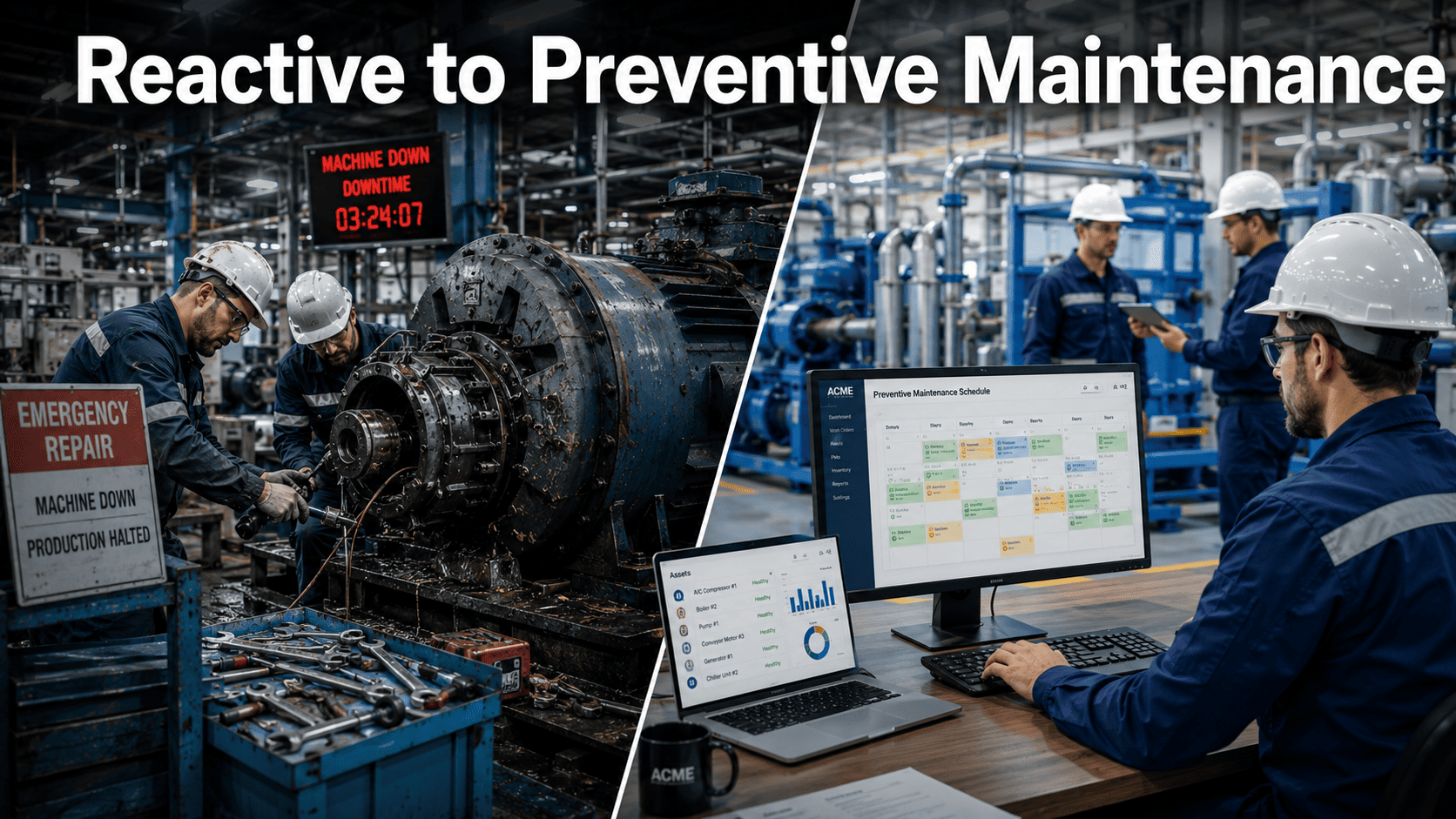
Equipment is repaired only after breakdown. No planning, no data, no PM schedule. Work orders are created post-failure. Emergency repair costs run 4.8x above planned maintenance. Downtime is unpredictable and budgets are uncontrollable. 58% of facilities still spend the majority of their maintenance time here despite claiming preventive strategies.
Cost ratio: 4.8x vs. planned maintenance
Stage 2
Preventive — Schedule-Based
Maintenance is scheduled at fixed intervals — monthly, quarterly, annually — regardless of actual asset condition. Better than reactive, but produces premature replacements on healthy equipment and misses faults developing between intervals. Work orders are planned but not data-driven. This is where most organisations land when they implement a basic CMMS.
Typical PM compliance: 60–70% — parts wasted on over-servicing
Stage 3
Condition-Based — Threshold Monitoring
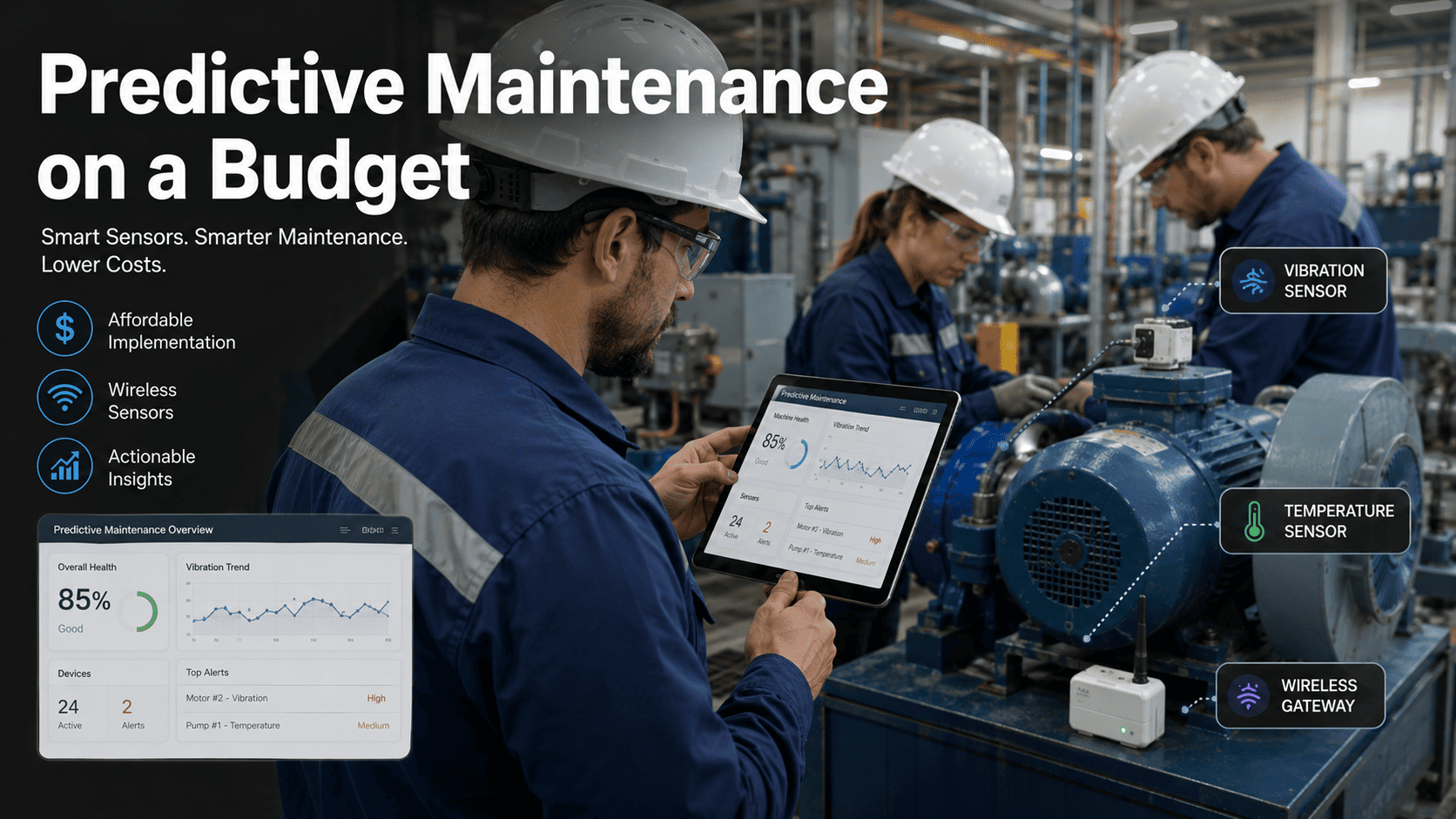
Maintenance is triggered by measurable asset condition — vibration readings, temperature trends, oil analysis, pressure differentials. Sensors and IIoT devices feed condition data to the CMMS. Work orders generate when parameters cross configured thresholds. This stage eliminates much of the over-servicing from Stage 2 while improving fault detection significantly.
35%+ of maintenance professionals now use sensors extensively at this stage
Stage 4
Predictive — AI Failure Forecasting
Machine learning models analyse sensor patterns, historical failure data, and operating conditions to predict failures 2–6 weeks before they occur. The question shifts from "what is broken?" to "what will break and when?" Only 27% of facilities have reached this stage in 2025 — despite the technology being widely available. The gap is strategy, not technology.
27% adoption in 2025 — reduces maintenance costs up to 25%
Stage 5
Prescriptive — AI-Recommended Action
The highest stage of maintenance maturity. AI does not just predict failure — it recommends the optimal action, timing, resources, and parts to minimise total cost and production impact. Prescriptive systems analyse real-time sensor data, production schedules, inventory levels, technician availability, and failure probabilities simultaneously — and output specific, prioritised maintenance recommendations ready for execution.
Maximum uptime, minimum maintenance cost, highest asset reliability
WHY MOST STRATEGIES STALL
Four Reasons Maintenance Strategies Get Stuck at Stage 2
The majority of maintenance operations that invested in CMMS software and sensors in 2020–2023 are still operating at Stage 2 or early Stage 3. The barriers are not technical — they are strategic and structural.
Barrier 01
Data Collected, Not Actioned
Sensors generate continuous data. IIoT platforms aggregate it. But without AI analysis connected directly to maintenance workflows, the data produces dashboards — not maintenance actions. Teams review reports after failures rather than using data to prevent them. Collection without action is the most expensive stage to be stuck in.
Barrier 02
CMMS Disconnected from Asset Intelligence
Most CMMS platforms manage work orders and PMs efficiently. But when AI failure predictions, sensor alerts, and condition data live in separate systems, the loop never closes. A predictive alert in a monitoring platform that does not automatically create a CMMS work order with parts and technician assignment is a notification — not a maintenance programme.
Barrier 03
No Maturity Roadmap to Follow
Most maintenance teams know they should be "more predictive" but have no structured framework for how to get there. Without a defined Stage 3 to Stage 4 transition plan — covering data requirements, asset prioritisation, CMMS configuration, and skill development — investment in sensors and AI tools produces isolated improvements rather than systemic capability advancement.
Barrier 04
CapEx Planning Disconnected from Asset Reality
At Stage 2, capital expenditure decisions are made on age, budget cycles, and operational instinct. Facilities replacing assets based on years-in-service rather than condition scores are systematically over-spending on healthy equipment and under-investing in assets approaching critical failure. AI-driven CapEx forecasting only becomes possible at Stage 4 maturity or above.
THE OXMAINT FRAMEWORK
How Oxmaint Accelerates Every Stage of the Maturity Journey
Oxmaint is built as a unified platform that supports organisations at every maturity stage — and provides the specific capabilities that enable progression from each stage to the next. You do not need a different system at each stage. You need one platform that grows with your strategy.
Stage 1 to 2: Structured Work Orders
Replace reactive firefighting with a disciplined work order system. Full asset registry with condition scoring, documented maintenance history, technician accountability, and PM scheduling tied to asset records. Every repair becomes data. Every data point feeds the AI models you will need at Stage 4.
Stage 2 to 3: Production-Based Triggers
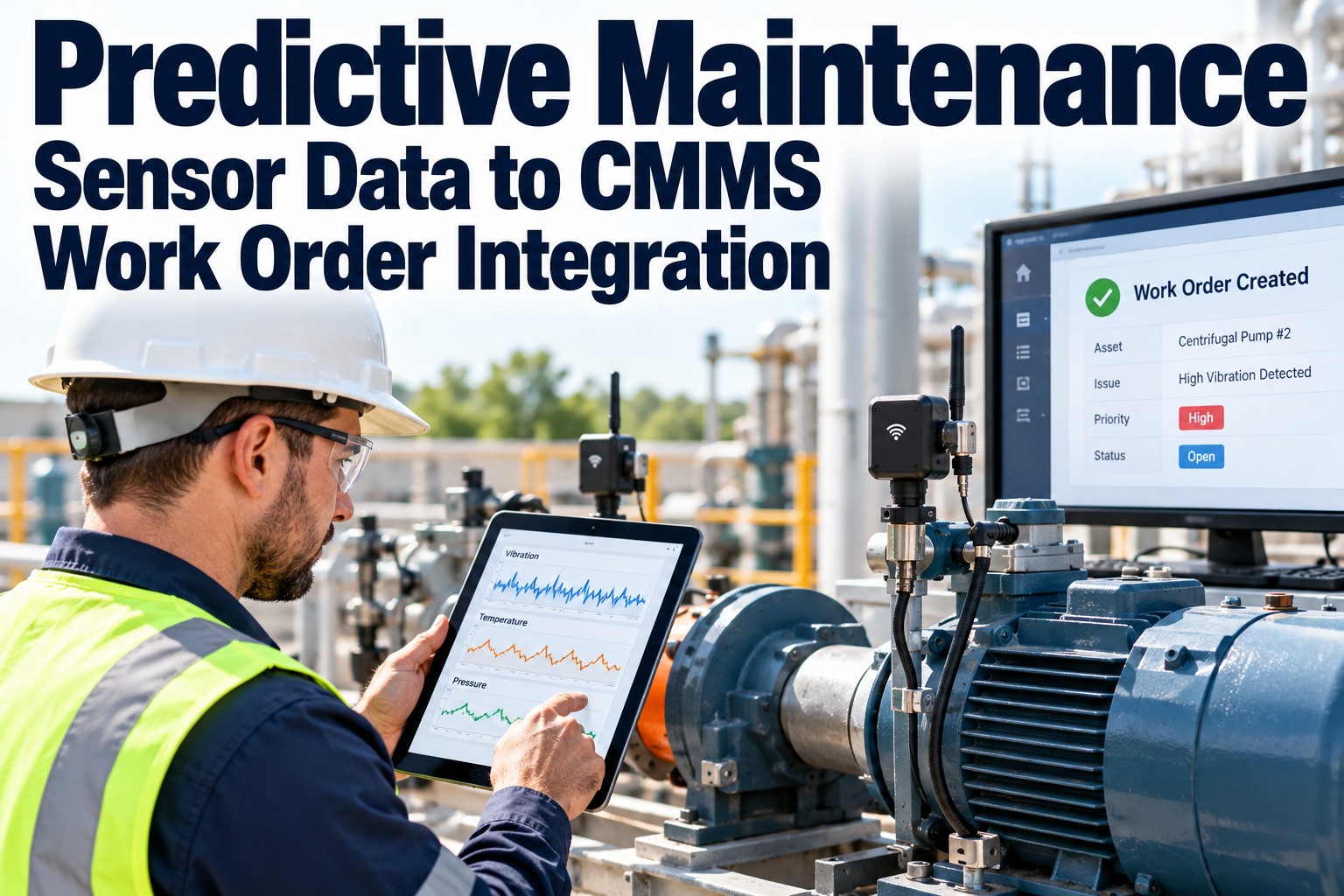
Move from calendar-based PM to condition and production-based maintenance triggers. Oxmaint connects to IIoT sensors and SCADA systems — replacing fixed intervals with maintenance triggers based on units produced, cycles completed, operating hours, or real-time condition threshold breaches.
Stage 3 to 4: AI Failure Prediction
Machine learning models analyse asset condition histories, failure patterns, and operating parameters to predict failures weeks ahead. Confidence-scored predictions auto-generate work orders with parts lists and recommended timing windows — the closed loop that separates predictive programmes from monitoring exercises.
Stage 4 to 5: Prescriptive Recommendations
Oxmaint's prescriptive engine processes failure probability, production schedule, parts availability, and technician skill sets simultaneously — producing specific, prioritised maintenance recommendations that optimise for minimum cost and production impact. The AI answers not just "what will fail" but "what to do about it and when."
CapEx Forecasting from Condition Data
Rolling 5–10 year CapEx forecasting models built from real asset condition scores, failure rate trends, and maintenance cost histories. Capital planning moves from budget-cycle guesswork to data-driven investment decisions — with investor-grade reporting available out of the box for ownership groups and asset managers.
Portfolio-Level Maturity Benchmarking
Compare maintenance maturity stages, OEE performance, MTBF, and maintenance cost per asset across all facilities in a single portfolio dashboard. Identify which sites are lagging at Stage 2 and consuming disproportionate reactive maintenance spend — directing investment where AI advancement has the highest ROI.
PRESCRIPTIVE IN PRACTICE
What Prescriptive Maintenance Looks Like Inside Oxmaint
A prescriptive recommendation is not a sensor alert. It is a fully actionable maintenance decision. Here is what Oxmaint produces when a bearing on a critical compressor shows early degradation signals.
Predictive Alert (Stage 4)
Vibration on Compressor C-101 shows 85% probability of bearing failure within 72 hours. Sensor threshold breached at 14:23 on Tuesday. Alert logged.
Prescriptive Recommendation (Stage 5)
Replace bearing during scheduled line changeover on Thursday at 3 AM. Parts in stock: confirmed. Certified technician available: confirmed. Production impact: zero. Total cost at planned rate: $840 vs. $4,032 emergency. Work order auto-generated and assigned.
BEFORE VS. AFTER
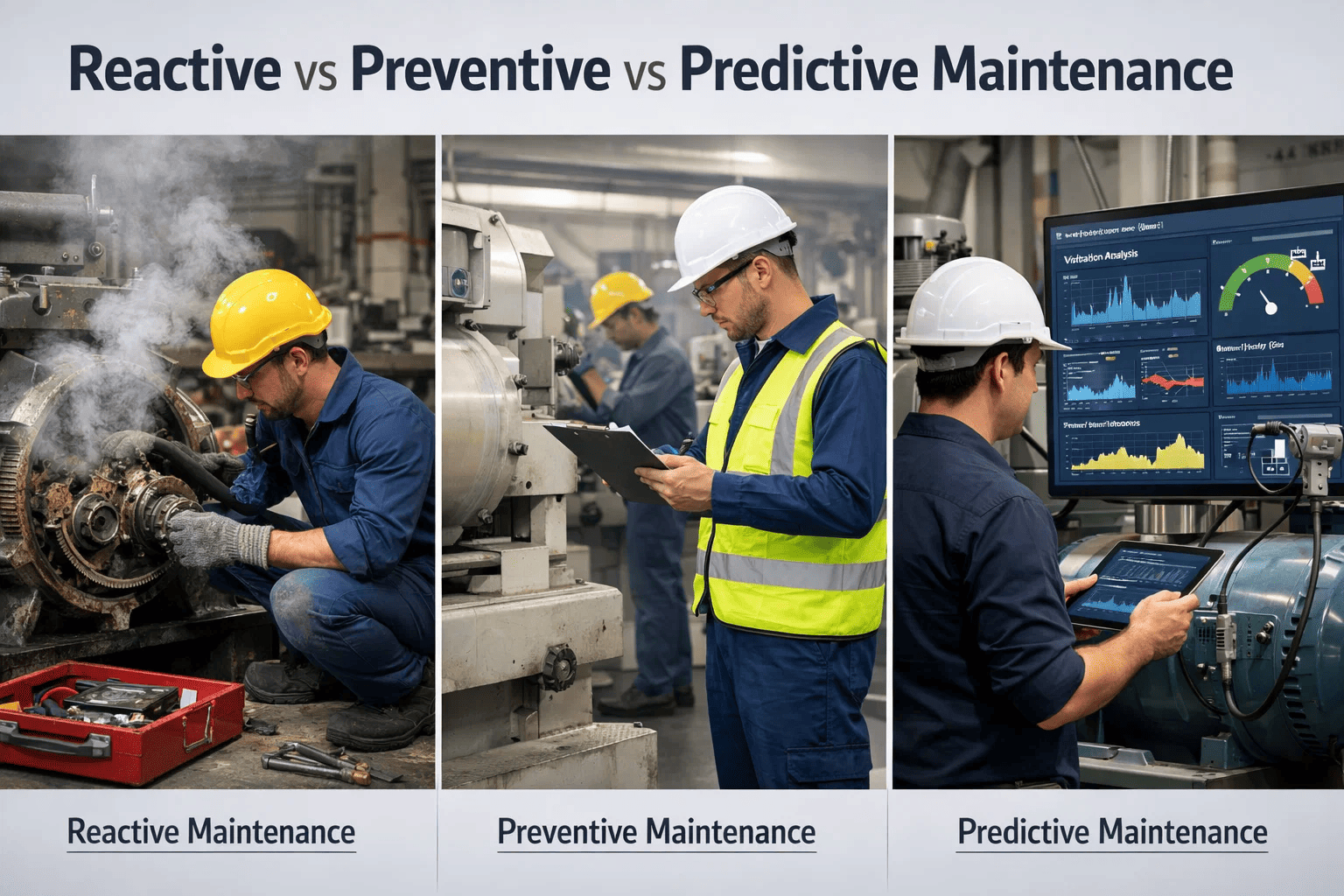
Reactive Maintenance vs. AI Prescriptive Maintenance: The Full Comparison
Maintenance Strategy Transformation: What Changes at Every Level
ROI AT EACH STAGE
What Each Stage of AI Adoption Delivers in Measurable Results
4.8x
Reactive Cost Premium Eliminated
Moving from Stage 1 reactive to Stage 2 planned maintenance alone eliminates the 4.8x cost premium on emergency repairs — the single largest ROI event in the maturity journey for most facilities.
25%
Maintenance Cost Reduction
Reaching Stage 4 predictive maintenance reduces total maintenance costs by up to 25% — through eliminated emergency procurement, reduced over-servicing, and fewer secondary damage events from undetected failures.
20%
Uptime Increase
Facilities reaching predictive and prescriptive maturity document uptime increases of 10–20%. For a facility losing $253M annually to unplanned downtime, a 10% uptime improvement represents $25M+ in recovered production value.
$2.8B
Average Fortune 500 Downtime Cost
Unplanned equipment downtime costs the average Fortune 500 company $2.8B annually — approximately 11% of revenue. AI maintenance strategy is not an operational improvement. It is a financial imperative at this scale.
FAQ
Frequently Asked Questions
How long does it take to move from reactive to predictive maintenance with Oxmaint?
Most facilities move from Stage 1 reactive to Stage 3 condition-based maintenance within 60–90 days of Oxmaint deployment — by establishing the asset registry, configuring work order workflows, connecting existing IIoT sensors, and setting condition-based PM triggers. Reaching Stage 4 predictive maturity typically requires 3–6 months of operational data for AI model training, depending on asset fleet size and historical CMMS data quality. Stage 5 prescriptive capability activates progressively as the AI accumulates confirmed failure-to-recommendation-to-outcome data that enables action optimisation.
Sign up free to start building your maturity foundation today, or
book a demo to map your specific facility's transition path.
What is the difference between predictive and prescriptive maintenance?
Predictive maintenance answers the question: what will fail and when? It uses AI and sensor data to forecast failure probability and estimated time to failure for specific assets. Prescriptive maintenance answers the next question: what is the best action to take, and when? A prescriptive system combines the failure prediction with production schedule data, parts inventory status, technician availability, and cost models to recommend the specific intervention that minimises total cost and production impact. Predictive tells you the bearing will fail in 72 hours. Prescriptive tells you to replace it during Thursday's scheduled changeover at 3 AM using parts already in stock, at a planned cost of $840 instead of $4,032 as an emergency repair.
Does Oxmaint work for facilities currently at Stage 1 or Stage 2 without existing sensor infrastructure?
Yes. Oxmaint is specifically designed to provide value at every maturity stage. A Stage 1 or Stage 2 facility without IIoT sensors starts by deploying Oxmaint's asset registry, work order management, and PM scheduling capabilities — which immediately improve maintenance visibility, reduce reactive costs, and begin building the maintenance history data that AI models require. As sensor infrastructure is added incrementally, Oxmaint integrates the condition data without requiring platform migration or additional CMMS investment. The platform grows with your strategy.
Book a demo to see a maturity assessment of your current operations, or
start free and begin the foundation today.
How does AI maintenance strategy connect to CapEx planning and investor reporting?
At Stage 4 and Stage 5 maturity, Oxmaint's asset condition scores, failure rate trends, and maintenance cost histories feed directly into rolling 5–10 year CapEx forecasting models. Rather than replacing assets based on age or annual budget cycles, leadership can make asset investment decisions based on actual remaining useful life projections and condition-driven replacement triggers. Portfolio-level CapEx reports are generated automatically from live asset data — formatted for ownership groups, asset managers, and investors who require structured capital planning documentation rather than maintenance team spreadsheets.
Every Stage of Your Maintenance Journey Has a Next Step. Oxmaint Makes It Clear.
Whether you are managing reactive chaos or ready to activate prescriptive AI recommendations, Oxmaint provides the platform, the data model, and the intelligence to advance — stage by stage, with documented ROI at every transition. No heavy implementation. No long onboarding. Results from day one.