Here's the uncomfortable truth about campus security systems: the dashboard is green, and it's lying. A camera can show "online" while its lens is fogged, its IR is dead, or its image has degraded below usable resolution — and you only discover it when you go looking for footage that isn't there. Security technology is a software layer running on physical hardware that fouls, drifts, drains, and fails, and the AI analytics on top are only as good as the reader, camera, strike, and battery underneath. When a card reader intermittently fails or a door closer lets a secured door drift open, that's not an IT ticket — it's a maintenance failure with a safety consequence. This guide covers PM for the six campus security systems — access control, cameras, door hardware, intercoms, intrusion, and emergency stations — and how OxMaint's maintenance management software runs each as a scheduled asset. Start free or book a demo.
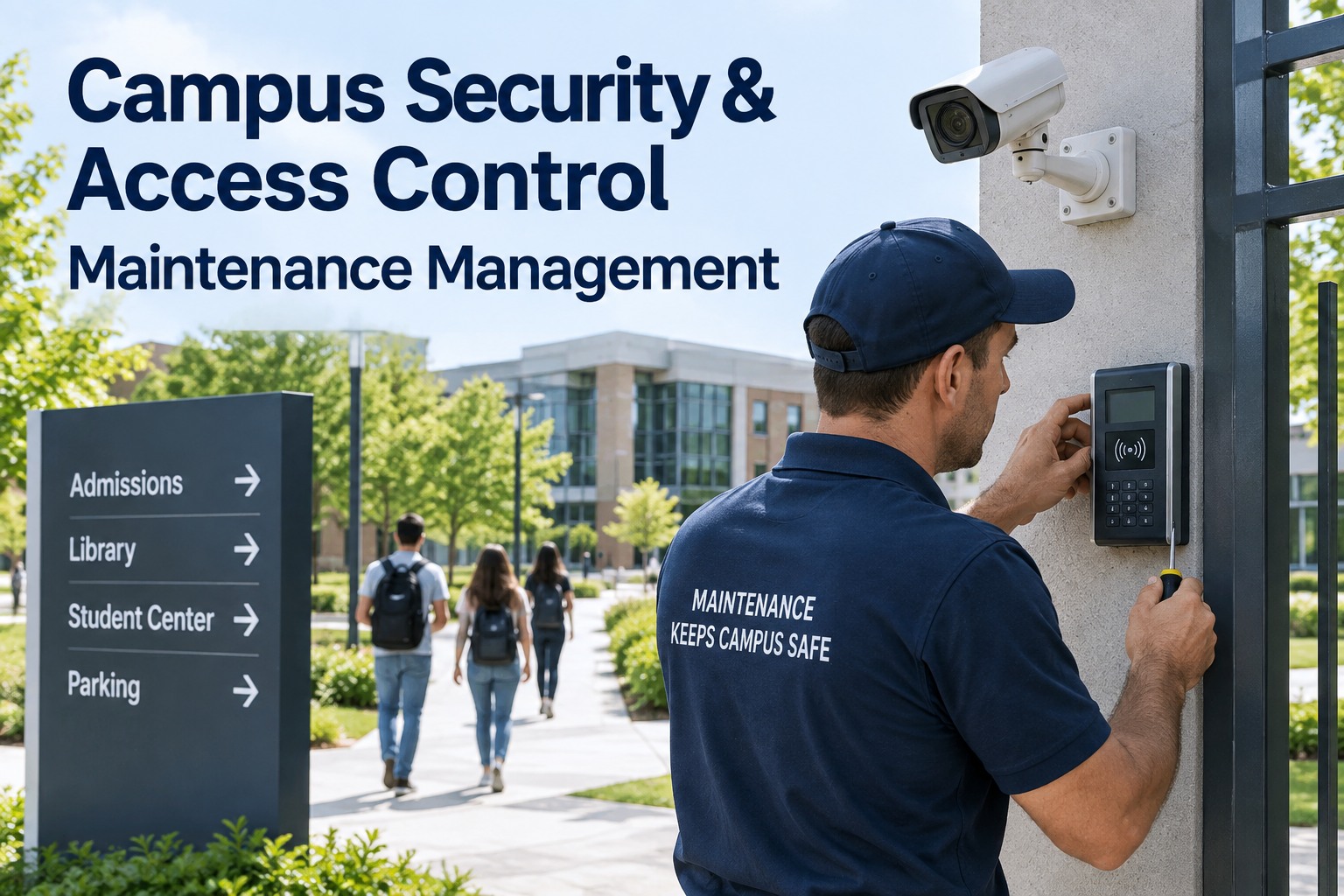
Campus Security & Access Control Maintenance Management
Every reader, camera, strike, and call station is an asset with its own inspection schedule, test record, and replacement forecast — so the security layer runs on hardware that actually works, not a dashboard that says it does.
The Dashboard Says "Online." The Footage Isn't There.
The most dangerous state in campus security isn't a device that's clearly down — it's one that reports healthy while quietly failing. Campus audits routinely find cameras offline or below usable resolution that appeared fully operational on the monitoring dashboard. A "connected" reader can still misread cards intermittently; a mag lock can hold while its strike wears. Connectivity is not condition — and only physical PM tells the difference. Sign up free and OxMaint turns an offline or degraded device into an immediate work order, not just a dashboard flag.
Six Systems, One PM Program
Campus security isn't one system — it's six, each with distinct hardware, failure modes, and the right inspection rhythm. Registering every device as an individual asset with its own schedule is what turns "we have cameras" into "every camera is verified this month." Here's the per-system PM map. Book a demo to see all six on one asset register.
Access Control: Three Failure Modes That Need PM
Access control feels like software, but it fails as hardware. Three failure modes recur across campuses, and each has a physical PM task that prevents it — none of which a software dashboard performs. Sign up free to schedule these against every controlled door.
A Locked Door That Traps People Is a Code Violation, Not Security.
Campus door hardware answers to two masters at once: security and life safety. Fire codes demand free evacuation — doors can't trap occupants — and ADA requires accessible operation, even as the door stays secured against intruders. Every closer, strike, and operator PM must verify fail-safe and accessible behavior, not just that the lock holds. OxMaint records each door's inspection against both the security and life-safety checks, so compliance is provable.
The Cameras Problem: Verify Image, Not Uptime
A camera's job isn't to be online — it's to produce usable footage when something happens. Those are different things, and only one shows on a dashboard. The monthly camera PM verifies the four things that make footage actually usable, and any failure opens a work order rather than sitting as a green tile. Book a demo to see image-quality PM per camera.
Reactive / Vendor-Only vs. OxMaint Security PM
Most campuses run security maintenance two ways: fix-on-fail, or lean entirely on the install vendor's occasional visit. Both leave the gap where a device fails silently between touches. Here's what changes when every device is a scheduled asset. Start free and build your security asset register this week.
What OxMaint Gives Campus Public Safety & Facilities
OxMaint registers every security device as an individual asset with its own schedule, test record, and replacement forecast — so public safety and facilities share one source of truth instead of trusting a dashboard. Here's the concrete mapping. Book a demo to see it on your campus.
Use this program plus OxMaint to make every camera, reader, door, and call station a maintained asset — closing the gap between a dashboard that says "fine" and hardware that actually protects students. Try OxMaint free or book a demo to see it on your campus.
We thought our camera coverage was solid because the VMS dashboard was all green. Then an incident needed footage from a residence-hall entrance and the camera had been producing a fogged, useless image for months — online the whole time. That was the wake-up call. We put all six security systems into OxMaint as individual assets: every camera gets a monthly image-quality check, every controlled door a quarterly closer-and-ADA inspection, our blue-light phones a documented monthly test. Degraded devices now open work orders instead of hiding behind a green tile. When our Clery and safety auditors came, we had a per-device test record for the first time — and we haven't been surprised by a dead camera since.
Frequently Asked Questions
Don't Trust the Green Tile. Maintain the Hardware.
OxMaint registers every camera, reader, door, intercom, sensor and call station as a scheduled asset with its own test record and replacement forecast — so degraded devices open work orders, life-safety checks are documented, and campus security runs on hardware that actually works. Start free — no credit card, unlimited users, forever. Or book a demo.